Thursday, May 25, 2006

A Libyan Solution for Iran?

Reuters reports that John Bolton suggested that the ruling class and clerical gerontocrats of Iran could choose from two alternatives: regime change or a Libyan solution:
John Bolton, the US ambassador to the United Nations, said on Monday that Iran's leaders could stay in power and improve their ties with Washington if they ended their pursuit of nuclear arms.

He later insisted, however, that he had not meant to threaten Tehran with regime change if its leaders failed to do so.

Bolton, addressing a meeting of B'nai B'rith International, a Jewish humanitarian organization, cited Washington's movelast week to normalize relations with Libya after that country gave up its pursuit of weapons of mass destruction and said Iran's leaders faced a similar "clear choice". ("Iran Regime Can Stay If Does a Libya: Bolton," The Times of India, 23 May 2006)
Yes, the Libyan solution would be possible if Washington made a
serious offer -- Rafsanjani would be overjoyed, Khamenei would take that offer, too, and the President of Iran would not be in a position to reject it.

But is the offer serious? For, if that's all that Washington wanted, it could have made the same offer in the Khatami years.

Take a look at this BusinessWeek article: "Iran: The Mideast's Model Economy?" (Stanley Reed, with Babak Pirouz, 24 May 2004). The BusinessWeek writer all but kissed the hands of the clerical rulers of Iran.

Tehran was liberalizing Iran's economy:
The country has racked up growth in the 5% range for four years running, thanks to high oil revenues, abundant rainfall, and a gradual easing of the choking economic restrictions ushered in by the 1979 revolution. Not long ago, Iran was a bona fide basket case struggling to pay its debts. Now its external accounts are under control, with the trade balance in surplus and substantial hard currency reserves of $35 billion. The government is also raising money internally by privatizing shipping, auto, and other assets. (Reed, 24 May 2004)
And it was seeking to assist Washinton in Afghanistan and Iraq:
Despite the nuclear tensions, the optimists point out that the U.S. and Iran share plenty of regional interests. Iran despised both the Taliban in Afghanistan and Iraq's strongman, Saddam Hussein, and applauded the toppling of both. Since then, the Iranian government has encouraged local businesses to supply both countries with goods that range from fuel to cement. While some Iranian factions may be contributing to the turmoil in Iraq, the mainstream wants calm to return to its neighbor in order to hasten the departure of U.S. troops. The Iranians reckon that once the Americans go, a Shiite-led government friendly to the Islamic Republic will come to power. In an interview with BusinessWeek, Iranian Vice-President Mohamed Ali Abtahi poured scorn on the rebel Iraqi cleric Moqtada al-Sadr. Sadr's troublemaking "is providing the Americans with a reason to stay" in Iraq, the vice-president said (Reed, 24 May 2004)
Really, what's not to like?

Besides, if Washington had made a serious offer back then, it could have conceivably prevented the rise of Ahmadinejad -- notwithstanding the simmering discontent of workers and slum dwellers that the BusinessWeek article completely ignored -- for that would have given neoliberal "reformists" a tangible result to boast of and lifted the morale of educated urban professionals and small producers who love America and want to study in it and do business with it.

I suspect that the reason it didn't make that offer when it made perfect sense to make it was Washington wanted a full neo-con prize: the total restructuring of Iran at Washington's, not the clerical gerontocrats', pace, and an overtly (not covertly) pro-Tel-Aviv government.

Has Washington given up on the full neo-con prize, in view of the rise of resource populism in Iran?

Not bloody likely, according to the Hindustan Times:
US President George W Bush and Israeli Prime Minister Ehud Olmert have agreed on a timetable for American intervention to prevent Iran from acquiring nuclear capability.

Bush told Olmert that the plans for US intervention are congruent with the timetable put up by the later during their discussion, a media report said on Thursday.

He assured the Israeli premier that Washington would not allow Iran to acquire nuclear capability, Ynetnews reported.

According to Israeli intelligence assessment, Iran will acquire the necessary nuclear technology to build a nuclear weapon within a year, Olmert said during the talks.

The prime minister also expressed concern over diplomatic foot-dragging at the United Nations, where the United States has faced Russian and Chinese opposition to push for tough sanctions against Iran.

Despite the US assurance, officials in Washington have cast doubt over its ability to prevent Iran from acquiring nuclear technology, the news portal said.

"I am very, very, very satisfied," Olmert told Israeli reporters after talks with Bush.

The US will ask the Security Council to impose economic and military sanctions on Iran if it refuses to halt uranium enrichment activities, it said.

If Russia uses its veto to block a US-backed resolution for imposing sanctions on Iran, Washington will circumvent the Security Council by luring allied countries to impose an economic and military embargo on Tehran, it said. (Press Trust of India, "Bush, Olmert Agree on Iran Deadline," 25 May 2006)

Wednesday, May 24, 2006

Katherine Jashinski

"Army National Guard Specialist Katherine Jashinski received a bad conduct discharge today and was sentenced to 120 days confinement after pleading guilty to the charge of 'refusal to obey a legal order'" ("First Female Conscientious Objector Sentenced for Refusing Deployment to Afghanistan," 24 May 2006), says a press release from the SOA Watch. Salute her courage.

What Jewish Leftists Can Do for Iranians

"A story authored by a prominent U.S. neo-conservative regarding new legislation in Iran allegedly requiring Jews and other religious minorities to wear distinctive colour badges circulated around the world this weekend before it was exposed as false," writes Jim Lobe of Inter Press Service ("Iran Target of Apparent Disinformation Ploy," 22 May 2006). The neo-con in question is Amir Taheri, so keep this name in mind, in case he will be up to more mischief. And he probably will, with connections like these: "Taheri is a member of Benador Associates, a public relations firm that lists a large number of leading neo-conservatives, including American Enterprise Institute (AEI) associates Richard Perle, David Frum, Michael Ledeen, Michael Rubin, and Joshua Muravchik, among its clients. Major boosters of the war with Iraq, Benador clients, who also include former Central Intelligence Agency chief James Woolsey and former Israeli minister Natan Sharansky, have also called for the Bush administration to take a hard line against Iran" ("Iran Target of Apparent Disinformation Ploy," 22 May 2006).

Thankfully, the lone Jewish MP in Iran's parliament, Maurice Motamed, immediately issued a strong condemnation of Taheri's lie: "One Jewish representative in the Iranian parliament, Maurice Motamed, insisted that colour requirements for ethnic minorities had 'never been proposed or discussed in parliament', let alone approved. 'Such news,' he told the Associated Press, 'is an insult to religious minorities here'" ("Iran Target of Apparent Disinformation Ploy," 22 May 2006).

There are several things that Jewish leftists in the United States can do to counter psy-op like this:
  • Speak up/write about Iran as a Jewish activist/intellectual, and encourage others to do so.

  • Contact the Jewish community in Iran, and invite them to send reps to the US on a speaking tour (I realize getting visas for them would be a hassle, but probably doable).

  • Get lefty Jewish organizations to send their reps to Iran to talk to people in the Jewish community there and report back to the US.
Given Mahmoud Ahmadinejad's execrable flirtations with Holocaust revisionism, it would be only Jewish leftists with a nearly infinite capacity to forgive who might even consider undertaking jobs like the above. Yet, those who do so can make a great deal of difference in the citizen diplomacy department at a time when Iranians, including Jewish Iranians, need all the international help they can get.

No SCO Membership for Iran?

RIA Novosti commentator Dmitry Kosyrev writes in an opinion piece: "For obvious reasons, everyone was interested whether Iran would be accepted as a member this summer. The answer in Shanghai was a clear no. Neither Iran with its complicated relations with the U.S. and the IAEA, nor European Belarus, nor Pakistan with its attempts to find new friends in the wake of the ongoing Indian-American rapprochement, none of them will join the SCO now" ("Why Iran, Belarus Will Not Join Shanghai Cooperation Organization This Summer," RIA Novosti, 17 May 2006). If true, bad news for Iran.

Reforming Iran's Oil Industry

Ghaida Ghantous and Barbara Lewis of Reuters report that Tehran may be reconsidering the buy-back system ("Foreign Cash Still Flows to Iran's Oilfields," 23 April 2006):
The so-called buy-back investment model, where foreign firms are repaid with proceeds from oil output, has drawn criticism. Western oil executives say risks far outweigh rewards, while some Iranian politicians remain distrustful of foreign capital.

Tehran has said it was reviewing its buy back contracts to make investment in its fields more alluring.

"We have received all the views and we're doing it and I think we're very close to a conclusion," Vaziri said without elaborating.
No doubt that whether or not the current contracts with foreign oil companies, as well as the buy-back system in general, are really in the Iranian people's interest must be looked into.

But, before getting there, the most urgently needed reform of Iran's oil industry is transparency.

Parviz Mina, a former member of the Board of Directors and Managing Director of International Affairs of the National Iranian Oil Company, pointed out last August in an interview conducted by Reza Bayegan that "Iranian members of parliament are complaining bitterly about being kept entirely in the dark about the terms of these contracts" ("New Oil Disorder," Iranian.com, 8 August 2005). When the books are closed to the public, no reform is possible, and that's what needs to change first and foremost.

Then, a reformer has to go after the structure that creates corruption, as Mina elaborates:
[After the revolution of 1979, t]he Minister of Oil appointed seven deputies in charge of supervising the activities of various managers in the National Oil Company. In reality all the major decisions were made by these deputies who, by the way had no expertise. Their only credential was commitment to the Islamic regime and a connection to one of the country's centers of power. Accordingly, all the prerogative and authority was gradually taken away from the NIOC and given to the Ministry of Oil.

Ahmadinejad has said that he wants to put a stop to duplication and introduce measures that ensure transparency. This would prove as difficult as putting the genie back into the bottle. Bijan Zanganeh, from the time he has been appointed as Islamic Republic's oil minister has created close to one hundred affiliated and subsidiary companies. All the projects are divided between these companies.

As an example previously all the exploration, drilling and production efforts were concentrated under one director in the NIOC, now there are ten to twelve companies each making decisions and having a finger in the pie. Before the revolution we had in total 54,000 employees working for the Iranian oil industry, 34,000 were rank and file and 20,000 professional staff. Today this number has reached the colossal figure of over 180,000. What is Mahmoud Ahmadinejad planning to do with this monstrosity? ("New Oil Disorder," Iranian.com, 8 August 2005)
Such a structural reform is an extraordinarily difficult task, but unless that gets done, trying to negotiate with foreign companies more lucrative contracts than the current ones will likely prove futile, since surplus rents will get consumed by the mullah–bazaari nexus, not by the Iranian people.

Hugo Chavez got lucky with his opposition's failed lockout, for surviving it allowed him to purge all who stood in his way inside PDVSA. Mahmoud Ahmadinejad tried to do the same with cabinet appointments, but that's not the sort of purge he can pull off till emergency circumstances of the sort that confronted the Chavez government arise.

Update

Yoshie Furuhashi, "Privatization Iranian Style," Critical Montages, 14 October 2007.

Abortion in Iran and Venezuela

US leftists generally fail to see similarities between Iran and Venezuela, but there are many. After all, both are oil producer nations and price hawks, both have relatively well educated populations, both have managed to industrialize, and their per capita incomes are in the same league: Venezuela's GDP Per Capita = $5,800; and Iran's GDP Per Capita = $7,700. Both wish to lead masses of the other nations in their respective regions under their respective leaderships. No doubt Hugo Chavez and Mahmoud Ahmadinejad have thought about these similarities, beyond the fact that they are both under pressures from Washington, though incomparably more so in the case of Iran than that of Venezuela. That is why I hope that Ahmadinejad will see Venezuela -- especially its commitment to participant democracy, in which everyone is a protagonist -- as a model for Iran and take lessons from Chavez on political survival, especially his cultivation of supporters in the military as well as barrios.

But one of the similarities between Iran and Venezuela, alas, is conservatism: women in both societies lack the right to abortion, except the right to abortion performed to save the mother's life (women in El Salvador do not enjoy even this limited right, as even most MPs of the ostensibly secular FMLN eventually voted for total criminalization [Jack Hitt, "Pro-Life Nation," New York Times, 9 April 2006]).

In 2005, the Iranian parliament -- dominated by "conservatives" many of whom backed Ahmadinejad in the election in the same year -- "voted to liberalise the country's abortion laws" (Frances Harrison, "Iran Liberalises Laws on Abortion," BBC, 12 April 2005). It was the same clerical gerontocrats who blocked Ahmadinejad's oil ministry reform, decree to allow women to attend sports events at stadiums, etc. that vetoed the liberalized abortion law. Unless the basic structure of the Islamic Republic is undone, either through a passive revolution or other means, a fundamental change is not possible. Iran desperately needs a populist political force capable of pursuing its own social and economic agenda and sweeping away all -- including the mullah–bazaari nexus -- who stand in the way. Such a force, given the fact that a majority of Iranians -- including most of neoliberal "reformists" -- are religious in one way or another, won't and can't be secular at this point in history.

A couple of weeks ago, "Pope Benedict XVI told Venezuela President Hugo Chavez in a meeting at the Vatican . . . that he doesn't want him to weaken the abortion ban the South American nation currently has in place. The meeting came on the same day that news broke about a court's decision in Colombia to allow abortions in certain rare cases" (Steven Ertelt, "Pope Tells Venezuela President Hugo Chavez Don't Weaken Abortion Ban," LifeNews, 12 May 2006). It is frustrating to see that Colombia is ahead of Venezuela on the right to abortion. I understand that there is a chance to put the issue on a referendum in 2007, but Chavez probably won't move on this till he succeeds in removing the term limits.

Tuesday, May 23, 2006

Venezuela: A Model for Iran

Venezuela ought to be a model for Iran, both in its domestic and foreign policy. After all, both are oil producer nations and price hawks ("Venezuela's Minister of Energy and Petroleum Rafael Ramirez said on Monday that Venezuela supports the idea of an oil production cut at the next meeting of the Organization of Petroleum Exporting Countries (OPEC)" ["Venezuela Supports OPEC Production Cut: Minister," Xinhua, 23 May 2006]), both have relatively well educated populations, both have managed to industrialize, and their per capita incomes are in the same league: Venezuela's GDP Per Capita: $5,800; and Iran's GDP Per Capita: $7,700. Both wish to lead masses of the other nations in their respective regions under their respective leaderships. No doubt Chavez and Ahmadinejad have thought about these similarities, beyond the fact that they are both under pressures from Washington, though incomparably more so in the case of Iran than that of Venezuela.

Tariq Ali noted: "The mullah–bazaari nexus behind Rafsanjani has already thwarted Ahmadinejad's efforts to clean up the Oil Ministry, and remains entrenched in the Expediency Council" ("Mid-point in the Middle East?" New Left Review 38, March-April 2006). Ahmadinejad doesn't have to lose on this and other fights against the ruling class and clerical gerontocrats, if he could cultivate the sort of mass following in Iran, including its military and militias, in the fashion that Chavez has. I'm sure both men have thought about that, too.

The Chavez and Ahmadinejad administrations also have the same shortcoming: fondness for grandstanding. Washington just slapped a ban on weapons sales to Venezuela, and what does Caracas say? It might sell F-16s to Iran. That's more a gesture than anything else: after all, Iran doesn't need hard-to-maintain F-16s; but such a statement allows the Chavez government to assert its defiance of Washington to the max and plays well in the international gallery in Latin America and the Middle East. This shortcoming probably won't go away -- it's ingrained in the temperament of both leaders.

Sunday, May 21, 2006

Street-fighting Days

Street-fighting days, alas, are long behind the Axis of Feeble: leftists in the USA, the UK, Australia, Canada, and Japan:
Recent polls tell us, for instance, that 60% of Americans disapprove of President Bush's overall job performance; 74% disapprove of his handling of rising gasoline prices; 62% disapprove of his handling of the Iraq war; 63% think the president's role in the intelligence leak scandal was either illegal or unethical. Further, 45% of Americans think Bush should be censured or officially reprimanded for authorizing secret domestic surveillance by the National Security Agency, and an astonishing 33% of Americans think Bush should be impeached. (As a point of reference, public support for impeaching President Clinton averaged only 26% in the summer and fall of 1998.)

In many foreign countries, such a high level of popular discontent would translate rapidly into mass protests. (Rosa Brooks, "One More Job for Immigrants," Los Angeles Times, 14 April 2006)
The French, alone among peoples of filthy rich countries, still remember how to rock the government in the streets. They admirably put it in practice in fierce defense of their way of life: contre la précarité généralisée. That's a great start. No people who cannot defend themselves can hope to defend others. And yet, it is telling that, after the victory over the CPE, streets of France went quiet, even as the National Assembly passed a bill for selective immigration: for skilled and educated workers from the South, against non-skilled and ill educated workers from the South:
France's lower house of parliament easily passed a divisive immigration law put forward by Interior Minister Nicolas Sarkozy on Wednesday which has been heavily criticised by the opposition, the church and immigrant groups.

The law aims to attract skilled workers while keeping less skilled ones out. Critics say it will stigmatise foreigners, discriminate against the poor and undermine France's traditional role as a haven for the persecuted.

The deputies in the National Assembly, where the ruling UMP party has an easy majority, adopted the law by 367 votes to 164. The Senate will start debating it on June 6. (Emile Picy, "French Deputies back Divisive Immigration Bill," Reuters, 18 May 2006)

Always behind the Revolutionary Solidarity Schedule

Near the beginning of the Bolivarian Revolution, opinions about Hugo Chavez were quite divided among US leftists. Not now. Chuck Munson of Infoshop must be the last Chavez skeptic.

That is ironic, because Chavez doesn't need US leftists' support now: his national and Latin American support is rock-solid, and Washington is too busy with the Middle East -- what with campaigns for dual regime changes in Iran and Palestine -- to make a major move against Venezuela at this moment.

Most US leftists seem to be always a couple of years behind the revolutionary solidarity schedule: they embraced Chavez too late to give him support when he could have used it (2002, the year of the anti-Chavez coup and lockout); they committed themselves to US withdrawal too late to prevent the death of modern Iraq. I fear that, by the time when they manage to pay attention to Iran and its leader, they will have already missed the train again.

Chronicling the Death of a Nation

Riverbend, who keeps the Baghdad Burning blog, is a great chronicler. This must be the first time in history the death of a nation has been so richly electronically documented, in real time.

Reading her diary is not unlike watching a baby die before our eyes due to lack of medical supplies in an Iraqi hospital, near the end of a documentary titled "Iraq's Missing Billions":
ALI COMMT: he problem is the doctors caring for Zehara have virtually nothing to “make the best of”. They have no ventilators, no adrenaline, not even a cheap but essential medicine like vitamin K. Even the cannula being used on Zehara had to be bought on the black market by her father.And now he’s gone into town again – this time looking for vitamin K.Only the grandmother is here.Then Zehara starts to deteriorate – she is gasping for breath. Her father has still not returned. But it is too late.

00:34:18

THE DOCTOR: Where is the mother of this child? This child has passed away.

ALI VO: And then the father comes back .

FATHER: I just went to get this for her, they told me to bring it. It’s vitamin K as they don’t have it here

ALI VO: If this hospital had had the correct equipment and the right drugs, Zehara should have survived.

FATHER: She saw nothing in her life. . . . We all return to Allah.

FATHER: No, no, poor child. This box is too small. Go and get another one.

UNCLE: From where?

FATHER: From the pharmacy.

ALI VO: The next day, Abbas, Zehara’s brother, died too. This is not the new Iraq we were promised when the coalition invaded our country.

THE END
An Iraqi friend of mine recently got hold of this documentary on video, and she did a showing. Only a handful showed up. I was one of the few, and so was an Iranian friend of mine. That's when I made up my mind about what should be Western leftists' priority. It's too late to save modern Iraq. The dead cannot be resurrected. But modern Iran is still alive. It's time for triage.

How long will Riverbend remain in Iraq? She has education, so she has means to live as an exile elsewhere. It is brave and patriotic of her to persist in Baghdad. I wonder if she, too, will be eventually forced to abandon Iraq or die with it.

Return of Resource Populism

We are living an early stage of an epochal change: return of resource populism (the idea of using the proceeds of natural resources for the needs of people and national economy, rather than for the profits of multinational corporations and their investors), after the exhaustion of neoliberal hegemony. It is significant that the leaders of the nations that have made a clear turn to resource populism -- Hugo Chavez (b. 28 July 1954), Evo Morales (b. 26 October 1959), Mahmoud Ahmadinejad (b. 28 October 1956), and Vladimir Putin (b. 7 October 1952) -- are about the same age. They are also all from relatively humble class backgrounds. They all were young men during the 1970s, so they must all vividly remember what the control of strategic natural resources -- mainly fossil fuels -- can do. In addition, Chavez and Ahmadinejad have clear ambitions to remake not only their respective nations but regions as well.

Of the four, Ahmadinejad is the only one who actually participated in a victorious political revolution in the 1970s. Some call his presidency the second Islamic revolution. Rare are men on whom fortune smiles twice: participate in the making of a revolution as a youth and then take the helm of the state later, this time to initiate social revolution at home and abroad.

The missing link is Africa, where a leader comparable to the four standard bearers of resource populism has yet to rise.

Saturday, May 20, 2006

Ahmadinejad, the Mardomyar

Here is an excellent profile of Mahmoud Ahmadinejad: Iason Athanasiadis, "Ahmadinejad: A Study in Obstinacy" (Asia Times 19 May 2006). It shows he is the right man at the right time for the Muslim world as well as his country, and he's winning the right friends and making the right enemies (namely both neoliberal "reformists" and clerical gerontocrats) at home.

Friday, May 19, 2006

Death of Iraq

The people of Iraq were abandoned by Western leftists two years ago -- streets of America were quiet even as the Abu Ghraib scandal exploded and Sunnis and Shiites held a joint uprising.

Because of our desertion and dereliction, Iraq is now on the way to becoming an Afghanistan, an irreversible course.
Across central Iraq, there is an exodus of people fleeing for their lives as sectarian assassins and death squads hunt them down. At ground level, Iraq is disintegrating as ethnic cleansing takes hold on a massive scale. (Patrick Cockburn, "Iraq Is Disintegrating as Ethnic Cleansing Takes Hold," The Independent, 20 May 2006)
Deaths run like water through the life of the Bahjat family. Four neighbors. A barber. Three grocers. Two men who ran a currency exchange shop.

But when six armed men stormed into their sons' primary school this month, shot a guard dead, and left fliers ordering it to close, Assad Bahjat knew it was time to leave.

"The main thing now is to just get out of Iraq," said Mr. Bahjat, standing in a room heaped with suitcases and bedroom furniture in eastern Baghdad.

In the latest indication of the crushing hardships weighing on the lives of Iraqis, increasing portions of the middle class seem to be doing everything they can to leave the country. In the last 10 months, the state has issued new passports to 1.85 million Iraqis, 7 percent of the population and a quarter of the country's estimated middle class.

The school system offers another clue: Since 2004, the Ministry of Education has issued 39,554 letters permitting parents to take their children's academic records abroad. The number of such letters issued in 2005 was double that in 2004, according to the director of the ministry's examination department. Iraqi officials and international organizations put the number of Iraqis in Jordan at close to a million. Syrian cities also have growing Iraqi populations. (Sabrina Tavernise, "As Death Stalks Iraq, Middle-Class Exodus Begins," May 19, 2006)
Modern Iraq is dead, and everyone who can leave is leaving the country.

I don't believe in God, so I don't think there will be divine retribution. But I do believe in cause and effect -- we'll all pay earthly prices for this. How high the prices will be, I don't know.

Don't let this happen to Iran.

Price of Dual Regime Changes in Iran and Palestine

Hamas has offered an indefinite truce if Israel withdraws to its pre-1967 borders: (Yitzhak Benhorin, "Hamas: Ceasefire for Return to 1967 Border," 30 January 2006).

But Tel Aviv won't do that. It would rather have Hamas collapse due to lack of funds, and so would Washington:
U.S. officials said the Bush administration could take punitive action against banks that help provide money or services directly to the Hamas-led Palestinian Authority because Washington has designated the Islamic militant group a "terrorist" organisation.

The United States has not threatened to punish banks that transfer funds directly to the office of moderate Palestinian President Mahmoud Abbas, whose Fatah faction was trounced by Hamas in January elections. ("Arab League Says to Transfer $50 Mln to Hamas Govt," Reuters, 23 AprIL 2006)
Or at least provoke a conflict between Hamas and Fatah:
Rival Palestinian forces faced off at Gaza's border crossing with Egypt after a Hamas official was caught with 639,000 euros ($A1.08 million) hidden in his clothing, authorities said.

Palestinian Prime Minister Ismail Haniyeh vowed during Friday prayers not to disband a new Hamas-led security force and said he was prepared to increase its size in defiance of President Mahmoud Abbas and the Bush administration.

About 100 Hamas gunmen raced to the Rafah crossing where Hamas spokesman Sami Abu Zuhri was caught with the money. Rafah is guarded by Abbas's presidential guard, raising fears of fresh Palestinian infighting after clashes on Thursday night.

Abbas's elite guard also called in reinforcements.

Hamas said Abu Zuhri was carrying Arab donations for the new government, which is desperately short of funds, and for Palestinians in Israeli jails.

"Is it a crime to bring in money?" Haniyeh said, defending his spokesman. "Are the Palestinian people being forced to starve?"

Abu Zuhri told Reuters: "If bringing support for my people is a crime then I am very proud of this crime."

Abu Zuhri initially refused to leave the border terminal without the money, which was confiscated by Palestinian customs agents. He later left and the gunmen withdrew. The militant group said it expected the money to be quickly returned.

But senior Abbas aide Saeb Erekat said the president had ordered an investigation by the attorney-general.

The Palestinian Authority is facing a financial crisis after international donors suspended aid because of the Hamas-led government's refusal to renounce violence and recognise Israel since coming to power in March. ("Hamas Aide Caught at Border with Cash," Reuters, 20 May 2006)
It's Tel Aviv's maximalist rejectionism that has compelled Hamas to rely on Tehran more than before.

Rather than prompting Tel Aviv to make peace with Hamas in an effort to isolate Iran, Washington is pursuing a strategy of regime changes in both Iran and Palestine. That's the sort of situation that makes liberals wonder if Tel Aviv is still really Washington's strategic asset or has already become its strategic burden, for there can be a blowback: destablization of the pro-Washington Arab regimes -- the Gulf states (Jim Wolf, "US Looks to Arm Iran's Neighbors, General Says," Reuters, 18 May 2006), Jordan (Jamal Halaby, "Jordan Plays Hardball with Hamas," Associated Press, 19 May 2006), and Egypt (Nadia Abou El-Magd/Associated Press, "Egypt Urges Hamas to Recognize Israel, Renounce Violence," USA Today, 2 February 2006) -- that have volunteered to serve in the dual regime change campaign.

If the price of dual regime changes is, for instance, the destruction of Abqaiq, "the world’s biggest oil processing complex," is the price worth it?

Bolivar in Tehran

Compared to Iraq, Iran is a far larger prize (it's literally larger, too, in size and population). You see, even before the invasion began, Iraq was already reduced to a shadow of its former self by genocidal UN sanctions, incapable of trying to become a contender for regional leadership (which was the specter posed by its invasion of Kuwait, prompting the Gulf War) again. Not so with Iran. Iran is modern, its populace well educated, its revolutionary philosophy -- the heritage of Ali Shariati now personified by Mahmoud Ahmadinejad -- appealing to not just Shiites but other Muslims elsewhere groaning under the oppression of pro-American regimes (note, in particular, that the oil-rich Gulf states have large Shiite populations, with Bahrain having a Shiite majority). You might say that the invasions of Afghanistan and Iraq were to surround Iran, the beginning of a siege for regime change, the regime change Washington wants even more now than before the election of Ahmadinejad.

Western leftists ought to do what we can to help Ahmadinejad survive this siege. That's not just our moral duty to the Iranian masses who voted to cast their lot with him. In the process of survival, internal and external circumstances may eventually compel Ahmadinejad to choose between his political, economic, and social agenda on one hand and the structure of the Islamic Republic on the other hand (which are sure to come into conflict) -- then, we'll see what stuff he is made of. Depending on the circumstances and choices he will make under them, what we will have is the beginning of an epoch-making change in the entire Middle East, comparable to the rise of the Bolivarian Revolution in Venezuela and gradual formation of a regional bloc in which the left (led by Hugo Chavez) and the right (led by Lula), leaders and masses, contend with each other over democratic control of natural resources in particular and production in general. Given where most of the world's oil lies, change in the Middle East is even more urgently needed than change in Latin America. Who better to initiate that change than a Bolivar in Tehran?

Iran is the key -- both for the ruling class and for us.

Wednesday, May 17, 2006

SCO Invites Iran to Its Summit on June 15

This is extremely good news -- the best news about Iran that I've heard in months:
Russian Foreign Minister Sergei Lavrov said on Tuesday Iran has been invited as an observer to the Shanghai Cooperation Organization's summit due on June 15.

"The invitation has already been sent," he said.

At present, the UN Security Council is studying the International Atomic Energy Agency director-general's report on Iran's nuclear problem.

"The IAEA will meet in session in two weeks' time," Lavrov said. (Itar-Tass, "SCO Invites Iran to Its Summit on June 15 -- Russian Foreign Minister Sergei Lavrov," 16 May 2006)
Iran's recent announcement that it intends to join the Shanghai Cooperation Organization (SCO) could complicate Western efforts to curb Tehran's nuclear ambitions. Iran now has observer status at the SCO, but it hopes membership could come as early as June. Although SCO membership is no foregone conclusion -- and does not include mutual defense pledges -- being inside the Shanghai "club" could bring Tehran extra support from its two key members: Russia and China.

PRAGUE, May 15, 2006 (RFE/RL) -- Membership of the SCO could offer Iran shelter from the intense U.S.-led international pressure on Tehran to end uranium enrichment.

Iranian Deputy Foreign Minister Manuchehr Mohammadi was quoted by ITAR-TASS and Xinhua news agencies as saying in April that his country hopes to join the SCO this summer. He said Iran is looking forward to reviewing the nuclear dispute with its SCO "colleagues." Mohammadi said Tehran hopes for those countries' support at the organization's June summit in Shanghai.

"What we are seeing is really a tectonic shift of diplomatic and every other kind of activity into Western and Central Asia."

Russia and China have already given Tehran crucial support in the United Nations debate over its controversial nuclear program. Both have resisted pressure from the United States and its European allies to formulate a UN draft resolution that could open the way for economic sanctions or even military intervention unless Iran stops work on the nuclear fuel cycle. (Breffni O'Rourke, "Iran: Plans to Join Shanghai Group Seen as Bold Geopolitical Stroke," Radio Free Europe/Radio Liberty, 15 May 2006)

Tuesday, May 16, 2006

Focus on Iran and Palestine, Not Iraq

Leftists in the West (the US, the EU, and Japan) should focus on Iran and Palestine, Latin America, and Moscow and Beijing (in that order), rather than Iraq, on the foreign policy front. Face it -- Iraq is a goner. We failed Iraqis, and we won't be in a position to do much for them for many years to come.

Ahmadinejad, albeit religious, is an equivalent of Hugo Chavez. He can be a Bolivar in Tehran, though he isn't yet, till he pulls off a passive revolution against the gerontocracy of clerics.

Explain to the Western public what Ahmadinejad is doing in Iran -- objectively. Do NOT defend the indefensible -- e.g., flirtations with Holocaust revisionism -- that WON'T be credible and WON'T help Ahmadinejad AT ALL. Instead, CLARIFY his economic and social policies and foreign policy and inspire support for them. He is the most important leader to arise in the Near East in decades. He needs our INTELLIGENT (NOT blind and uncritical) support.

Why put Iran rather than Venezuela at the top of our agenda? Because Chavez's domestic and regional support is far more solid than Ahmadinejad's. Economic troubles and political collapse of the ruling-class party duopoly in Venezuela had cleared the political field for Chavez and Bolivarians. Not so in Iran. Ahmadinejad is the president of Iran, but Iran's military, police, and militias officially answer to Khamenei, who is perfectly capable of cutting deals with Washington behind Ahmadinejad's back and perhaps having him killed. Ahmadinejad needs to change that, in a war of positions, but he needs time, much time, to transfer the allegiance of soldiers to him, away from Khamenei. Our job is to buy him time.

Monday, May 15, 2006

Doomed: Letters from Third-World Leaders

William Blum reminds us that "[w]ith his recent letter to President Bush, Iranian President Mahmoud Ahmadinejad has become part of a long tradition of Third-World leaders who, under imminent military or political threat from the United States, communicated with Washington officials in the hope of removing that threat," such as Ho Chi Minh, Cheddi Jagan, Maurice Bishop, Che Guevara, Hugo Chavez, and Saddam Hussein ("Appealing to the United States Is Not Very Appealing," CounterPunch and Dissident Voice, 15 May 2006). In all cases, their communication did nothing to change Washington's plan.

The only consolation is that the Vietnamese eventually succeeded in making Washington withdraw its troops and abandon its proxies and that the threatened governments of Cuba and Venezuela did survive Washington's aggressions.

Will the Ahmadinejad administration and Iran?

If Fallujah is any indication, the Iranian people may have to brace for what will befall them on November 8, the day after Election Day in the United States.

The Nakba: Then and Now

In collaboration with the Institute for Middle East Understanding, MRZine remembers the Nakba. As Sam Bahour says, "The Nakba is not a memorial for the dead. It is a remembrance of the living, of a proud and steadfast people yearning to return home and begin the bitter and difficult process of repatriation."

Sunday, May 14, 2006

Norman G. Finkelstein, "Haunted House"

Here's another piece from another love of mine: Norman G. Finkelstein, "Haunted House" (MRZine, 13 May 2006). If you have met him, you know he is as razor-sharp and intense in person as his writing is. Where does his edge, his intensity, come from? His mother.
Every night as we watched the news on television my mother would avert her eyes and raise her hand to block the screen when scenes from Vietnam flashed across it. After a few moments the question would invariably come: "Is it over yet?" Not at all given to self-dramatization, she simply couldn't endure the scenes of destruction and death. Whereas most of my friends and their parents eventually came to be against the Vietnam War, the moral urgency of opposition sounded at a different decibel in my home. The war wasn't a subject of intellectual or political argument, even vehement argument. My mother's whole being revolted against it. I wouldn't say she was emotional about the war; she was hysterical. Although knowledgeable about the facts, she detested any intellectualizing of it. Even to engage in debate about Vietnam constituted a moral travesty. It manifested a lack of genuine outrage at, and comprehension of, the unfolding horror: no one who had actually experienced war could or would calmly discuss it. For related reasons she disdained my joining the high school forensics team. The art of debate was to argue with equal passion and skill both sides of a given question. To her mind, it nurtured duplicity, the amoral manipulation of words. (Norman G. Finkelstein, "Haunted House," MRZine, 13 May 2006)

Link van de Maand

MRZine is Dutch magazine Grenzeloos's "Link van de Maand" [Link of the Month]. Here's the blurb it gave MRZine:
Het Amerikaanse Monthly Review (MR) is een van de langst bestaande en meest gerespecteerde marxistische tijdschriften. Sinds enige is het MR zine online, een website waaraan lezers zelf een bijdrage kunnen leveren. Het resultaat is een boeiende mengelmoes van korte en langere artikelen over een grote verscheidenheid van onderwerpen, geschreven door auteurs uit de hele wereld.

[The American Monthly Review (MR) is among the longest-standing and most respected Marxist magazines. MRZine has been online for some time, a Web site to which readers themselves can make contributions. The result has been a captivating mix of short and long articles concerning a wide variety of subjects, by authors from all over the world.]
How nice!

Jean Genet: "They Are in the Right Because I Love Them"

"Le choix que l'on fait d'une communauté privilégiée, en dehors de la naissance alors que l'appartenance à ce peuple est native, ce choix s'opère par la grâce d'une adhésion non raisonnée, non que la justice n'y ait sa part, mais cette justice et toute la défense de cette communauté se font en vertu d'un attrait sentimental, peut-être même sensible, sensuel; je suis français, mais entièrement, sans jugement, je défends les Palestiniens. Ils ont le droit pour eux puisque je les aime. Mais les aimerais-je si l'injustice n'en faisait pas un peuple vagabond?" -- Jean Genet, "Quatre heures à Chatila"

"You can select a particular community other than that of your birth, whereas you are born into a people; this selection is based on an irrational affinity, which is not to say that justice has no role, but this justice and the entire defense of this community take place because of an emotional -- perhaps intuitive, sensual -- attraction; I am French, but I defend the Palestinians wholeheartedly and automatically. They are in the right because I love them. But would I love them if injustice had not turned them into a wandering people?" -- Jean Genet, "Four Hours in Chatila"

Saturday, May 13, 2006

The Man from the Middle Ages

This is really beautiful.
The Man from the Middle Ages
by Michael Steinberg

. . . The heart of Ahmadinejad's letter is this passionate series of rhetorical questions:
The people will scrutinize our presidencies.

Did we manage to bring peace, security and prosperity for the people or insecurity and unemployment? Did we intend to establish justice, or just support special interest groups and by forcing many people to live in poverty and hardship make a few people rich and powerful -- thus trading the approval of the people and the Almighty with theirs'? Did we defend the rights of the underprivileged or ignore them? Did we defend the rights of all people around the world or impose wars on them, interfere illegally in their affairs, establish hellish prisons and incarcerate some of them? Did we bring the world peace and security or raise the specter of intimidation and threats? Did we tell the truth to our nation and others around the world or present an inverted version of it?

Were we on the side of people or the occupiers and oppressors? Did our administration set out to promote rational behavior, logic, ethics, peace, fulfilling obligations, justice, service to the people, prosperity, progress and respect for human dignity -- or the force of guns, intimidation, insecurity, disregard for the people, delaying the progress and excellence of other nations and trampling on people's rights?"
These questions have an oddly familiar ring, as they should. They pose a challenge about human communities that was first framed by Aristotle: that of making a world conducive to eudaimonia, or -- to use the most common English translation -- human flourishing. . . .

FULL TEXT:
mrzine.monthlyreview.org/steinberg120506.html
Michael, my Sheherazade, has one thousand and one nights' worth of stories about the main effects of commodity fetishism. . . .

[Don't cavil about a couple of points on which you would disagree with him. It's important for a piece like this to go online.]

Friday, May 12, 2006

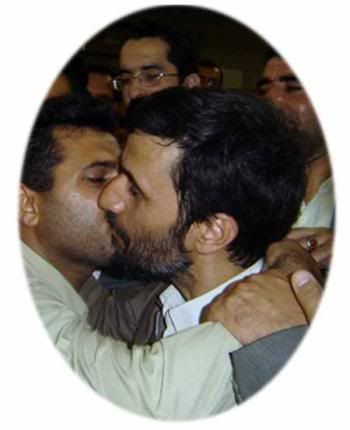
Ahmadinejad: The Kiss

Here's a lovely photo of Mahmoud Ahmadinejad:
Mahmoud Ahmadinejad
Really, this is irresistible.

I intend to use this image on MRZine for his birthday: 28 October 1956.

I shall also send him flowers on his birthday . . . if he is still alive. (Tulips -- Iran's national flower and symbol of martyrdom and revolution -- if possible, though they are out of season in October.) Will he be? Washington will certainly try to oust him or have him killed, and he has numerous local enemies. Fidel and Chavez need to give him survival tips, too, in addition to tips on how best to offer solidarity with Palestinians, how to organize counter-hegemonic diaspora identity politics, and other subjects of importance.

Letter to Ahmadinejad

Really, I ought to give Fidel a call: "Hi, Fidel, you don't know me, but you knew Paul S, Paul B, Leo, and Harry, and I've inherited a piece of them. Here's what I implore you to do, for the good of Iranians, Palestinians, Jews, and the rest of us: talk sense into the President of Iran!" :-)

Or else write a letter to Ahmadinejad:
In the Name of God, the Compassionate, the Merciful,

Mr. Mahmoud Ahmadinejad,
President of the Islamic Republic of Iran,

Your excellency, I applaud your economic policy, defense of Iran's right to nuclear research, recent decree allowing women to attend sports events at stadiums, sympathy for US troops put into harm's way, and solidarity with Palestinians and other oppressed peoples. But, today, I write to you on a matter that concerns me and others who wish well for your republic: are you aware that Neo-Nazis are trying to appropriate your image and Palestinian suffering for their despicable cause? Please take a look at this music video: "President Ahmadinejad Music Video." Has it ever occurred to you, as you attend the World Cup in Germany next month, Neo-Nazis might try to hold a rally ostensibly for you and Palestinians, but really trying to promote only their anti-Semitic ideology? Imagine that spectacle! That's not good for you, Iranians, Palestinians, or anyone else for that matter except Washington and Tel Aviv! You would be no doubt aghast at it yourself. Please issue a statement -- before you take off for Germany -- that reiterates your solidarity with Palestinians, condemns Neo-Nazis, and extends your support to Jewish leftists in Israel and the diaspora who are fighting for one Palestine with equal rights and freedoms for Palestinians, Jews, and others.

Take good care of yourself, and please send my regards to your wife and Messers. Fidel Castro, Hugo Chavez, and Evo Morales.

Ciao,

Yoshie

Ahmadinejad as "die Sonne"

I was looking for videos of Mahmoud Ahmadinejad. I wanted to hear what he sounds like. There are a couple of good ones which have him looking all amiable and saying what he ought to be saying: "Ahmadinejad on People"; and "President Ahmadinejad Press Conference."

Then, I also found this one, "A music video made for President Ahmadinejad of Iran": "President Ahmadinejad Music Video.". The person who posted this video claims: "The video is not made by myself, I have no idea who the author is." That's a lie . . . or evidence of profound political cluelessness. The video is clearly made by Neo-Nazis trying to appropriate Ahmadinejad and the oppression of Palestinians for their despicable cause. Why do I know that? The video ends with a sequence that represents white Holocaust deniers -- Verbeke, Irving, Graf, Zundel, Rudolf -- as martyrs (superimposed on images of gun-toting IDF soldiers) and cuts to a logo of the Star of David with a legend: "Israel: Built on a Lie."

The video is set to Rammstein's "Sonne," and it cuts between scenes of Israeli oppressions of Palestinians, photographs and video clips of Ahmadinejad, and photos and video clips from mass electoral rallies for Ahmadinejad in Iran. It's edited to synchronize images of Ahmadinejad with the song's chorus:
"Hier kommt die Sonne
Hier kommt die Sonne
Sie ist der hellste Stern von allen
Hier kommt die Sonne"
[Here comes the Sun
Here comes the Sun
It is the brightest star of all
Here comes the Sun].
This really drives me up the wall! Does Ahmadinejad know that he is being used in this way? Fidel, you ought to have that talk with Ahmadinejad ASAP and bring the man to senses!

UPDATE
"Letter to Ahmadinejad" (12 May 2006)

Wednesday, May 10, 2006

Ahmadinejad's Letter

Mahmoud Ahmadinejad's letter to George W. Bush is made available to the public by Le Monde and the Council on Foreign Relations.

The President of Iran is a more rational man than the President of the United States, and much of his criticism of the US government makes sense. But why did he, or his aids, have to mix that legitimate criticism with a Holocaust denial (again!) and a 9-11 conspiracy theory? Has Fidel not had the time to pull Ahmadinejad aside and tell him: "Yo, Mahmoud, only crackpots and dumbasses believe that shit. Here, read this [Marx's Capital] instead"?

Tuesday, May 09, 2006

The End of Genocide

Genocide at the origin of its term was a term to name a racist crime, but since then it has become largely a racist term (in much of political discourse and people's consciousness) to name only crimes committed by peoples or governments outside the rich countries where relative prosperity allows relative peace, never crimes committed by peoples or governments of rich countries. "We" (of the United States, the European Union, and Japan), the civilized, try to save lives, no matter how much direct and indirect deaths and injuries our actions cause in the process; "they" (in Sudan, Rwanda, Yugoslavia, Russia, etc.), the uncivilized, just kill, kill, kill because they are hateful brutes. That's the prevailing understanding of the world that the power elite create through their usage of the term genocide.

The term genocide is useful to the power elite because it, like their anti-Semite-baiting, helps silence dissenters: "There are certain things in the world that the only appropriate response is to shut up and remain silent" in the words of Wojtek Sokolowski, a Johns Hopkins University sociologist. What are "certain things" about which one is asked to shut up and remain silent? Politics, economy, history . . . or anything else that may help us understand what's going on. So, labeling other peoples' crimes "genocides" helps the power elite of the rich countries: when one hears the term, one is supposed to condemn designated enemies without understanding what's going on, without thinking at all, in fact.

To be sure, there are leftists who apply the term genocide to past and present crimes committed by the power elite of the rich countries (e.g., the Holocaust of American Indians), but since leftists don't have power or own major media, leftist usage doesn't stick and fails to change the dominant understanding of what genocide is: "other peoples' crimes," compared to which "we" look good!

Michael Steinberg concludes his essay "The End of Genocide" (MRZine, 8 May 2006) thus:
We do not need a concept that simplifies political struggles beyond recognition or gives preferential attention to those calamities where leaders of one side happen to claim that their enemy is a specific ethnic, racial or religious group. . . . The notion of genocide emerged from an understandable sense that Nazi crimes were somehow unlike the crimes of the past and must never be repeated. But it remains too closely tied to those crimes, and to a particular explanation of them, to be of any use in today's world. There is no such thing as genocide. There are cruelty, oppression, murder, and torture. Those are real, and they need to be stopped. Genocide is imaginary. It is time we did away with it.
I once thought otherwise, but I cannot agree more.

Urbanization, Industrialization, and Feminism

Under capitalism, feminism and environmentalism may be at odds with each other: urbanization and industrialization usually are necessary conditions for the development of feminism (beyond the elite) and gender equality; but urbanization and industrialization tend to bring more energy-intensive lives and push up per capita energy use. It may be possible to urbanize and industrialize without wrecking the environment under another mode of production; but it must be noted that historical socialist records on the environment are on the whole unpromising. In any event, it doesn't look like we can switch from capitalism to a higher mode of production before capitalism really aggravates global warming. The only "solution" on the political horizon in the United States -- the "solution" that got on the political horizon thanks to underinvestment during the era of cheap oil, Washington's incessant wars and terrorism, and other social conflicts -- is higher oil prices, but even higher prices are only temporary: higher prices will eventually bring about attempts at conservation, but conservation attempts appear to end as soon as prices go down substantially.

Saturday, May 06, 2006

Ahmadinejad's "Passive Revolution"?

Juan Cole writes: "The Iranian 'president' is mostly powerless. The commander of the armed forces is the Supreme Jurisprudent, Ali Khamenei" ("Hitchens the Hacker; And, Hitchens the Orientalist; And, 'We don't Want Your Stinking War!'" Informed Comment, 3 May 2006). I've heard that before, but I wonder if it is still true or if it will be always true. Isn't what Ahmadinejad and his backers are trying to pull off a kind of "passive revolution" (cf. Antonio Gramsci): demote clerics without annihilating them?

Friday, May 05, 2006

Why Liberals Love to Hate Rich Arabs

DailyKos Blog Ad of Puppet BushHere is a copy of an image for a FreedomToast blog ad featured at DailyKos (as of 5 May 2005, it's in the top ad space near the top right corner of the blog). It's an image of a rich Arab, dollars in hand, pulling the strings of a white male puppet in suits, with a sign flashing high gas prices in the background (and a FreedomToast logo in the bottom right corner). What's the visual message here? Rich Arabs are bribing and pulling the strings of Republican politicians and oil industry executives, profiting handsomely from Americans who are paying through their noses for gas.

What's wrong with this picture?

Oil price hawks are actually Caracas and Tehran, not royals, sheiks, and emirs of the Gulf who subserviently pump up as much gas as possible in response to Bush's demand.

Besides, the main political factor (aside from economic factors like supply and demand and investor speculation, over which no one really has control right now, except through attempts at conservation, which have yet to be seriously made) that has led to the rise of oil prices is Washington's ceaseless warmongering and unquenched thirst for regime changes overseas: the continuing war in Iraq, rumors of nuke strikes and threats of sanctions against Iran, Sudan (the United States being the only government to call the Darfur conflict a genocide, threatening military interventions), the list goes on. Yet, self-described "netroots" liberals let Bush's foreign policy off the hook, for powerful Democrats essentially agree with Bush on Iraq (no full US withdrawal from Iraq) and Iran (sanctions or military strikes on Iran for regime change, before Iran gets its insurance against a US invasion: nuclear weapons) and go so far as to urge Bush to send US troops to Sudan if necessary.

Moreover, scapegoating rich pro-Washington Arabs for terrorism as well as rising oil prices is a safe game: it lets Dumbocrats score a few irrelevant points against Bush without really jeopardizing Washington's essential access to Gulf oil and geopolitically strategic territories. The case in point: the extraordinarily inane Dubai WP imbroglio. After getting a big slap in the face, Dubai eagerly offered to serve as a spy station for Washington in its Iran adventure. That's the reason liberals love to hate rich Arabs.

Mind you, there is much to hate about the Arab ruling class in the Gulf. Taking one look at any of the Gulf states makes you wish someone exported revolution to it. And yet, the state of Arab politics being what it is, the only serious challenge to the pro-Washington Arab power elite in the Gulf and beyond, alas, comes from Islamists of various schools. The best case scenario, the scenario feared by Washington as well as the Arab power elite, is that Tehran will extend its Islamist populist political influence in Lebanon, Palestine, and beyond, while cementing its ties with the socialist axis of good Caracas, Havana, and La Paz (one hopes that the Latin socialist leaders will wean the President of Iran from his urge to play to the Holocaust-denying gallery) and retaining Beijing and Moscow's support. The worst case scenario is that Islamist terrorists will grow even more militarily sophisticated, one day succeeding in sabotaging Abqaiq, "the world’s biggest oil processing complex."

Chechnya, Darfur, and Jewish Activism

Take a look at my new MRZine article on Darfur and Jewish activism:
"Chechnya, Darfur, and Jewish Activism."

Tuesday, May 02, 2006

Norman G. Finkelstein: "The Lobby: It's Not Either-Or"

I just posted Norman G. Finkelstein's comment on the controversy rekindled by John Mearsheimer and Stephen Walt's essay "The Israel Lobby": "The Lobby: It's Not Either-Or" in MRZine. I think his perspective is very useful.

I attempted to put the roles played by establishment Jewish leaders in the context of similar identity-based mobilizations for imperialist foreign policy, with a glance at the tragicomic character of their coalition with evangelical Christians, in
"'Save Darfur': Evangelicals and Establishment Jews" (also in MRZine, revised from a posting here). But, boy, it's attracted quite a bit of name-calling and some wingnuts.

Had I talked mainly about, say, establishment Cubans, establishment Iranians, establishment whatever allying themselves with and actively pushing for imperialist policy, such responses would not have come. Some people appear to take mentioning Jewish identity at all, if it is in the context of criticism of a coalition for imperialist policy, to be offensive. Why can't we have rational discussion of the roles played by identity politics in imperialism?

Sunday, April 30, 2006

"Save Darfur," Don't Give Peace a Chance!

Saw a good bit of the "Save Darfur" rally on C-Span. The rally was small -- only several thousands according to Reuters ("Thousands March to Stop Darfur Killing," 30 April 2006). And it was overwhelmingly white. But, boy, it was a professionally-staged photo op, with celebs, politicos, and exiles at the podium expertly framed by the U.S. Capitol in the background.

The timing of the rally was perfect, designed to coincide with -- and scuttle -- the Abuja peace negotiations between the rebels and Khartoum brokered by the African Union, whose deadline is midnight today. And sure enough, the rebels rejected the AU peace deal:
The rebels called for changes to the deal hours before an African Union deadline -- and after the Sudanese government indicated it would accept the proposal. . . . The Sudanese government had said it was ready to sign the agreement. But a spokesman for one of Sudan's rebel factions said the proposal does not adequately address implementation nor their key demands for a vice president from Darfur and more autonomy. Hahmed Hussein, a spokesman for the Justice and Equality Movement, said he was speaking for both rebel factions. (Associated Press, "Rebels Reject Draft Darfur Peace Deal," New York Times 30 April 2006)
Really, why should the rebels accept it, when Washington, given an excuse by the pro-war rally organized by an alliance of evangelicals and establishment Jews, is pushing for NATO interventions just at this moment? "U.S. Secretary of State Condoleezza Rice said on Thursday that the African Union (AU) peacekeeping mission in Sudan's Darfur region was not strong enough and that NATO should take on a larger role there" (Reuters, "Rice urges Expanded NATO Role in Darfur," 30 April 2006). The rebels would naturally think: "Why don't we wait till Washington sends us NATO or UN or US troops to weaken the government's hands, so we can get a better deal?"

Remember how the specter of an international military intervention prolonged the civil war in Yugoslavia: "It also appears to be true the United States encouraged Izetbegovic to reject the EC-sponsored cantonization plan agreed upon in two separate meetings in late winter 1992," as General Charles G. Boyd puts it cautiously, "Making Peace with the Guilty: The Truth about Bosnia," Foreign Affiars September/October 1995)? It's the same dynamics . . . except the prize is more valuable than territories: "Sudan has proven reserves of some 563 million barrels of oil, with the potential for far more in regions of the country made inaccessible by conflict" (Esther Pan, "China, Africa, and Oil," Council on Foreign Relations, 12 January 2006).

Putting an end to the Darfur conflict now would consolidate Beijing's dominant position in Sudan's oil industry:
China has a $4 billion investment in the country widely believed to have the largest untapped oil reserves in Africa. The China National Petroleum Corp. has a 40% stake in Greater Nile Petroleum, which owns oil fields, a pipeline, a large refinery and a port. Last year, China purchased more than half of Sudan's oil exports. Conversely, Sudan accounted for 6% of China's oil imports, about 200,000-plus barrels a day. (Jon D. Markman, "How China Is Winning the Oil Race," MSN Money, 25 April 2006)
Who wants peace in Darfur? Certainly not Washington.

UPDATE
I revised this entry, retitled it "Who Wants Peace in Darfur?" and published it in MRZine.

David Kelsey Questions the Jewish Leadership of the "Save Darfur" Coalition

David Kelsey, a Jewschool blogger, courageously asks tough questions about the "Save Darfur" coalition:
Is the Jewish community helping the situation in Darfur by championing the Dafurians’ cause, or are we poisoning the well of potential solidarity through our leadership?

Obviously Jewish activism on Darfur is ecumenical. And it is certainly promoted as such.

“The Save Darfur Coalition is an alliance of over 100 faith-based, humanitarian and human rights organizations. Our mission is to raise public awareness and to mobilize an effective unified response to the atrocities that threaten the lives of two million people in the Darfur region.”

But the ecumenical language of the Coalition it is somewhat of a facade. The Save Darfur Coalition is heavily (overly?) Jewish, and was created by the United States Holocaust Memorial Museum and the American Jewish World Service.

It appears that intensive Jewish leadership and organizational support is viewed with cynicism from other possible allies for the Darfurians, including crucial African-American organizations. Like say, the NAACP, whose signature is notably absent on the Unity Statement.

Could it be that our commitment to Darfur is somehow viewed with suspicion when The Jews are calling for yet another intervention against Islamic aggression? Is it unfair to suspect that the OU might need an ulterior political motive to stand alongside the Reform Movement other than a purely moral objection to the plight of the Darfurians?

Can we at least try to understand why some might be unwilling to give us the benefit of the doubt?

In the U.S., the Holocaust is the primary lens in which to view all genocides in the past and present. In order to maintain credibility (which translates into continued and expanded Holocaust education, the major justification usually offered for Israel’s creation) don’t we have to react with alarm this way, or risk our mandate which allows us to promote our particular Jewish concerns provided we include universal ones?

If there is concern about our true intentions, and discomfort about what the Jews really want in the wake of Neocon support for the Iraq War and the broader Israeli push for U.S. pressure on Iran, including the possibility of a preemptive strike, does our heading the Save Darfur Coalition hinder, not help, its chance of receptivity?

Judging by the heavily Jewish signatures of the mission, it seems it may indeed be a hard sell, at least if The Jews are the ones selling it.

We may indeed only mean well. But we are not the best strategists. This effort needs the prominent leadership of African-American groups to succeed.

Or perhaps, just not a prominent Jewish leadership. Perhaps the moral compass of the Jewish community no longer carries a lot of weight nor enjoys widespread trust -- either internationally or domestically -– when it comes to our calls for intervention, particularly one that may require military action.

Things are different now. ("Jewish Leadership on Darfur," 17 April 2006)
I object to those who conflate neo-cons with Jewish communities. Far from being neo-cons, ordinary Jews stand to the left of almost all racial/ethnic groups in the United States except Blacks on the Iraq War or any other issue (and perhaps even to the left of Blacks when polling results are adjusted by income, given that income positively correlates with support for wars, tax cuts for the rich, social program cuts for the poor, and so on). The same cannot be said for prominent establishment Jews (i.e., those who hold leadership positions in Jewish community), however, too many of whom tend to uncritically support Tel Aviv's views on many foreign policy questions. The Sudan question is probably no exception. Can Kelsey's caution reach Jewish leaders without discouraging ordinary Jewish activists from getting involved in whatever issues they want to get involved in? I hope it will.

CAIR Asks Why No Muslim Groups to Speak at Darfur Rally

Here's a significant new development on the pro-war rally today. The Council on American-Islamic Relations belatedly realizes that it's been had:
The Council on American-Islamic Relations (CAIR) today questioned why no representatives of major American Muslim groups are listed as speakers at the Save Darfur Coalition "Rally to Stop Genocide" this afternoon in Washington, D.C.

To view the list of speakers, go to:

http://www.savedarfur.org/rally/speakers

CAIR and other American Muslim groups, including the Islamic Society of North America, the Islamic Circle of North America, the Muslim Public Affairs Council, and the Muslim American Society Freedom Foundation, are members of the coalition. But no representative from these, or any Muslim coalition member, is listed on the latest rally program. (Several Muslims will speak, but they do not represent Islamic groups that are coalition members.)

The Washington Post reported that rally organizers "rushed this week to invite two Darfurians to address the rally after Sudanese immigrants objected that the original list of speakers included eight Western Christians, seven Jews, four politicians and assorted celebrities -- but no Muslims and no one from Darfur."

Earlier this month, after noticing the lack of Muslim speakers on the program, CAIR wrote to rally organizers asking to have a representative speak at the rally. The Save Darfur Coalition never replied to CAIR's letter, despite the fact that the Washington-based Islamic civil liberties group is an original signatory of the coalition's founding "Unity Statement."

"It is unfortunate that the Save Darfur Coalition chose not to list any mainstream American Muslim groups in the rally program," said CAIR Executive Director Nihad Awad. "This disturbing omission calls into question the coalition's true agenda at the rally." Awad said rally participants would have benefited from hearing American Muslim leaders offer support for those suffering in Darfur and in neighboring areas. (Council on American-Islamic Relations, "CAIR Asks Why No Muslim Groups to Speak at Darfur Rally: Lack of Muslim Speakers Calls Into Question Rally's 'True Agenda'," Press Release, 30 April 2006)

A Twelve-Step Program for America

1. We admitted we were powerless over our addiction to wars and sanctions and interventions, real or imagined, US or multinational, with or without US troops, with our money or other people's money -- that our lives had become unmanageable.
2. We came to believe that a Power greater than ourselves could restore us to sanity.
3. We made a decision to turn our will and our lives over to the care of the rest of the World.
4. We made a searching and fearless moral inventory of ourselves.
5. We admitted to the rest of the World and to ourselves the exact nature of our wrongs.
6. We are entirely ready to have the rest of the World remove all these defects of character.
7. We humbly asked the rest of the World to remove our shortcomings.
8. We made a list of all persons we had harmed and became willing to make amends to them all.
9. We made direct amends to such people wherever possible, except when to do so would injure them or others.
10. We continued to take personal inventory and, when we were wrong, promptly admitted it.
11. We sought through prayer and meditation to improve our conscious contact with the rest of the World, praying only for knowledge of the rest of the World's will for us and the power to carry that out.
12. Having had a spiritual awakening as the result of these steps, we tried to carry this message to other addicts and to practice these principles in all our affairs.

30 April 1975

On 30 April 1975, the Vietnamese Communists finally triumphed. Whatever the rest of the world think of the subsequent history of Viet Nam (or whether they think about it at all), all of us should thank the Vietnamese for abolishing conscription in the United States and thus rendering it incapable of fighting a big war that causes millions of casualties. (Alas, Americans still have appetite for smallish wars like the Iraq and Afghanistan Wars, missile strikes on Iran, "peace-keeping" in Sudan, and so on and so forth.)

Saturday, April 29, 2006

300,000 Demonstrate against the War in NYC

"The demonstrators stretched for about 10 city blocks as they headed down Broadway. A police spokesman declined to give an estimate of the size of the crowd, although organizers claimed there were 300,000 people. There were no arrests," says Associated Press. Phew, it wasn't as small as I feared it might be! But I bet the media will give bigger space to the infernal pro-war rally in DC on the 30th.

Friday, April 28, 2006

"Save Darfur": Evangelicals and Establishment Jews

It's embarrassing that America -- and the world -- will be witnessing a PRO-WAR rally for a third oil war in Washington, D.C. on April 30 (see SaveDarfur.org) that is far more highly publicized than an anti-war one (that appears to be poorly organized) in New York City on April 29, even while Washington is still soldiering on in Afghanistan and Iraq and gunning for sanctions or war on Iran.

Who is behind this astonishing pro-war rally in war-weary America (as far as the Iraq War is concerned, that is)? A rag-tag coalition of evangelicals and establishment Jews (those whom the corporate media designate as official leaders of Jewish communities):
Keeping the peace within the diverse Save Darfur Coalition has not been easy. Tensions have arisen, in particular, between evangelical Christians and immigrants from Darfur, whose population is almost entirely Muslim and deeply suspicious of missionary activity.

Organizers rushed this week to invite two Darfurians to address the rally after Sudanese immigrants objected that the original list of speakers included eight Western Christians, seven Jews, four politicians and assorted celebrities -- but no Muslims and no one from Darfur.

Some Darfur activists also have complained about the involvement in the rally of a Kansas-based evangelical group, Sudan Sunrise.

Last week, after an inquiry from The Washington Post, Sudan Sunrise changed its Web site to eliminate references to efforts to convert the people of Darfur. Previously, it said it was engaged in "one on one, lifestyle evangelism to Darfurian Muslims living in refugee camps in eastern Chad" and appealed for money to "bring the kingdom of God to an area of Sudan where the light of Jesus rarely shines."

Although it is not formally part of the Save Darfur Coalition, Sudan Sunrise helped arrange buses and speakers, and it is co-hosting a dinner for 600 people on the rally's eve.

(Alan Cooperman, "Groups Plan Rally on Mall To Protest Darfur Violence: Bush Administration Is Urged to Intervene in Sudan," Washington Post, 27 April 2006: A21)
Wow, fascinating.
For this effort, the coalition has recruited major celebrities like George Clooney and Elie Wiesel to speak to those assembled. Though recent reports have indicated that the turnout might be lower than expected, organizers, while refusing to give a concrete number, believe it will be in "the tens of thousands."

Little known, however, is that the coalition, which has presented itself as "an alliance of over 130 diverse faith-based, humanitarian, and human rights organization" was actually begun exclusively as an initiative of the American Jewish community.

And even now, days before the rally, that coalition is heavily weighted with a politically and religiously diverse collection of local and national Jewish groups.

A collection of local Jewish bodies, including the Jewish Community Center in Manhattan, United Jewish Communities, UJA-Federation of New York and the Jewish Council for Public Affairs, sponsored the largest and most expensive ad for the rally, a full-page in The New York Times on April 15.

Though there are other major religious organizations, like the United States Conference on Catholic Bishops and the National Association of Evangelicals, both of which have giant constituencies that number in the millions, these groups have not done the kind of extensive grassroots outreach that will produce numbers.

Instead, the Jewish Community Relations Council, a national organization with local branches that coordinate communal activity all over America, has put on a massive effort to bus people to Washington on Sunday. Dozens of buses will be coming from Philadelphia and Cleveland. Yeshiva University alone, in upper Manhattan, has chartered eight buses.

Besides the Jewish origins and character of the rally - a fact the organizers consistently played down in conversations with The Jerusalem Post - the other striking aspect of the coalition is the noted absence of major African-American groups like the NAACP or the larger Africa lobby groups like Africa Action. When asked to comment, representatives of both groups insisted they were publicizing the rally but had not become part of the coalition or signed the Unity Statement declaring Save Darfur's objectives.

The coalition's roots go back to the spring of 2004 following a genocide alert, the first ever of its kind, issued by the United States Holocaust Museum. An emergency meeting was coordinated by the American Jewish World Service, an organization that serves as a kind of Jewish Peace Corps as well as an advocacy group for a variety of humanitarian and human rights issues.

At the meeting, which was attended by numerous American Jewish organizations and a few other religious groups, it was decided that a coalition would be formed based on a statement of shared principles.

After a year of programming that involved raising awareness about the genocide, the coalition came up with the idea for a rally in Washington. Planning began in the fall of 2005.
David Rubenstein, the director or "coordinator," as he prefers it, of the coalition says that, given that the groups who started the coalition were Jewish, "it's not surprising that they had the numbers of more Jewish organizations in their rolodexes."

He says that the Jewish community has been "extraordinarily responsive and are really providing the building for this thing," and yet he insists that the coalition has worked "very, very hard to be inclusive, to make sure there are people beyond the usual suspects."

This is a sentiment echoed by Ruth Messinger, president of American Jewish World Service and one-time Manhattan borough president and Democratic mayoral candidate for New York City. The world service and Messinger personally have been at the forefront of planning for the rally. Much of the Jewish turnout has been a result of her lobbying efforts.

. . . . . . . . . . . . . . . . . . . .

The fact that the aggressors in Darfur are Arab Muslims - though it should be said that the victims are also mostly Muslim - and are supported by a regime in Khartoum that is backed by the Arab League has made some people question the true motives of some of the Jewish organizations involved in the rally.

(Gal Beckerman, "US Jews Leading Darfur Rally Planning," Jerusalem Post, 27 April 2006)
Should we laugh or should we cry?

Some say America is addicted to oil, but America is even more addicted to war (or economic sanctions when war is not in the cards). "Leaders" of almost all groups in America -- Republicans or Democrats, Christians or Jews or Muslims (many of whom rooted for the war in Afghanistan in the Carter-Reagan era and the war on Yugoslavia in the Clinton era), whatever -- come up with their pet wars to promote, sooner or later.

UPDATE: I posted my two cents (an expanded version of this entry) at MRZine also, briefly featured by Google News.

Sunday, April 09, 2006

Gnostic Gospels and Conspiracy Theory

The National Geographic Society had the Gospel of Judas translated. The story has received much attention from the corporate media.

The Gospel of Judas tells us that Judas didn't really betray Jesus. Rather, Judas fulfilled the task he was given by Jesus: "sacrifice the man that clothes me." By doing so, Judas would "exceed" all other disciples, says Jesus. That is the "secret knowledge" that Jesus made Judas bear and that the Gospel of Judas purports to reveal.

But if Judas didn't betray Jesus, there would be no real conflict and no human drama!

What makes the Synoptic Gospels in the New Testament more interesting than Gnostic Gospels, to me, is that the four Gospels tell an insightful story about the politics of a community. Judas betrays Jesus for money. Peter betrays Jesus by denying him three times, and he does so, unlike Judas, out of weakness, not wanting to be associated with his teacher when the powerful really come after the teacher. Jesus expected both kinds of betrayal, not because he was the Son of God, but because he had a pretty good insight into human nature, as all good political leaders do. The empire gets Jesus, a rebel leader, executed by having the pillars of a community from which he comes demand his execution. On the day of execution, it is the marginalized and oppressed -- a condemned criminal, a former prostitute, and so on -- who stand by the man who gets martyred. Happens all the time, in the history of the left.

The structure of Gnostic Gospels, in contrast, resembles that of conspiracy theory, or rather conspiracy theory may have taken its undemocratic narrative structure from Gnostic Gospels: events are determined by the power that orchestrates both sides of a seeming opposition; and knowledge is accessible to only a chosen few, rather than all who strive to acquire it.

Moreover, the four Gospels of the New Testament are free from statements that could lend themselves to homophobia, whereas the newly translated Gospel of Judas includes them and even attributes one to Jesus:
They [said, “We have seen] a great [house with a large] altar [in it, and] twelve men -- they are the priests, we would say -- and a name; and a crowd of people is waiting at that altar, [until] the priests [… and receive] the offerings. [But] we kept waiting.”
[Jesus said], “What are [the priests] like?”
They [said, “Some …] two weeks; [some] sacrifice their own children, others their wives, in praise [and] humility with each other; some sleep with men; some are involved in [slaughter]; some commit a multitude of sins and deeds of lawlessness. And the men who stand [before] the altar invoke your [name], [39] and in all the deeds of their deficiency, the sacrifices are brought to completion […].”
After they said this, they were quiet, for they were troubled.

. . . . . . . . . . . . . . . . . . . .

Jesus said to them, “Those you have seen receiving the offerings at the altar -- that is who you are. That is the god you serve, and you are those twelve men you have seen. The cattle you have seen brought for sacrifice are the many people you lead astray [40] before that altar. […] will stand and make use of my name in this way, and generations of the pious will remain loyal to him. After hi another man will stand there from [the fornicators], and another [will] stand there from the slayers of children, and another from those who sleep with men, and those who abstain, and the rest of the people of pollution and lawlessness and error, and those who say, ‘We are like angels’; they are the stars that bring everything to its conclusion. For to the human generations it has been said, ‘Look, God has received your sacrifice from the hands of a priest’ -- that is, a minister of error. But it is the Lord, the Lord of the universe, who commands, ‘On the last day they will be put to shame.’” [41]
All in all, the Gospel of Judas brings no good news politically.

Steffie Woolhandler: Massachusetts' Health Care Reform Is "a Hoax"

Is Massachusetts' health care reform bill as good as the New York Times (Pam Belluck, "Massachusetts Sets Health Plan for Nearly All," 5 April 2006) makes it sound? Doug Henwood asks Steffie Woolhandler on his Behind the News radio show (6 April 2006).
Doug Henwood: As I was reading the New York Times the other day, boy, it sounded like the second coming of Christ or something: Governor Mitt Romney, Democrats, and Republicans of Massachusetts coming together to produce this wonderful, innovative, post-partisan universal health care system. Is it as good as it sounds?

Steffie Woolhandler: Well, I think it's really a hoax. What the bill does is it creates an individual mandate and tells people that they have to purchase their own health insurance. That will apply primarily to middle-income people. And the bill says that there are just going to be affordable comprehensive policies available. But of course there are no affordable comprehensive policies available to individuals in the state. The average individual policy costs $4,500 a year. So, it's a little like saying that the legislature is going to make chocolate chip cookies with no sugar or fat or calories. The other provisions of the bill are extremely generous toward the major hospitals in town. They are extremely generous to the private health insurance industry, since all of the new health insurance would be purchased at the private insurance industry. So, hospitals and the insurance industry lobbied pretty hard for the bill. The only piece of the bill that an advocate might like would be some modest Medicaid expansions, but they don't come anywhere close to covering the three quarters of a million people in the state who have no health insurance.
Click here to listen to the rest of the show.

See, also, Steffie Woolhandler and David U. Himmelstein, "Massachusetts' Health Bill Failed Before, Will Again" (Atlanta Journal-Constitution 7 April 2006).

Friday, April 07, 2006

Naita Aka Oni

There is a popular picture book for children in Japan, titled Naita Aka Oni [The Red Ogre Who Cried].

The story goes like this:
Once upon a time, there were two ogres. One was red, and the other was blue. The red ogre wanted to become friends with children in a village nearby. So, the red ogre put up a sign in front of his house:Naita Akaoni
Home of a Gentle Ogre
All Are Welcome
Tea and Tasty Cakes Available
But no one showed up, and the red ogre grew puzzled, sad, and angry. "I'm such a kind ogre -- why would nobody visit me?" Despairing, the red ogre even tore down the sign: "This is useless."

Moved by his friend's feelings, the blue ogre said, "Look, I have a plan."

The blue ogre's plan was for him to pretend to terrorize children and then have the red ogre chase him off, "rescuing" them from him. The plan went without a hitch, and the red ogre became the most popular creature among the children, and all came to play with him.

After a happy day of enjoying the children's company, the red ogre found a letter from the blue ogre. The letter said, "My Dear Red Ogre, if people find out that you are a friend of the Bad Blue Ogre's, they will not let the children come to you any more. So, I'm leaving. Please live happily with the children. Goodbye. Blue Ogre."

The red ogre cried out, "Blue Ogre is gone! A dear friend of mine! He is gone!" And he wept.

The red ogre and the blue ogre were never to see each other again.
Hamada HirosukeIt's a great story about the costs of assimilation.

The story was written by Hamada Hirosuke, who wrote many other children's stories. It was first published in 1933.

I read it first (or rather my parents read it to me) when I was a child, and later I wondered if the author was gay, if he was a leftist, or if he had read Oscar Wilde's "The Selfish Giant." I never found out.

Sunday, November 13, 2005

A History of Violence

David Cronenberg's latest, A History of Violence, is a fine reworking of the Western and film noir in his "realist" turn. In a feminist twist of film noir, in this film it is a man, not a woman, who has a past. The past that the man (well played by Viggo Mortensen) thought he left behind in the East catches up with him in the West, after he becomes a "local hero" by killing two murderous robbers who threatened his life as well as his customers' and employees' in a diner he runs.

A History of Violence

The past in question is a history of violence, his service as a violent foot soldier for a gangster capitalist (who happens to be his brother). To defend his family and home in a small town in Indiana from the long arms of the gangster capitalist, he ends up resurrecting an extremely efficient killing machine that he once was and finds himself at odds with his wife and teenage son, who feel betrayed by his secrecy (he had hidden his past from them by assuming a new name) and appalled by the newly resurrected violent masculinity in him (which begins to bleed into his sex with his wife), though they love one another. The man overcomes the gangster capitalist's underlings in the West (and in the process makes his son an accomplice in violence) and the capitalist himself in the East. Then, he comes back home.

The film's ending is a tense and ambiguous scene of homecoming. His wife, son, and daughter are at dinner table. When he comes in, there is silence. After a moment that feels longer than it is, his daughter (who is too young to fully understand the meaning of trust and betrayal) makes place for him at the table. He and his wife look into each other's eyes, wordlessly, as she passes a plate to him. Fade to black.

A History of Violence makes no explicit reference to the Iraq War. Yet you keep thinking about it, as you watch the film. There must be many homes where soldiers' homecomings are as fraught as the protagonist's in A History of Violence. Divorces are sharply up in the military.

Repeated long deployments alone take their toll. And, then, there is psychological trauma: "Of the 244,054 veterans of Iraq and Afghanistan already discharged from service, 12,422 have been in VA counseling centers for readjustment problems and symptoms associated with PTSD" (William M. Welch, "Trauma of Iraq War Haunting Thousands Returning Home," USA Today, 28 February 2005).

The violent past cannot be buried and forgotten, nor can the home and hometown be insulated from the violent "outside," as the protagonist of A History of Violence, like many Americans, thought they could. The history of violence must be dealt with. But how? The film does not seek to answer that -- it wants the audience to think about it.

[This essay was first published by MRZine.org.]