Showing posts with label Germany. Show all posts

Monday, October 13, 2008

Multinational Investors' Vote of Confidence in Ultra-imperialism

Check out multinational investors' major vote of confidence in ultra-imperialism today: John Willman, "Markets Cheer Bank Bail-outs" (Financial Times, 13 October 2008); Ralph Atkins, "European Banks Offer Unlimited Dollar Funding" (Financial Times, 13 October 2008); "Full Text: US Treasury Tarp Plans" (Financial Times, 13 October 2008); Louise Story and Andrew Ross Sorkin, "Morgan Agrees to Revise Terms of Mitsubishi Deal" (New York Times, 13 October 2008); "Gulf Shares Surge as UAE and Qatar Act (Financial Times, 12 October 2008); and Robin Wigglesworth and Simeon Kerr, "UAE Leads Drive to Stem Crisis" (Financial Times, 13 October 2008).

It's true that, if China, Japan, Germany, Saudi Arabia, and the United States functioned as one politically (if not legally) coherent establishment, Americans would be back in the black:

Global Balance of Payments ($bn, 2007)
Click on the chart for a larger view.
SOURCE: Martin Wolf, "Asia's Revenge," Financial Times, 9 October 2008, p. 9.

That's the level at which the ruling classes have built their post-WW2 hegemony (cf. Kees van der Pijl, The Making of an Atlantic Ruling Class; and Gavan McCormack, Client State: Japan in the American Embrace; etc.).

Therefore, a radical shift in global class relations could come only if there were a radical shift in any one of the aforementioned countries, but these are the very ones where the Left has the least chance in the world.

Is China, though, a weak or strong link in this chain of empire (to which Latin socialists, Islamists from the Hindu Kush to the Persian Gulf to the Horn of Africa to the Niger Delta, Maoists in Nepal and India, the national security interests of Russia, etc. have provided a partial material -- if ideologically incoherent -- counterweight)?

Update

"[T]he needs of our economy require that our financial institutions not take this new capital to hoard it, but to deploy it" ("Text: Henry Paulson Remarks Tuesday," 15 October 2008).

"Investors are recognizing that the financial crisis is not the fundamental problem. It has merely amplified economic ailments that are now intensifying: vanishing paychecks, falling home prices and diminished spending. And there is no relief in sight" (Peter S. Goodman, "Markets Suffer as Investors Weigh Relentless Trouble," New York Times, 16 October 2008).

Sunday, October 12, 2008

Toward the Highest Stage of Ultra-imperialism?

A local friend of mine jokes: if worst comes to worst, the US can always annex Saudi Arabia. But why stop there on the way to the highest stage of ultra-imperialism: America, China, Japan, Germany, and Saudi Arabia together legally conglomerated into a new United States, bringing Americans -- thank Allah and Confucius -- back in the black?

Global Balance of Payments ($bn, 2007)
Click on the chart for a larger view.
SOURCE: Martin Wolf, "Asia's Revenge," Financial Times, 9 October 2008, p. 9.

Jokes aside, Martin Wolf's article that I used as the source for the chart above is actually very useful (except its conclusion still in favor of "liberalized finance" that is unsupportable based on the logic and evidence of the article itself). It succinctly highlights the problem of global inequity and inefficiency -- poorer nations exporting surpluses to richer nations, only to see them wasted on an enormous debt-fueled real-estate Ponzi scheme -- as the cause of the financial crisis of the century.
What lay behind the savings glut? The first development was the shift of emerging economies into a large surplus of savings over investment. Within the emerging economies, the big shifts were in Asia and in the oil exporting countries (see chart). By 2007, according to the International Monetary Fund, the aggregate savings surpluses of these two groups of countries had reached around 2 per cent of world output.

. . . . . . . . . . . . . . . . . . . .

Last year, the aggregate surpluses of the world's surplus countries reached $1,680bn, according to the IMF. The top 10 (China, Japan, Germany, Saudi Arabia, Russia, Switzerland, Norway, Kuwait, the Netherlands and the United Arab Emirates) generated more than 70 per cent of this total. The surpluses of the top 10 countries represented at least 8 per cent of their aggregate GDP and about one-quarter of their aggregate gross savings.

Meanwhile, the huge US deficit absorbed 44 per cent of this total. The US, UK, Spain and Australia -- four countries with housing bubbles -- absorbed 63 per cent of the world's current account surpluses.

That represented a vast shift of capital – but unlike in the 1970s and early 1980s, it went to some of the world's richest countries. (emphasis added, Wolf, p. 9)
There is no political or economic incentive on the part of the biggest deficit spenders, especially the US, to change this pattern. The change therefore has to come from surplus generators.

Friday, July 25, 2008

Afghanistan Threatens to Become Obama's Vietnam

Afghanistan Threatens to Become Obama's Vietnam
by Christine Buchholz

On the occasion of US Democratic presidential candidate Barack Obama's visit to Berlin, Christine Buchholz, a member of the Left Party executive board, comments:

Many hopes are tied to Barack Obama, since George W. Bush is the most unpopular American President ever, and Obama promises to improve the social situation and bring the Iraq War to an end.

However, Obama is making a big mistake by identifying Afghanistan as the main battlefield of the "war on terror" and declaring that he will redeploy up to 10,000 more soldiers to the Hindu Kush.  The Iraq War has shown that what the United States and the NATO care about is not freedom from terrorism but their interests in natural resources in a strategically key region.  The war has increased, rather than decreased, the danger of terrorist attacks.

If Obama really seeks to change foreign policy, he must break with Bush's war-mongering.  He should withdraw the troops not only from Iraq but also from Afghanistan and refrain from threatening war against Iran.  The war in Afghanistan is as unwinnable as the war in Iraq.  Afghanistan threatens to become Obama's Vietnam if he doesn't have the courage to defy the neoconservatives and the ruling class.

The Left rejects the transparent plan of the German Federal Government, with Obama's backing in autumn, to have the Bundestag extend the mandate and increase troops in Afghanistan.  War cannot bring peace to Afghanistan.  The German Armed Forces must leave Afghanistan.

The original statement in German was made available on the Web site of Die Linke on 24 July 2008.  Translation by Yoshie Furuhashi.

Thursday, July 03, 2008

OPEC Warns against Iran War

OPEC Warns against Iran War
by Rüdiger Göbel

Oil prices rise and rise.  New record on Thursday: a barrel (159 liters) of oil costs more than US$145 for the first time.  In the event of an attack on Iran, prices could really explode.  Yesterday, the Secretary General of the Organization of the Petroleum Exporting Countries (OPEC), Abdallah Salem El-Badri, warned.  "It would be difficult to replace 4.2 million barrels a day if something happened to Iran" and "the price of crude oil would certainly rise," the OPEC chief was cited in the Bulletin of the World Petroleum Congress in Madrid.  In this Tehran has an effective means of exerting pressure.  If the oil exporting nation were attacked by Israel and the United States, it could block the Strait of Hormuz.  About 40 percent of the world's oil transported on the high seas is shipped through the strait.  Asked if Iran would block the strait, El-Badri said that in war a country would use any strategy to win.

Iran's Oil Minister Gholam Hossein Nozari confirmed in Madrid that a military attack on his country will be met by a "forceful" reaction.  He also warned of even higher crude oil prices in the event of war.  Iranian Foreign Minister Manouchehr Mottaki said to the Associated Press on Wednesday that the US could not afford to open another front in the Middle East.  And Israel already has enough political turmoil on its hands.  He doesn't believe that the US or Israel would do such a crazy thing.

AP Interview: Iranian Foreign Minister

However, just this weekend Israeli politicians threatened massive attacks on Iran.  US military leaders traveled to Tel Aviv and had talks with their colleagues.  Back in Washington, Admiral Mike Mullen, the Joint Chiefs of Staff Chairman, said on Wednesday that an attack on Iran would be a high-risk move that could further destabilize the Middle East.  With regard to the US wars in Iraq and Afghanistan, Mullen said: "opening up a third front right now would be extremely stressful on us" -- but feasible.

US journalist Seymour M. Hersh reports in an article titled "Preparing the Battlefield" in the current issue of The New Yorker that the George W. Bush administration has expanded its covert actions in Iran (see the 1 July 2008 issue of junge Welt).  The CIA-directed operations include support for separatist and armed opposition organizations, including the Kurdish PJAK and the People's Mojahedin.   According to the report, the US Congress last year approved US$400 million for these purposes.

The People's Mojahedin, who also agitate under the name of the "National Council of Resistance of Iran" (NCRI), eagerly beat the drums for Bush's intervention.  At the same time, the Mojahedin are fighting to be de-listed from the EU terrorist list.  The highlight of their latest activities was a big rally outside Paris last Sunday.  According to press reports, more than 70,000 people -- including several hundred politicians from Europe, North America, Australia, and the Arab world -- attended the propaganda event.  Among them was Volker Schneider, the pension expert of the Left Party faction in the Bundestag.  Spiegel Online quoted Schneider: "I support the Iranian opposition."  Schneider hopes that the European Parliament itself will be active in the NCRI.  "The terrorists are not in Paris but are sitting in the government in Tehran."  Harsh accusations, which even Washington has yet to make.

The original article in German was published in junge Welt on 4 July 2008.  Translation by Yoshie Furuhashi.

Saturday, June 14, 2008

A Region in Chaos: An Interview with Dr. Mohssen Massarrat

A Region in Chaos:
An Interview with Dr. Mohssen Massarrat

by Deutsche Militärzeitung

Mohssen Massarrat, born in Tehran in 1942, is Professor of Political Economy and International Relations at Universität Osnabrück.

Deutsche Militärzeitung: Professor Massarrat, William Fallon, US Commander responsible for the Middle East, unexpectedly resigned after just one year. A cause for his resignation is obviously the US policy toward Iran. Admiral Fallon criticized the US government by saying, "This constant drumbeat of conflict is one that strikes me as not helpful, not useful for the people," and stressed in contrast the importance of diplomacy. What does the resignation of such a high-ranking military officer mean?

Dr. Mohssen Massarrat: Honestly, it's a very bad sign. Because, without actual bellicose intentions on the part of the United States, Fallon's resignation doesn't make sense.

Do you think a war against Iran is a realistic possibility?

After the publication of the consensus of all 16 US spy agencies in November last year which deprived the US government of any pretext for war, many -- including myself -- breathed a sigh of relief. Israel, however, immediately cast doubt on that report. US President George W. Bush and Vice President Dick Cheney lay low for several months, obviously counting on people's forgetfulness, and now the drums of war are loud again. As long as they determine the fate of the United States, a war against Iran cannot be ruled out. The same also goes for a John McCain presidency. A reasonable degree of foresight is necessary if we are to prevent -- if it is still possible at all -- the war. To the old US neo-conservative plans for regime change in Iran by means of war, more recently a domestic political reason has been added: i.e., Barack Obama.

Just imagine: Israel takes the planned summer launch of the first Iranian space satellite for a pretext and bombs, with the slogan of "Enough Is Enough," Iran's nuclear plants, rocket silos, and launching pads, at first on its own. The Iranian government reacts with counterstrikes. Then Bush and Cheney feel compelled to enter the war to protect its ally. Neo-conservatives would see their dream come true, and at the same time they would achieve the goal of preventing the victory of Barack Obama, who is seen to be against the war, in favor of McCain.

At the heart of the conflict are the controversial Iranian nuclear program and Iranian President Mahmoud Ahmadinejad's hostile remarks against Israel. In your opinion, do these two factors justify verbal and military escalation against Iran?

Hardly. Rather, they seem to be used as pretexts for a new war in the Middle East. For example, the United States has accepted Pakistan's nuclear weapons, which already exist, although they represent a real danger to the region unlike the Iranian nuclear program. The real reason for the escalation against Iran is rather the desire of US neo-conservatives for a regime change in Tehran in order to remove a "troublemaker" from the region.

You mentioned Pakistan's nuclear weapons, which are at present still in the hands of US ally Pervez Musharraf. The country is plagued by domestic unrests. Is there a risk of the Pakistani nuclear weapons falling into the hands of less predictable rulers?

One can never rule out such a possibility, since it is well known that there exist radical Islamic forces within the military apparatus of Pakistan.

In your view, does Iran present a threat to the Middle East and also to the so-called "Western world"?

Iran is now the only remaining regional power that doesn't dance to the tune of the United States. The country opposes the hegemonic pretension of the United States, which wants to exercise complete control over mineral resources and all oil and gas transit routes. Together with other oil states, Iran would also be in a position to jeopardize the dollar as the currency of transaction. A danger to the US hegemonic interests, however, cannot be equated with a danger to the West! For example, having another hard currency like the euro besides the dollar would actually help stabilize the global economy -- even the weakened US economy. Because the US national economy remains afloat thanks to the dollar, the key currency, supported by the contributions of other national economies, it goes deeper into debt without a care in the world. Therefore it would be in the interests of the international community if the US national economy flourished through its own performance instead of endless debt and dollar devaluation.

What, in your opinion, are we to make of Iran's nuclear program?
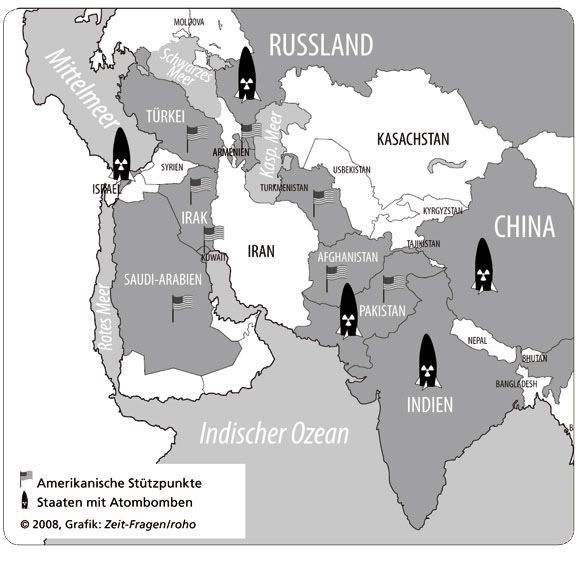
Staaten mit AtombombenIran is a regional middle power and, in view of Israel's nuclear first-strike capacity, faces a very serious security dilemma. This problem has nothing to do with the present regime in Tehran. Any other Iranian government would also have to deal with this problem. For Iran, in principle there are only two possibilities: to develop its own nuclear retaliatory capacity; or to make the region a nuclear weapons-free zone. Of course, the latter would also have to encompass Israel's nuclear weapons. The Iranian government appears to have chosen the first option and be taking the same path that Israel has pursued, with impunity from the Nuclear Non-Proliferation Treaty, for almost forty years. Paradoxically, however, Iran today does not avow its security dilemma but proclaims purely civilian reasons for its nuclear program.

Why is that paradoxical?

I believe that the Islamic Republic intends to ultimately acquire the skills to manufacture atomic bombs without, however, violating the NPT in the process. Camouflaging military intentions with peaceful use of atomic energy is in principle possible. The problem is, though, that it's impossible to convince anyone of the necessity for atomic energy in Iran. Iran has considerable fossil fuel resources and also has the possibility of meeting its growing energy need by implementing renewable energy technologies. It would therefore be difficult to dispel the suspicion that Iran is pursuing other goals with its nuclear program. The general public would be probably more sympathetic to Iran, and the debate could possibly rise to a completely different level, if Tehran were to make its case based on its security dilemma.

Would a military action against Tehran be similar to the previous attacks on Afghanistan and Iraq?

A detailed plan for air strikes against Iran exists in Washington. It's a matter of preventing Iran from striking back. In the Pentagon circles, it is understood that already 2,000 targets to be destroyed in Iran have been selected.

Military targets?

Not just military targets. The attacks are to destroy Iran not only as a regional military power but also as a functioning state. That encompasses the destruction of airports, roads, power plants, and sewage plants. So-called "collateral damage," the murder of civilians, is thus factored into such a plan, approved and accepted.

That sounds very similar to the US strategy in Iraq. Will the Iranian military break down just as rapidly as the Iraqi military did?

I believe that the Iranian military would most probably be able to cause great difficulties for aggressors and subvert the Pentagon's plans. Then again, it is also very much possible that, after the first air strikes, the Iranian army would be obliged to devote itself to taking care of civilians. One imagines that the power plants, water reservoirs, and sewage plants of Tehran would be destroyed at the beginning of the air strikes. The army would then be hamstrung from crucial defense. That's precisely the reason why the possible attacks are aimed at civilian infrastructure.

After the invasion of the US armed forces into Baghdad, many Iraqis hailed America as their "liberator" from the regime of Saddam Hussein. Would there be such scenes in Tehran?

That is inconceivable. An overwhelming majority of Iranians will support their government in the event of a military attack. Even critics of the government will do so if their country is attacked.

What makes you think so?

Let me give you an example: when Saddam Hussein attacked Iran in 1980, the world thought that the Iranian army was demoralized because of the Islamic Revolution that had taken place two years before. Large sections of the army still consisted of hardened monarchists from the Shah's time and were actually opponents of the Islamic Republic. But the army stood united and succeeded in repelling the Iraqi attack, which was supported by the United States with substantial money and weapons. It would be probably no different with a coming Israeli-American attack.

What role does the Federal Republic of Germany play in the Iran conflict?

Here, Germany unfortunately plays the role of a seemingly disinterested spectator. In reality, the German government supports, goes along with, and sometimes even schemes for the policy of the Bush administration, which is implementing ever sharper sanctions against Iran. It is very naive of Berlin. Actually, thinking people like German Foreign Minister Frank-Walter Steinmeier long ago realized that, for the United States, the Iranian nuclear program was a pretext for war just like the alleged weapons of mass destruction in Iraq.

What impacts would a war against Iran have on the region?

The region would fall into a long period of destabilization. The central state would cease to exist in Iran, and the country would be "Afghanized" and "Iraqified."

From which do you think the United States would profit more: a stable or unstable region?

Let's stick to the example of Iraq: its destabilization has benefited the US military-industrial complex and the oil and construction industries, which began to receive lucrative contracts as soon as the US invasion started. Many US neo-conservatives, such as Dick Cheney and US Secretary of State Condoleezza Rice, are closely involved in these sectors. Washington's criminal, irresponsible policy, however, is diametrically opposed to the long-term interests of the US population as well as the entire West. The costs of war directly weigh on not only a majority of the American people but, through dollar devaluation, also China, Japan, and the European Union that have dollar surpluses.

It should be obvious that this asymmetric arrangement in favor of US conglomerates, which are closely tied to Washington, cannot last long. But they think that, by destabilizing and decomposing the multi-ethnic state of Iran, they can secure the interests of the US military-industrial complex by the tried and true means of recycling petrodollars into weapons exports to Iran for years and decades to come.

What role does Israel play in this conflict?

Israel is strategically seen as the most reliable bridgehead of the United States in this region. This is based on mutual dependence. For Israel, the United States is a vital ally, without whose constant military and financial assistance the country cannot survive. For the United States, Israel is more than a strategic bridgehead in the Middle East necessary for its hegemonic pretension that I have already mentioned. With a change of government, other US allies in the region can become enemies of the United States (as Iran for example did after the fall of the Shah's regime), but in Israel all conceivable governments will always be allied with the United States.

About 3,290 soldiers of the German Federal Armed Forces are currently stationed in Afghanistan. Would an Iran war affect their safety?

Absolutely! I bet that the entire region would plunge into chaos. All countries allied with the United States, which have likewise stationed their troops in Afghanistan or Iraq, would then be confronted with a completely new situation, and there would be more losses of human lives -- including German lives!

In the West's media war against Iran, the human rights condition in Iran is constantly brought up for discussion, among other things with the newly coined term of "Islamofascism," the term eagerly embraced by the German media as well. What are we to think of that?

That, in my judgment, is a shocking development as well as a symptom of the moral decline in the media. This term, which was evidently fabricated by US-Israeli think tanks, has -- as you correctly observe -- enjoyed wide currency in the German media. Even Die Zeit, Der Spiegel, and the Frankfurter Allgemeine Zeitung have unfortunately promulgated this absurd catchword. This term is used to suggest that Islamic states are potentially fascist states.

What objectives is such a suggestion meant to achieve?

It serves to appeal to anti-fascist "reflexes" in the Western democracies. Because against fascism all means are permitted, including military ones. The spearhead of this alleged new fascism is supposed to be Tehran. Many of those who propagate the term "Islamofascism" and try to make it acceptable advocate more or less openly for a "Final Solution of the Iran Question." The term "Final Solution," of course, is not mentioned explicitly, but it is still unmistakably there. It is ironic that such insinuations are also made by none other than Israel, though they do nothing less than minimize Nazism by comparing it with Iran. Thus the victims of the Holocaust are insulted in order to justify new crimes against Islamic countries. Especially in Iran, Jews have never come to harm because of their faith. For centuries Jews lived in peace in the Islamic societies of the East, but one cannot say the same for Europe.

In the future must we expect to see wars started with an ostensibly "anti-fascist" rhetoric?

I would like to remind all that such a rhetoric was already used before the NATO attack on Yugoslavia in 1999. Above all, former German Foreign Minister Joschka Fischer and former Defense Minister Rudolf Scharping employed such parallels. That, too, is an indication of the rapid moral decline in politics and the media. Thus it is quite possible that's the model for the future.

However, we should not be too pessimistic either -- it is never too late to change anything! How may we go about it?

By exerting ourselves, as much as possible, for truth and integrity in politics.

How credible is the human rights position of the United States, given Washington's close ties with feudal, anti-democratic Islamic monarchies, for instance, Saudi Arabia?

I think this contradiction speak for itself. Surely one can criticize the development of democracy in Iran. Also regarding the human rights situation in Iran, one mustn't be silent. Compared with Saudi Arabia, though, Iran is a really democratic country. Also one should not ignore the development of the last two decades, in which reformists made great achievements. I see little reason for the dark picture of Iran painted in the West today.

How would you define the German interests in this region?

It's, above all, an energy question here. The interests of Germany and Europe lie in the security of energy supply, which will probably consist mainly of fossil fuels for the next forty to fifty years. Why shouldn't there be a similar relation to what exists today between Europe and Russia -- on the basis of free trade and cooperation? For there to be such a relation, however, the European states -- above all Germany -- would have to develop self-confidence to extricate themselves from the hegemonic interests of the United States and to pursue their own independent policy, oriented toward fair trade and cooperation with the states in the Middle East.

Germany enjoyed a great reputation in the Islamic world in previous years. But, of course, the Federal Republic has lost much of its reputation, especially through its participation in the occupation of Afghanistan. Do you see any chance at all to repair this relationship?

Let me take a concrete example: when former Federal Chancellor Gerhard Schröder clearly refused German participation in the war against Iraq, and former French President Jacques Chirac did the same, overnight both became the most credible Europeans in the entire Islamic world! A few weeks later, Chirac visited Algeria -- a country that still has problems with its former French colonial masters, actually -- and he was received and celebrated by almost a million jubilant people because of his stand against the Iraq War. See, it's never too late.

Do you see a possibility of a peaceful resolution to the Iran conflict?

Yes. There is a quite realistic solution, though difficult to put into practice: a process to establish common security and cooperation in the Middle East, a kind of CSCE (Conference on Security and Co-operation in Europe) for the Middle East. It is difficult, because all those who, like the United States and Israel, are now pursuing their objectives with their "divide and conquer" policy, by dividing and weakening their adversaries -- for example dividing Hamas and the PLO in Palestine and fomenting mutual resentment among Sunnis and Shi'is -- will lose ultimately and therefore try to prevent it.

It is realistic, because all states of the region, including the population of Israel, would, in the medium and long terms, benefit from dialogue and gradual convergence on the concept of "common security" and economic cooperation. In all likelihood, in 1943, it was unimaginable that France and Germany would be so reconciled in ten years that wars between the states of the European Union would be ruled out and that in thirty years the European Union would develop into a flourishing economy in the interest of the EU populations.

Professor Massarrat, thank you for your discussion.

The original Deutsche Militärzeitung interview in German was republished in Zeit-Fragen on 2 June 2008 (see, also, Vicente Romano's Spanish translation at TLAXCALA). English translation by Yoshie Furuhashi.

Sunday, November 18, 2007

Streikpostenlied

Victor Grossman says that the GDL's rail strike, "the biggest labor struggle in years in Germany," is far from over: "Unless the railroad company comes up with a new offer, they may close down municipal train service, long-distance passenger service, and freight transportation all at the same time, holding out as long as the railroad company stays stubborn" ("German Rail Strike Hits Hard," MRZine, 18 November 2007). Watch a video of the strike, set to Joint Venture's "Streikpostenlied" [Strike Picket Song]:

Saturday, November 17, 2007

Threat of War against Iran: "It's Two Minutes before Midnight"

The Arbeitsgruppe Friedensforschung [Peace Research Working Group] of the University of Kassel wrote an excellent letter to the German Minister of Foreign Affairs: "Kriegsdrohung gegen Iran: 'Es ist zwei Minuten vor zwölf,'" 24 October 2007.

Here are highlights of the letter:
1. The West should take the Iranian leadership at their word and deal with them based on their declared intention not to use uranium enrichment for the development of nuclear weapons.

2. The West, in turn, should eliminate the Iranian leadership's fears of security regarding a Western intervention for their overthrow.

Action Framework:

(1) All decisions must be based on valid agreements according to international laws. In accordance with Article IV of the Nuclear Non-Proliferation Treaty, Iran has the right to make full use of nuclear energy for peaceful purposes and enrich uranium.

(2) An agreement on enrichment must be reached between the IAEA and Iran which grants the Iranian side the possibilities of enriching uranium on one hand and carrying out their promise not to strive for atomic weapons on the other hand.

(3) The conclusion of the agreement between the IAEA and Iran should be followed by a reduction in the level of military operational readiness of the USA and the NATO in the Persian Gulf region. The range and modalities of such a reduction should be agreed upon parallel to the negotiations between the IAEA and Iran.

(4) A principled agreement on consolidation of an enduring relationship with the Islamic Republic of Iran. The regulation of conflict on the atomic question should be accompanied with and facilitated by a principled agreement on the consolidation of the relationship with the Islamic Republic of Iran. Such an agreement makes for the building of durable confidence. It is to ground the relation on mutually acceptable rational principles. The Federal Government is requested to initiate such an agreement.

Bahman Nirumand: The Danger of War against Iran Grows

Die Kriegsgefahr wächst:
Das Szenario erinnert an den Irak-Krieg

von Bahman Nirumand

Die ständigen Mitglieder des UN-Sicherheitsrats hatten sich im Atomstreit mit dem Iran Anfang Oktober geeinigt: Die Entscheidung über verschärfte Sanktionen wird vertagt, bis die Internationale Atomenergiebehörde (IAEO) einen neuen Bericht über das Atomprogramm Irans vorgelegt hat.  Aber so viel Geduld wollten die USA nicht aufbringen.  Im Alleingang verschärften sie die Wirtschaftssanktionen, stuften die Revolutionsgarden als terroristisch ein und übten zudem Druck aus auf ausländische Banken und Unternehmen, ihre Geschäfte mit dem Iran einzustellen.  US-Außenministerin Rice nannte Iran das gefährlichste Land der Welt.

Nun legte IAEO-Generalsekretär el-Baradei seinen neuen Bericht vor.  In ihm bescheinigte er dem Iran zwar Fortschritte bei der Zusammenarbeit, fügte aber auch hinzu, dass Teheran sich weiterhin weigere, der Forderung des UN-Sicherheitsrats nach Einstellung der Urananreicherung nachzukommen.  Nichts Neues also.  Iran pocht auf sein Recht, die Atomenergie friedlich zu nutzen.

El-Baradei und seine Behörde sollten jedoch noch etwas anderes herausfinden: Hat Iran die Absicht, Nuklearwaffen herzustellen.  Darüber konnte der Generalsekretär keine klare Auskunft geben.  Nur dies: Vorläufig gehe von Iran keine unmittelbare Gefahr aus, und es gebe Zeit genug, den Streit auf diplomatischem Weg zu lösen.

Aus amerikanischer Sicht hätte es dieses Berichts nicht bedurft.  Schon im Vorfeld wurde aus Washington verkündet, die Kooperationsbereitschaft Irans reiche nicht aus, Iran müsse die Urananreicherung einstellen, andernfalls würden die Sanktionen verschärft. Sollten diese auch zu keinem Ergebnis führen, stünden andere Optionen offen -- militärische eben.  Der Streit wird also weiter eskalieren.  Da höchstwahrscheinlich Russland und China weitere Sanktionen nicht mittragen wollen, werden die USA am Sicherheitsrat vorbei ihren Kurs fortsetzen.  Haben wir nicht ein ähnliches Szenario vor dem Irakkrieg erlebt?  Nur dieses Mal sollen Frankreich und Deutschland auch mit ins Boot geholt werden.

The Danger of War Grows:
The Scenario Reminiscent of the Iraq War

by Bahman Nirumand

The permanent members of the Security Council had agreed on the nuclear controversy over Iran at the beginning of October: the decision over escalation of sanctions is to be postponed until the International Atomic Energy Agency (IAEA) submits a new report on Iran's nuclear program.  But the USA did not want to exercise so much patience.  Unilaterally, it intensified the economic sanctions, classified the Revolutionary Guards as terrorist, and put more pressure on foreign banks and other enterprises to stop their business with Iran.  US Secretary of State Rice called Iran the most dangerous country in the world.

Now, IAEA Director General El-Baradei submitted his new report.  He certified Iran's progress in cooperation, adding that that Tehran still refuses to comply with the Security Council's demand to cease uranium enrichment.  Nothing new in this.  Iran hammers on its right to use nuclear energy peacefully.

El-Baradei and the IAEA should find out something else, however: whether Iran has the intention to build nuclear weapons.  The Director General could not give clear information on this question.  This much is certain: there is no immediate danger from Iran, and there is enough time to solve the controversy diplomatically.

From the American point of view, this report was irrelevant.  Even before the release of the IAEA report, Washington already announced: Iran's willingness to cooperate is not enough -- Iran must stop uranium enrichment, or else the sanctions will be intensified.  Should the sanctions fail to yield results, there would be other options, even military ones.  The controversy will thus continue to escalate.  Since Russia and China most likely do not want to impose further sanctions, the USA will continue its course outside the Security Council.  Didn't we experience a similar scenario before the Iraq war?  Only this time France and Germany will also be in the same boat.


Bahman Nirumand, born in 1936 in Tehran, is an Iranian-German writer.  The article in German appeared in Taz on 17 November 2007.  Translation by Yoshie Furuhashi.

Wednesday, October 17, 2007

Vision of a Europe for a Eurasian Century

In the new alignment of the US, the UK, and France, the weakest link is, of course, France.

Socialists are not sold on Bernard Kouchner's line,1 and Sarko the American is likely to prove as much of a divider2 as Bush.

The French Left, however, need a vision thing. What kind of vision? Like this. The 21st century shall be a Eurasian century, in which European nations for the first time become Europe, under Franco-German leadership, a Europe that recognizes Islam as a Eurasian religion, an integral part of the Western Civilization that ought to have existed but never did. And this Europe shall have a foreign policy of its own, independent of Washington's, and come to terms with nuclear Iran, push the Jewish state from the sea to the river to give voting rights to Palestinians in the OPTs, and re-invite Turkey, a friend of Iran and Israel, in good faith to become a member of the European Union.

1 Check out the Socialist Party line on Iran:
Mohammad EL BARADEI, Directeur général de l'AIEA, déploie des efforts considérables pour tenter de trouver une solution à la crise, en mettant en place une méthode de solution des principaux points en litiges et fait état des signaux encourageants en ce sens.

Il ne voit pas aujourd'hui de danger clair concernant le programme nucléaire iranien. C'est le moment qu'ont choisi Nicolas SARKOZY et son ministre des Affaires Etrangères pour préconiser des sanctions hors Nations Unies et des préparatifs de guerre. La position de Nicolas SARKOZY, s'engageant à nouveau dans un scénario à l'Irakienne ne peut s'expliquer que par son alignement sur l'administration Bush. Cet alignement affaiblit l'autorité de l'ONU, met en danger la crédibilité, les intérêts et la sécurité de la France et est en contradiction avec les engagements de notre pays au Moyen-Orient.

Le Parti socialiste estime que l'AIEA doit mener jusqu'au bout la procédure de vérification du programme nucléaire iranien et la mise en œuvre d'un système rigoureux de contrôles internationaux. La France ne peut s'engager avec autant de légèreté dans des confrontations militaires dans une région si instable et mouvementée.

Le Parti socialiste demande qu'un débat soit engagé rapidement au Parlement sur ce dossier.

Communiqué du Secrétariat international ("IRAN: Déclaration de Bernard Kouchner," 17 septembre 2007)
Nor is the rest of the European Union eager to follow Sarko and Kouchner's plan to further Americanize Europe: "A number of EU states -- such as Germany -- say the EU must not start applying a raft of sanctions wholly outside the UN framework, arguing that this would risk fragmenting the UN process" (James Blitz and Fidelius Schmid, "EU Seeks to Step Up Pressure on Tehran," Financial Times, 16 October 2007).

2 See Elaine Sciolino, "Is Nicolas Sarkozy's Honeymoon Over?" International Herald Tribune, 16 October 2007; and Associated Press, "French Transport to Stand Still in First Major Strikes against Sarkozy's Reforms," 17 October 2007.

Friday, August 31, 2007

Germany: East Feels Poor

Have you heard this post-socialist joke, told by an immigrant from the former Eastern bloc? "Everything they told us about socialism was a lie. Worse, everything they told us about capitalism is true." That's exactly what East Germans have found out since the fall of the Berlin Wall.

Iain Rogers of Reuters reports ("Growth Spurt No Mask for Eastern German Problems," 12 August 2007):
At 14.9 percent in July unemployment remains almost twice as high as in western Germany and particularly affects younger people. Emigration and a low birth rate are shrinking the population, social problems are rife and right-wing extremism has been on the rise.

The number of people living in the east has dropped by 12 percent since 1988 and the region still relies on massive transfers from the federal government -- some 1.5 trillion euros ($2.1 trillion) since unification and running at around 90 billion euros annually.

. . . The gross annual wage per worker in the so-called "new states" in the east was 21,340 euros (about $29,400) in 2006 -- well below the level in the "old states" in the west of 27,615 euros.

. . . . . . . . . . . . . . . . . . . .

A Forsa poll for television station n-tv published earlier this month showed 60 percent of Germans think easterners and westerners are yet to become one "Volk", or people.

And the share of easterners who think they are better off now than under communism has fallen to just 31 percent from 66 percent in 1995, n-tv said.
Persistent unemployment in East Germany has become a fertile ground for the growth of Neo-Nazis targeting people of color. See Victor Grossman, "Neo-Nazis in Germany, or Déjà Vu?," MRZine, 31 August 2007.

Thursday, August 23, 2007

Lenin Platz in Berlin

A friend of mine says that three blocks from his apartment in Moscow stands a statue of Lenin. The sculptor who made the statue "did his first Lenin at the age of about 8, when Lenin died. He said he remembered that everybody was really sad, so he went down to the river and made a little Lenin out of clay," according to an article about him. My friend also tells me that to the left of the statue of Lenin, just out of view, is an Iran Air office -- how appropriate.
Lenin Platz in Berlin
by Fadhil al-Azzawi

There in his square
he stood, arms stretched forward
as if begging the passers-by
to stop and hear him out.
He wore his ragged black coat
and had his grey cap
pulled over his eyes.
I saw him prophesy revolution
to workers and soldiers
and threaten the bourgeoisie with Hell.

He did not have a chair to sit on
so he remained standing
and waited forever.

When they arrested him
he was asleep and dreaming
on his high platform.
They cut through his hardened body
with an electric saw
and carried his marble head
with a rented forklift
to a storeroom of archaeological remains.

The workers covered his grassy square
with cement
afraid the thieves of the class struggle
would plunder its invaluable dust.

A lot of blood stuck to our shoes
as we walked the streets
following his coffin.

Dasvedanya!

Translated by the author
and Khaled Mattawa

Banipal, No. 6, Autumn 1999, p. 7

Friday, May 12, 2006

Ahmadinejad as "die Sonne"

I was looking for videos of Mahmoud Ahmadinejad. I wanted to hear what he sounds like. There are a couple of good ones which have him looking all amiable and saying what he ought to be saying: "Ahmadinejad on People"; and "President Ahmadinejad Press Conference."

Then, I also found this one, "A music video made for President Ahmadinejad of Iran": "President Ahmadinejad Music Video.". The person who posted this video claims: "The video is not made by myself, I have no idea who the author is." That's a lie . . . or evidence of profound political cluelessness. The video is clearly made by Neo-Nazis trying to appropriate Ahmadinejad and the oppression of Palestinians for their despicable cause. Why do I know that? The video ends with a sequence that represents white Holocaust deniers -- Verbeke, Irving, Graf, Zundel, Rudolf -- as martyrs (superimposed on images of gun-toting IDF soldiers) and cuts to a logo of the Star of David with a legend: "Israel: Built on a Lie."

The video is set to Rammstein's "Sonne," and it cuts between scenes of Israeli oppressions of Palestinians, photographs and video clips of Ahmadinejad, and photos and video clips from mass electoral rallies for Ahmadinejad in Iran. It's edited to synchronize images of Ahmadinejad with the song's chorus:
"Hier kommt die Sonne
Hier kommt die Sonne
Sie ist der hellste Stern von allen
Hier kommt die Sonne"
[Here comes the Sun
Here comes the Sun
It is the brightest star of all
Here comes the Sun].
This really drives me up the wall! Does Ahmadinejad know that he is being used in this way? Fidel, you ought to have that talk with Ahmadinejad ASAP and bring the man to senses!

UPDATE
"Letter to Ahmadinejad" (12 May 2006)

Saturday, January 15, 2005

The Politics of Mourning

What was lost when state socialism collapsed? It wasn't simply what socialist states did manage to provide. The most devastating loss is, paradoxically, the most intangible: the loss of what we never had. Only by mourning that loss can we mourn the loss of socialism properly, or so says Volker Braun in his poem "Das Eigentum [Property]":
Das Eigentum

Da bin ich noch: mein Land geht in den Westen.
KRIEG DEN HÜTTEN FRIEDE DEN PALÄSTEN.
Ich selber habe ihm den Tritt versetzt.
Es wirft sich weg und seine magre Zierde.
Dem Winter folgt der Sommer der Begierde.
Und ich kann bleiben wo der Pfeffer wächst.
Und unverständlich wird mein ganzer Text
Was ich niemals besaß wird mir entrissen.
Was ich nicht lebte, werd ich ewig missen.
Die Hoffnung lag im Weg wie eine Falle.
Mein Eigentum, jetzt habt ihrs auf der Kralle.
Wann sag ich wieder mein und meine alle.

Property

I'm still here, though my country's gone West.
PEACE TO THE PALACES AND DEVIL TAKE THE REST.
I gave it the elbow and heave-ho once myself.
Now it's giving away its negligible charms itself.
Winter is followed by a summer of guzzling.
But I remain, worrying at the root of all evil.
And my poem becomes increasingly puzzling,
To wit: what I never had is being filched.
I shall always mourn what never happened to me in person.
Hope lay across the path like a trap.
And that's my junk you've got your paws on.
Will it ever again be given me
To say mine and thereby mean the collective me.
The sense of loss expressed by Braun is not his alone -- it is a "mass perception" that has elicited "a memory crisis" because state socialism was never given a proper burial:
"What I never had, is being torn away from me. What I did not live, I will miss forever." With these line from his drama Property (Das Eigentum, 1990), playwright Volker Braun renders his melancholic reaction to the disintegration of the German Democratic Republic. The GDR once prided itself as the tenth strongest world economy, but following the postcommunist turn, or Wende, most of its industries have been brought to a halt, and hundreds of thousands have found themselves jobless. The euphoria at the opening of the Berlin Wall dimmed within a few months, and a pall seemed to set in over the two Germanys, one which prompted many to reconsider the disintegration of state socialism. Whereas most Germans considered the communist project a failure, many others proceeded to mourn its passing, nonetheless. Paradoxically, what Braun's protagonist lost with the collapse of communism was the possible past he never really had.

The mass perception of loss has elicited a memory crisis in contemporary culture. While retrospective literary texts and artworks proliferate, museum exhibitions salvage and curate the wreckage of the GDR as if there were literally no tomorrow. A new German word has surfaced to describe this trend: Ostalgie, derived from Nostalgie, or nostalgia. The first syllable drops the letter n to become ost, the word for east. What remains signifies something like nostalgia for the "eastern times" of state socialism. Yet the nostalgic longing for some home that, perhaps, never really existed distinguishes itself from two other modes of memory that charge postcommunist culture: mourning and melancholia. . . . (Charity Scribner, "Left Melancholy," Loss: The Politics of Mourning, University of California Press, 2003, p. 300)
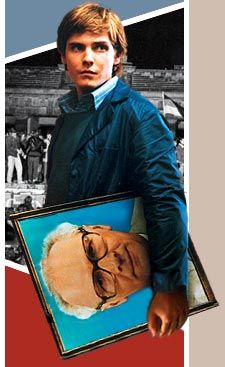
Is it any wonder that, in 2003, Wolfgang Becker's film Goodbye, Lenin! became one of the highest grossing German films in history?

 Daniel Brühl

Goodbye, Lenin!

Goodbye, Lenin! became an international hit as well. The act of mourning socialism perhaps "harbors a latent utopian desire, a refusal to accept the fait accompli of late capitalism as the only imaginable frame of our world" (Scribner, p. 316) -- the desire that is utopian, not because it has no place in the world, but because it knows no geographic border or generational boundary.

Monday, August 16, 2004

Rosenstraße

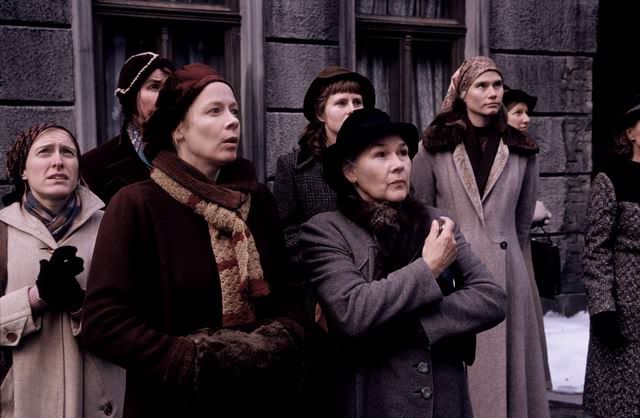
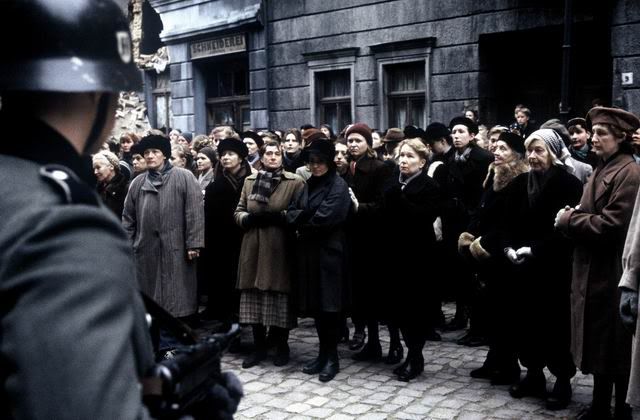
Margarethe von Trotta's new film Rosenstraße (2003) will be released on August 20 in the United States (Laura Winters, "The Women Who Stood up to Hitler," Financial Times, August 13, 2004). Watch the trailers at the film's official websites in German and English.

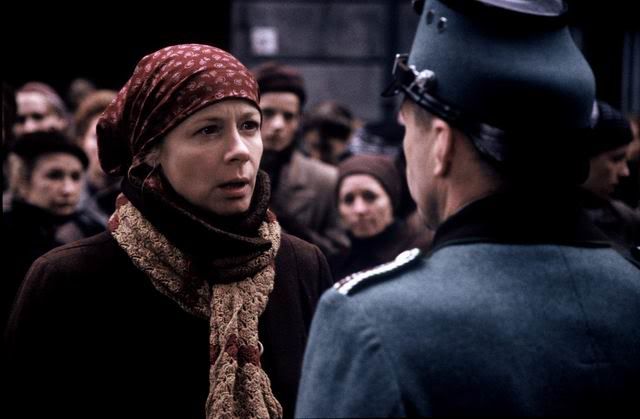
Rosenstrasse tells a little known story of the 1943 protest of thousands of non-Jewish German women who had resisted the Nazi pressures on them to divorce their Jewish husbands, demonstrated when their husbands were finally rounded up, and, most importantly, succeeded in securing their release.


Why is this remarkable event so little remembered in Germany and the rest of the world? "Hannah Arendt says, 'When everybody is guilty, nobody is guilty.' So I liked the idea of putting up another mirror for people to look into -- to show that these women did behave differently, and they did succeed," says von Trotta (qtd. in Winters, August 13, 2004). Peter Schneider elaborates the theme of "collective guilt" as a paradoxical means of denying one's own moral and political responsibility: "If you look at the big heroes of the German resistance, the military men like von Stauffenberg, you could say 'You can't ask the same thing from me because I'm just a little citizen.' But if you prove that ordinary citizens took risks to help Jews and were successful -- well, it shows that resistance was, in fact, possible, but that most people chose not to do it" (Winters, August 13, 2004). Reluctance of many to face their own choice not to resist is one of the important reasons why memories of resistance -- especially collective and successful resistance like the Rosenstrasse protest -- are rarely included in dominant representations of the holocaust and other instances of genocide.

Moreover, the power elite who control the media do not want us to know how to resist them. An intuition that the audience might take away from films like Rosenstrasse knowledge of how to fight the power, convinced that a good fight may very well result in a practical victory, rather than just a moral triumph, is what motivates them to obstruct their production -- it took von Trotta eight years to make this film -- or dismiss the significance of their subjects if they get produced and distributed at all. Soon after Rosenstrasse was released in Germany, Wolfgang Benz, director of the Center for Research on Anti-Semitism in Berlin, tried to discount the importance of women's protest at Rosenstrasse: "Ein Teil der deutschen Juden war in 'Mischehe' mit Nichtjuden verheiratet. Diese Gruppe war in der Rosenstraße, mitten in Berlin, interniert. Die Frauen sammelten sich auf der Straße vor dem Gebäude, harrten tagelang aus, kämpften um die Freilassung ihrer Angehörigen, wurden laut und ließen sich nicht vertreiben. Sie konnten nicht wissen, dass den Männern in der Rosenstraße nicht das Vernichtungslager zugedacht war, dass sie vielmehr zum Austausch mit anderen für bestimmte Funktionen festgehalten wurden" (Wolfgang Benz, "Kitsch, Klamotte, Klitterei: Die Legende von der 'Rosenstraße,'" Süddeutsche Zeitung, September 18, 2003). In short, he questioned whether it was the Rosenstrasse women's protest that secured their husbands' release:
Benz cited an article written by his former student Wolf Gruner that postulates that the Nazis never intended to deport the people being held in Rosenstrasse 2-4. On the phone from Berlin, Gruner explains his sources. "One of them is a regional decree from Frankfurt am Oder with orders from the Reich Main Security Office for the next deportation wave," he says. "This decree specifically excluded Jews in mixed marriages from the Final Roundup."

. . . So if these Jews were not to be deported, why were they detained? By comparing lists of the Jewish employees who worked in Jewish organisations in Berlin both before and after the Final Roundup, Gruner concludes that the people held in Rosenstrasse 2-4 went on later to fill the jobs of Jews who had been deported. (Winters, August 13, 2004)
Von Trotta and Nathan Stoltzfus -- a historian who authored the most important work on the Rosenstrasse protest Resistance of the Heart: Intermarriage and the Rosenstrasse Protest in Nazi Germany (W. W. Norton, 1996) -- disagree:
Von Trotta disagrees. "There were children held in that building," she says. "If the Nazis meant solely to be filling the jobs of bureaucrats, why did they hold young people there?"

Stoltzfus, who wrote a sharp riposte to Benz, concurs with von Trotta. "Deportation decrees were often used to deceive. For instance, they had been deporting Jews from Germany to Auschwitz since the middle of the summer in 1942, but no deportation directives said they were to go there until February of 1943." (Winters, August 13, 2004)
The controversy is but one instance of ceaseless struggles over popular memory of resistance.

Finally, if resistance is publicly commemorated at all, those who are honored are more often men than women. Von Trotta's very choice of the subject goes against the grain. From Stoltzfus's research, we learn that:
In the decades leading up to the Third Reich, Jewish assimilation in Germany had taken the form of intermarriage. In 1904, 9.3 percent of Jewish men who married, and 7.7 percent of Jewish women, married outside the Jewish faith. Between 1910 and 1913, these averages increased, respectively, to 13.5 percent and 10.92 percent, while the war years, 1914 to 1918, saw further sharp increases to 29.86 percent and 21 percent.[49] In 1933, against the grain of the new politics, this trend was still strong, as 44 percent of the German Jews who married chose non-Jews. In 1934, with the tide of Nazi propaganda and persecution rising, this number fell to 15 percent,[50] and in September 1935 the Nuremberg Laws prohibited further intermarriages altogether, and nullified all marriage engagements between mixed couples. As of June 1935 some 500,000 persons stood on the membership lists of Jewish communities in Germany; approximately 35,000 of these lived in intermarriages.[51] . . .

Thus after Hitler took power, fewer German men married Jews, while it was still possible, and more German men than women divorced their Jewish spouses under the Third Reich.[54] Because the large majority of intermarried Germans were women, and because these women were part of "Jewish households" -- married to men subject to every measure of the anti-Jewish persecution -- the story of opposition by intermarried Germans is largely (but not only) the story of German women married to Jewish men. (Resistance of the Heart: Intermarriage and the Rosenstrasse Protest in Nazi Germany, W. W. Norton, 1996)
Therefore, the memory of the Rosenstrasse protest is doubly subversive: it not only encourages us to believe that resistance is possible but may also lead many women to remember that we have even more stakes in fighting the rise of the right than men do.