Showing posts with label War. Show all posts
Showing posts with label War. Show all posts
Wednesday, December 02, 2009
A New John Brown?
"If a new John Brown arose today -- fundamentalist, patriarchal, and yet devoted to the cause of racial equality, or anti-imperialism, environmentalism, or some other good cause -- and moreover employed "direct action" (which would be naturally called "terrorism") to advance the cause, how many leftists would hail him as a hero? Would he not be scorned on account of his less than enlightened views about women, homosexuals, and so on?" -- Suleman Sheikh

Wednesday, October 28, 2009
What It Takes to Make Keynes Work
John Ross wrote in the Guardian ("No Secrets to China's Success," 18 August 2009):
The thing about Keynes is that you can make Keynes work but not under a normal capitalist state in a normal capitalist market economy. It takes something like (1) China's one-party state or (2) war economy (of not capital-intensive wars like today's Afghanistan and Iraq wars but labor-intensive wars of total mobilization subordinating capital and labor alike to the state, like WW2) or (3) the working class so awesomely powerful that it might as well go ahead and do socialism instead of Keynes.
That's what typical Keynesians and typical anti-Keynesians (either of the Marxist or of the capitalist liquidationist kind) don't understand.
Keynes noted in the final chapter of his General Theory, in a point highly relevant to a situation where mass unemployment is again soaring, that "a somewhat comprehensive socialisation of investment will prove the only means of securing an approximation to full employment".A good point.
That "somewhat comprehensive socialisation of investment" is impossible in a private sector-dominated economy. The decisive advantage China has in the present crisis is that it does not have to rely only on indirect means (reduction of interest rates, budget deficits etc) to attempt to reverse the plunging investment that is the driving force of this as with every major recession. China can use its large state-owned company sector to increase investment and instruct its state-owned banks to lend. That is why its economy is growing, while Alistair Darling is still pleading ineffectually for UK banks to increase their lending and while UK investment in housing and transport is plunging by 30% and more.
The thing about Keynes is that you can make Keynes work but not under a normal capitalist state in a normal capitalist market economy. It takes something like (1) China's one-party state or (2) war economy (of not capital-intensive wars like today's Afghanistan and Iraq wars but labor-intensive wars of total mobilization subordinating capital and labor alike to the state, like WW2) or (3) the working class so awesomely powerful that it might as well go ahead and do socialism instead of Keynes.
That's what typical Keynesians and typical anti-Keynesians (either of the Marxist or of the capitalist liquidationist kind) don't understand.
Sunday, August 17, 2008
Saturday, August 16, 2008
Uruguayan Writer Eduardo Galeano Apologizes for the War That Devastated Paraguay
Uruguayan Writer Eduardo Galeano Apologizes for the War That Devastated Paraguay
Asunción, 15 August (EFE) -- Uruguayan writer Eduardo Galeano today publicly apologized to Paraguayans for the war that his country, allied with Argentina and Brazil, fought against Paraguay between 1865 and 1870.
"Let me take this opportunity to apologize as an Uruguayan, because that [imperialist] punishment [for the crime of protecting the workers and products of the nation] was inflicted through three neighboring countries of Paraguay," Galeano said at a press conference in which Venezuelan President Hugo Chávez, Ecuadorian President Rafael Correa, and Paraguayan President Fernando Lugo participated.
The author of Open Veins of Latin America regretted his country's participation in a war "that was said to last three months" but lasted five years "and exterminated the entire adult male population of this country."
"That model was misnamed 'free trade,' which, as we know well, is a freedom that imprisons people, a big lie, because that's the name that the global North gives to everything that it preaches but doesn't practice," said the Uruguayan.
For his part, Boff expressed how pleased he was to have taken part in the civic festival in Paraguay today on the occasion of the inauguration of Lugo and said: "I think all who are at this table are for liberation, and for me, who comes from that theology, this is an extremely happy moment."
He reminded all that the purpose of this religious current "is to practice not so much theology as liberation, because what matters to God is not theology, it is the concrete liberation of individuals" and stressed that "the pressure of the poor has given a very powerful force to a government that realizes the dreams denied for so many generations."
Cardenal spoke in the same vein, describing Lugo as "true bishop of liberation."
Moreover, he said: "We are celebrating the rise to power of one more liberator of Latin America."
"A few days ago I was in Bolivia, and there I saw a miracle: an Indian president of Bolivia. Now I have seen another miracle here, too: a bishop president," said Cardenal.
In the end, Lugo said he was honored to have shared "a feast" with Galeano, Cardenal, and Boff and reaffirmed that he doesn't feel any fear about his friendly relation with the politics of Chávez, Morales, and Correa.
"People say: Don't be close to Chávez or Evo. I'm not afraid of Chávez, I'm not afraid of Evo, I'm not afraid of anyone. Latin America is living a different moment," said Lugo, who put an end to 61 years of the conservative Colorado Party hegemony in government.
The original EFE dispatch in Spanish was published in Yahoo! Noticias on 16 August 2008. Translation by Yoshie Furuhashi.
Asunción, 15 August (EFE) -- Uruguayan writer Eduardo Galeano today publicly apologized to Paraguayans for the war that his country, allied with Argentina and Brazil, fought against Paraguay between 1865 and 1870.
"Let me take this opportunity to apologize as an Uruguayan, because that [imperialist] punishment [for the crime of protecting the workers and products of the nation] was inflicted through three neighboring countries of Paraguay," Galeano said at a press conference in which Venezuelan President Hugo Chávez, Ecuadorian President Rafael Correa, and Paraguayan President Fernando Lugo participated.
Fernando Lugo, Presidente de Paraguay
con Leonardo Boff, Eduardo Galeano, y Ernesto Cardenal
The author of Open Veins of Latin America regretted his country's participation in a war "that was said to last three months" but lasted five years "and exterminated the entire adult male population of this country."
Guerra do Paraguai / Guerra del Paraguay
"That model was misnamed 'free trade,' which, as we know well, is a freedom that imprisons people, a big lie, because that's the name that the global North gives to everything that it preaches but doesn't practice," said the Uruguayan.
For his part, Boff expressed how pleased he was to have taken part in the civic festival in Paraguay today on the occasion of the inauguration of Lugo and said: "I think all who are at this table are for liberation, and for me, who comes from that theology, this is an extremely happy moment."
He reminded all that the purpose of this religious current "is to practice not so much theology as liberation, because what matters to God is not theology, it is the concrete liberation of individuals" and stressed that "the pressure of the poor has given a very powerful force to a government that realizes the dreams denied for so many generations."
Cardenal spoke in the same vein, describing Lugo as "true bishop of liberation."
Moreover, he said: "We are celebrating the rise to power of one more liberator of Latin America."
"A few days ago I was in Bolivia, and there I saw a miracle: an Indian president of Bolivia. Now I have seen another miracle here, too: a bishop president," said Cardenal.
In the end, Lugo said he was honored to have shared "a feast" with Galeano, Cardenal, and Boff and reaffirmed that he doesn't feel any fear about his friendly relation with the politics of Chávez, Morales, and Correa.
"People say: Don't be close to Chávez or Evo. I'm not afraid of Chávez, I'm not afraid of Evo, I'm not afraid of anyone. Latin America is living a different moment," said Lugo, who put an end to 61 years of the conservative Colorado Party hegemony in government.
The original EFE dispatch in Spanish was published in Yahoo! Noticias on 16 August 2008. Translation by Yoshie Furuhashi.
Friday, August 15, 2008
Mass Expulsion in Pakistan: In the Shadow of the Caucasus Crisis
Mass Expulsion in Pakistan:
In the Shadow of the Caucasus Crisis
by Knut Mellenthin
Russia's response to the Georgian aggression against South Ossetia has been the central theme of the media for a week, and it's scarcely noticed that the human tragedy in northwest Pakistan will probably be of no less great political significance. On Friday, the ninth day of a punitive military expedition against Bajaur Agency in the so-called tribal areas, over 100,000 people were seeking refuge. No one knows the exact number, which reflects the fact that there is no organized aid for refugees. An English-language Pakistani newspaper, The News, said on Friday that "several hundred thousands" were fleeing. News agencies reported that, according to the Governor of the North-West Frontier Province, into whose capital Peshawar tens of thousands fled, the number is about 219,000.
Many had to leave all their possessions behind, because the "security forces," in their campaign against suspected insurgents, repeatedly used heavy artillery, helicopters, and fighter planes against villages. In addition, there are systematic expulsions. Leaflets are dropped from helicopters, calling on people to immediately vacate certain areas. The leaflets contain detailed instructions about how to behave, any failure to comply with which carries the risk of lethal attacks by the "security forces": No vehicle movements after sunset. Cars may not be parked under trees, or in the shade. Upon seeing a helicopter, all refugees must come out of their vehicles with their hands up. Those who don't receive leaflets or cannot read -- a majority of the population in the area -- are in mortal danger. Air raids on refugee convoys are not uncommon. Many families are fleeing on foot. Those who were expelled or have simply fled are not supplied with food and medical care. Tens of thousands have to sleep outdoors.
Bajaur is one of many districts in which such punitive expeditions have taken place in recent months. The "security forces" had already similarly wreaked havoc in Swat and Hang before, outside the Federally Administered Tribal Areas, in the North-West Frontier Province. As the Pakistani media reported on Friday, now thousands are fleeing from Mohmand Agency, on the southern border of Bajaur. which it is suspected the "security forces" will strike next.
These military actions cannot be called appropriate or effective even for the purpose of the US/NATO counter-insurgency campaign. Their function is essentially to demonstrate to Washington, which is more and more aggressively putting pressure on Islamabad, that things are under control and there is no reason for a US intervention in Pakistan.
The original article in German appears in junge Welt on 16 August 2008. Translation by Yoshie Furuhashi.
In the Shadow of the Caucasus Crisis
by Knut Mellenthin
Russia's response to the Georgian aggression against South Ossetia has been the central theme of the media for a week, and it's scarcely noticed that the human tragedy in northwest Pakistan will probably be of no less great political significance. On Friday, the ninth day of a punitive military expedition against Bajaur Agency in the so-called tribal areas, over 100,000 people were seeking refuge. No one knows the exact number, which reflects the fact that there is no organized aid for refugees. An English-language Pakistani newspaper, The News, said on Friday that "several hundred thousands" were fleeing. News agencies reported that, according to the Governor of the North-West Frontier Province, into whose capital Peshawar tens of thousands fled, the number is about 219,000.
Many had to leave all their possessions behind, because the "security forces," in their campaign against suspected insurgents, repeatedly used heavy artillery, helicopters, and fighter planes against villages. In addition, there are systematic expulsions. Leaflets are dropped from helicopters, calling on people to immediately vacate certain areas. The leaflets contain detailed instructions about how to behave, any failure to comply with which carries the risk of lethal attacks by the "security forces": No vehicle movements after sunset. Cars may not be parked under trees, or in the shade. Upon seeing a helicopter, all refugees must come out of their vehicles with their hands up. Those who don't receive leaflets or cannot read -- a majority of the population in the area -- are in mortal danger. Air raids on refugee convoys are not uncommon. Many families are fleeing on foot. Those who were expelled or have simply fled are not supplied with food and medical care. Tens of thousands have to sleep outdoors.
Bajaur is one of many districts in which such punitive expeditions have taken place in recent months. The "security forces" had already similarly wreaked havoc in Swat and Hang before, outside the Federally Administered Tribal Areas, in the North-West Frontier Province. As the Pakistani media reported on Friday, now thousands are fleeing from Mohmand Agency, on the southern border of Bajaur. which it is suspected the "security forces" will strike next.
These military actions cannot be called appropriate or effective even for the purpose of the US/NATO counter-insurgency campaign. Their function is essentially to demonstrate to Washington, which is more and more aggressively putting pressure on Islamabad, that things are under control and there is no reason for a US intervention in Pakistan.
The original article in German appears in junge Welt on 16 August 2008. Translation by Yoshie Furuhashi.
Friday, July 25, 2008
Afghanistan Threatens to Become Obama's Vietnam
Afghanistan Threatens to Become Obama's Vietnam
by Christine Buchholz
On the occasion of US Democratic presidential candidate Barack Obama's visit to Berlin, Christine Buchholz, a member of the Left Party executive board, comments:
Many hopes are tied to Barack Obama, since George W. Bush is the most unpopular American President ever, and Obama promises to improve the social situation and bring the Iraq War to an end.
However, Obama is making a big mistake by identifying Afghanistan as the main battlefield of the "war on terror" and declaring that he will redeploy up to 10,000 more soldiers to the Hindu Kush. The Iraq War has shown that what the United States and the NATO care about is not freedom from terrorism but their interests in natural resources in a strategically key region. The war has increased, rather than decreased, the danger of terrorist attacks.
If Obama really seeks to change foreign policy, he must break with Bush's war-mongering. He should withdraw the troops not only from Iraq but also from Afghanistan and refrain from threatening war against Iran. The war in Afghanistan is as unwinnable as the war in Iraq. Afghanistan threatens to become Obama's Vietnam if he doesn't have the courage to defy the neoconservatives and the ruling class.
The Left rejects the transparent plan of the German Federal Government, with Obama's backing in autumn, to have the Bundestag extend the mandate and increase troops in Afghanistan. War cannot bring peace to Afghanistan. The German Armed Forces must leave Afghanistan.
The original statement in German was made available on the Web site of Die Linke on 24 July 2008. Translation by Yoshie Furuhashi.
by Christine Buchholz
On the occasion of US Democratic presidential candidate Barack Obama's visit to Berlin, Christine Buchholz, a member of the Left Party executive board, comments:
Many hopes are tied to Barack Obama, since George W. Bush is the most unpopular American President ever, and Obama promises to improve the social situation and bring the Iraq War to an end.
However, Obama is making a big mistake by identifying Afghanistan as the main battlefield of the "war on terror" and declaring that he will redeploy up to 10,000 more soldiers to the Hindu Kush. The Iraq War has shown that what the United States and the NATO care about is not freedom from terrorism but their interests in natural resources in a strategically key region. The war has increased, rather than decreased, the danger of terrorist attacks.
If Obama really seeks to change foreign policy, he must break with Bush's war-mongering. He should withdraw the troops not only from Iraq but also from Afghanistan and refrain from threatening war against Iran. The war in Afghanistan is as unwinnable as the war in Iraq. Afghanistan threatens to become Obama's Vietnam if he doesn't have the courage to defy the neoconservatives and the ruling class.
The Left rejects the transparent plan of the German Federal Government, with Obama's backing in autumn, to have the Bundestag extend the mandate and increase troops in Afghanistan. War cannot bring peace to Afghanistan. The German Armed Forces must leave Afghanistan.
The original statement in German was made available on the Web site of Die Linke on 24 July 2008. Translation by Yoshie Furuhashi.
Thursday, July 03, 2008
OPEC Warns against Iran War
OPEC Warns against Iran War
by Rüdiger Göbel
Oil prices rise and rise. New record on Thursday: a barrel (159 liters) of oil costs more than US$145 for the first time. In the event of an attack on Iran, prices could really explode. Yesterday, the Secretary General of the Organization of the Petroleum Exporting Countries (OPEC), Abdallah Salem El-Badri, warned. "It would be difficult to replace 4.2 million barrels a day if something happened to Iran" and "the price of crude oil would certainly rise," the OPEC chief was cited in the Bulletin of the World Petroleum Congress in Madrid. In this Tehran has an effective means of exerting pressure. If the oil exporting nation were attacked by Israel and the United States, it could block the Strait of Hormuz. About 40 percent of the world's oil transported on the high seas is shipped through the strait. Asked if Iran would block the strait, El-Badri said that in war a country would use any strategy to win.
Iran's Oil Minister Gholam Hossein Nozari confirmed in Madrid that a military attack on his country will be met by a "forceful" reaction. He also warned of even higher crude oil prices in the event of war. Iranian Foreign Minister Manouchehr Mottaki said to the Associated Press on Wednesday that the US could not afford to open another front in the Middle East. And Israel already has enough political turmoil on its hands. He doesn't believe that the US or Israel would do such a crazy thing.
US journalist Seymour M. Hersh reports in an article titled "Preparing the Battlefield" in the current issue of The New Yorker that the George W. Bush administration has expanded its covert actions in Iran (see the 1 July 2008 issue of junge Welt). The CIA-directed operations include support for separatist and armed opposition organizations, including the Kurdish PJAK and the People's Mojahedin. According to the report, the US Congress last year approved US$400 million for these purposes.
The People's Mojahedin, who also agitate under the name of the "National Council of Resistance of Iran" (NCRI), eagerly beat the drums for Bush's intervention. At the same time, the Mojahedin are fighting to be de-listed from the EU terrorist list. The highlight of their latest activities was a big rally outside Paris last Sunday. According to press reports, more than 70,000 people -- including several hundred politicians from Europe, North America, Australia, and the Arab world -- attended the propaganda event. Among them was Volker Schneider, the pension expert of the Left Party faction in the Bundestag. Spiegel Online quoted Schneider: "I support the Iranian opposition." Schneider hopes that the European Parliament itself will be active in the NCRI. "The terrorists are not in Paris but are sitting in the government in Tehran." Harsh accusations, which even Washington has yet to make.
The original article in German was published in junge Welt on 4 July 2008. Translation by Yoshie Furuhashi.
by Rüdiger Göbel
Oil prices rise and rise. New record on Thursday: a barrel (159 liters) of oil costs more than US$145 for the first time. In the event of an attack on Iran, prices could really explode. Yesterday, the Secretary General of the Organization of the Petroleum Exporting Countries (OPEC), Abdallah Salem El-Badri, warned. "It would be difficult to replace 4.2 million barrels a day if something happened to Iran" and "the price of crude oil would certainly rise," the OPEC chief was cited in the Bulletin of the World Petroleum Congress in Madrid. In this Tehran has an effective means of exerting pressure. If the oil exporting nation were attacked by Israel and the United States, it could block the Strait of Hormuz. About 40 percent of the world's oil transported on the high seas is shipped through the strait. Asked if Iran would block the strait, El-Badri said that in war a country would use any strategy to win.
Iran's Oil Minister Gholam Hossein Nozari confirmed in Madrid that a military attack on his country will be met by a "forceful" reaction. He also warned of even higher crude oil prices in the event of war. Iranian Foreign Minister Manouchehr Mottaki said to the Associated Press on Wednesday that the US could not afford to open another front in the Middle East. And Israel already has enough political turmoil on its hands. He doesn't believe that the US or Israel would do such a crazy thing.
AP Interview: Iranian Foreign Minister
US journalist Seymour M. Hersh reports in an article titled "Preparing the Battlefield" in the current issue of The New Yorker that the George W. Bush administration has expanded its covert actions in Iran (see the 1 July 2008 issue of junge Welt). The CIA-directed operations include support for separatist and armed opposition organizations, including the Kurdish PJAK and the People's Mojahedin. According to the report, the US Congress last year approved US$400 million for these purposes.
The People's Mojahedin, who also agitate under the name of the "National Council of Resistance of Iran" (NCRI), eagerly beat the drums for Bush's intervention. At the same time, the Mojahedin are fighting to be de-listed from the EU terrorist list. The highlight of their latest activities was a big rally outside Paris last Sunday. According to press reports, more than 70,000 people -- including several hundred politicians from Europe, North America, Australia, and the Arab world -- attended the propaganda event. Among them was Volker Schneider, the pension expert of the Left Party faction in the Bundestag. Spiegel Online quoted Schneider: "I support the Iranian opposition." Schneider hopes that the European Parliament itself will be active in the NCRI. "The terrorists are not in Paris but are sitting in the government in Tehran." Harsh accusations, which even Washington has yet to make.
The original article in German was published in junge Welt on 4 July 2008. Translation by Yoshie Furuhashi.
Friday, June 27, 2008
Iraq: We All Work for the Casino in the Green Zone
Iraq: We All Work for the Casino in the Green Zone
An Interview with Martin Eisenstadt
As you know, there's a talk of developing the Green Zone. The Marriott Hotel chain is here, and I too am involved in hospitality. I'm representing interests that are building a hotel. . . . Five stars, a casino, gambling, and it's going to be here in the Green Zone.
The sponsors are a Dubai-based company which has a lot of experience with hotels and casinos in the Middle East. And there's also a Las Vegas partner.
There's a lot of disposable wealth now in this region, as you must know -- a lot of foreign investors, foreign contractors, the troops are paid in dollars.
I'd call it a cultural center. We're excited to build hotels, to build golf courses, to bring Madonna, and to bring Elton John.
Money does talk. Democracy is the first step, but it needs to be followed by capitalism and entertainment, because that's what brings people together, and it's worked many times before. I noticed that now in the Green Zone there's even a Wendy's. Wendy's is a very famous American hamburger restaurant. . . . Do what tastes right! Yeah, Wendy's, it's an exciting process. I see the Green Zone transforming before my eyes.
And it's to the benefit of the Iraqi people, because that disposable income trickles down, as we say in America trickles down, when the people with the big money are spending that at roulettes they are also leaving tips to waiters. We have 6,000 rooms, we need many young girls to clean them. We're going to have a golf course, which needs gardeners, people with the gardening background.
The massage. We're gonna be able to bring people from all around the world, so your masseuse might actually be from the former Soviet Union or from Thailand. A boxer might come from America, mixed martial artists might come from Brazil. That's what I'm trying to convey. And there's been some lobbying, because there's a vote this week in the parliament. Democracy is vibrant, it's alive, and the Iraqis feel . . . right, the feeling is here, the feeling of democracy.
There's an issue of legalized gambling. I know in Kurdistan there is a casino that is very successful, and that's what we are trying to bring to Iraq. And I'm telling you, Iraq is already transforming, but soon it's gonna be like Berlin, it's gonna be like Okinawa, it's gonna be like Seoul, it's gonna be like Las Vegas, but within the Iraqi context, sensitive to the sensibilities of local people, of course. There'll be a mosque, a room for prayers, five times a day, there will be a call for prayers. We're gonna have a special section for Shesh Besh. Backgammon. Not just roulettes, blackjack, and poker, but a special section for Shesh Besh. So, we are going to incorporate local norms. And we are going to have off-track betting for the camel races in Dubai and countries nearby.
But yes, the pizzazz, the Vegas pizzazz, the American, can-do, let's-have-fun, we're-all-one attitude, yes, unapologetically, we're going to bring that here, but mixed with local sensibilities.
When you have a jack and a six, and you hit, everybody is in it together. That rush transcends your language, your culture, your religion. That I think is what's gonna really bring people together.
Whether you are Shia, Sunni, or Kurd, you're gonna be seen wearing the same casino uniform, with the same nameplates. which says we're all one, we all work for the casino, there are no differences between us. Our employment is going to be one third, one third, one third, so that all the peoples of Iraq are represented.
I haven't spoken as much about this in America, but I think here it's ok, it's gonna happen soon. I'm probably soon gonna be an advisor for the McCain campaign, because my candidate, Rudi Giuliani, dropped out. And I can assure you that John McCain supports this effort. John McCain will likely be the next American president. And I think the people here in Baghdad should understand that a future American president supports this endeavor.
John McCain as the head of the Indian Affairs Committee in the Senate knows hands-on, full well, the importance of development, how a casino, haw a sauna, how a golf course can transform a people, can transform a region and bring peace to groups that otherwise fight. We also had a racial conflict, between Indians, the white people, the Caucasians from Europe, and the Black people from Africa. And somehow casinos have managed to fix that divide. Only twenty years ago the Indians were drunk, and homeless, and committing crimes. Today, they're prosperous and wealthy, driving a Mercedes, with their kids with Game Boys and PlayStations, satellite dishes on their homes. And so too the Black people with sports have managed to advance themselves in this kind of entertainment sector. It's brought harmony between all the peoples. And we intend to bring the same thing here to Baghdad.
Iraq has changed. I think it's because of casinos. You find that today there's a wide consensus, across the board the American people are committed to helping Iraq see this problem through to its end. We're not gonna cut and run, we're partners, we're in this together for at least a hundred years. And I'll see you at the blackjack table. And what happens in the Green Zone stays in the Green Zone.
This is a partial transcript (omitting the interviewer's questions) of a program that is said to have been broadcast on Al-Iraqia in February 2008, featuring Martin Eisenstadt speaking at the "Baghdad Business 2 Business EXPO." H/T to Juan Cole, Raed Jarrar, and Rick B. The video is (most likely) a satire.
An Interview with Martin Eisenstadt
As you know, there's a talk of developing the Green Zone. The Marriott Hotel chain is here, and I too am involved in hospitality. I'm representing interests that are building a hotel. . . . Five stars, a casino, gambling, and it's going to be here in the Green Zone.
The sponsors are a Dubai-based company which has a lot of experience with hotels and casinos in the Middle East. And there's also a Las Vegas partner.
There's a lot of disposable wealth now in this region, as you must know -- a lot of foreign investors, foreign contractors, the troops are paid in dollars.
I'd call it a cultural center. We're excited to build hotels, to build golf courses, to bring Madonna, and to bring Elton John.
Money does talk. Democracy is the first step, but it needs to be followed by capitalism and entertainment, because that's what brings people together, and it's worked many times before. I noticed that now in the Green Zone there's even a Wendy's. Wendy's is a very famous American hamburger restaurant. . . . Do what tastes right! Yeah, Wendy's, it's an exciting process. I see the Green Zone transforming before my eyes.
And it's to the benefit of the Iraqi people, because that disposable income trickles down, as we say in America trickles down, when the people with the big money are spending that at roulettes they are also leaving tips to waiters. We have 6,000 rooms, we need many young girls to clean them. We're going to have a golf course, which needs gardeners, people with the gardening background.
The massage. We're gonna be able to bring people from all around the world, so your masseuse might actually be from the former Soviet Union or from Thailand. A boxer might come from America, mixed martial artists might come from Brazil. That's what I'm trying to convey. And there's been some lobbying, because there's a vote this week in the parliament. Democracy is vibrant, it's alive, and the Iraqis feel . . . right, the feeling is here, the feeling of democracy.
There's an issue of legalized gambling. I know in Kurdistan there is a casino that is very successful, and that's what we are trying to bring to Iraq. And I'm telling you, Iraq is already transforming, but soon it's gonna be like Berlin, it's gonna be like Okinawa, it's gonna be like Seoul, it's gonna be like Las Vegas, but within the Iraqi context, sensitive to the sensibilities of local people, of course. There'll be a mosque, a room for prayers, five times a day, there will be a call for prayers. We're gonna have a special section for Shesh Besh. Backgammon. Not just roulettes, blackjack, and poker, but a special section for Shesh Besh. So, we are going to incorporate local norms. And we are going to have off-track betting for the camel races in Dubai and countries nearby.
But yes, the pizzazz, the Vegas pizzazz, the American, can-do, let's-have-fun, we're-all-one attitude, yes, unapologetically, we're going to bring that here, but mixed with local sensibilities.
When you have a jack and a six, and you hit, everybody is in it together. That rush transcends your language, your culture, your religion. That I think is what's gonna really bring people together.
Whether you are Shia, Sunni, or Kurd, you're gonna be seen wearing the same casino uniform, with the same nameplates. which says we're all one, we all work for the casino, there are no differences between us. Our employment is going to be one third, one third, one third, so that all the peoples of Iraq are represented.
I haven't spoken as much about this in America, but I think here it's ok, it's gonna happen soon. I'm probably soon gonna be an advisor for the McCain campaign, because my candidate, Rudi Giuliani, dropped out. And I can assure you that John McCain supports this effort. John McCain will likely be the next American president. And I think the people here in Baghdad should understand that a future American president supports this endeavor.
John McCain as the head of the Indian Affairs Committee in the Senate knows hands-on, full well, the importance of development, how a casino, haw a sauna, how a golf course can transform a people, can transform a region and bring peace to groups that otherwise fight. We also had a racial conflict, between Indians, the white people, the Caucasians from Europe, and the Black people from Africa. And somehow casinos have managed to fix that divide. Only twenty years ago the Indians were drunk, and homeless, and committing crimes. Today, they're prosperous and wealthy, driving a Mercedes, with their kids with Game Boys and PlayStations, satellite dishes on their homes. And so too the Black people with sports have managed to advance themselves in this kind of entertainment sector. It's brought harmony between all the peoples. And we intend to bring the same thing here to Baghdad.
Iraq has changed. I think it's because of casinos. You find that today there's a wide consensus, across the board the American people are committed to helping Iraq see this problem through to its end. We're not gonna cut and run, we're partners, we're in this together for at least a hundred years. And I'll see you at the blackjack table. And what happens in the Green Zone stays in the Green Zone.
This is a partial transcript (omitting the interviewer's questions) of a program that is said to have been broadcast on Al-Iraqia in February 2008, featuring Martin Eisenstadt speaking at the "Baghdad Business 2 Business EXPO." H/T to Juan Cole, Raed Jarrar, and Rick B. The video is (most likely) a satire.
Monday, June 23, 2008
The Fires Within: Sri Lanka at War
Watch Ron Haviv's "The Fires Within: Sri Lanka at War," a documentary that is as compassionate as it is objective.
Cf. Nermeen Shaikh, "Photographing Conflict to 'Give a Voice': Ron Haviv Discusses Recent Sri Lanka Project," Asia Society, 12 June 2008.
Cf. Nermeen Shaikh, "Photographing Conflict to 'Give a Voice': Ron Haviv Discusses Recent Sri Lanka Project," Asia Society, 12 June 2008.
Friday, June 06, 2008
Israel Threatens Iran, and Oil Prices Skyrocket
We have to come up with a way of making clear to the US power elite: no, we can't afford Israel any more. Otherwise, we'll all go bankrupt. Look:
If the Americans were smarter, they would be demanding that, instead of backing Israel no matter what, the USG withdraw troops from Iraq and Afghanistan (which the Iranians, the Syrians, the Turks, the Pakistanis, the Indians, the Russians, and other interested parties in the region can collaboratively manage on behalf of the world) and invest the money saved ($165 billion from now through June 2009) into oil field development to cover the estimated investment shortfall ($95 billion, according to Platts). Technology to raise oil production exists -- what's lacking is the political will to transfer it, as well as money, into the right hands (i.e., the hands of those who own most existing and potential oil reserves, the national oil companies of the global South).
Meanwhile, "the unemployment rate [in the United States] in May had its highest monthly increase in 22 years" (Bhattarai, 7 June 2008). Will the Fed stick to its promise not to cut rates again any time soon and to defend the dollar? Cut the rates to revive economy,1 and the Fed will stoke inflation and risk imperiling the dollar's status as the world's reserve currency2 (of which US Treasury Secretary Henry Paulson recently had to reassure the Gulf Arab ruling class3); raise the rates to attack inflation and restore confidence in the dollar, and the Fed will risk plunging economy into a depression.
1 More fundamentally, cutting the rates, i.e., treating the credit crisis as if it were a crisis of liquidity, doesn't touch the heart of the financial darkness: banks' inability to trust each other (cf. Joseph Halevi, "Los bancos centrales ya no tienen margen de maniobra. . . ," Sin Permiso, 30 December 2007). Hence the crisis continues: "Banking Group Won't Change Way Libor Measure Is Set" (Bloomberg News, 30 May 2008); Michael Mackenzie and Gillian Tett, "Libor Remarks Fail to Put Unease to Rest" (Financial Times, 2 June 2008); Tony Jackson, "Lack of Trust Lurks at the Heart of Banking Trouble" (Financial Times, 2 June 2008); Sean Farrell, "The Next Banking Crisis?" (Independent, 3 June 2008); "Why Interest Rates Are Higher than You Think" (Money Week, 5 June 2006).
2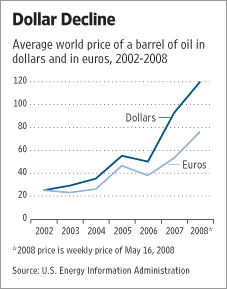 The European Central Bank has been more hawkish on inflation than the Federal Reserve. There is no coherent international policy on inflation and economic growth, even among the power elites of the US-led multinational empire, which makes it difficult for the Fed to perform its balancing act. Moreover, a great part of the recent oil price rises has been due to the dollar's weakness. Those oil producers, like the Gulf states, whose currencies are pegged to the dollar (but most of whose imports come from Europe), are thus forced to adopt a pro-cyclical policy against their interests. Bretton Woods II has ceased to make sense even on capitalist terms (to say nothing of the social costs to the South of accumulating dollar reserves and financing the US economy at the expense of domestic investment).
3 See how crucial petrodollar recycling has become to plug the US current account deficit:
- "Oil prices had their biggest gains ever on Friday, jumping nearly $11 to a new record above $138 a barrel, after a senior Israeli politician raised the specter of an attack on Iran and the dollar fell sharply against the euro" (Jad Mouawad, "Oil Prices Skyrocket, Taking Biggest Jump Ever," New York Times, 7 June 2008).
- "Oil prices surged almost 8 percent, to $138.54 a barrel after a senior Israeli politician raised the specter of an attack on Iran and the dollar fell against the euro. 'As soon as that news hit the tape, oil spiked about $6,' said David Kovacs, an investment strategist at Turner Investment Partners" (Abha Bhattarai, "Dow Slides Nearly 400 Points; Oil Surges," New York Times, 7 June 2008).
If the Americans were smarter, they would be demanding that, instead of backing Israel no matter what, the USG withdraw troops from Iraq and Afghanistan (which the Iranians, the Syrians, the Turks, the Pakistanis, the Indians, the Russians, and other interested parties in the region can collaboratively manage on behalf of the world) and invest the money saved ($165 billion from now through June 2009) into oil field development to cover the estimated investment shortfall ($95 billion, according to Platts). Technology to raise oil production exists -- what's lacking is the political will to transfer it, as well as money, into the right hands (i.e., the hands of those who own most existing and potential oil reserves, the national oil companies of the global South).
Meanwhile, "the unemployment rate [in the United States] in May had its highest monthly increase in 22 years" (Bhattarai, 7 June 2008). Will the Fed stick to its promise not to cut rates again any time soon and to defend the dollar? Cut the rates to revive economy,1 and the Fed will stoke inflation and risk imperiling the dollar's status as the world's reserve currency2 (of which US Treasury Secretary Henry Paulson recently had to reassure the Gulf Arab ruling class3); raise the rates to attack inflation and restore confidence in the dollar, and the Fed will risk plunging economy into a depression.
1 More fundamentally, cutting the rates, i.e., treating the credit crisis as if it were a crisis of liquidity, doesn't touch the heart of the financial darkness: banks' inability to trust each other (cf. Joseph Halevi, "Los bancos centrales ya no tienen margen de maniobra. . . ," Sin Permiso, 30 December 2007). Hence the crisis continues: "Banking Group Won't Change Way Libor Measure Is Set" (Bloomberg News, 30 May 2008); Michael Mackenzie and Gillian Tett, "Libor Remarks Fail to Put Unease to Rest" (Financial Times, 2 June 2008); Tony Jackson, "Lack of Trust Lurks at the Heart of Banking Trouble" (Financial Times, 2 June 2008); Sean Farrell, "The Next Banking Crisis?" (Independent, 3 June 2008); "Why Interest Rates Are Higher than You Think" (Money Week, 5 June 2006).
2
The European Central Bank has been more hawkish on inflation than the Federal Reserve. There is no coherent international policy on inflation and economic growth, even among the power elites of the US-led multinational empire, which makes it difficult for the Fed to perform its balancing act. Moreover, a great part of the recent oil price rises has been due to the dollar's weakness. Those oil producers, like the Gulf states, whose currencies are pegged to the dollar (but most of whose imports come from Europe), are thus forced to adopt a pro-cyclical policy against their interests. Bretton Woods II has ceased to make sense even on capitalist terms (to say nothing of the social costs to the South of accumulating dollar reserves and financing the US economy at the expense of domestic investment).3 See how crucial petrodollar recycling has become to plug the US current account deficit:
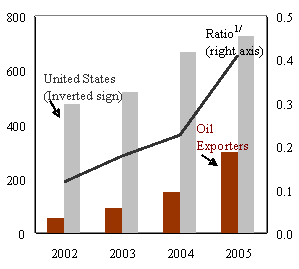
As a result of the recent rise in oil prices, oil exporters have become important counterparts to the United States in the ownership of foreign savings. Their current account surplus represented in 2005 some 40 percent of the U.S. current account deficit, nearly doubling in one year (Chart 2).Chart 2
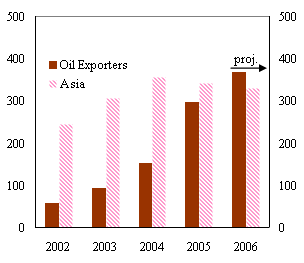
Oil exporters are close to becoming more important than Asia in the holding of net savings outside the United States (Chart 3). While Asia's current account surplus is projected to have risen to US$341 billion in 2005 (equivalent to 47 percent of the United States' current account deficit), that of oil exporters is projected to have reached US$296 billion (equivalent to 41 percent of the United States' current account deficit). Relative positions are expected to reverse in 2006. According to IMF projections, oil exporters' current account surplus would amount to 46 percent of the U.S. deficit in 2006, while the figure for Asia would drop to 41 percent.
Current Account Positions
(in billions of US$)
1Ratio of current account of oil exporters to current account of the United States (in percent, right axis).Chart 3
(Saleh M. Nsouli, Director, Offices in Europe, International Monetary Fund, "Petrodollar Recycling and Global Imbalances," Presentation at the CESifo's International Spring Conference, Berlin, 23-24 March 2006)
Foreign Savings
(Current account surplus, US$ billion)
Wednesday, May 28, 2008
Sadr Calls for Weekly Protests against US-Iraq Status of Forces Agreement
This just in: "Militant Shiite cleric Muqtada al-Sadr called Tuesday for followers to hold weekly protests against a U.S.-Iraqi security deal under negotiation that could lead to a long-term American troop presence" (Qassim Abdul-Zahra, "Militant Cleric Urges Protests on US-Iraq Deal," Associated Press, 27 May 2008). It should be clear to the Iranians which Iraqi Shi'i faction is their best friend.
Sunday, May 25, 2008
US-Iraq Status of Forces Agreement
The fate of the proposed US-Iraq status of forces agreement will be a test of the degree of influence of hard-liners on Iran's foreign policy and on Shia factions in Iraq:
This just in: "Militant Shiite cleric Muqtada al-Sadr called Tuesday for followers to hold weekly protests against a U.S.-Iraqi security deal under negotiation that could lead to a long-term American troop presence" (Qassim Abdul-Zahra, "Militant Cleric Urges Protests on US-Iraq Deal," Associated Press, 27 May 2008). It should be clear to the Iranians which Iraqi Shia faction is their best friend.
- Strong Opposition To Proposed US-Iraq Deal," Iran Daily, 24 May 2008 (citing Grand Ayatollah Seyyed Ali Sistani and Ali Akbar Velayati, an advisor to the leader of the Islamic Revolution on international affairs).
- Juan Cole, "Sistani Forbids Feeding Americans; Warns against Security Agreement; Hundreds of Sadrists Arrested," Informed Comment, 25 May 2008.
- Mark Kukis, "The Return of Iraq's Ayatollah," Time, 25 May 2008.
- Juan Cole, "Will Sistani Declare Jihad on US?" Informed Comment, 23 May 2008.
- "Iran Warns against US-Iraq Deal," Alalam News, 24 May 2008 (citing Velayati).
- "Iran Cleric Blasts US-Iraqi Military Agreement," AFP, 23 May 2008 (citing Ahmad Khatami, a member of the Assembly of Experts).
- Hussein Shariatmadari, "Iraq on the Edge," Kayhan International, 11 May 2008.
- Ali Akbar Dareini, Iran Hard-liners Come Out against Iraqi-US Deal," Associated Press, 12 May 2008 (citing Jomhuri-e-Eslami and Hezbollah).
This just in: "Militant Shiite cleric Muqtada al-Sadr called Tuesday for followers to hold weekly protests against a U.S.-Iraqi security deal under negotiation that could lead to a long-term American troop presence" (Qassim Abdul-Zahra, "Militant Cleric Urges Protests on US-Iraq Deal," Associated Press, 27 May 2008). It should be clear to the Iranians which Iraqi Shia faction is their best friend.
Friday, April 11, 2008
Chicken Littles and Other Problems
DisarmamentActivist.org criticizes anti-war Chicken Littles:
What we need to be fighting against is, instead, the sanctions, "democracy assistance," covert actions, media propaganda, etc. against Iran, but it's next to impossible to get even activists to do so, let alone the general public. Even the shooting wars in Iraq and Afghanistan don't get people off their asses. Anti-war sentiments in the USA are broadly held but very shallow.
Here's an example. Commenting on the antiwar "work stoppage" on May Day that San Francisco's ILWU Local 10 proposed, for which the rank and file of the rest of the ILWU voted, ILWU spokesman Craig Merilees said:
In my absence, one, two, three, many Chicken Littles have emerged in full force to warn of imminent "nuclear war with Iran!!!" See the nuclear fire descend from the skies, transforming humankind into a tribe of Radioactive Zombies!!! From some of these blogs, one would almost think they wish it…I agree that war against Iran is unlikely in the short term, and most of the war drums against Iran in the Western media are in the nature of psychological warfare against Iranian government officials and non-governmental opinion makers (the reformist camp, advocating appeasement of the West, is the weak link in the country), to which anti-war activists and other well-meaning people can unwittingly contribute.
Crackpot newspapers like the UK Independent are gleefully writing about the pospects of war which has been an ongoing theme for the last five years. But there is little more to these stories than there was two years ago. While seriously contingency plans do exist (see Hersh, New Yorker 2006) the 'drumbeat' seems to be mostly coming from our side these days. There is a point where the people who need convincing are going to turn down all this static, so that when the real balloon goes up, nobody will listen. ("War?? Chicken Little Says, Get a Grip," 11 April 2008)
What we need to be fighting against is, instead, the sanctions, "democracy assistance," covert actions, media propaganda, etc. against Iran, but it's next to impossible to get even activists to do so, let alone the general public. Even the shooting wars in Iraq and Afghanistan don't get people off their asses. Anti-war sentiments in the USA are broadly held but very shallow.
Here's an example. Commenting on the antiwar "work stoppage" on May Day that San Francisco's ILWU Local 10 proposed, for which the rank and file of the rest of the ILWU voted, ILWU spokesman Craig Merilees said:
It's been agreed that on the first of May, the union will exercise its right to hold a meeting on that day. On the day shift, local unions will have the opportunity, if they wish, to take some of that time to speak out against the war if they feel so inclined (emphasis added, qtd. in Matt Smith, "ILWU to Shut Down West Coast Ports on Socialist Holiday,", SF Weekly, 12 March 2008)If they wish. If they feel so inclined. And that's from the spokesman of one of the most progressive unions here. Feel the temperature of the anti-war opinion in the USA today.
Thursday, April 03, 2008
Patrick Cockburn on Sadrists and Iran
Patrick Cockburn says:
A lot of what the U.S. has done over the last five years is find a way in which Saddam is gone, but they don't have the alternative of a powerful religious Shia government backed by Iranian power. Moktada represents their worst nightmare. He is the guy who seems to be calling the shots in Iraq, is wearing a black turban, and looks and sounds a bit like the Ayatollah Khomeini. And whatever reason they overthrew Saddam for, it wasn't for that.That's the bottom line: the US power elite don't want to withdraw US troops from Iraq until they succeed in eliminating or neutralizing Sadrists or Iran or both. If they eventually end up having to order the troops to retreat into the predominantly Kurdish area of Iraq, they will still leave behind the already 90,000-strong Sunni militias, so-called "Awakening Councils," who think that their main enemy is the Shia due to Shi'i militias' acitons during the Sunni-Shi'i civil war that began under the US occupation.
Saturday, March 29, 2008
No War: The Movement That Has Dissolved Itself
| No war Il movimento che si è dissolto di Tariq Ali Cos'è successo al movimento contro la guerra, che esplose nel 2003 mobilitando milioni di persone in tutto il mondo occidentale, al punto da esser definito una volta dal New York Times come «la seconda superpotenza»? Il fatto è che esso non è mai stato un movimento vero e proprio ma solo lo spasmo di un giorno, un tentativo spontaneo e disperato dei cittadini di ogni sfumatura politica per fermare la guerra. Era concepito, se si vuole, come un colpo preventivo contro una guerra che la gente istintivamente sapeva esser basata su un mucchio di bugie. Il giorno in cui la guerra è iniziata davvero, le mobilitazioni contro di essa sono andate a morire. I cittadini, demoralizzati dal proprio fallimento, non hanno più trovato la forza di scendere in strada in gran numero. Pure, nel quinto anniversario di questa crudele e immorale occupazione, i dati che vengono dall'Iraq sono drammatici: oltre un milione di civili morti e più che altrettanti feriti, tre milioni di profughi rifugiati nei paesi vicini, una completa dissoluzione delle infrastrutture sociali del paese e una sua balcanizzazione di fatto. Di fronte a tutto questo la risposta dei cittadini del Nord America e dell'Europa è muta. Perché? Non c'è solidarietà con gli iracheni. Sono arabi, in gran parte islamici: e l'ondata di islamofobia che ha spazzato il mondo occidentale ha portato alla de-umanizzazione di coloro che venivano uccisi. La stessa cosa accadde quando il colonialismo europeo del diciottesimo e diciannovesimo secolo conquistò il Maghreb. Le atrocità commesse dagli italiani in Libia e la pubblica impiccagione del leader ribelle Sheikh Mukhtar non suscitarono nessuna emozione in Italia. I francesi fecero passare un sacco di tempo prima di protestare contro la guerra in Algeria. Gli esempi sono tanti. La «febbre civilizzatrice», oggi come allora, ha smobilitato l'opinione pubblica occidentale. C'è poi il fatto che i gruppi che resistono all'occupazione in Iraq tendono ad essere religiosi (anche se non solo): e i movimenti dei lavoratori o comunque progressisti nell'Europa occidentale, sempre più in crisi, sono indifferenti al loro destino -- così come sono indifferenti alle sofferenze dei palestinesi. Tutto ciò è anche un riflesso di quanto sta accadendo nello stesso Occidente. Perché anche se negli ultimi quattro anni si può a stento dire che ci sia stata una qualsiasi mobilitazione contro la guerra, pure una maggioranza dei cittadini del Nord America e dell'Europa è ancora a favore del ritiro di tutte le truppe straniere dall'Iraq: ma le loro voci non sono ascoltate dagli establishment politici. C'è una crescente crisi di rappresentanza politica nell'Occidente. La democrazia viene svuotata. Nella campagna elettorale statunitense entrambi i candidati democratici pubblicamente sono a favore di un ritiro dall'Iraq, ma in privato riassicurano i militari sul fatto che non intendono davvero ritirarsi e devono dirlo perché la gente è scontenta. Infine, il fatto che non ci sia la leva obbligatoria negli Stati uniti comporta che la maggior parte della popolazione non è toccata direttamente dalla guerra. Le famiglie di militari ostili alla guerra sono il solo serio gruppo di pressione. Invece della coscrizione, gli Stati uniti hanno reclutato mercenari da tutto il mondo: ci sono cinquemila ugandesi, migliaia di centroamericani, sudafricani e altri che vengono pagati a prezzi di mercato per combattere in Iraq. A chi importa se muoiono? E' un rischio che assumono per guadagnare soldi e la cittadinanza americana. E' un quadro sinistro, che dovrebbe motivare qualche riflessione tra i cittadini dell'Occidente. | No War: The Movement That Has Dissolved Itself by Tariq Ali What has happened to the movement against the war that exploded in 2003, mobilizing millions of people in the entire West, to the point that the New York Times called it "the second superpower"? The fact is that it never was, in the true and proper sense of the word, a movement -- only a day of paroxysm, a spontaneous and desperate attempt of citizens of all political persuasions to stop the war. It was conceived, if you will, as a preventive blow against a war that people instinctively knew was based on a heap of lies. The day when the war really began, antiwar mobilizations began to die. Citizens, demoralized by their own failure, could no longer find the strength to take to the streets in great numbers. Nevertheless, on the fifth anniversary of this cruel and immoral occupation, data from Iraq are dramatic: more than a million civilians dead, and at least as many injured; three million refugees taking shelter in neighboring countries; total destruction of social infrastructures of the country, and its de facto Balkanization. In the face of all that, the response of North American and European citizens is silence. Why? There is no solidarity with the Iraqis. They are Arabs, largely Muslims, and the wave of Islamophobia that has swept the West has brought with it the dehumanization of those who were murdered. The same thing happened when eighteenth-century and nineteenth-century European colonialism conquered the Maghreb. The atrocities committed by Italians in Libya and the public hanging of the rebel leader Sheikh Mukhtar did not provoke the least emotion in Italy. It took a long time before the French protested against the Algeria war. The examples are many. The "civilizing mission fever," now as then, has demobilized the Western public opinion. Then, there is the fact that the groups resisting the occupation of Iraq tend to be religious (although the religious are not the only ones): and the movements of workers and progressives in general in Western Europe, increasingly in crisis, are indifferent to their destiny -- just as they are indifferent to the suffering of Palestinians. All that is also a reflection of what is happening in the West itself. Although in the last several years there has been scarce any mobilization against the war to speak of, a majority of the North American and European citizens are still in favor of the withdrawal of all foreign troops from Iraq: however, their voices are not being heard by the political establishment. There is a growing crisis of political representation in the West. Democracy is becoming hollow. In the US electoral campaign, both the Democratic candidates publicly say they are in favor of a withdrawal from Iraq, but privately they reassure the military that they do not seriously intend to withdraw despite being forced to say so because people are discontent. In the end, the fact that there is no draft in the US means that most Americans are not directly affected by the war. Military families opposed to the war constitute the only important pressure group. As a substitute for the draft, the US has recruited mercenaries from all over the world: there are 50,000 Ugandans, thousands of Central Americans, South Africans, and others who are paid the market price to fight in Iraq. Who cares if they die? It's a risk that they assume, in exchange for wages and US citizenship. A grim picture, which should make Westerners think. |
Tariq Ali, a member of the New Left Review editorial committee, is the author of Pirates of the Caribbean: Axis of Hope (Verso 2006) among numerous other books and articles. His new book, The Duel: Pakistan in the Flight Path of American Power, will be published later this year. The essay in Italian was first published in Il Manifesto on 20 March 2008, available at Essere Comunisti. N.B. The English text on the right is a translation from the Italian text, not Tariq Ali's own words. Translation by Yoshie Furuhashi.
Friday, March 28, 2008
Basra
"The present onslaught aims to break popular resistance, especially from the Sadrist movement, to the passage of the oil law and to the occupation itself," says Naftana, a UK group working in solidarity with the Iraqi Federation of Oil Unions ("Basra Assault Threatens Trade Unionists," 28 March 2008).1
In doing so, the empire backs Hakim against Sadr.
Where does Tehran stand on the conflict between them, since it has cultivated both among other Iraqis? Vali Nasr speculates:
In my humble opinion, Tehran should back Sadr against Hakim, especially if Sadrists successfully resist the present US onslaught. Hakim won't be able to govern Iraq without US forces, but Sadr, potentially, can, and he is less likely than Hakim to establish a government that sells off Iraqi oil, hosts permanent US bases, and lets Iraq be used as a launching pad of attacks against Iran.
What of Western leftists? If Islamophobia weren't so prevalent among them,2 they would reach out to Sadr.
1 See, also, Hassan Hafidh and John D. McKinnon, "Violence Imperils Iraq's Oil Progress; Attacks in Basra Come amid Talks with Western Firms," Wall Street Journal, 28 March 2008: A1.
2 Explaining why the anti-war movement has dissolved, despite the staggering tolls that the occupation of Iraq has taken, Tariq Ali wrote on the occasion of the fifth anniversary of the invasion of Iraq:
In doing so, the empire backs Hakim against Sadr.
Where does Tehran stand on the conflict between them, since it has cultivated both among other Iraqis? Vali Nasr speculates:
Well, Iran has backed both of them and has supported a truce between them that was signed last year. The Iranians encouraged the two of them to put the fighting aside and not to fight one another at a time when the larger issue of the fate of Iraq was still out there. However, Iran has only limited influence and ultimately Muqtada al-Sadr will not sit by idly as Hakim and the United States begin to downgrade his forces and ultimately move to crush him, regardless of what Iran says.In short, we have no clue.
On the other hand, one might say that Iran also encourages Sadr to disrupt the stability of southern Iraq because its relations with the United States are growing more tense and Iran ultimately would like to see the United States leave Iraq. The lull in the fighting, a sort of truce, which Iran contributed to by holding Muqtada down, may no longer be in Iran’s interest right now. It’s difficult to see how the Iranians are calculating this. They may be supportive of Muqtada raising the heat, not completely but somewhat, to put pressure on the United States. On the other hand, it might very well be that the Iranians are not able to totally control what happens next door, that they are able to influence the decisions that Sadr and Hakim make but they cannot completely control them.
We have to wait and see as this thing unfolds whether the Iranians will act to restrain the two sides or not. When the British moved out of Basra, it was argued that the Iranians would not try to control Basra but they did. For a very long period of time, the governor was very close to Iran, and the various militias maintained a truce in Basra. In fact the Iranians touted the relative stability of Basra as an indication of their ability to influence the situation in Iraq. It is possible the Iranians would use this issue of this escalation of tensions in the south as a way of reminding the United States that they are very relevant in southern Iraq and their value to stability in Iraq should not be taken for granted. ("Nasr: Iraqi Prime Minister ‘Irrelevant’ in Shiite Power Struggle," Council on Foreign Relations, 26 March 2008)
In my humble opinion, Tehran should back Sadr against Hakim, especially if Sadrists successfully resist the present US onslaught. Hakim won't be able to govern Iraq without US forces, but Sadr, potentially, can, and he is less likely than Hakim to establish a government that sells off Iraqi oil, hosts permanent US bases, and lets Iraq be used as a launching pad of attacks against Iran.
What of Western leftists? If Islamophobia weren't so prevalent among them,2 they would reach out to Sadr.
1 See, also, Hassan Hafidh and John D. McKinnon, "Violence Imperils Iraq's Oil Progress; Attacks in Basra Come amid Talks with Western Firms," Wall Street Journal, 28 March 2008: A1.
2 Explaining why the anti-war movement has dissolved, despite the staggering tolls that the occupation of Iraq has taken, Tariq Ali wrote on the occasion of the fifth anniversary of the invasion of Iraq:
Di fronte a tutto questo la risposta dei cittadini del Nord America e dell'Europa è muta. Perché? Non c'è solidarietà con gli iracheni. Sono arabi, in gran parte islamici: e l'ondata di islamofobia che ha spazzato il mondo occidentale ha portato alla de-umanizzazione di coloro che venivano uccisi. La stessa cosa accadde quando il colonialismo europeo del diciottesimo e diciannovesimo secolo conquistò il Maghreb. Le atrocità commesse dagli italiani in Libia e la pubblica impiccagione del leader ribelle Sheikh Mukhtar non suscitarono nessuna emozione in Italia. I francesi fecero passare un sacco di tempo prima di protestare contro la guerra in Algeria. Gli esempi sono tanti. La «febbre civilizzatrice», oggi come allora, ha smobilitato l'opinione pubblica occidentale.Few leftists have trouble accepting liberal Muslims (who think and act like typical liberal Westerners in all relevant respects), but Muslims who think and act like Sadr are another story.
In the face of all that, the response of North American and European citizens is silence. Why? There is no solidarity with the Iraqis. They are Arabs, largely Muslims, and the wave of Islamophobia that has swept the West has brought with it the dehumanization of those who were murdered. The same thing happened when eighteenth-century and nineteenth-century European colonialism conquered the Maghreb. The atrocities committed by Italians in Libya and the public hanging of the rebel leader Sheikh Mukhtar did not provoke the least emotion in Italy. It took a long time before the French protested against the Algeria war. The examples are many. The "civilizing mission fever," now as then, has demobilized the Western public opinion. (Tariq Ali, "No War: Il movimento che si è dissolto," Il Manifesto, 20 March 2008, English translation by Yoshie Furuhashi)
Wednesday, March 26, 2008
How to Counter the Danger of War at This Sensitive Moment
How to Counter the Danger of War at This Sensitive Moment
by Mohssen Massarrat
Mohssen Massarrat, born in Tehran in 1942, is Professor of Political Economy and International Relations at Universität Osnabrück. The original article in Persian was published on the Web site of the Campaign Against Sanctions and Military Intervention in Iran (CASMII) on 22 November 2007. Translation by Yoshie Furuhashi.
by Mohssen Massarrat
Unfortunately, influential American and Israeli opponents of Iran have been successful: using negative propaganda of the sort that claims that Iran has an intention to cause a nuclear holocaust and that a Third World War and "Islamic fascism" must be prevented, and tying the disaster of Iraq to Iran's interference, they have turned Iran into a dangerous monster in the world public opinion. Thus the psychological battleground against Iran is being prepared, just as it was against Iraq before. Therefore, the war party is not confronted by any significant opposition in either the United States or European countries. Furthermore, with the election of Nicolas Sarkozy, France has joined the right-wing, war-mongering Western coalition of America, England, and Israel. Germany is now abstaining from any public opposition to the probable war against Iran, and its silence in effect legitimates the coalition of war mongers. The Russian and Chinese governments certainly will express opposition to any resolution that employs harsh measures at the United Nations Security Council, but in so far as the American government, away from the Security Council, takes steps toward war, just as it did in the case of Iraq, these two governments will not do anything except protest. Therefore, the only power, the only government, which can act in the interests of peace, the Iranian people, and the territorial integrity of our country, preventing an outbreak of disastrous war that destroys families, for the sake of not only Iran but also the entire Middle East and the whole world, is the government of the Islamic Republic of Iran itself.
Central Aims of the United States and Very Serious Danger of War
Given the undeniable evidence of danger of war, the intention of America and Israel is very serious. American neo-conservatives, like before, are out in full force, seeking to lay down the strategy of the Project for the New American Century and the Greater Middle East. The fundamental pillar of this strategy is the establishment of a Middle East wholly subordinated to the medium- to long-term interests of America. Having achieved regime change in Afghanistan and Iraq and unleashed chaos in these two countries, now, they have turned to Iran. The government of the Islamic Republic in the current condition has to be the most important obstacle to a Middle East wholly subordinated to America. For this reason, regime change in Iran has become the fundamental aim of US actions in the Middle East. The ideal Middle East for neo-conservatives is a Middle East all of whose major powers have been destroyed; a divided and fragmented Middle East in which local ethnic wars pitting, for instance, Arabs against Kurds, Arabs against Iranians, and Kurds against Iranians, and sectarian wars between Sunnis and Shi'is, involving Hizballah and Hamas or other forces in Lebanon and Palestine, proliferate; a Middle East in which the weak armies of the client states from the past century are reinforced -- so that America can set them all at one another's throats, sell them weapons, and turn the region completely into a laboratory of the military-industrial complexes of America and Europe, and, by aggravating competition, America can force them to exploit their oil as much as possible, till oil supply will correspond to demand at the global level, oil prices prevented from rising, and in the end the oil-producing region's dependence on the dollar maintained, with their joint measure to really sell oil for euros or other reliable international currencies decisively vetoed. The strategy of the Project for the New American Century is far from a mere adventurist and Christian fundamentalist wish under the influence of Vice President Dick Cheney and President George W. Bush. Unfortunately, their strategy is in keeping with the interests of the military-industrial complex, the goals of oil companies, and in truth short- to medium-term interests of the entire US economy.
The US economy is in debt to the world, and to maintain the continuing global capital inflows into this country, and maintain its residents' living standards, the dollar must be perpetuated as the only world currency, much like air indispensable for human life. In order to sustain the current position of the dollar, all oil trades must be conducted in dollars. Establishment of weak client states in the Middle East gives the United States a possibility that, by creating many military bases including in Iran, and with total military control over the oil-producing regions and the production and price of oil, it can hold onto its hegemonic position, vis-à-vis its current and future economic rivals, including the European Common Market, China, Russia, Japan, and India, for several decades to come. Therefore, many Europeans' assessment that, given the Bush government's difficulties in Iraq and Afghanistan, they need not care much about the danger of war against Iran is superficial, merely helping them justify their indifference to the probable war against Iran and their historic irresponsibility when what is at stake is world peace. Furthermore, Europe's inattention to the danger of war is itself dangerous in that the American government takes it to be support for its policy of violence against Iran.
Regrettably, some of the government officials of the Islamic Republic, instead of taking the danger of war seriously, also set much store by America's difficulties in Iraq and Afghanistan to give themselves peace of mind. They thus drive themselves and the Iranian people into a trap that America's economic and ideological leaders have set for them. Leaders of a country threatened at a dangerous moment act with profound insight and responsibility for their country's inhabitants and territory, starting from the worst case scenario and being prepared to respond to anything in kind, not by emphasizing the least dangerous scenario, failing to make use of all possibilities to prevent war, and thereby disarming themselves. Moreover, chaos in Iraq and Afghanistan isn't a reason not to start a new war in the region, especially against Iran -- rather, it should be understood that sowing chaos is one of the fundamental US aims in all countries of the Middle East, especially Iran.
The statements of an Iranian defense official to the effect that America is capable of bombing and destroying Iran but will be totally incapable of occupying the country are shocking. This mode of thinking of government officials, scoffing at US air attacks -- which, in the event they materialize, will destroy the human capitals, infrastructure, and culture of our country -- and promising victory at war against ground forces, is really unacceptable, and nothing except irreparable betrayal of the interests of Iran and its inhabitants can result from it. What people expect from the officials of the Islamic Republic is this: to prevent even a single bomb from getting dropped on our country. Moreover, some of the government officials' assertions, which seek to console the people of Iran by promising an all-out counter-attack to the likely US-Israeli air attacks on them, are ignorant, since the military capacity of the Islamic Republic lacks the quality and quantity that, by putting the fear of counter-attack in the enemy mind, can deter the US-Israeli attacks.
Lightening Military Strikes
From the point of view of military strategies, America and Israel are said to be heading in the direction of an all-out air attack lasting a few days, which makes use of the full capabilities of the two powers and aims at the entire military and economic infrastructure of Iran, hitting 2,000 targets. The objective is not only the annihilation of nuclear centers; the planned targets include munitions factories, bridges, power plants, oil refineries, water purification plants of major cities, and others. From the same military strategic point of view, it is anticipated that bombings will follow the model of Nazi Germany's attack on Poland in 1938, intense enough to limit or even eliminate any possibility of counter-attack. In the event of air strikes, lives of 12 million people of Tehran will be severely disrupted for several days, and emergency capacities of security services and economic, transport, and energy lifelines will be strained, which makes it impossible to expect the defense system to function and commence counter-attack. Given this likely scenario, boasting of Iran's military power to defend itself hinders the search for non-military solutions and raises the likelihood of an outbreak of war.
How to Prevent War
American and Israeli neo-conservative invaders, under the pretext of prevention of proliferation of nuclear weapons, have succeeded in exploiting Iran's uranium enrichment and thereby legitimating military attacks on Iran and their continuing control over the Middle and Near East. At the same time, no question about Israel's 300 nuclear warheads has been raised and no debate about them has been permitted. Israel's security alone gets mentioned, and the security needs of the other nations of the region, including Iran, are counted for nothing. The undeniable reality is that, under threat from US-Israeli military strategies for domination, our country will suffer more than theirs; the entire Middle East will be pushed into the direction of an arms race and lasting chaos, just as neo-conservatives would like; future generations will be made to waste all their energy resources and human creativities and condemned to perpetual backwardness. So, the people of Iran expect their country's leaders and elite to come up with, as soon as possible, measures that change the dominant atmosphere conducive to war against Iran in the public opinions of the Western countries, neutralize the weapon that legitimates the military aims of neo-conservatives of America and its accomplice Israel, and make impossible for them to execute the dirty, criminal, and anti-human program based on their military and economic self-interests. However, in the opinion of this writer, there are essentially two ways to really prevent war. One is to accept the United States' and the West's conditions, i.e., voluntary abandonment of uranium enrichment on the part of the Islamic Republic, as is proposed by the ad-hoc national peace committee of Iran; and the other is to propose a plan for an agreement on emergency measures to truly guarantee the common security of the Middle East and Near East region.
The path of voluntary abnegation of the right to uranium enrichment is a path based on powerful moral reasons, in that it upholds the right to life of the people of Iran above the inalienable right to uranium enrichment. The prerequisite for this path is an agreement of the leaders of the Islamic Republic and consent of the extreme wing of the country, which is not impossible to secure if they are, for instance, pressured from below by serious movements of people. Remember that this extreme wing, under the pressure of internal debates among leadership, reluctantly accepted the Russian proposal one year ago, the proposal that would have limited uranium enrichment in Iran to a laboratory scale and transferred industrial-scale enrichment to Russia. At the same time, we know that, after this agreement, Russian Foreign Minister Sergey Lavrov went to Washington, met stiff opposition from Bush and Cheney there, and immediately held a press conference announcing that Russia really had not proposed any such thing. If even unilateral and unconditional abandonment of uranium enrichment on the part of the Islamic Republic does not satisfy neo-cons and they demand that the leadership of the Islamic Republic, on pain of severe hardships, for instance open all doors to the main military centers of the country in order to build sufficient confidence and to prove that no other secrete nuclear program exists, then, what is to be done?
One, in my estimation, Bush and Cheney will do exactly that, because their aim does not lie in any nuclear problem, just as they did the same with Iraq before. Two, in that event, the extreme wing of the Islamic Republic, just as they did after Washington's rejection of the Russian proposal, will immediately put the strategy that promotes their own position of power on the agenda. This time, too, they will browbeat the supporters of the pacifist path, indict them for being naive, and silence them so that their own seemingly logical and yet dangerous path will continue to be followed. In that case, Iran will remain bereft of defense, and, what with the anti-Iranian atmosphere in the world public opinion, the beginning of war may come even sooner. Moreover, Bush and Cheney, in their own propaganda, long ago ceased to be content with stopping uranium enrichment and have begun to claim that Iran is the culprit responsible for the disaster in Iraq and the death of American soldiers. Exactly because of this change in their propaganda strategy, more than 50% of Americans now support war against Iran. Furthermore, even if we set aside uranium enrichment, the problem of power imbalance and security predicament of Iran, i.e., the power imbalance in the region, will remain the same, even if war against Iran doesn't come to pass, and addressing it can be postponed only for a few years.
Therefore, it is better, given the likely scenario mentioned above, for the Islamic Republic to choose a path that can significantly moderate the anti-Iranian atmosphere in the world public opinion, or, ideally, change it in Iran's interest, and thereby prevent an outbreak of war. In my view, a common regional security plan -- on the conditions that it gets deliberated upon seriously, purposefully, and steadfastly and that the leadership of the Islamic Republic, behaving morally, honestly, and searchingly, set aside hesitation and put it really in practice -- can put the United States and its accomplice Israel on the defensive and even isolate them in the world public opinion. I'd venture to say that a common security plan that promises economic and cultural collaboration can achieve its ideal goal if it is proposed long before concrete actions for military attacks are taken, that is to say, as soon as possible, so that all parties involved won't be able to easily pass it off as Iran's last-ditch tactical move and make it moot. The points that a common regional security plan should encompass are the following:
1. The Islamic Republic of Iran is to invite all countries that are ready to accept the idea of a common security plan, with no preconditions, to participate in a regional security conference for cooperation. At the same time, for the purpose of understanding at all levels and real participation, as many countries from the Middle East and Near East region as possible should put their security needs on the agenda.
2. The Islamic Republic of Iran is to announce a voluntary suspension of uranium enrichment by the beginning of the conference and continue the suspension in the event that a serious plan to address all security problems of the region, particularly nuclear weapons and military installations for them, materializes based upon common principles of security and cooperation.
3. The Islamic Republic of Iran is to announce the readiness to ratify bilateral treaties to guarantee mutual security with all countries of the region to truly build confidence and to emphasize the plan's seriousness.
Announcement of voluntary suspension of uranium enrichment on the part of the Islamic Republic is conditional upon the holding of a common security conference for cooperation in the region as soon as possible. Nevertheless, not only will the Islamic Republic of Iran remain true to all principles of its foreign policy -- attention of the world public opinion should be also drawn to a real undeniable problem, i.e., Israel's nuclear weapons. Then, the United States and Israel will be compelled to explain why, despite Iran's readiness to suspend enrichment, they are not ready to begin dialogue, in good faith, on common security of the region. In that event, serious measures and considered actions that are likely to get attention, including the offer to build trust such as mutual treaties to renounce military attacks on each other, the date and location of the conference, and diplomacy for that purpose, will be able to render ineffective all useless propaganda and baseless claims of psychological warfare. In addition to preventing an outbreak of war, a common security conference will put a new prospect for stopping American and European interferences on the agenda of all countries of the region.
Mohssen Massarrat, born in Tehran in 1942, is Professor of Political Economy and International Relations at Universität Osnabrück. The original article in Persian was published on the Web site of the Campaign Against Sanctions and Military Intervention in Iran (CASMII) on 22 November 2007. Translation by Yoshie Furuhashi.
Tuesday, March 11, 2008
Admiral Fallon, Who Said "[An Attack on Iran] Will Not Happen on My Watch," Resigns
CENTCOM Commander Admiral William Fallon -- who had privately said that "[an attack on Iran] will not happen on my watch" -- resigned today.
Sunday, February 17, 2008
The Walking Paradox
| La paradoja andante por Eduardo Galeano Cada día, leyendo los diarios, asisto a una clase de historia. Los diarios me enseñan por lo que dicen y por lo que callan. La historia es una paradoja andante. La contradicción le mueve las piernas. Quizá por eso sus silencios dicen más que sus palabras y con frecuencia sus palabras revelan, mintiendo, la verdad. De aquí a poco se publicará un libro mío que se llama Espejos. Es algo así como una historia universal, y perdón por el atrevimiento. “Yo puedo resistir todo, menos la tentación”, decía Oscar Wilde, y confieso que he sucumbido a la tentación de contar algunos episodios de la aventura humana en el mundo, desde el punto de vista de los que no han salido en la foto. Por decirlo de alguna manera, se trata de hechos no muy conocidos. Aquí resumo algunos, algunitos nomás. - - - Cuando fueron desalojados del Paraíso, Adán y Eva se mudaron al Africa, no a París. Algún tiempo después, cuando ya sus hijos se habían lanzado a los caminos del mundo, se inventó la escritura. En Irak, no en Texas. También el álgebra se inventó en Irak. La fundó Mohamed al Jwarizmi, hace mil doscientos años, y las palabras algoritmo y guarismo derivan de su nombre. Los nombres suelen no coincidir con lo que nombran. En el British Museum, pongamos por caso, las esculturas del Partenón se llaman “mármoles de Elgin”, pero son mármoles de Fidias. Elgin se llamaba el inglés que las vendió al museo. Las tres novedades que hicieron posible el Renacimiento europeo, la brújula, la pólvora y la imprenta, habían sido inventadas por los chinos, que también inventaron casi todo lo que Europa reinventó. Los hindúes habían sabido antes que nadie que la Tierra era redonda y los mayas habían creado el calendario más exacto de todos los tiempos. - - - En 1493, el Vaticano regaló América a España y obsequió el Africa negra a Portugal, “para que las naciones bárbaras sean reducidas a la fe católica”. Por entonces, América tenía quince veces más habitantes que España y el Africa negra cien veces más que Portugal. Tal como había mandado el Papa, las naciones bárbaras fueron reducidas. Y muy. - - - Tenochtitlán, el centro del imperio azteca, era de agua. Hernán Cortés demolió la ciudad, piedra por piedra, y con los escombros tapó los canales por donde navegaban doscientas mil canoas. Esta fue la primera guerra del agua en América. Ahora Tenochtitlán se llama México DF. Por donde corría el agua, corren los autos. - - - El monumento más alto de la Argentina se ha erigido en homenaje al general Roca, que en el siglo diecinueve exterminó a los indios de la Patagonia. La avenida más larga del Uruguay lleva el nombre del general Rivera, que en el siglo diecinueve exterminó a los últimos indios charrúas. - - - John Locke, el filósofo de la libertad, era accionista de la Royal Africa Company, que compraba y vendía esclavos. Mientras nacía el siglo dieciocho, el primero de los borbones, Felipe V, estrenó su trono firmando un contrato con su primo, el rey de Francia, para que la Compagnie de Guinée vendiera negros en América. Cada monarca llevaba un 25 por ciento de las ganancias. Nombres de algunos navíos negreros: Voltaire, Rousseau, Jesús, Esperanza, Igualdad, Amistad. Dos de los Padres Fundadores de los Estados Unidos se desvanecieron en la niebla de la historia oficial. Nadie recuerda a Robert Carter ni a Gouverner Morris. La amnesia recompensó sus actos. Carter fue el único prócer de la independencia que liberó a sus esclavos. Morris, redactor de la Constitución, se opuso a la cláusula que estableció que un esclavo equivalía a las tres quintas partes de una persona. “El nacimiento de una nación”, la primera superproducción de Hollywood, se estrenó en 1915, en la Casa Blanca. El presidente, Woodrow Wilson, la aplaudió de pie. El era el autor de los textos de la película, un himno racista de alabanza al Ku Klux Klan. - - - Algunas fechas: Desde el año 1234, y durante los siete siglos siguientes, la Iglesia Católica prohibió que las mujeres cantaran en los templos. Eran impuras sus voces, por aquel asunto de Eva y el pecado original. En el año 1783, el rey de España decretó que no eran deshonrosos los trabajos manuales, los llamados “oficios viles”, que hasta entonces implicaban la pérdida de la hidalguía. Hasta el año 1986, fue legal el castigo de los niños en las escuelas de Inglaterra, con correas, varas y cachiporras. - - - En nombre de la libertad, la igualdad y la fraternidad, la Revolución Francesa proclamó en 1793 la Declaración de los Derechos del Hombre y del Ciudadano. Entonces, la militante revolucionaria Olympia de Gouges propuso la Declaración de los Derechos de la Mujer y de la Ciudadana. La guillotina le cortó la cabeza. Medio siglo después, otro gobierno revolucionario, durante la Primera Comuna de París, proclamó el sufragio universal. Al mismo tiempo, negó el derecho de voto a las mujeres, por unanimidad menos uno: 899 votos en contra, uno a favor. - - - La emperatriz cristiana Teodora nunca dijo ser revolucionaria, ni cosa por el estilo. Pero hace mil quinientos años el imperio bizantino fue, gracias a ella, el primer lugar del mundo donde el aborto y el divorcio fueron derechos de las mujeres. - - - El general Ulises Grant, vencedor en la guerra del norte industrial contra el sur esclavista, fue luego presidente de los Estados Unidos. En 1875, respondiendo a las presiones británicas, contestó: -- Dentro de doscientos años, cuando hayamos obtenido del proteccionismo todo lo que nos puede ofrecer, también nosotros adoptaremos la libertad de comercio. Así pues, en el año 2075, la nación más proteccionista del mundo adoptará la libertad de comercio. - - - Lootie, “Botincito”, fue el primer perro pequinés que llegó a Europa. Viajó a Londres en 1860. Los ingleses lo bautizaron así porque era parte del botín arrancado a China, al cabo de las dos largas guerras del opio. Victoria, la reina narcotraficante, había impuesto el opio a cañonazos. China fue convertida en una nación de drogadictos, en nombre de la libertad, la libertad de comercio. En nombre de la libertad, la libertad de comercio, Paraguay fue aniquilado en 1870. Al cabo de una guerra de cinco años, este país, el único país de las Américas que no debía un centavo a nadie, inauguró su deuda externa. A sus ruinas humeantes llegó, desde Londres, el primer préstamo. Fue destinado a pagar una enorme indemnización a Brasil, Argentina y Uruguay. El país asesinado pagó a los países asesinos, por el trabajo que se habían tomado asesinándolo. - - - Haití también pagó una enorme indemnización. Desde que en 1804 conquistó su independencia, la nueva nación arrasada tuvo que pagar a Francia una fortuna, durante un siglo y medio, para expiar el pecado de su libertad. - - - Las grandes empresas tienen derechos humanos en los Estados Unidos. En 1886, la Suprema Corte de Justicia extendió los derechos humanos a las corporaciones privadas, y así sigue siendo. Pocos años después, en defensa de los derechos humanos de sus empresas, los Estados Unidos invadieron diez países, en diversos mares del mundo. Entonces Mark Twain, dirigente de la Liga Antiimperialista, propuso una nueva bandera, con calaveritas en lugar de estrellas, y otro escritor, Ambrose Bierce, comprobó: -- La guerra es el camino que Dios ha elegido para enseñarnos geografía. - - - Los campos de concentración nacieron en Africa. Los ingleses iniciaron el experimento, y los alemanes lo desarrollaron. Después Hermann Göring aplicó, en Alemania, el modelo que su papá había ensayado, en 1904, en Namibia. Los maestros de Joseph Mengele habían estudiado, en el campo de concentración de Namibia, la anatomía de las razas inferiores. Los cobayos eran todos negros. - - - En 1936, el Comité Olímpico Internacional no toleraba insolencias. En las Olimpíadas de 1936, organizadas por Hitler, la selección de fútbol de Perú derrotó 4 a 2 a la selección de Austria, el país natal del Führer. El Comité Olímpico anuló el partido. - - - A Hitler no le faltaron amigos. La Rockefeller Foundation financió investigaciones raciales y racistas de la medicina nazi. La Coca-Cola inventó la Fanta, en plena guerra, para el mercado alemán. La IBM hizo posible la identificación y clasificación de los judíos, y ésa fue la primera hazaña en gran escala del sistema de tarjetas perforadas. - - - En 1953, estalló la protesta obrera en la Alemania comunista. Los trabajadores se lanzaron a las calles y los tanques soviéticos se ocuparon de callarles la boca. Entonces Bertolt Brecht propuso: ¿No sería más fácil que el gobierno disuelva al pueblo y elija otro? - - - Operaciones de marketing. La opinión pública es el target. Las guerras se venden mintiendo, como se venden los autos. En 1964, los Estados Unidos invadieron Vietnam, porque Vietnam había atacado dos buques de los Estados Unidos en el golfo de Tonkin. Cuando ya la guerra había destripado a una multitud de vietnamitas, el ministro de Defensa, Robert McNamara, reconoció que el ataque de Tonkin no había existido. Cuarenta años después, la historia se repitió en Irak. - - - Miles de años antes de que la invasión norteamericana llevara la civilización a Irak, en esa tierra bárbara había nacido el primer poema de amor de la historia universal. En lengua sumeria, escrito en el barro, el poema narró el encuentro de una diosa y un pastor. Inanna, la diosa, amó esa noche como si fuera mortal. Dumuzi, el pastor, fue inmortal mientras duró esa noche. - - - Paradojas andantes, paradojas estimulantes: El Aleijadinho, el hombre más feo del Brasil, creó las más hermosas esculturas de la era colonial americana. El libro de viajes de Marco Polo, aventura de la libertad, fue escrito en la cárcel de Génova. Don Quijote de La Mancha, otra aventura de la libertad, nació en la cárcel de Sevilla. Fueron nietos de esclavos los negros que generaron el jazz, la más libre de las músicas. Uno de los mejores guitarristas de jazz, el gitano Django Reinhardt, tenía no más que dos dedos en su mano izquierda. No tenía manos Grimod de la Reynière, el gran maestro de la cocina francesa. Con garfios escribía, cocinaba y comía. | The Walking Paradox by Eduardo Galeano Every day, reading newspapers, I attend a history class. Newspapers teach me by what they say and by what they don't say. History is a walking paradox. Contradiction moves its legs. Perhaps for that reason its silences say more than its words and its words reveal the truth frequently through lying. Soon a book of mine will be published, titled Espejos [Mirrors]. It's just like a universal history -- pardon my audacity. "I can resist everything except the temptation," Oscar Wilde said, and I confess that I have succumbed to the temptation to recount some episodes of human adventure in the world, from the point of view of those who have not appeared in the picture. In other words, it's about little known facts. Here I sum up some of them, just a few. - - - When they were expelled from Paradise, Adam and Eve moved to Africa, not to Paris. Some time later, after their children had already embarked upon the ways of the world, writing was invented. In Iraq, not in Texas. Algebra, too, was invented in Iraq. It was founded by Muhammad Al-Khwarizmi, one thousand two hundred years ago, and the words algorithm and guarismo [numeral] derive from his name. Names usually do not correspond to what they name. In the British Museum, for example, the sculptures of the Parthenon are called "Elgin marbles," but they are marbles of Phidias. Elgin was the name of the Englishman who sold them to the museum. The three novelties that made the European Renaissance possible, the compass, gunpowder, and the printing press, had been invented by the Chinese, who also invented just about everything that Europe reinvented. The Hindus had known before everybody that the Earth was round and the Mayans had created the most exact calendar of all times. - - - In 1493, the Vatican gave America to Spain and granted Africa to Portugal, "so that barbarous nations be reduced to the Catholic faith." At that time, America had fifteen times more inhabitants than Spain, and Black Africa one hundred times more than Portugal. Just as the Pope had commanded, barbarous nations were reduced. Very much. - - - Water made Tenochtitlán, the center of the Aztec Empire. Hernán Cortés demolished the city, stone by stone, and with its rubble he filled the canals where two hundred thousand canoes sailed. This was the first water war in America. Now Tenochtitlán is called Mexico City. Where water once ran, now run cars. - - - The highest monument of Argentina has been erected in tribute to General Roca, who in the nineteenth century exterminated the Indians of Patagonia. The longest avenue of Uruguay takes the name of General Rivera, who in the nineteenth century exterminated the last Charrúa Indians. - - - John Locke, the philosopher of freedom, was a shareholder of the Royal African Company, which bought and sold slaves. When the eighteenth century was born, the first of the Bourbons, Felipe V, abdicated his throne signing a contract with his cousin, the King of France, that the French Guinea Company would sell Blacks in America. Each monarch took 25 percent of the profits. Names of some slave ships: Voltaire, Rousseau, Jesus, Hope, Equality, Friendship. Two of the Founding Fathers of the United States vanished in the fog of official history. Nobody remembers Robert Carter or Gouverneur Morris. Amnesia was the reward of their deeds. Carter was the only independence leader who emancipated his slaves. Morris, drafter of the Constitution, objected to the clause that established that a slave was equal to three fifths of a person. The Birth of a Nation, the first Hollywood blockbuster, was released in 1915, at the White House. President Woodrow Wilson gave it a standing ovation. The film quotes Wilson's words singing a racist hymn to the Ku Klux Klan. - - - Some dates: From 1234, and for the following seven centuries, the Catholic Church prohibited women from singing in temples. Their voices were impure, on account of Eve and the original sin. In 1783, the King of Spain decreed that manual labor was not dishonorable, "vile offices" which thitherto entailed the loss of nobility. Until 1986, in the schools of England, it was legal to punish children with belts, sticks, and clubs. - - - In the name of freedom, equality, and fraternity, the French Revolution proclaimed in 1793 the Declaration of the Rights of Man and of the Citizen. Then, the revolutionary militant Olympe de Gouges proposed the Declaration of the Rights of Woman and the Citizen. Her head was cut off by the guillotine. Half a century later, another revolutionary government, during the First Commune of Paris, proclaimed universal suffrage. At the same time, it denied women the right to vote, unanimously except one dissent: 899 nays, one yea. - - - The Christian Empress Theodora never claimed to be revolutionary, nothing of the sort. But one thousand five hundred years ago, the Byzantine Empire became, thanks to her, the first place in the world where abortion and divorce were the rights of women. - - - General Ulysses Grant, victorious in the war of the industrial North against the slave South, next became President of the United States. In 1875, in response to British pressures, he answered back: -- Within 200 years, when America has gotten out of protection all that it can offer, it too will adopt free trade. So, in 2075, the most protectionist nation in the world will adopt free trade. - - - Lootie, "Little Booty," was the first Pekinese dog to arrive in Europe. The dog traveled to London in 1860. The English named it "Lootie" because it was part of the booty snatched from China, at the end of the two long opium wars. Victoria, the narco-trafficking queen, imposed opium by cannons. China was turned into a nation of drug addicts, in the name of freedom, free trade. In the name of freedom, free trade, Paraguay was annihilated in 1870. After a war of five years, this country, the only country in the Americas that did not owe a cent to anybody, incurred its first foreign debt. At its smoking ruins arrived, from London, the first loan. It was destined to pay an enormous indemnification to Brazil, Argentina, and Uruguay. The murdered country paid the murdering countries for the work of murdering it. - - - Haiti also paid an enormous indemnification. Ever since 1804, when it won its independence, the new nation, devastated, had to pay a fortune to France, for a century and a half, to expiate the sin of its freedom. - - - Great corporations enjoy human rights in the United States. In 1886, the Supreme Court extended human rights to private corporations, and thus stands it to this day. A few years later, in defense of human rights of its corporations, the United States invaded ten countries, in diverse parts of the world. Then, Mark Twain, a leader of the Anti-Imperialist League, proposed a new flag, with skulls instead of stars, and another writer, Ambrose Bierce, confirmed: -- War is God's way of teaching us geography. - - - Concentration camps were born in Africa. The English initiated the experiment, and the Germans developed it. Later, Hermann Göring applied in Germany the model that his papa had tried in 1904 in Namibia. The teachers of Joseph Mengele had studied, in the concentration camp of Namibia, the anatomy of the inferior races. The guinea pigs were all Blacks. - - - In 1936, the International Olympic Committee did not tolerate insolences. In the 1936 Olympics, organized by Hitler, the soccer team of Peru defeated, 4 to 2, the team of Austria, the native country of the Führer. The Olympic Committee annulled the match. - - - Hitler did not lack friends. The Rockefeller Foundation financed Nazi medicine's racial and racist research. Coca-Cola invented Fanta, in the middle of the war, for the German market. IBM made the identification and classification of Jews possible -- the first large-scale exploit of the punch card system. - - - In 1953, workers' protest exploded in Communist Germany. Workers took to the streets and the Soviet tanks took care to shut down their mouths. Then, Bertolt Brecht proposed: Would it not be easier in that case for the government to dissolve the people and elect another? - - - Marketing operations. The public opinion is their target. Wars, like cars, are sold by lies. In 1964, the United States invaded Viet Nam, because Viet Nam had attacked two US ships in the Gulf of Tonkin. After the war had already disemboweled a multitude of Vietnamese, Secretary of Defense Robert McNamara acknowledged that there had been no Tonkin attack. Forty years later, history repeated itself in Iraq. - - - Thousands of years before the North American invasion brought civilization to Iraq, in that barbarous land was born the first poem of love in universal history. In the Sumerian language, inscribed in clay, the poem narrated the encounter of a goddess and a shepherd. Inanna, the goddess, loved that night as if she were mortal. Dumuzi, the shepherd, was immortal while the night lasted. - - - Walking paradoxes, stirring paradoxes: El Aleijadinho [The Cripple], the ugliest man in Brazil, created the most beautiful sculptures of the colonial American era. The book of travels of Marco Polo, adventure of freedom, was written in a prison of Genoa. Don Quixote de la Mancha, another adventure of freedom, was born in a prison of Seville. It was descendants of slaves, Blacks, who created jazz, the freest music there is. One of the best jazz guitarists, the gypsy Django Reinhardt, had only two fingers on his left hand. Grimod de la Reynière, the great master of French cuisine, did not have hands. With hooks he wrote, cooked, and ate. |
Eduardo Galeano, a Uruguayan writer, is the author of Open Veins of Latin America, Days and Nights of Love and War, and Memories of Fire among other publications. This essay was first published in Página/12 on 30 December 2007. Translation by Yoshie Furuhashi.
Subscribe to:
Posts (Atom)