Showing posts with label Palestinians. Show all posts

Thursday, January 22, 2009

Israel: A State of Irresponsibility

Look for "Gaza" and "collateral damage" in Google News now, and you'll get 640 results (as of 22 January 2009, 8:15 PM). Search for "Gaza" and "human shield," and you'll get 6,741 results. That does not bode well for Israel.

"Collateral damage" and "human shield" are, among other things, both terms employed by belligerents to excuse themselves of responsibility for civilian casualties they caused. But they are not the same excuse.

The idea of "collateral damage" says that we aimed to kill enemy combatants but have ended up accidentally killing hapless civilians, too, who happened to be in a wrong place at a wrong time. The deaths of civilians, for which no one can be held responsible, are to be regretted.

The idea of "human shield," on the other hand, says that it is enemy combatants who caused not only deaths of civilians on our side but those on their own side as well. In the case of Gaza, it goes like this:
Hamas uses despicable tactics -- such as targeting Israeli civilians while using Palestinian civilians as human shields. As a result, the Israeli Defense Forces are forced to combat the terror infrastructure in the midst of the civilian Palestinian population. This leads to pain and suffering not only on the Israeli side, but also to innocent Palestinians, who are forced by means of violence and dictatorship to collaborate with Hamas and its commanders. (Histadrut -- General Federation of Labour in Israel)
Israeli civilians killed by Hamas = Hamas's responsibility.
Palestinian civilians killed by Israel = Hamas's responsibility.

In short, Israel is proclaiming to the world: it is irresponsible, less by accident ("We are not responsible for accidental collateral damage") than by nature ("Hamas made us do it, whatever it is. We are helpless. Israel is a victim of Hamas, and so are Palestinian civilians"), and all responsibility belongs to its enemy.

Israel says it wants the world, including Arabs, to recognize its right to exist -- in other words, it wants legitimacy in the eyes of the world and normal relations with other states, especially Arab states. Arabs, however, must wonder: Israel takes no responsibility for the choices it has made -- the choice to occupy other people's territories, the choice to keep building settlements on them, the choice to blockade and impoverish people, the choice to make war to begin with and the choice to bomb schools and other civilian infrastructure in the course of it. Should a state that claims only rights and no responsibility enjoy legitimacy in the eyes of the world? Should the state of irresponsibility be normalized?

And it is not just Arabs who wonder about such questions. In one European Commission survey, taken a little over a year after Israel's "Operation Defensive Shield," during which it reduced Jenin to rubble, nearly 60% of the respondents said: "Israel is the greatest threat to world peace." Imagine how many more will say so after Gaza.

Saturday, September 20, 2008

Iran, Syria, and Israel: War and Peace in the Middle East

With America busy nationalizing its mountains of bad debts, ever more dependent on capital import from East Asia and major oil exporters, will peace finally break out in the Middle East? If yes, what kind of "peace" will it be? If no, then what?

Several possibilities:
  1. Syria makes peace with Israel without extracting concessions from it (in which case the leader of Syria can get assassinated like Sadat), and Iran, now without its closest ally,1 will become the last defender of the heart -- Palestine -- of the Arab cause (to the chagrin of Iranian liberals and anti-Shia Arab sectarians).

  2. Both Iran and Syria make peace with Israel without extracting concessions from it,2 and the Palestinian people will become a homeless orphan in the Middle East (in which case the leaders of Iran and Syria can both get assassinated like Sadat).

  3. Both Iran and Syria make peace with Israel, having extracted concessions (which can get the leader of Israel assassinated -- Rabin was for only seeming to make a concession) from it that would allow the Palestinian people to establish a state (which will be to Israel at best what Mexico -- the provider of cheap labor and natural resources -- is to the United States3).

  4. Iran, Syria, and Israel settle for "cold peace": no normalization, but mutual self-restraint (i.e., both Israel and Hezbollah focus more on their respective domestic politics than on each other).

  5. Israel, having acquired 1,000 Boeing GBU-39 smart bombs (so-called bunker busters4) from the USA, attacks Hezbollah again.

  6. Israel, having successfully bombed Syria and having acquired 1,000 Boeing GBU-39 smart bombs from the USA, bombs Iran, too, and all hell breaks loose.
2, 3, 5, and 6 are much less likely than 1 and 4.


1 Sarkozy's Mediterranean Union is a far more successful first step in this direction than Bush's Annapolis.

2 That would be the final realization of a new Middle East as envisioned by the United States government:
A central component of this vision is the normalization and integration of Israel into the Middle East. The US envisions a Middle East resting upon Israeli capital in the West and Gulf capital in the East, underpinning a low-wage, neoliberal zone that spans the region. What this means is that Israel's historic destruction of Palestinian national rights must be accepted and blessed by all states in the region. (Adam Hanieh, "Palestine in the Middle East: Opposing Neoliberalism and US Power: Part 1," MRZine, 19 July 2008)
3 The Israeli vision of a Palestinian state looks like this:
Dov Lautman, the former president of the Association of Israeli Industrialists and one of the owners of "Delta-Galil Industries," stated in a meeting with Palestinian manufacturers in 1993: "The important issue is not whether a Palestinian state, an autonomy, or a Palestinian-Jordanian state is established, the important thing is that the economic borders between Israel and the territories remain open." For Lautman, and many others, economic relations between the states of Israel and Palestine should be modeled after "the free trade agreement that exists between Mexico and the U.S." For him (and others), there was no doubt as to who would play the role of the United States and who, the role of Mexico. (endnotes omitted, Efraim Davidi, "The Sewing Factory in Gaza, the Administration in Tel-Aviv, and the Owners in New York: Israeli Industrialists' Strategy in the Global Supply Chain," MRZine, 18 May 2006)
4 I say "so-called," for GBU39s are said to have an ability to penetrate only six feet of concrete. Therefore,
the GBU-39 would have limited utility against deeply-buried, hardened targets like those at Iran's nuclear research facilities. Covered by layers of concrete and earth, some of the research labs at Natanz (and other locations) are at least 30 feet underground, and perhaps as deep as 60 feet. ("The Consolation Acquisition," In from the Cold, 15 September 2008)
They represent a powerful threat against Hezbollah, but they are of uncertain utility against Iran.

Sunday, August 10, 2008

Mahmoud Darwish

Celebrated Palestinian poet Mahmoud Darwish died on 9 August 2008, at the age of 67, after open-heart surgery. Here is a video of his most famous poem "Identity Card" (published in 1964):

A poet of exile par excellence, Darwish died in exile. The village of his birth in western Galilee, al-Birwa (whose Arabic name is said to have been first recorded in Persian poet and traveler Nasser Khosro's Safarnameh), had been demolished, in whose place Moshav Ahihud was built in 1950.

Simone Bitton's 1997 documentary film Mahmoud Darwich: As the Land Is the Language traces some of the paths of Darwish's exile.

Mahmoud Darwich, et la terre comme la langue


Mahmoud Darwish, who refused to rest in peace without justice in his life, will now wander in the hearts of people, not only the Palestinians, but all who have been made homeless by the relentless drive to displacement and dispossession that is the engine of capitalist modernity.

Monday, March 31, 2008

Al Dhameer Al Arabi

Watch a video of "Al Dhameer Al Arabi," The Arab Conscience, produced and directed by Ahmed Al Arian, featuring 106 Arab singers. Much of the video cuts back and forth between harrowing images of deaths and destructions inflicted upon Arabs by American and Israeli wars and occupations, from Iraq to Lebanon to Palestine, and shots of singers reminding the audience that Arabs must overcome the game of divide and conquer played by the empire.

The only source of pride for Arabs today, as suggested by the video, is Hizballah. Arabs who listen to this song must go beyond its pan-Arabist framework and consider why the only governments in the Middle East that are giving material support to Hizballah are the governments of Iran and Syria. When the 2006 Israeli war on Lebanon began, the governments of Egypt, Jordan, and Saudi Arabia were in fact quick to condemn Hizballah till the overwhelming Arab support for the Party of God forced them to retreat, at least in rhetoric. Hamas's breach of the Egyptian border to break the siege of Gaza in January this year also briefly highlighted the Egyptian government's role in imprisoning Palestinians under the Israeli occupation. The same role is played by the other pro-American Arab governments as well, albeit less visibly.

Arabs who care about Palestine and admire Hizballah, a majority of common people in the Arab world, therefore must reject the empire's attempt to pit Sunnis against Shi'is and Arabs against Iranians and establish new governments in their own countries that actually reflect the Arab public opinion.

By the same token, Iranians mustn't fall for an illusion that, if they abandon Hamas and Hizballah and help the Americans in Iraq, the empire will make peace with them. It won't.

Now, an aside to Western leftists. Western leftists must stop and think about who in Iran are the least enthusiastic about supporting Hamas and Hizballah: secular and religious liberals who solicit the support of the West in the name of human rights and democracy, the very type of people whom Western leftists professed to love. The only thought about Palestine that occurs to Iranian liberals, in Iran as well as in the diaspora, is usually "a waste of money" (the same thought that Russian liberals thought under the Soviet government as they contemplated the expenses of the Soviet Union's international commitments). A line from a Persian band Kiosk's song "Eshgh-e Sorat," Love for Speed, speaks for them: "scraped up the very last dime / sent it all to Palestine."

The most fervently anti-Arab Iranians, dogmatic secularists, even think that their nation began a long decline when Arabs conquered Persia and brought Islam to its people.

In conclusion, all major problems for Arabs and Iranians -- the Israeli occupation of Palestine, the US occupation of Iraq, the US-Israeli threat to Iran -- really require regional, not national, solutions. Whether such regional solutions can be found depends on whether Arabs and Iranians can learn to collaborate with each other in search of them and include both Turks and Kurds as part of their common regional project in the end.

Monday, March 10, 2008

Obama: The Price of Hope

There are many differences between the Iraq and Vietnam Wars. One of the most striking differences is this: the Vietnam War compelled many Americans, especially young people, to question the nature of liberalism in general and the Democratic Party in particular, whereas the Iraq War, far from disillusioning them, has renewed their hope for both.

The face of that hope is Barack Hussein Obama. Hamid Dabashi concludes, after detailing Obama's "limits":
Two of my three children (born and bred here in the United States) have now reached the age when they can vote. They are both committed Obama fans and voted for him in the New York primaries on Super Tuesday. At this point, I am afraid the votes of my two children are all I can offer Brother Barack. Come next November, I too may leave my own darkest convictions behind and vote with the bright hope of my children.

Sometimes I think that the worst thing about the United States is that there is always hope for it. ("The Limit of Obama's Imagination," Al-Ahram Weekly 885, 21-27 February 2008)
But what has Obama really done to inspire this hope?

The only things that I can think of are (1) he is neither Hillary Rodham Clinton, who voted for the Iraq War and the Kyl-Lieberman amendment declaring Iran's Revolutionary Guards a terrorist organization, nor John McCain, who wants Americans to stay in Iraq for 100 years and jokes about bombing Iran; and (2) he says he would meet with the President of Iran and other designated enemies of the United States.

Then again, Obama has voted for all Iraq war appropriations since his arrival in the Senate, wants tougher sanctions against Iran, and won't meet with Hamas (unlike 64% of Israelis in favor of negotiation with the organization).

While the prices of fuels, food, and just about everything are going up, the price of hope is evidently indexed to the dollar and home equity.

Home Equity
Source: Sudeep Reddy and Sara Murray, "Housing, Bank Troubles Continue to Deepen," Wall Street Journal, 10 March 2008

It helps Obama in cheapening hope that, no matter what he says or does, he seems unable to win over fanatical Islamophobes and Likudniks.

What are US leftists to do?

There is the Ralph Nader/Matt Gonzalez campaign.

Gonzalez is probably the most intelligent voice (and attractive face!) on the electoral front against bipartisan oligopoly.

But our Guardian Council, aka the US ruling class, more zealously excludes opposition than the Guardian Council of Iran.

Besides, no motion in the streets, no commotion in elections. Americans have just about forgotten the art of industrial action and street demonstration, unlike Iranians. To take an example, teachers in Iran had a strike last year, shutting down "an estimated 80 percent of Iran's public schools." Impressive. When was the last time any sector of American workers did anything like that?

The Bureau of Labor Statistics' data show a radical decline of work stoppages: now virtually no work time is lost to industrial conflict in the USA.

Work Stoppages, Idling 1,000 or More Workers
Work Stoppages, Days of Idleness
Work Stoppages, % of Total Work Time

As workers have increasingly lost their capacity for concerted industrial action, the share of national income going to their wages and salaries has naturally declined. On 29 March 2007, the Center on Budget and Policy Priorities reported: "the share of national income going to wages and salaries in 2006 was at its lowest level on record, with data going back to 1929. The share of national income captured by corporate profits, in contrast, was at its highest level on record" (Aviva Aron-Dine and Isaac Shapiro, "Share of National Income Going To Wages And Salaries At Record Low In 2006: Share of Income Going to Corporate Profits at Record High," 29 March 2007). See Appendix Table 3 of the CBPP report below.


The top US union officials propose to support Iranian workers. The quality of their leadership of dollars-and-cents struggles, let alone class struggle, stateside, however, makes that a very doubtful proposition.

The same can be said about US leftists, most of whom would say that we must -- must! -- fight with Iranian workers against their ruling class while also fighting against our ruling class. To them I offer this anecdote:
[During the Civil War,] the secretary of state, William Seward, wanted to declare war on England and was supposedly restrained only by Lincoln himself ("One war at a time, Mr. Seward"). . . . (Geoffrey Wheatcroft, "Our Imaginary Friend," International Herald Tribune, 19 September 2007)
Given the chronic shortage of our troops, leftists might take a page from Lincoln: one war at a time.

Thursday, March 06, 2008

F-16 Missiles Destroy the Palestinian General Federation of Trade Unions Headquarters

Two F-16 missiles destroyed "the five-storey headquarters of the Palestinian General Federation of Trade Unions," killing one and injuring 37, "mostly women and children" (Mohammed Omer, "Missile Goes Down a Union's Throat," IPS 4 March 2008). Hear the sound of silence from the labor wing of the empire?

Why would top US union officials lift a finger? They are busy investing American workers' pension funds into Israeli bonds.
The AFL-CIO's support for Israel is monetary as well as rhetorical. The federation is the largest non-Jewish holder of Israeli bonds in the world, according to a report by Lenni Brenner in the June/July 1997 issue of the Washington Report on Middle East Affairs. AFL-CIO affiliates have more than $300 million in Israeli bonds invested in pension funds. In all, the US labor community holds $5 billion worth of Israeli bonds, according to Jerry Goodman, director of the National Committee for Labor Israel. (Lauren Anzaldo, "Labor for Palestine," Left Turn, 1 August 2005)
The only trade unionists in the Middle East whom the labor wing of the empire pretend to really care about are Iranians, for whom they are holding a "Global Day of Action" today (who knew besides me?) -- not that they can mobilize more than a handful of American workers, who are having trouble standing up for their own rights, for that.

What's really funny is that they claim, among other things, that "a mass rally or march" for Iranian workers is planned in "the West Bank" (see the "Worldwide Update" on the International Transport Workers' Federation's Iran campaign page)!

Worldwide Update

Needless to say, there is no "Global Day of Action" organized by the empire's trade union bureaucracy in opposition to the sanctions on Iran, even though the sanctions hurt Iran's working class more than its ruling class and the third round of sanctions imposed by the UN Security Council just now is especially dangerous, authorizing cargo inspection that may trigger a military attack on Iran (see Kaveh L. Afrasiabi, "UN Deepens the Iran Nuclear Crisis," Asia Times, 5 March 2008; Siddharth Varadarajan, "The U.N. Is Escalating the Iran Nuclear Crisis," The Hindu, 5 March 2008; and Mohammad Kamaali, "The Politics of Non-Proliferation", MRZine, 6 March 2008).

Far from it, some of the worst US union officials are augmenting the sanctions on Iran by calling for divestment from the country: e.g., "Hoffa Calls on Pension Funds to Divest in Companies Conducting Business in Iran" (Teamster.org, 22 August 2007).

In striking contrast, a who's who of US labor officialdom, including AFL-CIO President John J. Sweeney and Change to Win Chair Anna Burger, issued a joint statement opposing boycotts of and divestment from Israel last year, criticizing the few progressive trade unions that had come out in support of Palestinian workers calling for them to end the Israeli occupation: "Statement of Opposition to Divestment from or Boycotts of Israel" (July 2007).

Oppose the boycotts of and divestment from Israel which a majority of Palestinian workers support; support the economic sanctions on Iran which a majority of Iranian workers oppose. That's the logic of labor imperialism.

Sunday, December 16, 2007

Ibrahim Mousawi Speaks

Ibrahim Mousawi, editor of the Hizballah newspaper Al Intiqad, speaks, emphasizing that "What is happening in Palestine, it's not an Islamic issue, it's not an Arab issue, it's not a religious issue -- it's a human issue":

Thursday, November 01, 2007

Iranians, Israelis, and Palestinians on the Left

Karl Marx said that the vice he hated most was servility and the vice he excused most was gullibility ("Confession," 1 April 1865). If you live in the USA or Israel, you might want to think like Marx, or else you will begin to give up on your fellow Americans or Israelis. Between them, Israelis apparently outperform Americans in the world gullibility contest, or so suggests the Anti-Defamation League: "A majority of Israelis (59%) believe that in retrospect the US was correct in going to war in Iraq to topple Saddam Hussein, in contrast to the majority of Americans (including American Jews)" ("Poll Shows That Israel Is a Staunch American Ally," 18 May 2007). Another poll corroborates it:
Approximately 72 percent of Israelis support the use of nuclear weapons in certain circumstances, according to a Canadian survey released recently. The survey -- conducted jointly at the end of July by the Simons Foundation and Angus Reid Strategies -- was answered by adults in six countries and showed that 37% of Israelis believed the use of nuclear weapons to prevent a war would be justified, while 35% believed the weapons could be justifiably used during a war.

In addition, the survey found that Israel had the lowest public support for destroying nuclear weapons out of all the countries questioned.

Israel also had the highest percentage in favor of the country using its "power and influence in a way that serves its own interests" -- approximately 55% -- as opposed to "coordinat[ing] with other countries to do what's best for the world as a whole."

Nearly 72% also agreed that "nuclear weapons place Israel in a unique position, so it is not in our interest to participate in treaties that would reduce or eliminate our purported nuclear arsenal."("Poll: Most Israelis Support Using Nukes," Jerusalem Post, 1 October 2007)
And yet there are many Israeli organizations on the Left, such as the Alternative Information Center, B'Tselem, the Israeli Committee Against House Demolitions, and the Public Committee Against Torture in Israel, that are doing great work, side by side with such organizations as Adalah, the Arab Association for Human Rights, the Association of Forty, Aswat, and Ittijah that represent Palestinians in Israel. These are the hardiest leftists in the world, given what they are up against.

Leftists in the Iranian diaspora, as well as Iran itself, ought to contact these courageous leftists in Israel and coordinate their activist work. If done well, a common front of Iranians, Israelis, and Palestinians on the Left against war and occupation will be a great publicity coup against those in the USA as well as Israel who are itching for a military strike against Iran.


Update

Since I first posted the above, the Israeli opinion has improved: "Two-Thirds of Israelis Oppose Attack on Iran: Poll" (Agence France Presse, 6 December 2007). Thank God for Israeli leftists!

Wednesday, October 17, 2007

Vision of a Europe for a Eurasian Century

In the new alignment of the US, the UK, and France, the weakest link is, of course, France.

Socialists are not sold on Bernard Kouchner's line,1 and Sarko the American is likely to prove as much of a divider2 as Bush.

The French Left, however, need a vision thing. What kind of vision? Like this. The 21st century shall be a Eurasian century, in which European nations for the first time become Europe, under Franco-German leadership, a Europe that recognizes Islam as a Eurasian religion, an integral part of the Western Civilization that ought to have existed but never did. And this Europe shall have a foreign policy of its own, independent of Washington's, and come to terms with nuclear Iran, push the Jewish state from the sea to the river to give voting rights to Palestinians in the OPTs, and re-invite Turkey, a friend of Iran and Israel, in good faith to become a member of the European Union.

1 Check out the Socialist Party line on Iran:
Mohammad EL BARADEI, Directeur général de l'AIEA, déploie des efforts considérables pour tenter de trouver une solution à la crise, en mettant en place une méthode de solution des principaux points en litiges et fait état des signaux encourageants en ce sens.

Il ne voit pas aujourd'hui de danger clair concernant le programme nucléaire iranien. C'est le moment qu'ont choisi Nicolas SARKOZY et son ministre des Affaires Etrangères pour préconiser des sanctions hors Nations Unies et des préparatifs de guerre. La position de Nicolas SARKOZY, s'engageant à nouveau dans un scénario à l'Irakienne ne peut s'expliquer que par son alignement sur l'administration Bush. Cet alignement affaiblit l'autorité de l'ONU, met en danger la crédibilité, les intérêts et la sécurité de la France et est en contradiction avec les engagements de notre pays au Moyen-Orient.

Le Parti socialiste estime que l'AIEA doit mener jusqu'au bout la procédure de vérification du programme nucléaire iranien et la mise en œuvre d'un système rigoureux de contrôles internationaux. La France ne peut s'engager avec autant de légèreté dans des confrontations militaires dans une région si instable et mouvementée.

Le Parti socialiste demande qu'un débat soit engagé rapidement au Parlement sur ce dossier.

Communiqué du Secrétariat international ("IRAN: Déclaration de Bernard Kouchner," 17 septembre 2007)
Nor is the rest of the European Union eager to follow Sarko and Kouchner's plan to further Americanize Europe: "A number of EU states -- such as Germany -- say the EU must not start applying a raft of sanctions wholly outside the UN framework, arguing that this would risk fragmenting the UN process" (James Blitz and Fidelius Schmid, "EU Seeks to Step Up Pressure on Tehran," Financial Times, 16 October 2007).

2 See Elaine Sciolino, "Is Nicolas Sarkozy's Honeymoon Over?" International Herald Tribune, 16 October 2007; and Associated Press, "French Transport to Stand Still in First Major Strikes against Sarkozy's Reforms," 17 October 2007.

Sunday, May 14, 2006

Jean Genet: "They Are in the Right Because I Love Them"

"Le choix que l'on fait d'une communauté privilégiée, en dehors de la naissance alors que l'appartenance à ce peuple est native, ce choix s'opère par la grâce d'une adhésion non raisonnée, non que la justice n'y ait sa part, mais cette justice et toute la défense de cette communauté se font en vertu d'un attrait sentimental, peut-être même sensible, sensuel; je suis français, mais entièrement, sans jugement, je défends les Palestiniens. Ils ont le droit pour eux puisque je les aime. Mais les aimerais-je si l'injustice n'en faisait pas un peuple vagabond?" -- Jean Genet, "Quatre heures à Chatila"

"You can select a particular community other than that of your birth, whereas you are born into a people; this selection is based on an irrational affinity, which is not to say that justice has no role, but this justice and the entire defense of this community take place because of an emotional -- perhaps intuitive, sensual -- attraction; I am French, but I defend the Palestinians wholeheartedly and automatically. They are in the right because I love them. But would I love them if injustice had not turned them into a wandering people?" -- Jean Genet, "Four Hours in Chatila"

Wednesday, March 30, 2005

Commemorating Land Day

March 30 is Land Day, a day to commemorate the first general strike that Palestinian citizens in Israel organized in 1976, to protest Israeli confiscation of Palestinian land. Trying to crush the strike, the Israeli security forces shot six unarmed Palestinians to death and injured many others.

Land Day is commemorated by Palestinians in Israel, the West Bank, Gaza, and the diaspora. As Israel's strategy has been to divide Palestinians, reducing Palestinians inside the Green Line to the status of a "minority," the political significance of united mobilization on Land Day cannot be underestimated.

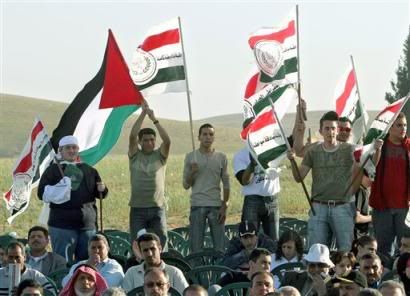
Young Israeli Bedouins participate in a demonstration to mark the Land Day near the Bedouin village of Abu Talul in southern Israel, Wednesday March 30, 2005. Land Day commemorates the unrest that erupted in March 1976 when Israeli Arabs protested the Israeli government's confiscation of thousands of acres of Arab-owned land and in which six Arab citizens were killed by Israeli police. (Tsafrir Abayov/AP)


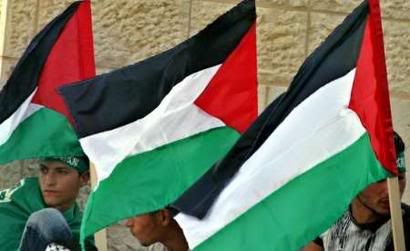
Palestinians wave Palestinian flags during a protest against Israel's controversial barrier near the West Bank village of Beit Hanina, March 30, 2005. Thousands of protestors marched in the Jewish state to mark 'Land Day,' while thousands of Palestinians held demonstrations, some marred by stone-throwing clashes with Israeli soldiers, in the West Bank. (Mahfouz Abu Turk/Reuters)


Palestinian women shout at Israeli security forces during a protest against Israel's controversial barrier, near the West Bank village of Bilin March 30, 2005. Thousands of protestors marched in the Jewish state to mark 'Land Day,' while thousands of Palestinians held demonstrations, some marred by stone-throwing clashes with Israeli soldiers, in the West Bank. (Oleg Popov/Reuters)


Palestinian and Israeli protesters run after Israeli forces threw stun grenades during a protest against Israel's controversial barrier near the West Bank village of Bilin, March 30, 2005. Thousands of protestors marched in the Jewish state to mark 'Land Day,' while thousands of Palestinians held demonstrations, some marred by stone-throwing clashes with Israeli soldiers, in the West Bank. (Goran Tomasevic/Reuters)


A Palestinian man holds an olive tree plant after Israeli forces threw stun grenades during a protest against Israel's controversial barrier, near the West Bank village of Bilin March 30, 2005. Thousands of protestors marched in the Jewish state to mark 'Land Day,' while thousands of Palestinians held demonstrations, some marred by stone-throwing clashes with Israeli soldiers, in the West Bank. (Goran Tomasevic/Reuters)


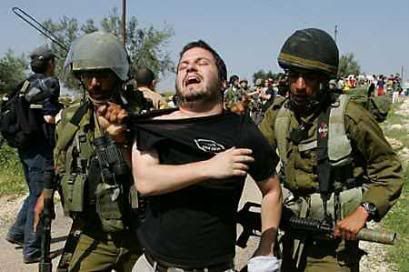
Israeli forces arrest a peace activist during a protest against Israel's controversial barrier near the West Bank village of Bilin March 30, 2005. Thousands of protestors marched in the Jewish state to mark 'Land Day' while thousands of Palestinians held demonstrations, some marred by stone-throwing clashes with Israeli soldiers in the West Bank. (Goran Tomasevic/Reuters)


An injured Palestinian demonstrator is carried after he was hit with a rubber bullet fired by Israeli soldiers during a protest at the construction site of a section of Israel's separation barrier in the ourskirts of the West Bank village of Bil'in near Ramallah, Wednesday March 30, 2005. The march marked Land Day, which commemorates the unrest that erupted in March 1976 when Israeli Arabs protested the Israeli government's confiscation of thousands of acres of Arab-owned land and in which six Arab citizens were killed by Israeli police. Three demonstrators were slightly injured during the clashes Wednesday. (Oded Balilty/AP)


A Palestinian boy walks in front a burning tire during an anti-Israel protest at the Buraij refugee camp in the Gaza Strip, March 30, 2005. (Suhaib Salem /Reuters)
The Daily Star ran a wonderful interview with Reverend Canon Dr. Shehadeh Shehadeh, then chairman of the National Committee for the Protection of Lands in Israel (now the priest at St. John's Episcopal Church in Haifa and the vice chairman of Al-Jebha, the Democratic Front for Peace and Equality), who led the 1976 strike. Patient and diligent organizing described by Dr. Shehadeh is an important reminder of what it takes to organize a mass action:
According to Shehadeh, the movement began when Rakah - the New Communist List, invited some 25 people (including the pastor) to a meeting in Haifa 29 years ago to discuss strategies for opposing the government's expropriation plans.

The group then held a larger meeting, to which the heads of Arab local councils were invited, and followed this by hosting an open, public meeting in a Nazareth film theater. Shehadeh's narration slows down as he recalls his profound amazement at the turn-out there.

"The meeting was enormous," he says, adding that members of the public not only filled the hall and corridors of the theater, but massed in the streets outside. It was at that meeting that the committee was officially formed, and Shehadeh appointed its chairman.

Palestinian public support for the committee proved to be its most precious resource. Letters the committee wrote to members of Knesset went largely unanswered, while an impromptu meeting with Israel's ruling Labor Party merely resulted in the party affirming that it would not reconsider its plans to expropriate private Palestinian land.

But Shehadeh and his fellow committee members reacted to governmental intransigence by intensifying their grass-roots campaign -- visiting the villages that were to be affected by the expropriation, informing residents of the plans and their likely consequences, and even photographing parcels of land destined for confiscation, whose coordinates would then be sent to villages to prompt local councils to discuss the plans. "I used to go to public meetings three or four times a week to tell people that we intended to organize a strike if the government doesn't listen to us," recalls the pastor.

True to their word, after weeks of rigorous campaigning, a strike was finally declared for March 30, 1976. Having failed to gain permission to hold a demonstration outside the Knesset, the committee instructed its supporters to register their protest by staying at home and striking peacefully.

Early on the morning of the strike, Shehadeh received a phone call alerting him that the government had ordered military and police forces to enter striking Arab villages.

Residents reacted with stone throwing and spontaneous demonstrations. By the end of the day, what had started out as a peaceful statewide protest had ended with the deaths of six unarmed Palestinians, felled by the live fire of Israeli security forces, in the Arab villages of Sakhnin, Arabeh, Kufr Kanna and Taibeh. Hundreds of other Palestinian citizens of Israel were maimed or injured.

Shehadeh believes the state's resort to violent confrontation with peaceful strikers that day was a tragic example of the long-term strategy that Israel continues to use to control Palestinians on both sides of the Green Line.

"Israeli policy has always been to treat the Palestinians with an iron fist," he says. "I know that, and I heard that several times, even from police people. They would say: 'Only through power can you be treated. You don't even know what democracy is.' So that's how we are treated," he explains.

Despite the violence, Shehadeh estimates that between 70 and 80 percent of the Palestinian public in Israel participated in the 1976 strike and quotes his late friend Saliba Khamis: "On Land Day, the genie came out of the bottle." (Sharif Hamadeh, "Priest Recalls Violent Origins of Land Day: Shehadeh Remembers Leading First Protest against Israeli Grab of Palestinian Properties," The Daily Star 31 Mar. 2005)

Wednesday, March 23, 2005

"Land for Peace"

Mahmoud Abbas, the candidate supported by the power elites of Israel and the United States, was duly elected in January this year, with the "mandate" given by 28% of eligible Palestinian voters. Abbas and Ariel Sharon agreed to a cease-fire in February. Then what?

"Israel has publicly confirmed plans to build 3,500 new housing units in the largest Jewish settlement in the West Bank, Maale Adumim," says Greg Myre ("West Bank Expansion Confirmed by Israel," New York Times/International Herald Tribune 23 Mar. 2005).

That's the latest clarification of what the "land for peace" formula actually means: Palestinians surrender their land in return for a semblance of peace that Israel allows them.

Why would any Palestinian settle for that? A Palestinian parable of an Israeli prison experience explains how "Palestinian-Israeli bargaining" works:
It was [Samir] Mashharawi ["a rising leader of 39, a politician-slash-security-man," who, like "many Palestinian men of his age," "cut his teeth in the first intifada" and "learned Hebrew in Israeli prisons"] who, one evening in Gaza City, gave me the most elegant description I have heard of Palestinian-Israeli bargaining. Palestinian officials were then negotiating, unsuccessfully, not for their own state but for the Israelis to pull their troops back to their positions before the uprising. Mashharawi recalled how, during one of his terms in prison, he and other inmates demanded chairs and tables. So the Israelis took their mattresses. The Palestinians demanded the mattresses back. "We forgot that we asked for the chairs and tables," he continued. "After a month, they returned the mattresses. And we felt very happy because we achieved something." I said this reminded me of the Jewish story in which a rabbi advises a man to bring a goat into his home; when, at the rabbi's instructions, he eventually takes the goat out, the man's wife no longer finds her house too small. Mashharawi nodded. "Israeli diplomacy," he said, "is based on this idea." (James Bennet, "The Interregnum," New York Times Magazine, March 13, 2005)
Without justice, however, this peace, too, will be short-lived.