Theoretically, China can pursue global Keynesian policy in addition to domestic Keynesian policy, which would go some way toward countering austerity in the US and Europe and be good for China as well as the rest of the world. China says that "By the end of 2009, China had provided a total of 256.29 billion yuan in aid to foreign countries, including 106.2 billion yuan in grants, 76.54 billion yuan in interest-free loans and 73.55 billion yuan in concessional loans" (the figures are cumulative -- unfortunately no annual figure is given). For such a global Keynesian purpose, China should give away 5% of its GDP in grants.
Then, China would also have to learn to veto all Western wars, so that what it helps build won't get bombed. Pax Sinica based on the Beijing Consensus would be welcomed by the axis of resistance in the Middle East, North Africa, and Latin America; the rest of BRIC, Turkey, and South Africa; and anyone else who prefers peace for profit to war for power.
Showing posts with label China. Show all posts
Showing posts with label China. Show all posts
Saturday, April 23, 2011

Sunday, July 25, 2010
Monopoly Capital Blocks Rational Policy of Wage-led Growth
What lesson might the working classes of the global North take from what's happening in China? Canadian journalist Paul Jay spells it out in plain English.
To that Kaleckian lesson, however, we want to add a Gorzian one, especially in the United States: take productivity gains more in the form of gains in disposable time than in the form of more consumption. That's our socialist ticket out of crisis, economic and environmental.
Minimum transitional demands: retirement at 50 with full benefits; free education and social wages for students (all the way up to doctoral degrees for those who want them); paid parental leaves (six years for each new child); two months of paid vacations per year at minimum; indefinite unemployment benefits (to last till the ruling classes come up with worthy jobs at worthy wages for the unemployed).
The lesson given by Jay is a Kaleckian one, one of the most important lessons, especially today, as we struggle against the drive to austerity in the North. First of all, make clear what obstacle needs to be removed if the rational alternative is to be implemented.
Paul Jay: So we've been talking about macroeconomic policy, the G-20, austerity. And there was one little line in the G-20 document I thought was interesting, and it's sort of buried in amongst everything. It said countries could facilitate wages going up proportional to productivity, which is rather interesting, 'cause it's the only time I've ever heard it even mentioned by these guys. There's quite a big section about how wages need to go up in China. There they understand the need for increasing demand. And we've heard President Obama say, we can't be the consumer engine of the world anymore, you guys have to do it, looking at China. And they talk about increasing the social safety net in China. They even talk about allowing strike struggles in China so wages can go up, but they sure don't talk about it when it comes to their own places. . . . So the problem is -- and this is where it becomes a political problem. I mean, it's not that difficult to sit down and kind of envision a rational solution to all of this -- you just can't pass it anywhere. The way that the politics is controlled and the small gang of people that actually own the commanding heights of the economy, starting with the banks, they don't allow any of this to actually get passed, so you get to an impasse. You can talk rational visions, but you can't execute on it.
To that Kaleckian lesson, however, we want to add a Gorzian one, especially in the United States: take productivity gains more in the form of gains in disposable time than in the form of more consumption. That's our socialist ticket out of crisis, economic and environmental.
Minimum transitional demands: retirement at 50 with full benefits; free education and social wages for students (all the way up to doctoral degrees for those who want them); paid parental leaves (six years for each new child); two months of paid vacations per year at minimum; indefinite unemployment benefits (to last till the ruling classes come up with worthy jobs at worthy wages for the unemployed).
Wednesday, October 28, 2009
What It Takes to Make Keynes Work
John Ross wrote in the Guardian ("No Secrets to China's Success," 18 August 2009):
The thing about Keynes is that you can make Keynes work but not under a normal capitalist state in a normal capitalist market economy. It takes something like (1) China's one-party state or (2) war economy (of not capital-intensive wars like today's Afghanistan and Iraq wars but labor-intensive wars of total mobilization subordinating capital and labor alike to the state, like WW2) or (3) the working class so awesomely powerful that it might as well go ahead and do socialism instead of Keynes.
That's what typical Keynesians and typical anti-Keynesians (either of the Marxist or of the capitalist liquidationist kind) don't understand.
Keynes noted in the final chapter of his General Theory, in a point highly relevant to a situation where mass unemployment is again soaring, that "a somewhat comprehensive socialisation of investment will prove the only means of securing an approximation to full employment".A good point.
That "somewhat comprehensive socialisation of investment" is impossible in a private sector-dominated economy. The decisive advantage China has in the present crisis is that it does not have to rely only on indirect means (reduction of interest rates, budget deficits etc) to attempt to reverse the plunging investment that is the driving force of this as with every major recession. China can use its large state-owned company sector to increase investment and instruct its state-owned banks to lend. That is why its economy is growing, while Alistair Darling is still pleading ineffectually for UK banks to increase their lending and while UK investment in housing and transport is plunging by 30% and more.
The thing about Keynes is that you can make Keynes work but not under a normal capitalist state in a normal capitalist market economy. It takes something like (1) China's one-party state or (2) war economy (of not capital-intensive wars like today's Afghanistan and Iraq wars but labor-intensive wars of total mobilization subordinating capital and labor alike to the state, like WW2) or (3) the working class so awesomely powerful that it might as well go ahead and do socialism instead of Keynes.
That's what typical Keynesians and typical anti-Keynesians (either of the Marxist or of the capitalist liquidationist kind) don't understand.
Wednesday, July 29, 2009
It Could Happen Here
Normally, the Western mass media love the stories of any old conflicts -- from electoral disputes to ethnic conflicts to even workers' uprisings -- in Southern nations of interest to the West, but they don't appear to find this story so amusing, as is suggested by the terseness of the report.
The riot, at the Tonghua Iron and Steel Works in Jilin Province in northern China, broke out after a visiting steel executive from a related company threatened mass layoffs at the Tonghua steel mills as part of a major restructuring of the state-owned company, China Daily said.That is not surprising. Shortly before this incident in China, "Workers at collapsed French car parts maker New Fabris threatened on Sunday to blow up their factory if they did not receive payouts by July 31 from auto groups Renault and Peugeot to compensate for their lost jobs" ("French Workers Threaten to Blow Up Factory," Reuters, 12 July 2009). It could happen here.
The riot followed a pattern of massive demonstrations that have taken place in various parts of the country over the past few years, many involving citizens outraged over government corruption or threatened with layoffs or orders to relocate.
The China Daily report said Chen Guojun, the steel executive who was beaten to death, had threatened 3,000 Tonghua steelworkers with layoffs, which he had said could take place within three days. He also had signaled that larger jobs cuts were likely at the struggling steel mill.
The report said the rioters blocked the police, ambulances and government officials from reaching Mr. Chen before he died. (David Barboza, "China Steel Executive Killed as Workers and Police Clash," New York Times, 27 July 2009)
Thursday, July 09, 2009
From Iran to China, Skipping Honduras
As far as the Western mass media are concerned, they went from Iran (electoral conflict in an oil-rich country) to China (ethnic conflict in an oil-rich region), skipping Honduras (a coup d'état in an oil-poor country dependent on foreign aid and remittances where the USG has a military base).
Thursday, November 13, 2008
New Deal with Chinese Characteristics
The "New Deal with Chinese Characteristics" is more ambitious than what Washington has come up with so far, and what Obama is likely to offer in the near future, but is it still too little too late, especially in light of "The Realities of China Today" explained by Martin Hart-Landsberg?
- "One critical but often overlooked explanation for China's manufacturing competitiveness is that approximately 70% of manufacturing work is done by migrants. Over the last 25 years, some 150-200 million Chinese have moved from the countryside to urban areas in search of employment. Although the great majority of these migrant workers have moved legally, they suffer enormous discrimination. For example, because they remain classified as rural residents under the Chinese registration system, not only must they pay steep fees to register as temporary urban residents, they also have no rights to the public services available to urban born residents (including free or subsidized education, health care, housing and pensions). The same is true for their children, even if they are born in an urban area."
- "Chinese wages as a share of GDP have fallen from approximately 53% of Gross Domestic Product in 1992 to less than 40% in 2006. Private consumption as a percent of GDP has also declined, falling from approximately 47% to 36% over the same period."
- ". . . [T]he region's export/GDP ratio grew from 24% in 1980 to 55% in 2005. By comparison, the world average in 2005 was only 28.5%."
- Between 1992-3 and 2004-5, the East Asian share of China's final goods exports declined from 49.5% to 26.5%, while the OECD share (excluding Japan and Korea) increased from 29.3% to 50.1%.
- According to various estimates cited by the Asian Development Bank, it appears that the percentage of Asian exports consumed within Asia ranges from a high of 22% to a low of only 11%.
Monday, October 13, 2008
Multinational Investors' Vote of Confidence in Ultra-imperialism
Check out multinational investors' major vote of confidence in ultra-imperialism today: John Willman, "Markets Cheer Bank Bail-outs" (Financial Times, 13 October 2008); Ralph Atkins, "European Banks Offer Unlimited Dollar Funding" (Financial Times, 13 October 2008); "Full Text: US Treasury Tarp Plans" (Financial Times, 13 October 2008); Louise Story and Andrew Ross Sorkin, "Morgan Agrees to Revise Terms of Mitsubishi Deal" (New York Times, 13 October 2008); "Gulf Shares Surge as UAE and Qatar Act (Financial Times, 12 October 2008); and Robin Wigglesworth and Simeon Kerr, "UAE Leads Drive to Stem Crisis" (Financial Times, 13 October 2008).
It's true that, if China, Japan, Germany, Saudi Arabia, and the United States functioned as one politically (if not legally) coherent establishment, Americans would be back in the black:
Therefore, a radical shift in global class relations could come only if there were a radical shift in any one of the aforementioned countries, but these are the very ones where the Left has the least chance in the world.
Is China, though, a weak or strong link in this chain of empire (to which Latin socialists, Islamists from the Hindu Kush to the Persian Gulf to the Horn of Africa to the Niger Delta, Maoists in Nepal and India, the national security interests of Russia, etc. have provided a partial material -- if ideologically incoherent -- counterweight)?
Update
"[T]he needs of our economy require that our financial institutions not take this new capital to hoard it, but to deploy it" ("Text: Henry Paulson Remarks Tuesday," 15 October 2008).
"Investors are recognizing that the financial crisis is not the fundamental problem. It has merely amplified economic ailments that are now intensifying: vanishing paychecks, falling home prices and diminished spending. And there is no relief in sight" (Peter S. Goodman, "Markets Suffer as Investors Weigh Relentless Trouble," New York Times, 16 October 2008).
It's true that, if China, Japan, Germany, Saudi Arabia, and the United States functioned as one politically (if not legally) coherent establishment, Americans would be back in the black:
Global Balance of Payments ($bn, 2007)
SOURCE: Martin Wolf, "Asia's Revenge," Financial Times, 9 October 2008, p. 9.
Therefore, a radical shift in global class relations could come only if there were a radical shift in any one of the aforementioned countries, but these are the very ones where the Left has the least chance in the world.
Is China, though, a weak or strong link in this chain of empire (to which Latin socialists, Islamists from the Hindu Kush to the Persian Gulf to the Horn of Africa to the Niger Delta, Maoists in Nepal and India, the national security interests of Russia, etc. have provided a partial material -- if ideologically incoherent -- counterweight)?
Update
"[T]he needs of our economy require that our financial institutions not take this new capital to hoard it, but to deploy it" ("Text: Henry Paulson Remarks Tuesday," 15 October 2008).
"Investors are recognizing that the financial crisis is not the fundamental problem. It has merely amplified economic ailments that are now intensifying: vanishing paychecks, falling home prices and diminished spending. And there is no relief in sight" (Peter S. Goodman, "Markets Suffer as Investors Weigh Relentless Trouble," New York Times, 16 October 2008).
Sunday, October 12, 2008
Toward the Highest Stage of Ultra-imperialism?
A local friend of mine jokes: if worst comes to worst, the US can always annex Saudi Arabia. But why stop there on the way to the highest stage of ultra-imperialism: America, China, Japan, Germany, and Saudi Arabia together legally conglomerated into a new United States, bringing Americans -- thank Allah and Confucius -- back in the black?
Global Balance of Payments ($bn, 2007)
SOURCE: Martin Wolf, "Asia's Revenge," Financial Times, 9 October 2008, p. 9.
What lay behind the savings glut? The first development was the shift of emerging economies into a large surplus of savings over investment. Within the emerging economies, the big shifts were in Asia and in the oil exporting countries (see chart). By 2007, according to the International Monetary Fund, the aggregate savings surpluses of these two groups of countries had reached around 2 per cent of world output.There is no political or economic incentive on the part of the biggest deficit spenders, especially the US, to change this pattern. The change therefore has to come from surplus generators.
. . . . . . . . . . . . . . . . . . . .
Last year, the aggregate surpluses of the world's surplus countries reached $1,680bn, according to the IMF. The top 10 (China, Japan, Germany, Saudi Arabia, Russia, Switzerland, Norway, Kuwait, the Netherlands and the United Arab Emirates) generated more than 70 per cent of this total. The surpluses of the top 10 countries represented at least 8 per cent of their aggregate GDP and about one-quarter of their aggregate gross savings.
Meanwhile, the huge US deficit absorbed 44 per cent of this total. The US, UK, Spain and Australia -- four countries with housing bubbles -- absorbed 63 per cent of the world's current account surpluses.
That represented a vast shift of capital – but unlike in the 1970s and early 1980s, it went to some of the world's richest countries. (emphasis added, Wolf, p. 9)
Sunday, September 28, 2008
Imperial Overreach
As Peter Lavelle of RussiaToday suggests, "the assumption that only the US and it[s] allies have foreign policy interests" is at the heart of its imperial overreach.
Great-nation chauvinism, to be fair, is not unique to the US. Below a certain threshold (in terms of GDP, population, armed forces, etc.) the security interests of a nation begin to fade from the concerns of more powerful nations.
But can any nation, even the US, afford to ignore the security interests of a nuclear power that is not only the eighth largest holder of its public debt but also allied with its soon-to-be-biggest creditor?
Great-nation chauvinism, to be fair, is not unique to the US. Below a certain threshold (in terms of GDP, population, armed forces, etc.) the security interests of a nation begin to fade from the concerns of more powerful nations.
But can any nation, even the US, afford to ignore the security interests of a nuclear power that is not only the eighth largest holder of its public debt but also allied with its soon-to-be-biggest creditor?
Saturday, July 26, 2008
Mission Suez
Gamal Abdel Nasser nationalized the Suez Canal on 26 July 1956. Here is a documentary, Mission Suez (CBC, 12 July 2006), about the nationalization and the British reaction against it.
If the Americans refuse to learn from history and continue to soldier on in the Middle East, wasting their treasure, depreciating the dollar, making oil prices higher, and endangering their own solvency as well as the world economy, maybe the Chinese and others should put America into receivership.
If the Americans refuse to learn from history and continue to soldier on in the Middle East, wasting their treasure, depreciating the dollar, making oil prices higher, and endangering their own solvency as well as the world economy, maybe the Chinese and others should put America into receivership.
Friday, May 16, 2008
Politics of Disasters
A cyclone devastates Burma's Irrawaddy Delta, and an earthquake strikes China's Sichuan Province, and the empire smells blood, itching to send "aid at the point of a gun," urging the United Nations to invoke the "responsibility to protect": "France's foreign minister, Bernard Kouchner, has spoken of the possibility of an armed humanitarian intervention, and there is an increasing degree of chatter about the possibility of an American-led invasion of the Irrawaddy River Delta."1 Why such an unseemly display of arms? Because a natural disaster can turn into a legitimation crisis, giving foreign powers a shot at regime change.
Michel Foucault reported in Corriere della sera on 28 September 1978:
One of the casualties of the Bam earthquake was an American man, Tobb Dell'Oro, who was vacationing with his fiancée Adele Freedman in the city. Freedman, who credits the "kindness of the Iranian people" for her survival,4 became the subject of an important documentary film, Bam 6.6: Humanity Has No Borders (Dir. Jahangir Golestan-Parast, 2007), which shows Iranians' solicitude for her wellbeing and gracious hospitality to her parents who initially thought Iran would be a terrible place for Jewish Americans like them to visit but have changed their minds about the Iranian people.
The Bam earthquake also moved many of the normally fractious Iranian diaspora, as well as the populace of Iran, to solidarity, holding benefits and raising funds for their countrymen and women in need back home.
Artists did their part, too. Mohammad Reza Shajarian, the finest musician in Iran, held a concert "همنوا با بم" [In Harmony with Bam] with Hossein Alizadeh, Kayhan Kalhor, and Homayoun Shajarian in remembrance of the victims of the earthquake.
Iran's Islamic government, by the way, did not reject international, including American, offers of assistance -- unlike the Bush White House who didn't let Cuba or Iran help Americans after Hurricane Katrina -- and welcomed international NGOs as well, even though well-intentioned outsiders can create as many hindrances as aids they bring:
1 Robert D. Kaplan, "Aid at the Point of a Gun," New York Times, 14 May 2008.
2 Naomi Klein, "Regime-Quakes in Burma and China," The Nation, 15 May 2008.
3 Michel Foucault, "The Army -- When the Earth Quakes," in Janet Afary and Kevin B. Anderson, Foucault and the Iranian Revolution: Gender and the Seductions of Islamism, U of Chicago P, 2005, p. 190. An endnote omitted from the quotation and replaced by a parenthetical editorial clarification.
4 Corey Kilgannon, "For One Earthquake Survivor, Joy Is Tempered by Sorrow," New York Times, 10 January 2004.
5 Jenty Wood, "Improving NGO Coordination: Lessons from the Bam Earthquake," Humanitarian Practice Network, 2003.
[N]othing terrifies a repressive regime quite like a natural disaster. Authoritarian states rule by fear and by projecting an aura of total control. When they suddenly seem short-staffed, absent or disorganized, their subjects can become dangerously emboldened. It's something to keep in mind as two of the most repressive regimes on the planet -- China and Burma -- struggle to respond to devastating disasters: the Sichuan earthquake and Cyclone Nargis. In both cases, the disasters have exposed grave political weaknesses within the regimes -- and both crises have the potential to ignite levels of public rage that would be difficult to control.2A regime's failure to respond promptly and effectively to suffering caused by a natural disaster, the failure that the opposition can exploit, can indeed become a factor in its downfall. Such was the case with the Shah's regime and the earthquake of 1978 that wiped out Tabas and damaged forty other villages in Iran.
Michel Foucault reported in Corriere della sera on 28 September 1978:
Who will rebuild Tabas today? Who will rebuild Iran after the earthquake of Friday, September 8 [Black Friday, when the army massacred hundreds of protesters in Djaleh Square of Tehran], right under the treads of the tanks? The fragile political edifice has not yet fallen to the ground, but it is irreparably cracked from top to bottom.Neither Islamic nor Marxist nor liberal revolutionaries of Iran, however, called upon the West to claim its "right to protect" and send its armies to save them from the Shah. They overthrew the Shah's regime on their own, and Iran's Islamic Revolution has grown into a republic that can survive natural disasters, such as the earthquake of 2003 that destroyed Bam, killing more than 20,000 and injuring many more.
In the torrid heat, under the only palm trees still standing, the last survivors of Tabas work away at the rubble. The dead are still stretching their arms to hold up walls that no longer exist. Men, their faces turned toward the ground, curse the Shah. The bulldozers have arrived, accompanied by the empress; she was ill received. However, mullahs rush in from the entire region; and young people in Tehran go discreetly from one friendly house to another, collecting funds before leaving for Tabas. "Help your brothers, but nothing through the government, nothing for it," is the call that Ayatollah Khomeini has just issued from exile in Iraq.3
One of the casualties of the Bam earthquake was an American man, Tobb Dell'Oro, who was vacationing with his fiancée Adele Freedman in the city. Freedman, who credits the "kindness of the Iranian people" for her survival,4 became the subject of an important documentary film, Bam 6.6: Humanity Has No Borders (Dir. Jahangir Golestan-Parast, 2007), which shows Iranians' solicitude for her wellbeing and gracious hospitality to her parents who initially thought Iran would be a terrible place for Jewish Americans like them to visit but have changed their minds about the Iranian people.
The Bam earthquake also moved many of the normally fractious Iranian diaspora, as well as the populace of Iran, to solidarity, holding benefits and raising funds for their countrymen and women in need back home.
Artists did their part, too. Mohammad Reza Shajarian, the finest musician in Iran, held a concert "همنوا با بم" [In Harmony with Bam] with Hossein Alizadeh, Kayhan Kalhor, and Homayoun Shajarian in remembrance of the victims of the earthquake.
Iran's Islamic government, by the way, did not reject international, including American, offers of assistance -- unlike the Bush White House who didn't let Cuba or Iran help Americans after Hurricane Katrina -- and welcomed international NGOs as well, even though well-intentioned outsiders can create as many hindrances as aids they bring:
In a recent lessons-learned meeting on the Bam earthquake in Iran, a polite and respectful colleague from the Iranian Ministry of Health related his frustration at international NGO coordination in the early days of the emergency. He said that, at the same time as he was desperately trying to set up field hospitals and bury the dead, representatives from over 100 international NGOs had individually requested meetings with him. He appreciated their help, he said, but some organisations wanted to ask him about the siting of rural clinics when he was still trying to arrange emergency medical evacuations. Was there no way, he asked, that these agencies could organise themselves better in the early days of a disaster?5But Iran's government, even under President Khatami, would not have accepted international relief if it had been imposed upon it by a show of force.
1 Robert D. Kaplan, "Aid at the Point of a Gun," New York Times, 14 May 2008.
2 Naomi Klein, "Regime-Quakes in Burma and China," The Nation, 15 May 2008.
3 Michel Foucault, "The Army -- When the Earth Quakes," in Janet Afary and Kevin B. Anderson, Foucault and the Iranian Revolution: Gender and the Seductions of Islamism, U of Chicago P, 2005, p. 190. An endnote omitted from the quotation and replaced by a parenthetical editorial clarification.
4 Corey Kilgannon, "For One Earthquake Survivor, Joy Is Tempered by Sorrow," New York Times, 10 January 2004.
5 Jenty Wood, "Improving NGO Coordination: Lessons from the Bam Earthquake," Humanitarian Practice Network, 2003.
Wednesday, May 14, 2008
The Beijing Consensus
What is the Beijing Consensus? There is little consensus on the Beijing Consensus yet. Arif Dirlik put it this way: "I would like to suggest that the term derives its meaning and appeal not from some coherent economic or political position but from its suggestion of a pole in the global political economy which can serve as a gathering place for those who are opposed to Washington imperialism" ("Beijing Consensus: Beijing 'Gongshi': Who Recognizes Whom and to What End?" 17 January 2006, p. 2).
Whether China can be such a pole remains to be seen, but in contrast to Washington -- which seeks to aggressively remake other countries' political economies to conform to its vision of capitalism and to redraw the political geography of the world according to its geopolitical doctrine, by force if necessary -- Beijing mostly bases its international relations on more or less business calculations alone, leaving the internal affairs of other nations to themselves. Note the absence of "conditionality" in China's relation with Africa, for instance:
Whether China can be such a pole remains to be seen, but in contrast to Washington -- which seeks to aggressively remake other countries' political economies to conform to its vision of capitalism and to redraw the political geography of the world according to its geopolitical doctrine, by force if necessary -- Beijing mostly bases its international relations on more or less business calculations alone, leaving the internal affairs of other nations to themselves. Note the absence of "conditionality" in China's relation with Africa, for instance:
Just like other Western powers, China has used aid strategically to support its commercial and investment interventions in Africa. Aid has taken the form of financial investments in key infrastructural development projects, training programs, debt relief, technical assistance, and a program of tariff exemptions for selected products from Africa, not dissimilar to the agreements that Africa has had with Europe, the US, and other Western economies. China's aid is attractive to African governments not only because it offers favorable terms, but in particular because it doesn't come with the conditionality that has so constrained, and many would argue undermined, the development that would have the potential for bringing about social progress. (Firoze Manji, "China Still a Small Player in Africa," MRZine, 28 April 2008)Thus Beijing deals with the West, it deals with Latin socialists, it deals with everyone with whom it pays to play. That is better than the economic Washington Consensus whose military corollary is the Project for the New American Century.
Tuesday, April 29, 2008
"Free Tibet" Flags Made in China
Capitalism has a way of making a mockery of nationalism, Chinese or Tibetan: "'Free Tibet' Flags Made in China" (BBC, 28 April 2008).
Saturday, April 12, 2008
Separatism of the Day
I just searched Google News for "Tibet" and "Darfur": 90,444 results for Tibet and 17,442 for Darfur. Tibet is apparently now the most powerful red herring of the PMC "human rights" set. Before them it was Kosovo. Kosovo's Google News results are 13,616 today, though, gaining on Darfur. That unfinished business may come back into fashion if Russia acts up. The West loves separatism (except separatists of their own nations or their client states): "Small Is Beautiful" as far as it is concerned.
Saturday, March 29, 2008
India and the Peace Pipeline
Will New Delhi sign onto the tri-national pipeline to transport natural gas from Iran to Pakistan and then to India, aka a peace pipeline because of its potential to diminish tensions between India and Pakistan? It is still in talks with Tehran over the gas price and with Islamabad over transit fees, but money, of course, is not the main reason why it has hesitated.
Economically speaking, India really needs gas from Iran:
Can the Indian Left veto the Indo-US nuclear deal and get India again on a path toward its own national development and regional security, based on the ideals -- Swaraj, Swadeshi, Satyagraha -- that inspired the Indians toward independence? If not, "China has told Pakistan it is ready to join a gas pipeline project to import Iranian gas if India decides not to be part of the multi-billion dollar venture" (PTI, "China Ready to Join Tri-nation Gas Project If India Opts Out," The Hindu 25 March 2008).
Economically speaking, India really needs gas from Iran:
India, Asia's third-largest economy, can produce only half the gas it needs to generate electricity, causing blackouts and curbing economic growth. Demand may more than double to 400 million cubic meters a day by 2025 if the economy grows at the projected rate of 7 to 8 percent a year, according to the oil ministry. (Manash Goswami, "India Plans Talks with Pakistan over Stalled Iran Gas Pipeline," Bloomberg.com, 28 March 2008)However, the Indian government is under pressure from the United States, to stay away from the pipeline in exchange for a nuclear deal.
Although publicly New Delhi has maintained that it stands by the IPI pipeline, the reality is going to be different.The nuclear deal that Washington offered to India, however, is in fact no favor to the country. To the contrary, it's one that will subject Indian nuclear policy to whims of the United States:
"The final deal [on IPI] is not going to happen in the near future as the project is no longer just about energy security, it's more about India's strategic position in the global community," a Foreign Ministry official told Asia Times Online on condition of anonymity.
"The project is in the radar of the Prime Minister's Office and unless there is a clear signal from there, it is unlikely that India's Petroleum Ministry will agree to any final arrangement," he added.
US Treasury Secretary Henry Paulson, during a recent visit to India, is believed to have recommended that Delhi not go ahead with the project. And subsequently Treasury Under Secretary for International Affairs David McCormick told reporters that the US hoped India would not move forward with the pipeline. He said "it would not be the right path during a time the world should be imposing greater discipline on its interactions with Iran". He added that India should meet its energy needs through the nuclear deal with the US that is now stalled in the Indian Parliament. (Siddharth Srivastava, "Iran, Pakistan Dump India on Pipeline," Asia Times, 15 November 2007)
Let us be clear then as to what this agreement entails: the U.S. openly gains the power to threaten to deny ongoing fuel supplies (and even the forcible removal of supplies previously given) in order to control future Indian policy. Is this a remote speculation? We must recall that in the 1970s the U.S. unilaterally cut off all fuel supply to Tarapur, in material violation of the previous "123" agreement between the U.S. and India of 1963. (Analytical Monthly Review, "The U.S.-Indian Nuclear Deal: An Unequal Colonial Treaty," MRZine, 12 August 2008)Communists and other leftists in India are opposed to this deal. Often at odds with one another over economic policy -- Maoists and other leftists are rightly critical of the CPI(M)'s neoliberalism, most clearly expressed in its embrace of Special Economic Zones -- they probably have more in common with one another on this issue than any other.
Can the Indian Left veto the Indo-US nuclear deal and get India again on a path toward its own national development and regional security, based on the ideals -- Swaraj, Swadeshi, Satyagraha -- that inspired the Indians toward independence? If not, "China has told Pakistan it is ready to join a gas pipeline project to import Iranian gas if India decides not to be part of the multi-billion dollar venture" (PTI, "China Ready to Join Tri-nation Gas Project If India Opts Out," The Hindu 25 March 2008).
Monday, March 24, 2008
US Declares War on Iran
Washington is now making the most ruthless use of its dollar hegemony against Iran. It just declared war on the entirety of Iran's banking system and will blackmail China, Europe, Japan, et al. to cut off Iran financially.
The dollar hegemony is declining (cf. Jeffrey Frankel, "The Euro Could Surpass the Dollar within Ten Years," Vox, 18 March 2008; Wolfgang Münchau, "This Crisis Could Bring the Euro Centre-stage," Financial Times, 23 March 2008), but will it decline fast enough for the Iranians?
The ruling clerics of Iran are able leaders who have run their country with a surer hand than leftists would have, but this presents them with the greatest challenge since Saddam Hussein, backed by the West, invaded Iran -- perhaps even a greater challenge, since at least the richest third of Iranians are not made of the same stuff as those who made the revolution and defended Iran's sovereignty in the eight-year-long war.
(1) the March 20 advisory [of the Financial Crimes Enforcement Network, a unit within the US Treasury Department] represents a US declaration of war by sanctions on Iran and a sanctions threat to the international banking community, (2) the US has various unilateral financial sanctions measures at its command in the form of executive orders and Patriot Act Section 311 and (3) the BDA-North Korea sanctions were, at least in retrospect, a test run for Iran.Make no mistake: this economic war is a strategy pursued by both Democrats and Republicans, realists and adventurists alike: Daniel Dombey, "Senators Urge Formal Sanctions," Financial Times, 6 March 2008.
If the US succeeds, an international quarantine on Iran's banks would disrupt Iran's financial linkages with the world by blocking its ability to process cross-border payments for goods and services exported and imported. Without those linkages Iran is unlikely to be able to engage in global trade and commerce. As 30% of Iran's GDP in 2005 was imports of goods and services and 20% was non-oil exports (World Bank and other data), a large chunk of Iran's economy would shrivel up. The repercussions will be painful and extend well beyond lost business and profits. For example, treating curable illnesses will become difficult. According to an Iranian health ministry official, Iran produces 95% of its own medicines but most pharmaceutical-related raw materials are imported. (John McGlynn, "The March 20, 2008 US Declaration of War on Iran," MRZine, 24 March 2008)
The dollar hegemony is declining (cf. Jeffrey Frankel, "The Euro Could Surpass the Dollar within Ten Years," Vox, 18 March 2008; Wolfgang Münchau, "This Crisis Could Bring the Euro Centre-stage," Financial Times, 23 March 2008), but will it decline fast enough for the Iranians?
The ruling clerics of Iran are able leaders who have run their country with a surer hand than leftists would have, but this presents them with the greatest challenge since Saddam Hussein, backed by the West, invaded Iran -- perhaps even a greater challenge, since at least the richest third of Iranians are not made of the same stuff as those who made the revolution and defended Iran's sovereignty in the eight-year-long war.
Wednesday, March 19, 2008
Tibet
Lenin's Tomb says: "one has always hoped for a more radical Tibetan liberation movement to emerge" ("Auguring Armageddon," 19 March 2008).
There was little chance of that to begin with. Besides, Washington has long practiced and perfected the art of pocketing dissidents opposing foreign governments: "Tibet Uprising and U.S. Government Grants," Moon of Alabama, 17 March 2008.
What's interesting is that Washington is helping cause big trouble for the Chinese government just at the moment when it needs its cooperation (as well as cooperation of other governments) the most to resolve the credit crisis: it will take massive US government bailouts of failing banks and funds and generous income support for bankrupted home owners and unemployed workers to prevent this crisis from hitting the rest of economy hard; and yet since the USA is a debtor nation, the money for the bailouts has to come from outside, including China. It looks like the geopolitics of US imperialism, having taken on a life of its own, has become decoupled from the economics of the US-led multinational empire.
There was little chance of that to begin with. Besides, Washington has long practiced and perfected the art of pocketing dissidents opposing foreign governments: "Tibet Uprising and U.S. Government Grants," Moon of Alabama, 17 March 2008.
What's interesting is that Washington is helping cause big trouble for the Chinese government just at the moment when it needs its cooperation (as well as cooperation of other governments) the most to resolve the credit crisis: it will take massive US government bailouts of failing banks and funds and generous income support for bankrupted home owners and unemployed workers to prevent this crisis from hitting the rest of economy hard; and yet since the USA is a debtor nation, the money for the bailouts has to come from outside, including China. It looks like the geopolitics of US imperialism, having taken on a life of its own, has become decoupled from the economics of the US-led multinational empire.
Friday, February 22, 2008
Desperately Seeking a Really Cold War
Joanne Landy and Thomas Harrison say we should be afraid, very afraid, of "a new Cold War between the United States and Russia":
What can doom Iran is a warm friendship between Russia and the USA.
The silly US attempt to install a "missile defense" system (which, by the way, doesn't work and is just a big waste of money) in Eastern Europe, as well as its support for the independence of Kosovo, "color revolutions" in Russia's periphery, and media propaganda against Russia itself, is a godsend as far as Iranians are concerned, for it prevents Russia from becoming a partner in the US-led multinational empire.
The planned 'missile defense' system in the Czech Republic and Poland will, if implemented, further increase the danger to human and all other forms of life that nuclear weapons pose, significantly expand U.S. military power, and contribute to a new Cold War between the United States and Russia. But it can be stopped. Its dangers are obvious and easy to demonstrate, and it is deeply unpopular among the citizens of the 'host' countries. Stopping it will, however, require action by American peace organizations, to strengthen our friends in the Czech Republic and Poland, to pressure our elected representatives, and to educate public opinion in this country. ("Pushing Missile Defense in Europe," Foreign Policy in Focus, 22 February 2008)Any thinking person who cares about the Iranian people, however, should welcome a really cold war between Russia and the USA. It is Moscow's distrust of the US intentions, as well as the Chinese need for Iranian oil for its industrialization project, that has so far helped mitigate US-led efforts to economically sanction Iran and helped protect Iranians from the worst military threat from the US-EU-Japan axis of evil.
What can doom Iran is a warm friendship between Russia and the USA.
The silly US attempt to install a "missile defense" system (which, by the way, doesn't work and is just a big waste of money) in Eastern Europe, as well as its support for the independence of Kosovo, "color revolutions" in Russia's periphery, and media propaganda against Russia itself, is a godsend as far as Iranians are concerned, for it prevents Russia from becoming a partner in the US-led multinational empire.
Monday, November 05, 2007
War, What Is It Good for?
Pacifists say, "Absolutely nothing." Their slogan is "War Is Not the Answer," for all times and all places. It's a lame slogan, if a well-meant one, on which younger right-wingers have zeroed in, looking for an easy target. Protest Warrior claims that the group invented a counter-slogan:
But it is a little sad to think that, among slavery, fascism, Nazism, and Communism, only the last vanished from the pages of history without being militarily defeated by an external enemy. State socialism created its own grave-diggers, the bureaucratic power elite, but capitalism hasn't. Historical materialism must account for this problem and propose a new solution.
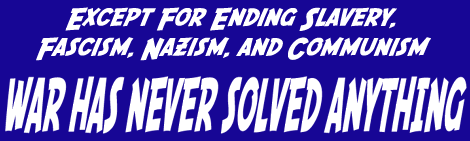
But it is a little sad to think that, among slavery, fascism, Nazism, and Communism, only the last vanished from the pages of history without being militarily defeated by an external enemy. State socialism created its own grave-diggers, the bureaucratic power elite, but capitalism hasn't. Historical materialism must account for this problem and propose a new solution.
Thursday, November 01, 2007
Mehdi Khalaji Sues Hossein Derakhshan
Mehdi Khalaji, the Washington Institute for Near East Policy's "Next Generation Fellow," filed "a libel and defamation lawsuit" against Hossein Derakhshan in Canada, claiming $2,000,000 in damage ("Mehdi Khalaji's $2 Million Lawsuit against Me over My Blog Posts," Editor: Myself, 30 October 2007). What's his beef? Among other things, Khalaji claims that Hoder made "Defamatory Statements" such as those that "state, falsely, that the Plaintiff is a traitor to the government and people of Iran."
Without reading any of Hoder's criticisms of Khalaji, however, any thinking person can see that working for WINEP, a hawkish pro-Israel think tank, means working against the interests of Iran, not only its government but also its people, and automatically earns anyone who does so a bad reputation among those, Iranians above all, who are opposed to Washington's dangerous campaign against Iran, the campaign whose means range from media propaganda, covert actions, economic sanctions, to outright threats of war.
To take just one example, last month, the US government, against the objections of such nations as Russia and China, established new unilateral sanctions against Iran's Revolutionary Guards among other things. That is a policy that Khalaji advocated: "The IRGC is a major obstacle to democratization and economic privatization. Imposing sanctions on the Revolutionary Guards could help promote democratic reform and stability in the region" (Mehdi Khalaji, "Iran's Revolutionary Guards Corps, Inc.," 17 August 2007).
Unfortunately for Derakhshan, Canada's libel law is said to be "the least protective of free speech in the English-speaking world":
Update
See, also, Yoshie Furuhashi, "Still Waiting for Godot," Critical Montages, 9 November 2007; and Richard Seymour, "Tough Times for Iranian Blogger," Lenin's Tomb, 15 November 2007.
Without reading any of Hoder's criticisms of Khalaji, however, any thinking person can see that working for WINEP, a hawkish pro-Israel think tank, means working against the interests of Iran, not only its government but also its people, and automatically earns anyone who does so a bad reputation among those, Iranians above all, who are opposed to Washington's dangerous campaign against Iran, the campaign whose means range from media propaganda, covert actions, economic sanctions, to outright threats of war.
To take just one example, last month, the US government, against the objections of such nations as Russia and China, established new unilateral sanctions against Iran's Revolutionary Guards among other things. That is a policy that Khalaji advocated: "The IRGC is a major obstacle to democratization and economic privatization. Imposing sanctions on the Revolutionary Guards could help promote democratic reform and stability in the region" (Mehdi Khalaji, "Iran's Revolutionary Guards Corps, Inc.," 17 August 2007).
Unfortunately for Derakhshan, Canada's libel law is said to be "the least protective of free speech in the English-speaking world":
Why do plaintiffs outside Canada bring libel suits against non-Canadian defendants such as the New York Post and the Washington Post in our courts? The answer is that they likely have good legal advisers who correctly tell them that Canadian libel laws favour plaintiffs. For all the lofty quotes about free speech in Canadian jurisprudence, the reality is that our libel laws are the least protective of free speech in the English-speaking world. (Dan Burnett, "Canada Should Reform Its Antiquated Libel Laws," The Lawyers Weekly, 27 October 2006)Everything that Derakhshan has written about Khalaji is likely to be found to be a "truth" or a "fair comment," as these terms are explained by Warren Sheffer and Marian Hebb in "Publish Safely! Know Your Libel Basics" (2006). And yet, by merely forcing Derakhshan, an individual who is unlikely to have a deep pocket, into a legal battle, Khalaji's lawsuit has a chilling effect on urgent political discussion necessary to stop Washington from doing to Iran what it has done to Iraq.
Update
See, also, Yoshie Furuhashi, "Still Waiting for Godot," Critical Montages, 9 November 2007; and Richard Seymour, "Tough Times for Iranian Blogger," Lenin's Tomb, 15 November 2007.
Subscribe to:
Posts (Atom)