Iran's populist government is backing away from a plan to phase out subsidies on energy and other basic commodities, analysts say. Instead, it is overpaying cash compensation to the poorer members of Iranian society to maintain political support.
Official estimates admit that for decades Iran spent $100bn a year on subsidising basic commodities -- although the support was widely viewed as unsustainable and distorting supply and demand signals.
In December last year, Mahmoud Ahmadi-Nejad, the president, embarked on a parliament-approved plan under which subsidies on energy products and foodstuffs were to be phased out gradually over a five-year period.
The plan was backed by all Iranian political groups as well as the International Monetary Fund and was viewed as a much-needed reform to the country's state-dominated economy.
However, economic analysts believe the government's populist approach has ended up inflicting a heavier burden on the economy and say that the government is moving away from the initial goal of making prices more realistic.
Under the plan, half of the government's savings from the cuts in subsidies were to be redistributed to those who registered to receive financial assistance, regardless of means. Now every man, woman and child can receive IR445,000 ($42.30) a month.
The remainder of the savings were to go to the industrial, agricultural and services sectors as well as state-owned organisations to help them cope with higher costs.
But analysts say the only section of the scheme which has been implemented is the cash payment to people.
Now, about 70m out of Iran's 75m-strong population is in receipt, which is generally considered to cost more than the old subsidies.
"People now receive cash two times more than their consumption which means our goal of managing consumption of energy products is not being achieved," Jamshid Ansari, a reform-minded parliamentarian, tells the Financial Times.
The cash payments have so far been benefiting up to 30m mainly rural poor.
They and their counterparts in the cities are even net winners because the per capita consumption of their populous families is low.
"The government is buying political support through an uneconomic and illogical way of extra subsidies payments despite the budget deficit this policy has been creating," says an analyst, who asked not to be named.
Akbar, a janitor in an affluent neighbourhood in northern Tehran, says he has not yet spent his family's payments which are almost equal to half of his monthly salary. "We have saved it so far," he says.
However, the middle class who are estimated to be also about 30m in number usually live in apartments equipped with gas and electricity for heating and cooling systems. They may own at least one car and do not have many children.
Officially, the price of gas has risen fivefold, electricity and water by three times, flour by 40 times and petrol between four and seven times.
Showing posts with label Iran. Show all posts
Showing posts with label Iran. Show all posts
Thursday, April 28, 2011
"Overpaying the Poor"
I submit what the empire likes the least about the Islamic Republic of Iran is not its nuclear program but its being prone to "overpaying [sic] . . . the poorer members of Iranian society." Cf. Najmeh Bozorgmehr, "Iran's Handouts Prove Costly" (Financial Times, 28 April 2011):

Sunday, April 10, 2011
Leftists for Chaos?
There is an opinion like this on the left side of the blogosphere:
If you want chaos, you can find it in Somalia, for instance, and increasingly in Libya as well, but Libya and Somalia (unlike Egypt and Tunisia), if anything, are in all likelihood disincentives, not incentives, for would-be left-wing revolutionaries elsewhere.
Arab regimes (and Iran) often warn against change and revolutions: they try to scare us by warning of the potential for chaos. I say: we should work for the overthrow of all those regimes (Arab regimes and Iran) because chaos is far superior to those regime. At least, under chaos there is a stronger chance for change and sabotage (sabotage of oppression and injustice and occupation and conspiracies).But I doubt that most leftists in the oppositions in Iran and the Arab world are looking for "chaos." In any case, they are too few in number and too unorganized to take advantage of it if that's the idea. Instead, such leftists as exist there are looking to establish better governments than they have and wish to lead organized mass action for that purpose, though in most cases they end up following rather than leading rebellious largely-non-left-wing crowds when such arise.
If you want chaos, you can find it in Somalia, for instance, and increasingly in Libya as well, but Libya and Somalia (unlike Egypt and Tunisia), if anything, are in all likelihood disincentives, not incentives, for would-be left-wing revolutionaries elsewhere.
Friday, March 25, 2011
Are the Libyan Rebels for Us or against Us?
Here's a comic footnote to the Libya war: Neither side of the Libyan conflict was actually looking for any real solidarity with leftists (least of all Marxists), but somehow one side (the regime) got a lot of gratuitous, undeserved Latin American leftist support and the other side (the rebels) got a lot of gratuitous, undeserved Western leftist as well as (both secular and religious) Arab and Iranian support.
As a matter of fact, both the regime and the rebels were looking for Western imperialist support, and they didn't hide it either. The Western imperialists -- unlike the world Left, the Arabs, and the Iranians, who all jumped into the Libyan fray without examining what they were jumping into -- first took a good, hard look at both sides and then decided to back the rebels.
The rebels got what they wanted, and that's that.
In recent days, though, I have noticed that the propaganda machine of the Islamic Republic of Iran began to change tack. Maybe the IRI establishment finally realized that the Libyan rebels aren't pro-Iranian -- in fact, the rebels are as likely to be against Shia Muslims as against Africans, Marxists, and so on. Hezbollah and Trotskyists, perhaps more selflessly idealistic than IRI officials, apparently have yet to ask a crucial question of international solidarity, which unlike charity is a two-way street: Are the rebels for us or against us?
Monday, January 17, 2011
The Tunisian Revolution: Views from Iran
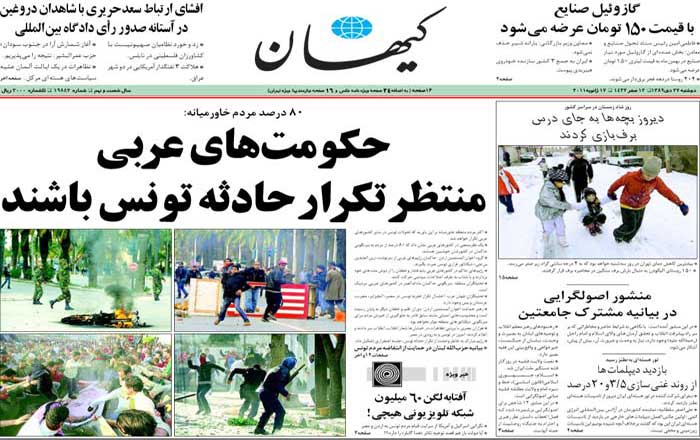
The biggest front page story of Kayhan on Monday, 17 January 2011 is headlined thus: "80% of People in the Middle East: Repeat of Tunisia Phenomenon in Store for Arab Governments."
Raja News,1 for its part, notes five similarities between the deposed Shah of Iran and the deposed Tunisian president: promoting secularism with an iron hand; supporting and being supported by the West; looting national wealth during escape; attempting to impose lifelong rule; and getting driven out from home and getting discarded by the West.
A note of general satisfaction, in short, is unmistakable among the oficialistas in Iran. The revolution in Tunisia, in their eyes, confirms their strategic assessment that "a major shift in the regional balance of power" underway favors the axis of resistance:
1 Raja News, by the way, is giving big play to the news of exiled Renaissance Party leader Rashid Ghannoushi's return to Tunisia. Its editor has apparently failed to canvass informed Arab sources such as this: "Aljazeera has [to] stop promoting Rashid Ghannushi and stop announcing his travel to Tunisia as if his impending arrival is analogous to that of Khumayni's return to Iran. No one cares about Ghannushi, from what I have seen, although I won't rule out the likelihood of the emergence of an Islamist current later on."
2 Rising youth unemployment, plus relative deprivation felt by educated youth, resulting from a combination of a youth bulge due to demographic transition, economic liberalization making decent jobs in the public sector scarcer, and slower growth of the world capitalist economy after the end of the post-WW2 boom, is a common story in the Middle East. What is peculiar to the Iranian case is both the rise and the fall of the youth bulge are sharper than in any other country: "As noted above, the current group of Iranian youth is the largest in the country's history. In 2005, the age group 20-24 was 62 percent larger than it was 10 years earlier, 9.1 million compared to 5.6 million, pushing the ratio of youth, which we define as ages 15-29, to total population to 35 percent, the highest recorded ratio in any country. Figure 1 shows that Syria has the second highest youth ratio (32 percent) while Turkey's is considerably lower, about 27 percent, having passed its peak of near 30 percent in the 1990s. By 2020, youth ratio will decline considerably, to less than 25 percent, the level observed in advanced countries. This is because the youth population is predicted to fall in absolute terms; for example, the 20-24 age group is expected to shrink by 75 percent in 2015, to 5.2 million. The reason for Iran's high youth ratio and its fluctuations is a baby boom in the early 1980s, when the revolutionary government was pro-natal, followed by a sharp decline in fertility in the 1990s, when it reversed this policy" (footnotes omitted, Djavad Salehi-Isfahani, "Iranian Youth in Times of Economic Crisis," September 2010).
3 E.g., "Iran has witnessed several spirited labor actions in recent years, well-known examples being the wildcat strikes of Tehran bus drivers and schoolteachers. But these actions have not crystallized into what can be called a coordinated, militant labor movement. Furthermore, militancy has not yet appeared in the most sensitive sectors of the economy, oil and transportation of freight. . . . These trends of diffusion of protest and relatively small-bore economic demands have held during the Ahmadinejad presidency. . . . [T]he core of the Green Movement leadership is devoted to an Iranian version of trickle-down economics, according to which the masses will eventually enjoy the good life but only if the elites prosper first and furiously. The Green Movement has offered little in terms of a redistributive vision that could motivate the working class to flex its muscles" (Mohammad Maljoo, "The Green Movement Awaits an Invisible Hand," Middle East Report, 26 June 2010).
4 Two contrasting views of the subsidy reform: Djavad Salehi-Isfahani, "Iran: Goodbye to Energy Subsidies, Hello to Price Controls?" (Tyranny of Numbers, 19 December 2010); Kevan Harris, "Iran's Subsidy Reductions: Upon Whom Will the Costs Fall?" (MRZine, 27 December 2010). It would be instructive to comparatively study Iran's subsidy reform juxtaposed with the aborted energy price reform in Bolivia and the ongoing economic reform in Cuba.
Raja News,1 for its part, notes five similarities between the deposed Shah of Iran and the deposed Tunisian president: promoting secularism with an iron hand; supporting and being supported by the West; looting national wealth during escape; attempting to impose lifelong rule; and getting driven out from home and getting discarded by the West.
A note of general satisfaction, in short, is unmistakable among the oficialistas in Iran. The revolution in Tunisia, in their eyes, confirms their strategic assessment that "a major shift in the regional balance of power" underway favors the axis of resistance:
In Tehran, there is a strong belief that the region is changing dramatically in favor of Hezbollah, the Palestinians, and the Resistance. The rise of an independent Turkey, whose government has a worldview very different from that of the U.S., German, British, and French governments, along with the relative decline of Saudi and Egyptian regional influence, signals a major shift in the regional balance of power. Saudi military incompetence during the fighting with Yemeni tribes along the border between the two countries, the general decline of the Egyptian regime in all respects, and the almost universal contempt among Arabs as a whole for the leaders of these two countries and other pro-western Arab regimes and their corrupt elites, are seen as signs that the center cannot hold. The fact that the Iranian president and the Turkish prime minister are so popular in Arab countries, while most Arab leaders are deeply unpopular, is a sign that the region is changing.Meanwhile, the Web site of the embattled Green Path Movement features Nader Marzban's opinion reflecting on "Iran and Tunisia: Superficial Similarities and Substantial Differences between the Two Movements." What is the main difference? Marzban highlights the difference between the Iranian movement's reform strategy and the Tunisian movement's revolutionary strategy. What is more important, however, is that in Tunisia the movement first began with, and has organically grown from, a protest against unemployment,2 a class battle, an aspect notable for its absence at the height of the Green Path Movement.3 As the tenth government of the Islamic Republic implements controversial subsidy reform4 in Iran, both defenders and opponents of the nezam of Iran today will have opportunities to revisit similarities and differences between Iran and Tunisia.
1 Raja News, by the way, is giving big play to the news of exiled Renaissance Party leader Rashid Ghannoushi's return to Tunisia. Its editor has apparently failed to canvass informed Arab sources such as this: "Aljazeera has [to] stop promoting Rashid Ghannushi and stop announcing his travel to Tunisia as if his impending arrival is analogous to that of Khumayni's return to Iran. No one cares about Ghannushi, from what I have seen, although I won't rule out the likelihood of the emergence of an Islamist current later on."
2 Rising youth unemployment, plus relative deprivation felt by educated youth, resulting from a combination of a youth bulge due to demographic transition, economic liberalization making decent jobs in the public sector scarcer, and slower growth of the world capitalist economy after the end of the post-WW2 boom, is a common story in the Middle East. What is peculiar to the Iranian case is both the rise and the fall of the youth bulge are sharper than in any other country: "As noted above, the current group of Iranian youth is the largest in the country's history. In 2005, the age group 20-24 was 62 percent larger than it was 10 years earlier, 9.1 million compared to 5.6 million, pushing the ratio of youth, which we define as ages 15-29, to total population to 35 percent, the highest recorded ratio in any country. Figure 1 shows that Syria has the second highest youth ratio (32 percent) while Turkey's is considerably lower, about 27 percent, having passed its peak of near 30 percent in the 1990s. By 2020, youth ratio will decline considerably, to less than 25 percent, the level observed in advanced countries. This is because the youth population is predicted to fall in absolute terms; for example, the 20-24 age group is expected to shrink by 75 percent in 2015, to 5.2 million. The reason for Iran's high youth ratio and its fluctuations is a baby boom in the early 1980s, when the revolutionary government was pro-natal, followed by a sharp decline in fertility in the 1990s, when it reversed this policy" (footnotes omitted, Djavad Salehi-Isfahani, "Iranian Youth in Times of Economic Crisis," September 2010).
3 E.g., "Iran has witnessed several spirited labor actions in recent years, well-known examples being the wildcat strikes of Tehran bus drivers and schoolteachers. But these actions have not crystallized into what can be called a coordinated, militant labor movement. Furthermore, militancy has not yet appeared in the most sensitive sectors of the economy, oil and transportation of freight. . . . These trends of diffusion of protest and relatively small-bore economic demands have held during the Ahmadinejad presidency. . . . [T]he core of the Green Movement leadership is devoted to an Iranian version of trickle-down economics, according to which the masses will eventually enjoy the good life but only if the elites prosper first and furiously. The Green Movement has offered little in terms of a redistributive vision that could motivate the working class to flex its muscles" (Mohammad Maljoo, "The Green Movement Awaits an Invisible Hand," Middle East Report, 26 June 2010).
4 Two contrasting views of the subsidy reform: Djavad Salehi-Isfahani, "Iran: Goodbye to Energy Subsidies, Hello to Price Controls?" (Tyranny of Numbers, 19 December 2010); Kevan Harris, "Iran's Subsidy Reductions: Upon Whom Will the Costs Fall?" (MRZine, 27 December 2010). It would be instructive to comparatively study Iran's subsidy reform juxtaposed with the aborted energy price reform in Bolivia and the ongoing economic reform in Cuba.
Monday, July 05, 2010
Separation of Religion and Science: US behind Iran
"Teach Evolution, Learn Science: We're ahead of Turkey, But behind Iran," according to Gerald Weissmann. Mollas are a dime a dozen in the world today, but Iran's mollas aren't just any mollas -- they are animal-cloning, robot-building, satellite-launching, stem-cell-researching, uranium-enriching mollas.
That is why there is no quick military solution for the empire comparable to Israel's attack on the Osirak reactor in Iraq and Israel's bombing of what is said to be a nuclear facility in Syria. Iran has succeeded in the tasks of both mass education and higher education, building a deeper and broader base of scientific and technological human capital than in any other country in the region except Israel. That means that Iran can rebuild what gets destroyed.
Given its rate of scientific production, as reported in NewScientist, Iran may eventually catch up with Israel, too:
Scientific output has grown 11 times faster in Iran than the world average, faster than any other country. A survey of the number of scientific publications listed in the Web of Science database shows that growth in the Middle East -- mostly in Turkey and Iran -- is nearly four times faster than the world average.Is that a "threat" to Israel or the United States? Not if these two countries aren't run by people who are given to seeing the world as if it were the stage for a zero-sum game of power struggle. The question is if they are.
Science-Metrix, a data-analysis company in Montreal, Canada, has published a detailed report (PDF) on "geopolitical shifts in knowledge creation" since 1980.
Tuesday, June 15, 2010
Two, Three, Many 1960s
Check out this beautiful article by an American woman: Chelsea Szendi Schieder, "Two, Three, Many 1960s" (MRZine, 15 June 2010). This is a very fair assessment, and moving commemoration, of the New Left in Japan and the global Sixties (maybe only a gaizin-san can be this fair to both the J New Left and the JCP -- the only thing missing in the article is a mention of Kanba Michiko's own writings, so I added links to those). This is 200% better than most of the articles about May 68 in France that came out in 2008. Anyhow, as you can see from the article, it's not easy establishing a republican state, is it, even -- or perhaps especially -- in the North? All sides of the Iranian nation and their leadership sometimes sound nutty, but, still and all, they are "people to be reckoned with," so very unlike the people running the show, and people who let them run it, in Japan, who are not even as interesting as the AKP!
Saturday, March 27, 2010
Jacobinism with Islamic Characteristics
The best way to understand the Islamic Republic of Iran is to see it not as "theocracy" but as "Jacobinism with Islamic Characteristics."
The power elite of Iran don't care about Islam as such (Islam, after all, is diverse, and some varieties of it, as conceived by Nader Hashemi, Mohsen Kadivar, Ahmad Sadri, and the like, are perfectly compatible with liberal democracy). What they care about is their revolution and their republic and their ideology (in which Islam does play a part but an increasingly smaller one). As IRGC General Mohammad Ali Jafari reportedly said:
حفظ نظام جمهوری اسلامی ایران از ادای نماز واجبتر است
They love their politico-economic order much more than prayers.
Unlike the USSR and the Eastern Bloc, whose legitimating ideology came from outside (Western Europe) and was instilled from above (the Marxist-Leninist Party), though, their ideology is one that has organically grown out of Iranian history, which is what is going for them.
My back-of-the-napkin calculation, however, says that about 20% of the Iranian population, largely of economically upper strata, are liberals who are tired of this politico-economic order and its legitimating ideology. Give Iran a couple of decades in which its social dialectic can unfold without foreign intervention, and liberals are likely to grow more numerous in the country as it undergoes its capitalist development; and liberals inside Iran might eventually transform the country in a way that liberals outside it would like, through passive revolution (much as the AKP has done in Turkey, which too was once ruled by men of the Jacobin mentalité).
Meanwhile, the duty of Iranian patriots, even liberals in exile, is not to let imperialists bomb Iran.
Tuesday, March 09, 2010
The Iranian Diaspora after the Green Wave
So, what is the new preoccupation of the Iranian diaspora after the Green Wave? Having received 170 comments (and counting), this item posted on International Working Women's Day is the most popular thing today at Iranian.com.
Thursday, March 04, 2010
IRIB in Japanese
A funny thing about the Islamic Republic of Iran Broadcasting (IRIB) is that, of all its numerous foreign-language versions, it provides Iranian food recipes, tourist information, a detailed introduction to master musicians of Iran, elementary Persian-language lessons, etc. only on its Japanese-language site. They know my people, whose main interests generally run toward good food, sightseeing, and cultural sampling (usually in that order)!
Wednesday, February 17, 2010
Thursday, February 11, 2010
Iran: The Islamic Revolution Defeats Western Hopes for Regime Change
. . . and Hashemi's hopes for a palace coup.
Having defeated the Western hopes for regime change and the endogenous upper-class hopes for a palace coup, Salomes of Iran will have a better chance to fight for freedom.
* For the social and political character of the Green Wave, consult Iran's Last Marxist Nasser Zarafshan: Setareh Derakhshesh, "Interview with Dr. Nasser Zarafshan and Farrokh Negahdar" (VOA Persian, 6 January 2010).
| Isfahan | Tehran |
Having defeated the Western hopes for regime change and the endogenous upper-class hopes for a palace coup, Salomes of Iran will have a better chance to fight for freedom.
* For the social and political character of the Green Wave, consult Iran's Last Marxist Nasser Zarafshan: Setareh Derakhshesh, "Interview with Dr. Nasser Zarafshan and Farrokh Negahdar" (VOA Persian, 6 January 2010).
Tuesday, August 18, 2009
The Scandal of Privatization in Iran
Probably the worst thing that the Islamic Republic of Iran has done for its working people is to educate its young economists at "the most prestigious Western economics departments." The horror, the horror! It's not the Western fashion in clothing but economics that the IRI should have kept out, but, as Sohrab Behdad has argued, the idea of Islamic economics met its demise soon after its rise -- much like the idea of socialist economics, I may add.
Despite the resurgence of gharbzadegi in its economics, though, hardly any privatization worth its name has been going on in Iran: "a main buyer of government assets over the last decade has been the para-governmental sector, which includes state banks, government-linked investment and holding companies, religious foundations, and pension funds" (Mohammad Khiabani, "The Great Tehran Expo Privatization Scandal You've Never Heard Of").
That is largely thanks to the Western sanctions, I suspect. It is probably also thanks to the political culture of Iran. Get ten Iranians to speak up, and you'll probably get twenty contradictory opinions about how thing are and why they are as they are in Iran, at least about fifteen of which are conspiracy theories. Nothing changes very fast in a country like that.
Monday, August 17, 2009
Ahmadinejad to Propose "at Least Three Female Ministers in His New Cabinet"
Reuters reports: "President Mahmoud Ahmadinejad said on Sunday he would propose at least three female ministers in his new cabinet following Iran's disputed election, an unprecedented move in the conservative Islamic state. . . . It would be the first time a woman would hold a ministerial position in Iran since its 1979 Islamic revolution" (Zahra Hosseinian, "Ahmadinejad Plans Female Ministers in Iran Cabinet," 16 August 2009).
Three female cabinet ministers would be more than Iran has ever gotten in its entire modern history, not just in the history of the Islamic Republic. Khatami had only Masoumeh Ebtekar (head of the Environment Protection Organization of Iran) and Zahra Shojaei (head of the Center for Women's Participation) in his cabinet, who were replaced by Fatemeh Javadi and Nasrin Soltankhah respectively in Ahmadinejad's first cabinet. It looks like it's easier to improve Ahmadi's cultural program than reform Khatami-Mousavi-Rafsanjani's economic and foreign policy programs.
Three female cabinet ministers would be more than Iran has ever gotten in its entire modern history, not just in the history of the Islamic Republic. Khatami had only Masoumeh Ebtekar (head of the Environment Protection Organization of Iran) and Zahra Shojaei (head of the Center for Women's Participation) in his cabinet, who were replaced by Fatemeh Javadi and Nasrin Soltankhah respectively in Ahmadinejad's first cabinet. It looks like it's easier to improve Ahmadi's cultural program than reform Khatami-Mousavi-Rafsanjani's economic and foreign policy programs.
Friday, August 14, 2009
Mahmoud & Esfandiar's Excellent Adventure
Khanome Yoshie finds Mahmoud & Esfandiar very trippy.
Mahmoud & Esfandiar's Excellent Adventure
MRZine Editor
Esfandiar Rahim Mashaei, whose daughter is married to a son of Mahmoud Ahmadinejad, is the President's Chief of Staff. Mr. Mashaei is known for actions that have appalled certain conservative quarters of the Iranian political establishment, such as attending a ceremony in Turkey where women danced and hosting a ceremony in Tehran where women drumming dafs brought out the Qur'an (don't ask me why this is controversial). He is also known for making such fascinating remarks as the following, according to Etemaad:
Mr. Mashaei is apparently incorrigible, however. Here's his latest bombshell, according to Etemad-e Melli today: "Of the 24 million Ahmadinejad voters, 20 million are critical of the system. These 20 million people are even more critical of the system than the 13 million Mousavi voters, since those 13 million only question the Ahmadinejad administration, whereas these 20 million are saying No to all the past years before Ahmadinejad."
Whoa!
Iran's reformist media have assiduously followed Mr. Mashaei's excellent adventure, a few episodes of which have also been briefly carried by some of the Western media. Both the Western and Iranian-reformist media fail to ask an obvious question, though: is the man who has stood loyally by Mr. Mashaei throughout his wild ideological trip the kind of guy for whom the guardians of the system, lay and clerical, military and civilian, would work in disciplined cooperation to pull off a massive conspiracy for a massively rigged election?
Mahmoud & Esfandiar's Excellent Adventure
MRZine Editor
Esfandiar Rahim Mashaei, whose daughter is married to a son of Mahmoud Ahmadinejad, is the President's Chief of Staff. Mr. Mashaei is known for actions that have appalled certain conservative quarters of the Iranian political establishment, such as attending a ceremony in Turkey where women danced and hosting a ceremony in Tehran where women drumming dafs brought out the Qur'an (don't ask me why this is controversial). He is also known for making such fascinating remarks as the following, according to Etemaad:
- "The age of Islamism is over. It's not that Islamism doesn't exist or isn't growing. Islam exists but its time is up. The age of horseback riding is over now, though horses exist, and so do riders. . . . Of course, it isn't completely finished, but it's getting there."
- "Iran today is a friend of the American and Israeli peoples. No nation in the world is an enemy of Iran, though, of course, we have enemies, in fact, faced with the most dastardly enemies in the world."
Mr. Mashaei is apparently incorrigible, however. Here's his latest bombshell, according to Etemad-e Melli today: "Of the 24 million Ahmadinejad voters, 20 million are critical of the system. These 20 million people are even more critical of the system than the 13 million Mousavi voters, since those 13 million only question the Ahmadinejad administration, whereas these 20 million are saying No to all the past years before Ahmadinejad."
Whoa!
Iran's reformist media have assiduously followed Mr. Mashaei's excellent adventure, a few episodes of which have also been briefly carried by some of the Western media. Both the Western and Iranian-reformist media fail to ask an obvious question, though: is the man who has stood loyally by Mr. Mashaei throughout his wild ideological trip the kind of guy for whom the guardians of the system, lay and clerical, military and civilian, would work in disciplined cooperation to pull off a massive conspiracy for a massively rigged election?
Wednesday, August 12, 2009
Egypt!
Not getting any play in the Western media, but the struggle in Egypt is incomparably more promising for the advancement of the Left than whatever is going on in Iran: Per Bjorklund, "Egypt's State-Controlled Unions Under Pressure" (10 August 2009); and Per Bjorklund, "Tax Collectors Repeat Historical Sit-in" (11 August 2009).
BTW, have I mentioned that Hossam el-Hamalawy, referenced in Bjorklund's notes above, is very hot (and about four decades younger than Mousavi who is even older than Ahmadi) in case any of you is looking for a cute Middle Eastern youth to back, the fashion in this political season? He's a revolutionary Marxist, too (unlike probably 99.99999% of the Green protesters in Iran, no matter how cute they are) if that means anything to you.
BTW, have I mentioned that Hossam el-Hamalawy, referenced in Bjorklund's notes above, is very hot (and about four decades younger than Mousavi who is even older than Ahmadi) in case any of you is looking for a cute Middle Eastern youth to back, the fashion in this political season? He's a revolutionary Marxist, too (unlike probably 99.99999% of the Green protesters in Iran, no matter how cute they are) if that means anything to you.
Tuesday, August 11, 2009
Japanese Lesson for the Iranian Left
The wind of populism blows in Japan, in rhetoric if not in policy, raising the hope of finally putting an end to the world's longest-standing one-party state. Alas, the wind has not filled the sail of the Communist Party, but that of the social liberal party on the center left. Still and all, it ought to be an object lesson to leftists in Iran, the only leftists in the world to line up behind a loser upholding an anti-Keynesian banner in the midst of a global economic crisis.
Monday, August 10, 2009
Banks Make $38bn from Overdraft Fees
From the middle of September 2008 till about the end of that year, I, as editor of MRZine, received a flood of submissions on the subject of the "Crisis of Capitalism" from assorted leftists. That genre of submissions has virtually disappeared, as it became clear to all, even leftists, that -- given the ruling-class alacrity in solving their collective action problem and the working-class difficulty in solving ours -- this is not a crisis of the capitalist class but a crisis of the working class, which is apparently not as exciting a topic for leftists as the idea of the Crisis of Capitalism.
The biggest international news this year so far has been the Israeli bombing of Gaza and the electoral dispute in Iran, which has even eclipsed the first successful military coup d'etat in South America since the end of the Cold War, let alone a little matter of bailed-out banks' ill-gotten gains: e.g., Saskia Scholtes and Francesco Guerrera, "Banks Make $38bn from Overdraft Fees" (Financial Times, 10 August 2009). I suspect a nefarious Zionist-Islamist conspiracy to try to hoodwink international leftists.
The biggest international news this year so far has been the Israeli bombing of Gaza and the electoral dispute in Iran, which has even eclipsed the first successful military coup d'etat in South America since the end of the Cold War, let alone a little matter of bailed-out banks' ill-gotten gains: e.g., Saskia Scholtes and Francesco Guerrera, "Banks Make $38bn from Overdraft Fees" (Financial Times, 10 August 2009). I suspect a nefarious Zionist-Islamist conspiracy to try to hoodwink international leftists.
Tuesday, August 04, 2009
Imagining a New Political Majority in Iran
The change that has come to Iran since the end of the Iran-Iraq War is more or less in line with the kind of change that has come to much of the rest of the world (though each nation's change is of course inflected with its own peculiar material and cultural conditions before the beginning of the neoliberal regime of accumulation): a package that combines economic liberalization, cultural liberalization, and political liberalization.
That is not a desirable package, from the point of view of historical materialism, though liberals are happy with it and social democrats adjust themselves to it.
In theory, it should not be impossible to construct a new political majority in Iran taking supporters from both the Ahmadinejad/Khamenei camp and the Rafsanjani/Mousavi/Khatami camp, under a program that puts premium on resistance to economic liberalization, creates space for "rooted cosmopolitan" culture, and develops a strategy to deepen democracy, empowering directly elected leaders (the presidency and the parliament) to eclipse indirectly elected leaders (the Leader and the Guardian Council) as well as promoting democratic participation and political education of the popular classes. But I have yet to see any social force in Iran proposing anything like that.
Saturday, August 01, 2009
Truth and Reconciliation for Iran
The following is an extremely good and timely statement, signed by Iranian patriots, some of whom have taken one side or the other regarding the presidential election and post-election conflicts, and others of whom have taken a neutral stand on them. I encourage non-Iranian leftists to support this attempt and others like it.
Truth and Reconciliation for Iran
We are a group of university educators and antiwar activists with diverse political views who are based in Europe and North America. During the past few years we have been active in defending Iran's national rights -- particularly those relating to the peaceful use of nuclear energy -- against the pervasive deception created by western and Israeli-influenced media and official statements. We have consistently taken a stand against the policies of the United States and its allies, including the improper submission of Iran's nuclear file to the United Nations security council, the imposition of sanction resolutions against Iran, covert destabilisation inside the country and repeated threats of military intervention and bombing of nuclear centres on the part of US and Israel.
At the same time, we have advocated the human rights of individuals and democratic rights for various groups and constituencies in Iran. We have emphasised that the guarantee of such rights is necessary not only for Iran's social and political advancement, but also for the vital unity of our people against foreign pressures.
In the current post-election crisis, we see it as our duty to share our views based on years of defending Iran's national rights, and to help develop realistic solutions for the benefit of all our compatriots of whatever political persuasion.
The background to the current situation is the longstanding belligerent policies of the US and its allies, encouraged by the neoconservatives and the Israeli lobby, which peaked during eight years of Republican rule in the White House. Despite President Khatami's conciliatory approach, exemplified by his promotion of "Dialogue Among Civilisations", and despite Iran's co-operation in the overthrow of the Taliban in neighbouring Afghanistan, the administration of George W Bush labelled the Islamic Republic a member of the "axis of evil". Following the illegal invasion of Iraq, Bush pushed for regime change in Iran. These provocative and confrontational policies played a key role in the defeat of Iranian reformists in the parliamentary elections of 2003 and the presidential election of 2005.
During the past four years, a whole series of policies have targeted Iran's right to produce nuclear fuel for peaceful energy, including illegitimate UN/US sanctions, repeated implicit and overt threats of military attack by the United States and Israel, overt and covert well-funded US destabilisation operations, and aid to terrorist forces seeking to overthrow the government of Iran. These policies have created fears of an externally-instigated "velvet revolution" in the leadership ranks of the Islamic Republic. These fears were used to justify restrictions of civil and political freedoms promoted by the reformist administration of Khatami and, as a result, civil society and non-governmental organisations suffered a setback.
According to critics, these social and political pressures, along with government mismanagement caused by the removal of competent technocrats, have negatively impacted the public interest and put enormous pressure on the middle class, the educated class, journalists and artists. These people must be allowed a more open and free environment in order to fulfil their instrumental roles in service of the country.
On the external front, the Obama administration, facing neoconservative pressure and keeping many of his predecessor's policies against Iran, has nevertheless declared its readiness for unconditional negotiations with Iran. He has for the first time referred to Iran as the "Islamic Republic" and indicated that he is not pursuing regime change in Iran. Furthermore, shortly before the Iranian elections, in a first for an American president, Obama admitted the role of his country in the 1953 coup that overthrew the democratically elected prime minister Muhammad Mossadegh. These changes in US politics have created room for active and constructive diplomacy for the purpose of solving conflicts and disagreements between Iran and the United States, and for creating a nuclear-free Middle East.
This year, there was in Iran a record level of participation in the elections, unprecedented television debates and, most important of all, widespread participation in election campaigns. Despite some restrictions, the elections took place in an overall constructive climate, perhaps making Iran a model democracy among Islamic nations of the region. A day before the elections, Senator John Kerry, a key US statesman, was so impressed that he dismissed as "ridiculous" Bush's policy of denying Iran peaceful nuclear energy, which in itself exposes the baseless nuclear accusations levelled against Iran and proves the illegitimacy of security council resolutions against Iran.
However, in the view of a considerable number of Iranians who are discontented and frustrated with the restrictions on civil and political freedoms, there were various irregularities in the elections, including the suspension of reformist newspapers and mobile telephone SMS service on election day. This caused mass public demonstrations in support of nullifying the election. The unrest has created a major rift between the supporters of Ahmadinejad, who deem Iran's national sovereignty to be of the highest priority, and the supporters of the two reform candidates Karroubi and Mousavi, who demand increased civil and political freedoms above all.
Each of these two major wings of the body politic includes millions of people and both play a vital role in Iran's progress. The rift between these two must heal in an environment of calm, without agitation and mudslinging, for the sake of Iran's future. This healing must be pursued through the path of constructive dialogue and reconciliation, so that the unity of our people for safeguarding national rights can be achieved.
Unfortunately, a large number of our protesting fellow countrymen have been attacked and injured and even more regrettably, a significant number of them have been killed. Also, a large group of reformist activists and leaders have been arrested and imprisoned after the elections.
Both Mousavi and Karroubi have stressed that all protests must remain within the law. Following the request of the reformist and Green leaders, almost all protesters rallied completely peacefully, and in the tradition of Mahatma Gandhi, condemned all types of violence, calling the Basijis and Revolutionary Guards their own brothers. Extremist elements who used the opportunity to create chaos and engaged in the destruction of public property were condemned by Mousavi.
The western media, by their one-sided coverage of the post-election developments, portrayed the street demonstrations protesting the election results as the start of a "velvet" revolution against the Islamic Republic. Regime-change advocates also tried to piggy-back on the protests outside Iran for their own purposes. The British government, which claims to follow a policy of non-interference in Iran's internal affairs, did its part by confiscating nearly £1bn of Iranian assets. To make matters worse, the neoconservatives demanded a re-evaluation of the Obama administration's policy of unconditional negotiations with Iran. The US state department also used this crisis to justify its continuation of Bush-era policies of financing anti-Iranian government organisations for the purposes of "spreading democracy, human rights and a government of law and order". For "security reasons" they refused to release the identities of the recipients of the funds. The Iranian government, for their part, deported two British diplomats, accusing them of interference in Iranian affairs and pointing to western governments as the root of the post-election unrest.
Whatever the role of the western media, governments, and regime change forces, it cannot detract from the legitimacy of the massively popular protests. In fact, Mousavi has emphasised his complete loyalty to the Islamic Republic and admonished his supporters abroad to stay away from the anti-Islamic Republic groups. To attribute the roots of the demonstrations by hundreds of thousands of Iranians to external interference or to regime-change groups amounts to questioning the independence of the country which has been gained and consolidated by the sacrifices of hundreds of thousands.
In the opinion of millions of Iranians, the current crisis has been caused by restrictions on political freedoms, particularly freedom of the press, economic discontent, and deficiencies in transparency and accountability on the part of government institutions. Although these issues have been aggravated by the US political, military and economic encirclement and the CIA's destabilisation programmes, in the view of this segment of society the problems are ultimately rooted in the government's own policies. After their unprecedented participation in the elections, millions of Iranians have lost their confidence in the system. Awareness of this reality was expressed by the speaker of the Iranian parliament Ali Larijani, who indicated on live national television that some members of the Guardian Council openly supported a certain candidate, instead of being neutral during the investigation of the election complaints. He also added that the large segments of society who distrust the declared election results should not be regarded in the same manner as the rioters.
On the basis of the above assessment, and in the interest of resolving the present crisis, we direct all officials and fellow countrymen to the following proposals:
1) Arrests and assaults of reformist and Green movement activists and any use of deadly weapons against the protesters are against the national interest and must be stopped and condemned by the authorities. Of the government of the Islamic Republic, we demand, in accordance with the constitution and for the preservation of national unity, that it release the reformist leaders from detention and observe freedom of the press and other civil rights. Iranian state television and radio must provide time to the protesters to express their views. Permits for nonviolent assembly must be given to the protesters. The government must guarantee the safety of the demonstrators against any violence and those responsible for battering and murdering students and demonstrators must be identified and prosecuted.
2) The current division among the people that separates government supporters and dissenters, under conditions of economic, military and political encirclement, must be reconciled with calm and patient negotiations and reasoning, by condemning any kind of violence and by renouncing name-calling and inflammatory rhetoric. We call on the political forces of both sides to move toward building such a constructive climate and toward creation of an economic, political, and cultural agenda that can respond to all social needs.
3) Of the government of the Islamic Republic, we request that in view of the distrust on the part of a great segment of the country's population, it form an independent truth and national reconciliation commission with representation from all candidates, such that it can gain the trust of the people of Iran and find a reasonable solution for the conflict. The votes of a great portion of the Iranian society for both Ahmadinejad and Mousavi show that the best solution is negotiations for reconciliation and creation of a government of national unity from the ranks of Principalists and the Green movement and reformists. With a comprehensive programme based on Iran's national rights and on people's civil rights, such a government of national unity must address the current challenges facing the country and mobilise in an effective way the totality of human resources and expertise for national development.
4) Of western governments, we request that they cease any and all interference in Iranian affairs and end all their illegitimate economic, political and military pressures aimed at the internal destabilisation of Iran. They need to cease any support for the anti-Islamic Republic opposition and lift the economic and scientific sanctions. The Obama administration should emphasise unconditional negotiations and take steps toward creating a nuclear weapons-free Middle East. Only under these conditions, without any foreign threats, can the Iranian people reach their aspirations of freedom and establish their unity in a framework of independence and national sovereignty.
5) To the leaders of the reformists and the Green movement, we suggest that in order to prevent exploitation of the current crisis by western propaganda and opportunist groups, they unambiguously oppose all sanctions and condemn regime change operations and any foreign support for the anti-Islamic Republic opposition.
Signed:
Dr Arshin Adib-Moghaddam, SOAS, University of London
Professor the Baroness Afshar, York University
Mojtaba Aghamohammadi, researcher, University of Arizona
Professor Mohammad Ala, Persian Gulf Task Force
Esfandiar Bakhtiar, Georgia Institute of Technology
Professor Abbas Edalat, Imperial College London
Javad Fakharzadeh, Iran Heritage
Dr Farideh Farhi, University of Hawaii at Manoa
Massy Homayouni, independent antiwar activist
Dr Mehri Honarbin-Holliday, Canterbury Christ Church University
Mojgan Janani, independent antiwar activist
Mohammad Kamaali, Campaign Against Sanctions and Military Intervention in Iran
Fareed Marjaee, writer and democracy activist
Masoud Modarres, independent activist
Professor Pirouz Mojtahedzadeh, Tarbiyat Modarres University
Daniel Pourkesali, Campaign Against Sanctions and Military Intervention in Iran
Rostam Pourzal, Campaign Against Sanctions and Military Intervention in Iran
Dr Mohammad Purqurian, LaaL.org
Manijeh Saba, independent human rights activist
Professor Mehdi Shariati, Kansas College
Professor Nader Sadeghi, George Washington University Hospital
Shirin Saeidi, University of Cambridge
Soraya Sepahpour-Ulrich, independent antiwar activist
Reza Shirazi, Goftogoo TV
Safa Shoaee, Imperial College London
Saeed Soltanpour, Iranian TV Canada
Dr Alireza Rabi, Middle-East Citizens Assembly
Dr Elaheh Rostami, SOAS, University of London
Professor Rahmat Tavakol, Rutgers University
Professor Farzin Vahdat, Harvard University
Leila Zand, Fellowship of Reconciliation
Mark Weisbrot: It's Time for Latin America to Take Charge
Regrettably, so far there has been no large protest in the US to pressure the USG to reverse the coup in Honduras. Such protests as have happened in the US on this issue appear to have been even smaller than the Iranian Green protests in the US, which have largely consisted of Iranian immigrants of various political persuasions, from leftists to liberals to monarchists and the Iranian Mojahedin (from which most non-Iranian leftists, including vocal Green Movement supporters, have abstained). There is such an immense political vacuum on the US front in the struggle against the Honduran coup that Mark Weisbrot now suggests that the solution has to come from Latin America, without the US: Mark Weisbrot, "U.S.-Brokered Mediation Has Failed -- It's Time for Latin America to Take Charge" (MRZine, 31 July 2009). This shouldn't be impossible, as long as Argentina, Brazil, and Chile, the key powers, act forcefully, 100% united with El Salvador and Nicaragua, as well as Bolivia, Ecuador, and Venezuela.
Subscribe to:
Posts (Atom)