The countries that are the first to dramatically go down (Iceland, Pakistan, Eastern Europe, etc.) in the financial crisis, and the ones that are soon to follow them (Turkey, South Africa, etc.), are the very ones where the Washington Consensus has had the strongest impact. The more pro-American you are, the worse off you will be.* If the IMF doesn't want to send that message to the world, it can attach fewer anti-working-class (and dangerously pro-cyclical) conditions to its bailout packages, especially for the ones in the former Soviet sphere of influence, but, if this AP dispatch about the Ukraine deal is any indication, it looks as if the only country that gets a lot of special political considerations may be Georgia: Associated Press, "Yatsenyuk: Parliament Will Adopt Unpopular Conditions in Exchange for IMF Aid," Kyiv Post, 28 October 2008).
* In contrast, "Financial Crisis Leaves Iran Untouched" (Al Jazeera, 8 Oct 2008):
See, also, "Iran and the Financial Crisis" (Al Alam TV, 7 October 2008):
Showing posts with label Debt. Show all posts
Showing posts with label Debt. Show all posts
Tuesday, October 28, 2008

Friday, October 17, 2008
Marx on the National Debt
The only part of the so-called national wealth that actually enters into the collective possessions of modern peoples is their national debt. Hence, as a necessary consequence, the modern doctrine that a nation becomes the richer the more deeply it is in debt. Public credit becomes the credo of capital. And with the rise of national debt-making, want of faith in the national debt takes the place of the blasphemy against the Holy Ghost, which may not be forgiven. -- Karl Marx, Capital
Monday, October 13, 2008
Multinational Investors' Vote of Confidence in Ultra-imperialism
Check out multinational investors' major vote of confidence in ultra-imperialism today: John Willman, "Markets Cheer Bank Bail-outs" (Financial Times, 13 October 2008); Ralph Atkins, "European Banks Offer Unlimited Dollar Funding" (Financial Times, 13 October 2008); "Full Text: US Treasury Tarp Plans" (Financial Times, 13 October 2008); Louise Story and Andrew Ross Sorkin, "Morgan Agrees to Revise Terms of Mitsubishi Deal" (New York Times, 13 October 2008); "Gulf Shares Surge as UAE and Qatar Act (Financial Times, 12 October 2008); and Robin Wigglesworth and Simeon Kerr, "UAE Leads Drive to Stem Crisis" (Financial Times, 13 October 2008).
It's true that, if China, Japan, Germany, Saudi Arabia, and the United States functioned as one politically (if not legally) coherent establishment, Americans would be back in the black:
Therefore, a radical shift in global class relations could come only if there were a radical shift in any one of the aforementioned countries, but these are the very ones where the Left has the least chance in the world.
Is China, though, a weak or strong link in this chain of empire (to which Latin socialists, Islamists from the Hindu Kush to the Persian Gulf to the Horn of Africa to the Niger Delta, Maoists in Nepal and India, the national security interests of Russia, etc. have provided a partial material -- if ideologically incoherent -- counterweight)?
Update
"[T]he needs of our economy require that our financial institutions not take this new capital to hoard it, but to deploy it" ("Text: Henry Paulson Remarks Tuesday," 15 October 2008).
"Investors are recognizing that the financial crisis is not the fundamental problem. It has merely amplified economic ailments that are now intensifying: vanishing paychecks, falling home prices and diminished spending. And there is no relief in sight" (Peter S. Goodman, "Markets Suffer as Investors Weigh Relentless Trouble," New York Times, 16 October 2008).
It's true that, if China, Japan, Germany, Saudi Arabia, and the United States functioned as one politically (if not legally) coherent establishment, Americans would be back in the black:
Global Balance of Payments ($bn, 2007)
SOURCE: Martin Wolf, "Asia's Revenge," Financial Times, 9 October 2008, p. 9.
Therefore, a radical shift in global class relations could come only if there were a radical shift in any one of the aforementioned countries, but these are the very ones where the Left has the least chance in the world.
Is China, though, a weak or strong link in this chain of empire (to which Latin socialists, Islamists from the Hindu Kush to the Persian Gulf to the Horn of Africa to the Niger Delta, Maoists in Nepal and India, the national security interests of Russia, etc. have provided a partial material -- if ideologically incoherent -- counterweight)?
Update
"[T]he needs of our economy require that our financial institutions not take this new capital to hoard it, but to deploy it" ("Text: Henry Paulson Remarks Tuesday," 15 October 2008).
"Investors are recognizing that the financial crisis is not the fundamental problem. It has merely amplified economic ailments that are now intensifying: vanishing paychecks, falling home prices and diminished spending. And there is no relief in sight" (Peter S. Goodman, "Markets Suffer as Investors Weigh Relentless Trouble," New York Times, 16 October 2008).
Sunday, October 12, 2008
Toward the Highest Stage of Ultra-imperialism?
A local friend of mine jokes: if worst comes to worst, the US can always annex Saudi Arabia. But why stop there on the way to the highest stage of ultra-imperialism: America, China, Japan, Germany, and Saudi Arabia together legally conglomerated into a new United States, bringing Americans -- thank Allah and Confucius -- back in the black?
Global Balance of Payments ($bn, 2007)
SOURCE: Martin Wolf, "Asia's Revenge," Financial Times, 9 October 2008, p. 9.
What lay behind the savings glut? The first development was the shift of emerging economies into a large surplus of savings over investment. Within the emerging economies, the big shifts were in Asia and in the oil exporting countries (see chart). By 2007, according to the International Monetary Fund, the aggregate savings surpluses of these two groups of countries had reached around 2 per cent of world output.There is no political or economic incentive on the part of the biggest deficit spenders, especially the US, to change this pattern. The change therefore has to come from surplus generators.
. . . . . . . . . . . . . . . . . . . .
Last year, the aggregate surpluses of the world's surplus countries reached $1,680bn, according to the IMF. The top 10 (China, Japan, Germany, Saudi Arabia, Russia, Switzerland, Norway, Kuwait, the Netherlands and the United Arab Emirates) generated more than 70 per cent of this total. The surpluses of the top 10 countries represented at least 8 per cent of their aggregate GDP and about one-quarter of their aggregate gross savings.
Meanwhile, the huge US deficit absorbed 44 per cent of this total. The US, UK, Spain and Australia -- four countries with housing bubbles -- absorbed 63 per cent of the world's current account surpluses.
That represented a vast shift of capital – but unlike in the 1970s and early 1980s, it went to some of the world's richest countries. (emphasis added, Wolf, p. 9)
Thursday, October 09, 2008
The Global Financial Crisis Has a Social Cause, Too: the World of Low Wages: An Interview with Emiliano Brancaccio
The Global Financial Crisis Has a Social Cause, Too: the World of Low Wages:
An Interview with Emiliano Brancaccio
by Waldemar Bolze
Emiliano Brancaccio is a professor of labor economics at the University of Sannio, member of Rifondazione Comunista, and advisor to the largest union of Italian metalworkers FIOM-CGIL.
You maintain that the financial crisis is not purely a technical financial phenomenon but has a social cause. Why?
The starting point is the weakness of the labor movement, which has made a world of low wages possible. However, this world is structurally unstable, which we are now beginning to experience. Today every country tries to keep the wage level low, thereby diminishing the domestic demand, and must find foreign markets for its own products.
This mechanism has worked for the last ten years because the United States has functioned as a "vacuum cleaner" for surplus products of other countries. And not because the wages of American workers were so high, but because a huge private debt was accumulated in the United States. The system led to workers paying their mortgage debts with new loans and paying the interests on the loans with new credit cards.
Could such a fragile credit structure actually hold?
It was nothing other than a time bomb, which has now exploded. The consequences are once again passed onto workers and employees, while executives of Wall Street, who manufactured these explosives, could even profit from them.
Take, for example, the Paulson plan. It stipulates that the government is to buy the risky assets of investment banks and in return place fresh money at their disposal, leaving a possibility that the banks, once the storm has passed, can regain their titles. If the government pays high enough prices, the bankers can eventually pocket a nice profit at the expense of the state budget.
What obvious impact will the current crisis have?
Much will depend on its duration and depth. At the moment, the establishment is pursuing a strategy which Giuseppe Tomasi di Lampedusa spelled out in his book The Leopard: "If we want everything to remain as it is, we must change everything." The Paulson plan is an example of this strategy, because it consists of a barter of cash for debts, designed to intervene as little as possible in the terms of ownership and control of bank capital. The same applies to the sales of preferred shares to the government because these restrict the voting right at the meetings of shareholders.
Has the ideology of neoliberalism failed and are the days of capitalism numbered?
The idea is amusing, but it would be naïve to assume an imminent end of capitalism. I cannot see how such a thing can materialize. The big absentee in this colossal state of emergency is precisely the labor movement. Rather, I see the possibility of a shift in relative power from finance lobbies to political pressure groups and also from Western and American political lobbies to Asian ones.
Can we then speak of the decline of the American empire?
The appearance and all temporary upsurges and short-term successes notwithstanding, the American decline has continued for at least a quarter century. For this decline is symptomatic of the long-term development of the dollar, whose price -- converted to today's currency -- has fallen from 1.50 euros to around 70 euro cents within 20 years. This decline ensures distrust toward the dollar and will likely prevent the USA from playing the role of the "vacuum cleaner" for surplus products of other countries again. Since there is no alternative international hegemon, there is a danger that the international monetary system will hit a dead end. In that event, the development of this crisis could take on really dark and unpredictable characteristics.
The original interview in German appeared in junge Welt on 9 October 2008. Translation by Yoshie Furuhashi.
An Interview with Emiliano Brancaccio
by Waldemar Bolze
Emiliano Brancaccio is a professor of labor economics at the University of Sannio, member of Rifondazione Comunista, and advisor to the largest union of Italian metalworkers FIOM-CGIL.
You maintain that the financial crisis is not purely a technical financial phenomenon but has a social cause. Why?
The starting point is the weakness of the labor movement, which has made a world of low wages possible. However, this world is structurally unstable, which we are now beginning to experience. Today every country tries to keep the wage level low, thereby diminishing the domestic demand, and must find foreign markets for its own products.
This mechanism has worked for the last ten years because the United States has functioned as a "vacuum cleaner" for surplus products of other countries. And not because the wages of American workers were so high, but because a huge private debt was accumulated in the United States. The system led to workers paying their mortgage debts with new loans and paying the interests on the loans with new credit cards.
Could such a fragile credit structure actually hold?
It was nothing other than a time bomb, which has now exploded. The consequences are once again passed onto workers and employees, while executives of Wall Street, who manufactured these explosives, could even profit from them.
Take, for example, the Paulson plan. It stipulates that the government is to buy the risky assets of investment banks and in return place fresh money at their disposal, leaving a possibility that the banks, once the storm has passed, can regain their titles. If the government pays high enough prices, the bankers can eventually pocket a nice profit at the expense of the state budget.
What obvious impact will the current crisis have?
Much will depend on its duration and depth. At the moment, the establishment is pursuing a strategy which Giuseppe Tomasi di Lampedusa spelled out in his book The Leopard: "If we want everything to remain as it is, we must change everything." The Paulson plan is an example of this strategy, because it consists of a barter of cash for debts, designed to intervene as little as possible in the terms of ownership and control of bank capital. The same applies to the sales of preferred shares to the government because these restrict the voting right at the meetings of shareholders.
Has the ideology of neoliberalism failed and are the days of capitalism numbered?
The idea is amusing, but it would be naïve to assume an imminent end of capitalism. I cannot see how such a thing can materialize. The big absentee in this colossal state of emergency is precisely the labor movement. Rather, I see the possibility of a shift in relative power from finance lobbies to political pressure groups and also from Western and American political lobbies to Asian ones.
Can we then speak of the decline of the American empire?
The appearance and all temporary upsurges and short-term successes notwithstanding, the American decline has continued for at least a quarter century. For this decline is symptomatic of the long-term development of the dollar, whose price -- converted to today's currency -- has fallen from 1.50 euros to around 70 euro cents within 20 years. This decline ensures distrust toward the dollar and will likely prevent the USA from playing the role of the "vacuum cleaner" for surplus products of other countries again. Since there is no alternative international hegemon, there is a danger that the international monetary system will hit a dead end. In that event, the development of this crisis could take on really dark and unpredictable characteristics.
The original interview in German appeared in junge Welt on 9 October 2008. Translation by Yoshie Furuhashi.
Saturday, October 04, 2008
History
Once upon a time, the Left believed that history was on the march toward socialism. This belief has been shaken by various events, from the Moscow show trials, Hungary 1956, Czechoslovakia 1968, to the end of the USSR and restoration of capitalism in China.
Once upon a time, the Right believed, like Francis Fukuyama, that history had ended, with the culmination of history in capitalism + liberal democracy. This belief has been shaken by various events: Islamic resistance to the West's politico-military campaign to create a New Middle East, a resurgence of the Left in Latin America, the West's self-destruction of its own liberal and democratic facade through the "War on Terror," and finally the global financial crisis starting in the subprime states of America.
Now both sides have to approach history as an open-ended process of struggle.
Once upon a time, the Right believed, like Francis Fukuyama, that history had ended, with the culmination of history in capitalism + liberal democracy. This belief has been shaken by various events: Islamic resistance to the West's politico-military campaign to create a New Middle East, a resurgence of the Left in Latin America, the West's self-destruction of its own liberal and democratic facade through the "War on Terror," and finally the global financial crisis starting in the subprime states of America.
Now both sides have to approach history as an open-ended process of struggle.
Six Weeks
After having threatened Americans with a great depression if their representatives don't vote for the $700 billion bailout NOW, it turns out that the Treasury won't be able to BEGIN to put it into action for SIX WEEKS. In normal course, the market reacts more negatively to a left-wing program than a right-wing one like this, but this financial crisis is probably an exception.
Friday, October 03, 2008
The Market Value of Islam Going Up?
At any other time at least since 11 September 2001 (if not 4 November 1979), well-financed propaganda like Obsession ("a documentary [sic] about 'radical Islam’s war against the West'"), combined with general hatred of immigrants, would have become big news and a not insignificant factor in not just elections but politics in general in the USA.
But I take comfort in the thought that even the dimmest bulbs in the middle of Middle America must be too appalled by the financial crisis to obsess over Muslims.
As a matter of fact, the market value of Islam might even be going up just now among the financially insecure: Syed Zahid Ahmad, "Islamic Banking Restrains Bankruptcy" (RGE, 28 September 2008); Mohammed Al-Hamzani, "Islamic Banks Unaffected by Global Financial Crisis" (Asharq Al-Awsat, 30 September 2008); "Non-Muslims Turn to Islamic Bank as a Safe Option" (Birmingham Post, 3 October 2008).
But I take comfort in the thought that even the dimmest bulbs in the middle of Middle America must be too appalled by the financial crisis to obsess over Muslims.
As a matter of fact, the market value of Islam might even be going up just now among the financially insecure: Syed Zahid Ahmad, "Islamic Banking Restrains Bankruptcy" (RGE, 28 September 2008); Mohammed Al-Hamzani, "Islamic Banks Unaffected by Global Financial Crisis" (Asharq Al-Awsat, 30 September 2008); "Non-Muslims Turn to Islamic Bank as a Safe Option" (Birmingham Post, 3 October 2008).

Sunday, September 28, 2008
Imperial Overreach
As Peter Lavelle of RussiaToday suggests, "the assumption that only the US and it[s] allies have foreign policy interests" is at the heart of its imperial overreach.
Great-nation chauvinism, to be fair, is not unique to the US. Below a certain threshold (in terms of GDP, population, armed forces, etc.) the security interests of a nation begin to fade from the concerns of more powerful nations.
But can any nation, even the US, afford to ignore the security interests of a nuclear power that is not only the eighth largest holder of its public debt but also allied with its soon-to-be-biggest creditor?
Great-nation chauvinism, to be fair, is not unique to the US. Below a certain threshold (in terms of GDP, population, armed forces, etc.) the security interests of a nation begin to fade from the concerns of more powerful nations.
But can any nation, even the US, afford to ignore the security interests of a nuclear power that is not only the eighth largest holder of its public debt but also allied with its soon-to-be-biggest creditor?
Wednesday, June 29, 2005
Better Default than "Debt Relief"
G8 claims to write off the debt of $40 billion that highly indebted poor countries owe the World Bank, the International Monetary Fund, and the African Development Bank, saving them the debt service of $1.5 billion a year. What's in fine print?
The poor have already more than repaid their debt. Take Africa, for instance. "As the United Nations Conference on Trade and Development’s 2004 report reveals, 'the continent received some $540 billion in loans and paid back some $550 billion in principal and interest between 1970 and 2002. Yet Africa remained with a debt stock of $295 billion'" (Norm Dixon, "Africa Needs Justice Not Charity," Green Left Weekly, 29 Jun. 2005). Enough is enough. Compelling them to pay a penny more would be a crime.
As the G8 charade demonstrates, however, there is no such thing as "debt relief," doled out as charity, with no strings attached. Paltry gains hardly justify pains of structural adjustment to meet the creditors' conditions.
The best bet for global justice activists in highly indebted countries is to force their governments to default. Countries "with more than $1 billion in international bonds outstanding" can pull off an "orderly default," as Norman Strong ("the pen name of someone who spends his life surrounded by financiers and central bankers") explained in "How to Default: A Primer" (Left Business Observer 99, February 2002). The virtue of "orderly default" is that, unlike in the case of "debt relief" trumpeted by the G8 power elite, which come with stringent policy prescriptions and excruciatingly slow timetables, indebted governments can cut debts more on on their own terms and on their own schedules than creditors' (though the terms still have to be negotiated with "market makers"). By now, activists have real-world examples of economic recovery following default: e.g., Argentina (one only wishes that Argentina had not squandered its reserves to defend its exchange rate peg prior to the default). Why not follow them?
For "the poorest countries, who can't sell bonds, and rely largely on official lenders like governments and the World Bank" (Strong, February 2002), Strong recommends the work of such organizations as Jubilee USA, but the G8 package painfully illustrates how far the Drop the Debt campaign has fallen short. There is still no way out for the poorest except a debtors' cartel for collective default. The G8 "debt relief," which separates the poorest from the next poorest and obliges each to jump through numerous policy hoops individually, is precisely designed to prevent such collective action.
The debt deal enacts 100% cancellation to these creditors for 18 countries in the Highly Indebted Poor Countries (HIPC) Initiative. The other 20 countries that are part of the HIPC Initiative will be eligible for debt cancellation on much less favorable terms: only after reaching the “completion point” in the HIPC Initiative; to reach this point, these nations must adhere to economic policy conditions which have been detrimental to growth and poverty eradication.That's essentially the same old blackmail as the bad old Structural Adjustment Programs.
. . . . . . . . . . . . . . . . . . . .
For the 20 HIPC countries beyond the 18 that have now qualified for cancellation, it could take years before they become eligible for cancellation. After all, it took the 18 countries included in the G-8 proposal eight years to satisfactorily implement the harmful economic conditions mandated in the HIPC process and thereby reach “completion point”. In order to progress to these points, nations must draft and have the IMF/World Bank approve Poverty Reduction Strategy papers (PRSPs) and be in compliance with conditions on other World Bank and IMF loan agreements, including the Poverty Reduction and Growth Facility (PRGF) of the IMF. PRSPs and PRGF loans contain hundreds of policy conditions that nations must enact in order to qualify for debt cancellation. Jubilee USA and social movements oppose the linking of debt cancellation to countries’ implementation of such economic policies.
These economic policies include privatization of government-run services and other entities, increased trade liberalization, and budgetary spending restrictions, as mandated by the IMF and World Bank. These policies have not been proven to increase per capita income growth or reduce poverty as found in research by the Center for Economic and Policy Research. Jubilee USA and social movements clearly call for these conditions and polities to be abandoned. (emphasis added, Debayani Kar and Neil Watkins, "The G-8 Debt Deal: First Step On A Long Journey," 21 Jun. 2005)
The poor have already more than repaid their debt. Take Africa, for instance. "As the United Nations Conference on Trade and Development’s 2004 report reveals, 'the continent received some $540 billion in loans and paid back some $550 billion in principal and interest between 1970 and 2002. Yet Africa remained with a debt stock of $295 billion'" (Norm Dixon, "Africa Needs Justice Not Charity," Green Left Weekly, 29 Jun. 2005). Enough is enough. Compelling them to pay a penny more would be a crime.
As the G8 charade demonstrates, however, there is no such thing as "debt relief," doled out as charity, with no strings attached. Paltry gains hardly justify pains of structural adjustment to meet the creditors' conditions.
The best bet for global justice activists in highly indebted countries is to force their governments to default. Countries "with more than $1 billion in international bonds outstanding" can pull off an "orderly default," as Norman Strong ("the pen name of someone who spends his life surrounded by financiers and central bankers") explained in "How to Default: A Primer" (Left Business Observer 99, February 2002). The virtue of "orderly default" is that, unlike in the case of "debt relief" trumpeted by the G8 power elite, which come with stringent policy prescriptions and excruciatingly slow timetables, indebted governments can cut debts more on on their own terms and on their own schedules than creditors' (though the terms still have to be negotiated with "market makers"). By now, activists have real-world examples of economic recovery following default: e.g., Argentina (one only wishes that Argentina had not squandered its reserves to defend its exchange rate peg prior to the default). Why not follow them?
For "the poorest countries, who can't sell bonds, and rely largely on official lenders like governments and the World Bank" (Strong, February 2002), Strong recommends the work of such organizations as Jubilee USA, but the G8 package painfully illustrates how far the Drop the Debt campaign has fallen short. There is still no way out for the poorest except a debtors' cartel for collective default. The G8 "debt relief," which separates the poorest from the next poorest and obliges each to jump through numerous policy hoops individually, is precisely designed to prevent such collective action.
Friday, April 15, 2005
Debtors of the World, Unite!
The "bankruptcy reform" bill "passed the House on a 302-126 vote on Thursday, a month after the Senate voted 74-25" (Marcy Gordon/Associated Press, "Congress Passes Bankruptcy Reform Bill," The Guardian 15 Apr. 2005).
Techpolitics reports that not only did 73 House Democrats vote for the bill but those who voted for it "included 10 members of the Congressional Black Caucus, 13 members of the Congressional Hispanic Caucus, 2 Progressive Caucus members and all but 3 Blue Dogs" ("Bankruptcy Bill Vote: 109th Congress, 1st Session," April 14, 2005). Be sure to look at Techpolitics' table of the bankruptcy vote, which sorts the data by "caucus, vote, party and Representative as well as by the median household income for the congressional district in the 2000 census" ("Bankruptcy Bill Vote: 109th Congress, 1st Session," April 14, 2005).
The most important vote, however, was taken on March 8, 2005, on the "Motion to Invoke Cloture on Bill S. 256," which passed 69-31. That was "the only vote that opponents of the bill had a chance of winning" in the words of Paul Krugman ("The $600 Billion Man," New York Times 15 Mar. 2005). Remember the 14 Democratic Senators who voted Yea, to cut off the debate on the bankruptcy bill and make it impossible to filibuster it:
While it is important to attempt to replace the Democratic Senators and Representatives who voted for debt slavery by men and women who are actually committed to upholding the interests of the heavily indebted US working class, electoral politics alone will not break open the virtual debtors' prison that the "bankruptcy reform" will soon create. Money wins elections, more than 90% of the time: "In 95 percent of House races and 91 percent of Senate races . . . , the candidate who spent the most money won, according to a post-election analysis by the nonpartisan Center for Responsive Politics. . . . The biggest spender was victorious in 415 of 435 decided House races and 31 of 34 decided Senate races. On Election Day 2002, top spenders won 95 percent of House races and 76 percent of Senate races" (Opensecret.org, "2004 Election Outcome: Money Wins," 3 Nov, 2004).
It is time for the American wing of the global justice movement, which has been struggling to force the International Monetary Fund and the World Bank to drop the debt under which peasants and workers of the global South groan, to take on the finance and credit industry that oppresses US workers by usury.
Unless and until US activists of the global justice movement begin to connect the debt burden on US workers with that on workers and peasants in poor nations, the movement will never grow beyond usual suspects. Charity, an exercise in altruism, need not begin at home, but class struggle that has a winning chance surely does.
Techpolitics reports that not only did 73 House Democrats vote for the bill but those who voted for it "included 10 members of the Congressional Black Caucus, 13 members of the Congressional Hispanic Caucus, 2 Progressive Caucus members and all but 3 Blue Dogs" ("Bankruptcy Bill Vote: 109th Congress, 1st Session," April 14, 2005). Be sure to look at Techpolitics' table of the bankruptcy vote, which sorts the data by "caucus, vote, party and Representative as well as by the median household income for the congressional district in the 2000 census" ("Bankruptcy Bill Vote: 109th Congress, 1st Session," April 14, 2005).
The most important vote, however, was taken on March 8, 2005, on the "Motion to Invoke Cloture on Bill S. 256," which passed 69-31. That was "the only vote that opponents of the bill had a chance of winning" in the words of Paul Krugman ("The $600 Billion Man," New York Times 15 Mar. 2005). Remember the 14 Democratic Senators who voted Yea, to cut off the debate on the bankruptcy bill and make it impossible to filibuster it:
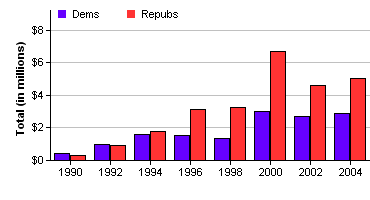
Biden (D-DE)This is a bill that finance and credit companies have long sought for. Observe how they radically increased their bribes over the last several years:
Byrd (D-WV)
Carper (D-DE)
Conrad (D-ND)
Johnson (D-SD)
Kohl (D-WI)
Landrieu (D-LA)
Lieberman (D-CT)
Lincoln (D-AR)
Nelson (D-FL)
Nelson (D-NE)
Pryor (D-AR)
Salazar (D-CO)
Stabenow (D-MI)
("U.S. Senate Roll Call Votes 109th Congress - 1st Session: On the Cloture Motion [Motion To Invoke Cloture On Bill S. 256]," 8 Mar. 2005)
How the finance and credit industry bought the "bankruptcy reform" is one of the clearest proofs that America is a plutocracy, not a democracy.
Source: Opensecrets.org, "Finance/Credit Companies: Long-Term Contribution Trends"
While it is important to attempt to replace the Democratic Senators and Representatives who voted for debt slavery by men and women who are actually committed to upholding the interests of the heavily indebted US working class, electoral politics alone will not break open the virtual debtors' prison that the "bankruptcy reform" will soon create. Money wins elections, more than 90% of the time: "In 95 percent of House races and 91 percent of Senate races . . . , the candidate who spent the most money won, according to a post-election analysis by the nonpartisan Center for Responsive Politics. . . . The biggest spender was victorious in 415 of 435 decided House races and 31 of 34 decided Senate races. On Election Day 2002, top spenders won 95 percent of House races and 76 percent of Senate races" (Opensecret.org, "2004 Election Outcome: Money Wins," 3 Nov, 2004).
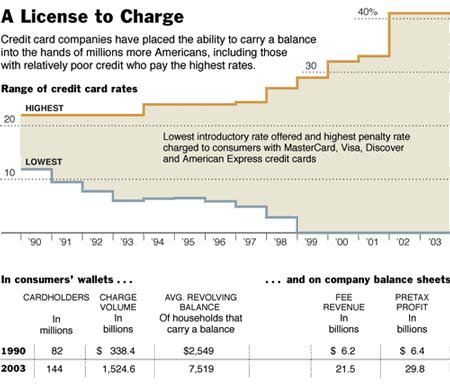
It is time for the American wing of the global justice movement, which has been struggling to force the International Monetary Fund and the World Bank to drop the debt under which peasants and workers of the global South groan, to take on the finance and credit industry that oppresses US workers by usury.
Proclaim liberty to the captives, and open the prison to them that are bound (Isa. 61:1–2) -- at home and abroad. Why not begin this weekend, when global justice activists gather in Washington D.C. to protest the 2005 Spring Meetings of the World Bank and the International Monetary Fund?
Source: Patrick McGeehan, "The Plastic Trap: Soaring Interest Compounds Credit Card Pain for Millions" (New York Times 21 Nov. 2004)
Unless and until US activists of the global justice movement begin to connect the debt burden on US workers with that on workers and peasants in poor nations, the movement will never grow beyond usual suspects. Charity, an exercise in altruism, need not begin at home, but class struggle that has a winning chance surely does.
Wednesday, March 30, 2005
Argentina and Brazil: Regaining Sovereignty
Good news for Argentina. Judge Thomas Griesa sided with Argentina, lifting "a freeze on $7 billion in bonds" challenged by NML Capital Ltd. (Erin McClam/Associated Press, "Judge Sides with Argentina in Debt Case," BusinessWeek 29 Mar. 2005). It's not all over yet, as the judge "stayed his own order until the 2nd U.S. Circuit Court of Appeals can review it" (McClam, 29 Mar. 2005). Argentina’s government, however, "said it was pleased with the ruling," so it must have a good reason to believe that it will gain "a quick and favorable verdict from the Appeals Court" (Reuters, "Argentine Bonds Unfrozen But Held for Appeal," Financial Times 30 Mar. 2005).
Larry Elliott said earlier that "[t]hree things worked in Argentina's favour" in bargaining with creditors: "Firstly, [Nestor] Kirchner's hand was strengthened by the good performance of the economy. Secondly, the IMF was heavily exposed and knew that any deal was better than no deal. Finally, Wall Street had moved out of Argentina before the crisis, and it was the European banks which were left holding the baby. The US treasury was therefore under no real pressure to take a tough line with Argentina, and was apprehensive that Kirchner might forge a powerful populist front with president Lula of Brazil" (Larry Elliott, "Who Needs the Hand of God?" The Guardian 7 Mar. 2005). Judge Griesa's ruling in favor of Argentina, too, is probably due to the same three reasons that Elliott explains above.
Meanwhile, Brazil declared that it would "not renew a $41.75 billion loan accord with the International Monetary Fund when it expires this month, braving global financial markets on its own for the first time since 1998" (Andrew Hay, "Brazil to End IMF Support for First Time since '98," Reuters 28 Mar. 2005). More symbolic than anything else, since Luiz Inacio Lula da Silva, assuming office in January 2003, "raised budget surplus goals above those stipulated by the IMF accord and renewed the deal for an extra 15 months in November 2003" (emphasis added, Hay, 28 Mar 2005) and, even without the IMF, "[t]he [Brazilian] government would maintain its current primary budget surplus target of 4.25 per cent of gross domestic product" and "continue to pursue the structural reform agenda it announced late last year," according to Finance Miniser Antonio Palocci (Raymond Colitt, "Brazil Ends $40bn IMF Loan Accord," Financial Times 29 Mar. 2005)? Nevertheless, the decision creates a political opening for the left, as the government can no longer say that the IMF made it do it when it confronts oppositions to its own neoliberal policy.
The rest of the world now has three precedents of defaults -- Russia, Brazil, and Argentina -- followed by economic recovery. According to Prensa Latina:
Larry Elliott said earlier that "[t]hree things worked in Argentina's favour" in bargaining with creditors: "Firstly, [Nestor] Kirchner's hand was strengthened by the good performance of the economy. Secondly, the IMF was heavily exposed and knew that any deal was better than no deal. Finally, Wall Street had moved out of Argentina before the crisis, and it was the European banks which were left holding the baby. The US treasury was therefore under no real pressure to take a tough line with Argentina, and was apprehensive that Kirchner might forge a powerful populist front with president Lula of Brazil" (Larry Elliott, "Who Needs the Hand of God?" The Guardian 7 Mar. 2005). Judge Griesa's ruling in favor of Argentina, too, is probably due to the same three reasons that Elliott explains above.
Meanwhile, Brazil declared that it would "not renew a $41.75 billion loan accord with the International Monetary Fund when it expires this month, braving global financial markets on its own for the first time since 1998" (Andrew Hay, "Brazil to End IMF Support for First Time since '98," Reuters 28 Mar. 2005). More symbolic than anything else, since Luiz Inacio Lula da Silva, assuming office in January 2003, "raised budget surplus goals above those stipulated by the IMF accord and renewed the deal for an extra 15 months in November 2003" (emphasis added, Hay, 28 Mar 2005) and, even without the IMF, "[t]he [Brazilian] government would maintain its current primary budget surplus target of 4.25 per cent of gross domestic product" and "continue to pursue the structural reform agenda it announced late last year," according to Finance Miniser Antonio Palocci (Raymond Colitt, "Brazil Ends $40bn IMF Loan Accord," Financial Times 29 Mar. 2005)? Nevertheless, the decision creates a political opening for the left, as the government can no longer say that the IMF made it do it when it confronts oppositions to its own neoliberal policy.
The rest of the world now has three precedents of defaults -- Russia, Brazil, and Argentina -- followed by economic recovery. According to Prensa Latina:
Mexico praised Brazil and Argentina for effectively negotiating their debt with the International Monetary Fund (IMF) and drawing a line against abusive economic policies.With sovereignty -- i.e. national governments taking "social needs into their own hands" -- comes political responsibility. Enemigos (published in October 2004) -- Argentine journalist Ernesto Tenembaum's interview with former director of the IMF's Western Hemisphere Department Claudio Loser -- has been a bestseller in Argentina.
La Jornada daily said that despite differences both countries turned into a powerful weapon by pleading defaults of 28 and 3.1 billion US dollars respectively.
The daily claims they have set a key precedent for Latin America to successfully stay sovereign by taking their social needs into their own hands despite huge debts with the IMF. ("Brazil and Argentina Praised for IMF Dealings," 30 Mar. 2005)
In the next economic turmoil, whom will Argentines and Brazilians see as their primary enemy?

Tuesday, March 29, 2005
Bonds That Bind: Argentina, Venezuela, and the US Current Account Deficit
Argentina successfully forced more than three quarters of its creditors to accept 35 cents on the dollar. As Quilombo reminds us, however, "Argentina is not completely out of the woods" yet ("Argentina Gets Out of Debt-lock," 26 Mar. 2005). Indeed, a hedge fund is striking back against Argentina as well as the hope that Argentina's tough bargaining with the creditor class kindled in the minds of the debtors of the world: "[L]ast week, Thomas Griesa of New York's southern district court ordered a freeze on $7bn of the old bonds that were tendered in the restructuring. The preliminary decision came after NML Capital, a Cayman Islands-based hedge fund, argued that the bonds belonged to the Argentine government and were therefore a legitimate target for 'attachment'" (Adam Thomson, "US Judge to Review Argentine Bond Case," 27 Mar. 2005). The ruling is to come today. Ominously, NML Capital is a fund "linked to Elliot Associates, a group that forced Peru to pay up on about $50m in defaulted debt in a landmark case during the 1990s" (Thomson, 27 Mar. 2005).
Other creditors' lawsuits have so far gone nowhere, but NML Capital's may prove different: "Experts believe a refusal by judge Griesa to lift the freeze could signal an intention to award the old bonds to NML rather than allowing them to be cancelled as planned," setting a favorable precedent for other hold-outs who rejected Argentina's debt restructuring offer (Thomson, 27 Mar. 2005).
The lawsuit has caused jitters in the market, and Argentine stocks have fallen for four days (Associated Press, "Stocks Down in Mexico, Brazil, Argentina," Forbes.com 28 Mar. 2005).
On March 24, 2005, Reuters reported that the International Monetary Fund said "it was not asking Argentina to reopen its $102.6 billion debt swap, which closed last month, to deal with the nearly 24 percent of bondholders who rejected the offer" ("IMF Says Not Asking Argentina to Reopen Debt Swap," 24 Mar. 2005). But the story is already changing: "The International Monetary Fund said on Monday it was studying Argentina's just-completed debt swap, leaving open the possibility it could ask Buenos Aires to re-negotiate with creditors who rejected the offer," if the IMF determines that Argentina is not negotiating with private creditors "in good faith" according to the IMF's "lending into arrears" rule (Reuters, "IMF Studying Outcome of Argentine Debt Swap," 28 Mar. 2005). At the very least, Judge Griesa's ruling today will affect Argentina's bargaining position vis-a-vis the IMF.
Bad news on the litigation front came at the same time as emerging market bonds and stocks, having flourished in the credit bubble (Richard Lapper, "More Faith in Emerging Economies," Financial Times [USA Edition], 14 Mar. 2005, p. 13), "dropped, extending a two-week slide, as rising interest rates in the U.S. pulled money away from high-risk securities" (Charles Penty, "Emerging Market Bonds, Stocks Decline on U.S. Rate Concerns," Bloomberg.com 28 Mar. 2005). In short, Washington's belated attempt to address the US current account deficit through higher interest rates alone, without giving up on the Iraq War and tax cuts for the rich that have pushed up its fiscal deficit or doing anything to resuscitate its atrophied export base, may be now beginning to take a toll on the global economy (cf. Nouriel Roubini and Brad Setser, "The US as a Net Debtor: The Sustainability of the US External Imbalances," November 2004, p. 24).
In the meantime, Venezuela, in a gesture of solidarity, "said it will buy $500 million of 7-year bonds that Argentina plans to sell within two weeks, the first bond sale for Argentina since its 2001 default," helping "Argentina pay back maturing bonds it issued after the default to compensate depositors for the seizure of their bank deposits, known as Boden bonds" (Peter Wilson, "Venezuela Says Argentina to Sell 7-Year Bonds [Update3]," Bloomberg.com 21 Mar. 2005). Is it any wonder Hugo Chávez's "petro populism" is more popular among Latin Americans than the moribund Washington Consensus?
Other creditors' lawsuits have so far gone nowhere, but NML Capital's may prove different: "Experts believe a refusal by judge Griesa to lift the freeze could signal an intention to award the old bonds to NML rather than allowing them to be cancelled as planned," setting a favorable precedent for other hold-outs who rejected Argentina's debt restructuring offer (Thomson, 27 Mar. 2005).
The lawsuit has caused jitters in the market, and Argentine stocks have fallen for four days (Associated Press, "Stocks Down in Mexico, Brazil, Argentina," Forbes.com 28 Mar. 2005).
On March 24, 2005, Reuters reported that the International Monetary Fund said "it was not asking Argentina to reopen its $102.6 billion debt swap, which closed last month, to deal with the nearly 24 percent of bondholders who rejected the offer" ("IMF Says Not Asking Argentina to Reopen Debt Swap," 24 Mar. 2005). But the story is already changing: "The International Monetary Fund said on Monday it was studying Argentina's just-completed debt swap, leaving open the possibility it could ask Buenos Aires to re-negotiate with creditors who rejected the offer," if the IMF determines that Argentina is not negotiating with private creditors "in good faith" according to the IMF's "lending into arrears" rule (Reuters, "IMF Studying Outcome of Argentine Debt Swap," 28 Mar. 2005). At the very least, Judge Griesa's ruling today will affect Argentina's bargaining position vis-a-vis the IMF.
Bad news on the litigation front came at the same time as emerging market bonds and stocks, having flourished in the credit bubble (Richard Lapper, "More Faith in Emerging Economies," Financial Times [USA Edition], 14 Mar. 2005, p. 13), "dropped, extending a two-week slide, as rising interest rates in the U.S. pulled money away from high-risk securities" (Charles Penty, "Emerging Market Bonds, Stocks Decline on U.S. Rate Concerns," Bloomberg.com 28 Mar. 2005). In short, Washington's belated attempt to address the US current account deficit through higher interest rates alone, without giving up on the Iraq War and tax cuts for the rich that have pushed up its fiscal deficit or doing anything to resuscitate its atrophied export base, may be now beginning to take a toll on the global economy (cf. Nouriel Roubini and Brad Setser, "The US as a Net Debtor: The Sustainability of the US External Imbalances," November 2004, p. 24).
In the meantime, Venezuela, in a gesture of solidarity, "said it will buy $500 million of 7-year bonds that Argentina plans to sell within two weeks, the first bond sale for Argentina since its 2001 default," helping "Argentina pay back maturing bonds it issued after the default to compensate depositors for the seizure of their bank deposits, known as Boden bonds" (Peter Wilson, "Venezuela Says Argentina to Sell 7-Year Bonds [Update3]," Bloomberg.com 21 Mar. 2005). Is it any wonder Hugo Chávez's "petro populism" is more popular among Latin Americans than the moribund Washington Consensus?
Thursday, March 17, 2005
Wolfowitz at the World Bank: An Empire without a Global Economic Policy?
George W. Bush nominates Paul Wolfowitz, Deputy Defense Secretary who is a leading neoconservative, to head the World Bank (Mark Tran, "Bush Picks Wolfowitz to head World Bank," The Guardian, March 16, 2005). Wolfowitz is no development expert, and "European officials have diplomatically focused on this shortfall, rather than over his role as an architect of the controversial war in Iraq" (Edward Alden, Andrew Balls, Bertrand Benoit, Demetri Sevastopulo, and John Thornhill, "Wolfowitz World Bank Shortlisting Raises Questions over Qualifications," Financial Times, London Edition, March 3, 2005, p. 10 ), apparently to no avail. Can European officials muster the courage to block the appointment, seizing on the precedent set by Bill Clinton in "blocking the appointment of Caio Koch Weser, the German candidate to head the International Monetary Fund, because Mr. Clinton considered Mr. Weser too weak" (David Stout, "Bush Throws Support Behind Wolfowitz for World Bank Post," New York Times, March 16, 2005)?
In any case, the selection of Wolfowitz is likely to give a second wind to the global justice movement, uniting it with the anti-war movement, in the United States as well as elsewhere. Several upcoming events are inviting targets for activists: the World Bank and the International Monetary Fund's 2005 Spring Meetings on April 16-17 in Washington D.C.; and their 2005 Annual Meetings on September 26-27 in Washington D.C.
A momentum to break open debtors' prisons that the Washington Consensus built in the global south has been building up.
In light of such development, Bush's choice of Wolfowitz is all the more puzzling. John Dizard of the Financial Times observed: "In the past the IMF has been characterised as an instrument of America's financial foreign policy. For that to be true the US would need to have a financial foreign policy, which right now it doesn't. John Snow, Treasury secretary, is preoccupied with tax and Social Security proposals; his deputies responsible for international policy are in the process of moving on to their next resumé entries" ("Mysterious Hope for Argentine Deal," March 13, 2005) -- the absence of "a financial foreign policy" that is underscored by the nomination of a Pentagon hawk for World Bank presidency.
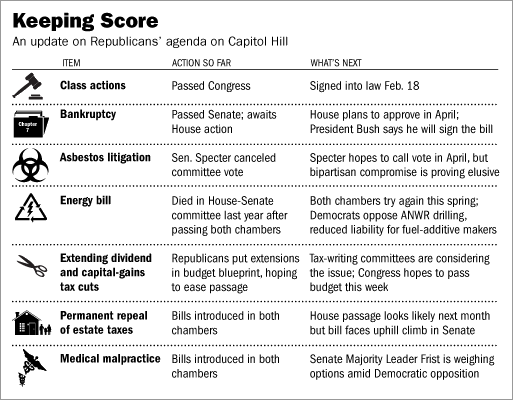
To be sure, there is no lack of clarity in the domestic business agenda. The White House and Congress delivered the Class Action Fairness Act of 2005 and is about to deliver the Bankruptcy Abuse Prevention and Consumer Protection Act of 2005. The Wall Street Journal's scorecard makes clear the progress of the business agenda:
All of them, however, either do nothing to defuse or make bigger ticking economic time bombs -- the ballooning housing bubble, mounting consumer debts, the credit bubble, the widening current account deficit, rising oil prices, the falling dollar, and so on -- that may go off any time. Any or all of the bombs may prove to be duds or carry only small charges of explosives, but only Dr. Pangloss could be confident that none would ever blow up in the face of the US economy.
In any case, the selection of Wolfowitz is likely to give a second wind to the global justice movement, uniting it with the anti-war movement, in the United States as well as elsewhere. Several upcoming events are inviting targets for activists: the World Bank and the International Monetary Fund's 2005 Spring Meetings on April 16-17 in Washington D.C.; and their 2005 Annual Meetings on September 26-27 in Washington D.C.
A momentum to break open debtors' prisons that the Washington Consensus built in the global south has been building up.
In 1902, after Venezuela defaulted on its sovereign debt, German, British and Italian gunboats blockaded the country's ports until the government paid up. In 1881, after the Ottoman empire failed to honour its obligations, European powers simply seized Ottoman customs houses and helped themselves to their due. The options available to more than 500,000 aggrieved creditors of the Republic of Argentina, which defaulted on bonds worth $81 billion in December 2001, were more limited. After much bluff and bluster, a large majority of them meekly surrendered their claims before a deadline on February 25th, in exchange for new bonds worth roughly 35 cents on the dollar.Activists who said that default would be good for Argentina, as it would "have more cash on hand for social and health programmes" (Emad Mekay, "Activists View Argentina's World Bank Default as Positive," Inter Press Service, November 15, 2002), were proven correct. "Argentina's fundamentals have certainly been impressive. The economy has grown about 9 per cent for two consecutive years and with consumer confidence improving and the rising price of soya, Argentina's main agricultural product, economists say growth in 2005 will be more than 6 per cent," says Adam Thomson of the Financial Times ("Post-debt Argentina Ready to Resume Its Place in the Sun," London Edition, March 16, 2005, p. 44). Other highly indebted governments, pressured by the restive poor, must be paying attention to Argentina's successful challenge to the IMF, the WB, and other international financial institutions' power to set debtors' domestic economic policy and dictate the terms of debt service.
The giant debt swap is epic in scale. It involves 152 varieties of paper denominated in six currencies and governed by eight jurisdictions. These bonds will now be exchangeable for three new issues. More importantly, the swap carries important lessons for emerging-market creditors and debtors alike. Bondholder groups think it a travesty. But on March 1st, Néstor Kirchner, Argentina's president, declared the restructuring a triumph, claiming "at least 70-75%" of bondholders had accepted it. As The Economist went to press, detailed figures were still not available, though some reports suggested that the level of acceptances was even higher than Mr Kirchner's claim.
. . . . . . . . . . . . . . . . . . . .
“Restructuring was formerly a taboo word, now it's a topic of open conversation,” says Walter Molano, of BCP Securities. The “haircut” inflicted on bondholders—the proportion of debt that Mr Kirchner has successfully written off—sets a new standard. In other restructurings, creditors have had to accept either a cut in principal, a lengthening of maturity or a reduction in interest payments. Argentina has achieved all three.
. . . . . . . . . . . . . . . . . . . .At around 75% of GDP, Argentina's debt ratio remains higher than the 52% carried by its neighbour Brazil. But the interest burden on Argentina's debts is now much lighter (a coupon of 2-5% in the first 10 years, compared with 10% in Brazil) and the maturities much longer than the market would normally accept. No big Latin American government has ever fully repaid a 30-year bond; Argentina has offered a 42-year bond.
Standard & Poor's, a credit rating agency, has said it will upgrade Argentina to B- after a successful debt swap, a rating shared by Ecuador, Suriname and Lebanon.
(emphasis added, "Argentina's Debt Restructuring: A Victory by Default?" The Economist, March 3, 2005)

In light of such development, Bush's choice of Wolfowitz is all the more puzzling. John Dizard of the Financial Times observed: "In the past the IMF has been characterised as an instrument of America's financial foreign policy. For that to be true the US would need to have a financial foreign policy, which right now it doesn't. John Snow, Treasury secretary, is preoccupied with tax and Social Security proposals; his deputies responsible for international policy are in the process of moving on to their next resumé entries" ("Mysterious Hope for Argentine Deal," March 13, 2005) -- the absence of "a financial foreign policy" that is underscored by the nomination of a Pentagon hawk for World Bank presidency.
To be sure, there is no lack of clarity in the domestic business agenda. The White House and Congress delivered the Class Action Fairness Act of 2005 and is about to deliver the Bankruptcy Abuse Prevention and Consumer Protection Act of 2005. The Wall Street Journal's scorecard makes clear the progress of the business agenda:
All of them, however, either do nothing to defuse or make bigger ticking economic time bombs -- the ballooning housing bubble, mounting consumer debts, the credit bubble, the widening current account deficit, rising oil prices, the falling dollar, and so on -- that may go off any time. Any or all of the bombs may prove to be duds or carry only small charges of explosives, but only Dr. Pangloss could be confident that none would ever blow up in the face of the US economy.
Sunday, July 04, 2004
Growing Older and Deeper in Debt
Jennifer Bayot of the New York Times reports on the growing debt burden of the elderly in the United States:

This at a time when the shirt from defined-benefit to defined-contribution pension plans has diminished the net worth of the median older household ("401(k) Boondoggle," June 14, 2004). . . .
- "One in four families headed by someone 65 or older still had a mortgage to pay in 2001, the most recent data available. In 1989, just one in six still had house payments to make."
- "As a group, people over 65 have the distinction of having not only the fastest-growing home debt, but also the fastest-growing share of personal bankruptcy filings and the biggest growth in demand for credit counseling."
- "Mortgage debt owed by older households nearly quadrupled between 1989 and 2001, even after accounting for inflation, according to an analysis of Federal Reserve data by Zhu Xiao Di, a research analyst at the Harvard Joint Center for Housing Studies. In 2001, the typical household headed by someone 65 or older had $44,000 in mortgage debt, compared with $12,000 in 1989, Mr. Zhu says in a forthcoming paper. The mortgage debts of younger homeowners, though still considerably larger at $75,000 on average, grew barely a fifth as quickly."
- "While home loans are usually their biggest payment, the elderly have been rapidly accumulating other debt as well. Credit card bills -- to cover everything from minor emergencies to ongoing essentials -- have risen sharply. All told, the debt burdens of borrowers between the ages of 65 and 74 doubled between 1992 and 2001, compared with an increase of 83 percent for the general population, the Federal Reserve says."
- "More and more of the elderly are in outright financial distress. One in seven households headed by someone 65 or older was considered heavily indebted in 2001 - devoting at least 40 percent of their incomes to debt payments, according to the Federal Reserve's Survey of Consumer Finances. That compared with one in 10 among all households with debt."
- From 1997 to 2001, bankruptcies among the elderly tripled to 82,000, says the Consumer Bankruptcy Project, a consortium of university researchers. The number of people 65 or older grew only 3 percent during that time. (Jennifer Bayot, "As Bills Mount, Debts on Homes Rise for Elderly," New York Times, July 3, 2004)

This at a time when the shirt from defined-benefit to defined-contribution pension plans has diminished the net worth of the median older household ("401(k) Boondoggle," June 14, 2004). . . .
Monday, June 28, 2004
Prisoners of the Subprime American Dream, Cont'd
When the Federal Reserve raises interest rates, the gap between poorer debtor and richer creditor classes, so far hidden under a pile of cheap credit, will widen and become painfully visible:
Cf. Tamara Draut and Javier Silva, "Borrowing to Make Ends Meet: The Growth of Credit Card Debt in the '90s" (September 8, 2003).
By several measures, Americans are more indebted than ever. Through the first quarter, they owed nearly $9 trillion in home mortgages, car loans, credit card debt, home equity loans and other forms of personal borrowing —- accumulating nearly 40 percent of this total in just four years, according to published Federal Reserve data. But most of the debt is at fixed interest rates. Thus it will be unaffected initially as the central bank begins its much expected quarter-point increases in the so-called federal funds rate, now at a 46-year low of 1 percent. The federal funds rate, in turn, influences the interest rate cost of most household and commercial debt.
Only one-fifth of the $9 trillion in total household debt, or $1.8 trillion, is borrowed at variable rates. Variable rates . . . often track what the Fed does, which means they are likely to rise one-quarter of a percentage point over the next few weeks. The immediate cost for the nation's households as a result of this process could be as much as $4.5 billion. . . .
The $4.5 billion is roughly 10 percent of the cost of the rise in oil prices so far this year. That is not a big number yet, but each quarter-point increase would be another step closer to matching the oil shock, which brought gasoline prices above $2 a gallon in many parts of the country.
While the oil shock quickly raised the gasoline and heating oil bills of nearly every household, the burden of higher interest payments falls most heavily in the early stages on lower- and middle-income families. They are the biggest users of variable rate debt, particularly on credit cards, various studies show.
Upper income families, on the other hand -- that is, families with more than $80,000 in annual income -- are more likely to have fixed rate debt, particularly mortgages, and to owe relatively little on their credit cards. What variable rate debt they do have is usually at lower interest rates than lower income people. Lower income people, as a result, are 10 times more likely than upper income people to be devoting 40 percent or more of their income to debt repayment, the Economic Policy Institute reports. In addition, upper income people are the nation's biggest savers, and a rate increase raises the return on their interest-bearing securities.
"If you are a household with a lot of variable-rate debt and little equity left in your home that you have not already borrowed against, this is going to be a scary time," said Mark Zandi, who is the chief economist at Economy.com. . . .
Another notch up in home prices would give . . . some relief; they could float a 4 to 5 percent home equity loan against the additional value of their home and use the loan to pay down credit card debt. Tens of millions of Americans have used this route to lower the interest cost of credit card debt. With homes appreciating more slowly, there is less collateral left to support home equity loans, and paying the outstanding balances will become more costly. They totaled $375 billion at the end of last year. Home prices are a big potential casualty of rising interest rates. Sales of new and existing homes surged in May, the government reported, as people apparently rushed to become homeowners before mortgage rates went any higher. The average 30-year mortgage is already up a percentage point since early spring.
But for Stephen Black, a homebuilder here, the surge in home sales is a false signal. The customer base is already shrinking for his basic product, a two-story house with four bedrooms and a two-car garage on nearly a quarter-acre, a home currently priced at $215,000.
The buyers were families with $50,000 to $70,000 in annual income. Now they are increasingly bunched at the high end. The low end is pulling back partly because mortgages are more costly . . .
Across town, in a rundown neighborhood, the working poor are just starting to show up in greater numbers at Tabor Community Services, a Lancaster agency that counsels those deeply in debt, said Michael Weaver, president of Tabor.
The "fragile low income," as Mr. Weaver calls them, do not tend to own homes, but those who do buy them through subprime mortgage loans, in many cases with adjustable rates. Apart from housing, nearly every transaction for these consumers involves interest payments in one form or another. Lacking enough income, they rent television sets, furniture and appliances, signing agreements that can adjust upward as interest rates rise.
Like their higher income peers, Mr. Weaver's clients often take loans to buy car, in their case, used cars. But they are loans of shorter duration and higher interest rates than the standard four- or five-year new car loan, now averaging 7.4 percent. They have credit cards, but at rates above 15 percent, which convert into much higher penalties when monthly payments are late.
"These are people who are maxed out on debt," Mr. Weaver said, "and their numbers are growing." (Louis Uchitelle, "Families, Deep in Debt, Facing Pain of Growing Interest Rates," New York Times, June 28, 2004)
Prisoners of the Subprime American Dream?
A while ago, I posted an entry on the housing bubble "The Day of Reckoning on the Home Front" (June 4, 2004). Here's a follow-up. Take a look at the chart below (New York Times, June 24, 2004):
The subprime and nontraditional mortgages account for nearly half of all mortgages. A lot of these loans can go bad quickly, once the Federal Reserve raises interest rates. An anecdote from the New York Times article that came with the chart above illustrates the precarious financial conditions of many homebuyers:

For years, Ray and Shahrazad Daneshi sought to buy a home, only to be told that they did not earn enough to qualify for a mortgage. But they recently managed to buy a small house in the shadow of Disneyland for $360,000 - six times their annual income - thanks to a lender who allowed them to borrow the entire value of the home, with no down payment.See, also, Blanche Evans, "Why Rising Interest Rates Will Hammer Housing" (Realty Times, June 23, 2004) and "The Perfect Real Estate Storm" (Reality Times, June 24, 2004).
"We will not be going to any movies or eating out at restaurants," said Mr. Daneshi, a self-employed wedding photographer who came here from Iran in 1988. "But in two years, the house will be worth a lot more and we will have something to show for it."
The Daneshis' purchase underscores the new, ever-optimistic economics of home buying. A kaleidoscopic array of mortgages for people with little cash or overstretched budgets has enabled families of modest income to take on debt that once would have been beyond their reach. As long as new home buyers could count on rock-bottom interest rates and housing values were going nowhere but up, this seemed to be a virtuous circle.
But now, with the Federal Reserve expected to embark on a series of interest rate increases starting with its meeting on June 30, some experts worry that recent first-time buyers could find easy home ownership a lot harder on their wallets, possibly causing housing prices to wobble in some high-price markets.
With the Daneshis, for example, rising interest rates on the two adjustable-rate mortgages they took out to buy their house would mean that their monthly payment of $2,500 - already more half their monthly income - could go up substantially in two years. Mr. Daneshi realizes that, but is unconcerned.
"Why worry?" he said, adding that he believes rising home prices will help him obtain a better loan deal by then.With interest rates going up, that may be wishful thinking. Most analysts agree that there is no nationwide housing bubble because housing prices have climbed only slowly in the Midwest and the South, even as they have soared on the East and West Coasts. Still, if rising interest rates cause housing prices to drop, even slightly, industry officials warn that some new buyers will have no equity in their homes and could choose to walk away from their loans if they run into trouble with payments.
"A lot of these loans are dangerous," said Allen Jackson, manager of Bristol Home Loan in Bellflower, Calif., a mortgage broker who specializes in so-called subprime loans, which charge higher interest rates to people unable to qualify for traditional mortgages. "If you have any dip in values, people can just say the heck with it because they don't have any of their own money in the house." (Edmund L. Andrews, "The Ever More Graspable, and Risky, American Dream," June 24, 2004)
Wednesday, June 23, 2004
Buy Venezuelan Bonds
Daniel Davies of D-Squared Digest (who nowadays mainly posts to Crooked Timber) says:
I have two pieces of Marxist financial advice (note to regulators: no I don't). Depending on your own financial circumstances and risk appetite, blah blah, I would:Good advice. Despite the Venezuelan oligarchy's repeated attempts at economic sabotage, Hugo Chávez's record of debt management has been excellent, and high oil prices and big foreign reserves should continue to bolster investor confidence:
1. Find a life assurance company run by people you trust and chuck it all into one of their long-dated policies.
or for the more adventurous
2. Chuck it into the bonds of more or less politically palatable emerging market countries. Venezuela has a few series of quite high-yielding bonds available, and buying them would both help Chavez to buy a little time to fend off the hegemon, and offer the possibility of a nice capital gain when and if he eventually fails and Vene becomes a US protectorate. Sort of a win-win situation, if you have a rather perverse definition of what constitutes a "win". (Progressive Economists Network, June 23, 2004)
Credit rating agencies have been extremely tough on Venezuela, to be sure, but that's only because they are politically motivated. Bondholders have not lost confidence in the Bolivarian Republic:
- "I think Chavez will stay in power, whether he avoids the recall or holds the vote and wins," said Jose Pedreira, a managing director at LW Asset Management, a New York-based hedge fund.
Wall Street, put off by Chavez's anti-capitalist rhetoric but impressed by the country's debt management policies, sees smooth sailing for Venezuelan sovereign bonds. They have already rewarded holders with total returns of 34.6 percent so far this year while the rest of the market is up 27 percent.
Venezuela total returns have risen 3.6 percent since Dec. 1 while JP Morgan's Emerging Markets Bond Index Plus has edged just 1.6 percent higher. . . .
"Venezuela bond prices have been going higher because, at the end to the day, Venezuela is in good shape in terms of being able to pay its debts," Pedreira said. "Other emerging market countries offer much less yield, which continues to make Venezuela attractive." (Hugh Bronstein/Reuters, "Venezuela Bonds Seen Rising above Political Woes," December 7, 2003)- Venezuela offered to buy back $1 billion of six-month dollar-denominated bonds after a surge in oil prices swelled government coffers.
The government, which had sold the securities to local investors in March, offered to buy the 1.15 percent notes due Sept. 30, 2004, at 100 cents on the dollar, or par.
"They've had huge revenue off the oil side for quite some time and huge reserve levels," said Enrique Alvarez, a Latin American debt analyst with research company IDEAglobal in New York. "And they're very comfortable repurchasing this since they're done selling dollar debt the rest of this year."
Venezuelan oil has averaged $30 a barrel this year, more than the $18.50 estimate the government used to calculate this year's budget. Venezuela, the world's fifth largest crude supplier, will likely receive between $5 billion and $7 billion of extra oil income this year, Central Bank Director Armando Leon said last month. (Alex Kennedy, "Venezuela Offers to Buy Back $1 Billion of Bonds," Bloomberg.com, June 7, 2004)- Venezuelan President Hugo Chávez "has almost unlimited supplies of cash, with Venezuelan oil selling at over $30 a barrel, foreign reserves of more than $23 billion, and few qualms about using public funds to bolster his campaign for a 'no' vote" (Phil Gunson, "Chávez Well-armed in Recall Battle," Miami Herald, June 22, 2004).
Venezuela, for instance, is rated Caa1 by Moody's -- one of the lowest ratings, even among high-yield, or "junk," bonds -- and a full two notches below Brazil's B2 high-yield rating. Yet yields for Venezuelan bonds are comparable to those of Brazil. That means the market isn't demanding a higher premium from Venezuela, despite the lower rating.
Investors like Mr. Hopper say this is understandable. Venezuela is a big oil producer and boasts foreign reserves that more than cover its debt, while Brazil's don't. "Venezuela has been volatile, and at times overdiscounted by the market," he says. "The ratings agencies have contributed to that." (Craig Karmin/The Associated Press, "Ratings Take on Political Risk," June 21, 2004)
Friday, June 04, 2004
The Day of Reckoning on the Home Front
This just in -- the latest government report shows a strong jobs growth:
The question is what will become of heavily indebted Americans once the Federal Reserve raises interest rates -- which is long overdue in the opinion of investors (Cf. Craig Torres, "Fed Should Have Raised Rates by Now, Investors Say," Bloomberg.com, May 4, 2004; Gretchen Morgensen, "Will the Fed's Slow-Mo Approach Backfire?" New York Times, May 30, 2004) -- and, more ominously, if the housing bubble bursts rather than slowly deflates:
U.S. employers added an unexpectedly large 248,000 jobs in May, according to a government report on Friday . . .Doug Henwood of the Left Business Observer declares: "No one can call this a jobless recovery anymore" (LBO-talk, June 4, 2004). Good news for job seekers for the last couple of months, however, has yet to bail out the President of the United States, due to Iraq, gas prices, and "wage recession": "[W]hile U.S. corporate profits jumped 32 percent in the 12 months ended in March, the biggest increase since 1984, according to Commerce Department figures, average hourly pay of production workers rose 2.2 percent in the year through April, the slowest pace for that period since 1987. After accounting for inflation, the gain was 0.5 percent, according to the Bureau of Labor Statistics" (Art Pine and Brendan Murray, "Bush Economy Gains Fail to Excite Amid Iraq, Gas Rise," Bloomberg.com, June 1, 2004). See, also, Christopher Farrell, "Bush Is His Own Worst Enemy" (BusinessWeek, June 4, 2004).
The May tally exceeded Wall Street expectations for 216,000 new jobs and followed an upwardly revised total of 346,000 jobs in April and 353,000 in March. The 947,000 jobs created in the March-May period made it the strongest for any three months in four years. . . .
Nearly 1.2 million jobs have been added since the start of the year, adding fodder for a campaigning Bush to blunt Democratic criticisms fueled by the slow recovery from the 2001 recession. (Reuters, "Jobs Growth Unexpectedly Strong in May," June 4, 2004)
The question is what will become of heavily indebted Americans once the Federal Reserve raises interest rates -- which is long overdue in the opinion of investors (Cf. Craig Torres, "Fed Should Have Raised Rates by Now, Investors Say," Bloomberg.com, May 4, 2004; Gretchen Morgensen, "Will the Fed's Slow-Mo Approach Backfire?" New York Times, May 30, 2004) -- and, more ominously, if the housing bubble bursts rather than slowly deflates:
Philo Thompson is 28, single and like many other Americans these days -- not afraid to stretch when it comes to buying a house.Without waiting for Alan Greenspan, bondholders have already begun to "sell bonds, pushing up interest rates, whatever the Fed says or does": "The yield on the 10-year Treasury note is up one percentage point from the end of March. It hit its 2004 peak of 4.85 percent in mid-May, though it has since retreated a bit, to 4.66 percent. . . . How high will bondholders take yields with the Fed in slow motion? Mr. [James W.] Paulsen [chief investment strategist at Wells Capital Management in Minneapolis] reckons that the 10-year Treasury could rise to 6 percent this year and maybe hit 7 percent later on a wild spike" (Morgensen, May 30, 2004).
A management consultant in Denver, Mr. Thompson bought a $500,000 townhouse last Friday in the suburb of North Cherry Creek.
As many other first-time homeowners have done, Mr. Thompson put no money down. Instead, he took out a first mortgage for 80 percent of the purchase price and paid the rest by taking a home equity loan against the new house. To reduce his monthly payments, and to qualify for a big enough loan, he took out an adjustable rate mortgage that requires him to make only interest payments.
People like Mr. Thompson could get squeezed if interest rates start to rise. With economic growth looking strong and hints of inflation in the air, Federal Reserve officials have made it clear that the era of extraordinarily cheap money is slowly drawing to a close. Yet Mr. Thompson betrays no worries.
"I'm too young to be scared," he said last week, betting that both the value of the house and his income will keep rising. If the bet fails, he said, it will not be the end of the world, adding: "There is a difference between being poor and being broke. Being broke is more of a temporary condition. Donald Trump has been broke a couple of times."
Mr. Thompson is not alone in such thinking. After a three-year period when the Federal Reserve cut interest rates to their lowest level since 1958, Americans have become far more willing to load up on debt and banks have become far more willing to let them.
Household debt climbed at twice the pace of household income from the beginning of 2000 through 2003, according to data at the Federal Reserve. Enticed by low interest rates, Americans took on $2.3 trillion in new mortgage debt during that period -- an increase of nearly 50 percent. Consumer credit, from zero-interest auto loans to the much more expensive debt on credit cards, climbed 33 percent, rising to $2 trillion in 2003 from $1.5 trillion in 2000.
Alan Greenspan, the Federal Reserve chairman, has repeatedly argued in recent months that rising household debt poses few problems. Fed officials note that the financial position of American households is, in some respects, stronger than ever. The value of household assets -- from resale prices of homes to the size of stock portfolios -- has increased even faster than debt.
Indeed, the collective net worth of American households is now higher than it was before the stock market bubble burst four years ago.
And thanks in part to lower interest rates, monthly debt payments consume a smaller share of monthly income today than in late 2001. . . .
But household debt could soon start to pinch. Fed officials . . . have made it clear that they must eventually raise rates. . . . [T]he main question is whether the move will come this summer or be delayed until early next year.
Regardless of when it happens, economists predict that a significant rise in interest rates will come as a jolt to many people. Those with home equity loans will see their monthly payments climb almost immediately. Adjustable mortgages will increase more slowly, because many borrowers lock in rates for several years. But monthly debt burdens will eventually rise.
In the meantime, housing prices could drop sharply in some overheated markets like New York and Southern California, where many homes have doubled in price over the last five years. People who bought their homes with no money down could find themselves unable to sell without owing money to their lenders.
Much has changed in the 10 years since the Federal Reserve embarked on its last sustained effort to raise rates. Inflation is much lower today and productivity growth is much higher, which may allow the Fed to take a more gradual approach than it did in 1994.
At the same time, though, many consumers and banks have profoundly changed their attitudes toward borrowing and debt. Responding to lower interest rates last year, homeowners refinanced $140 billion worth of mortgages in which they borrowed additional money. Mortgage lenders, in the meantime, rolled out scores of new kinds of loans, allowing people to borrow far more than they might have contemplated a decade ago.
The new loans go well beyond adjustable-rate mortgages. They include interest-only loans; "no document" loans, which allow people to borrow money at higher rates without proving their income or assets; and "no ratio" loans, which simply ignore a person's monthly income.
Mr. Thompson, who completed the purchase of his townhouse near Denver on Friday, said he would have qualified to borrow $330,000 if he had taken out a traditional fixed-rate mortgage. He qualified for a loan up to $550,000 by taking an adjustable-rate mortgage that will be constant for the first five years and that requires only interest payments.
He also avoided paying mortgage insurance, which could have cost several thousand dollars a year, even though he put no money down -- something that had been mandatory for those who borrowed more than 80 percent of the purchase price. Because of the home equity loan he also signed for, his primary mortgage amounted to only 80 percent of the purchase price.
"People are looking at their payments and asking, 'How much interest rate protection do I really need?'" said Richard Wohl, president of the mortgage banking group at IndyMac Bank, a large lender based in Pasadena, Calif. Nearly two-thirds of IndyMac's new loans in the first three months of this year were adjustable-rate mortgages, and a quarter of all new loans are subject to adjustments in the first year.
Nontraditional loans first proliferated in California and Washington, largely in reaction to soaring real estate prices. But IndyMac and other big Western lenders have been rolling out their full array of options to every part of the country, and competitors in every part of the country have followed suit.
Nationally over the last year, homeowners have tried to lock in low fixed-rate mortgages. But as rates began to creep up in March, making it harder for some people to afford fixed-rate mortgages, home buyers began shifting to the riskier adjustable rates to keep up with high real estate prices.
According to data compiled by the Mortgage Bankers Association, the share of people who took adjustable-rate mortgages jumped to 32 percent in March from about 13 percent last July.
Local mortgage brokers, linked by computer to large lenders and automated loan-approval systems, say they can often find money for almost any kind of customer, sometimes within minutes. . . .
The willingness to take risks is not limited to lower-income families struggling to buy a first home. Even as interest rates appear to be heading upward, a growing number of wealthy homeowners have decided to cut their monthly payments by switching to interest-only loans that adjust as often as once a month.
Alan Bubes, owner of a linen-supply service in Washington, is refinancing a mortgage of more than $1 million on the home he and his wife own in Georgetown. By switching to an interest-only mortgage that adjusts every month, Mr. Bubes expects to cut his monthly payments and reinvest those savings.
"It's a gamble," Mr. Bubes acknowledged, saying that he could make more by reinvesting his savings than paying down his debts. (Edmund L. Andrews, "As Household Debt Rises, New Risk in Higher Rates," New York Times, May 4, 2004, p. C1)
Mortgage rates have also risen accordingly:

Freddie Mac reported Thursday that rates on benchmark 30-year, fixed-rate mortgages declined to 6.28 percent, down from 6.32 percent last week, according to the mortgage giant's nationwide survey of rates. This time a year ago, however, rates on 30-year mortgages averaged 5.26 percent.Along with a difficult debate on "whether our volunteer military is adequate to meet our foreign policy commitments" (Andrew Exum, "For Some Soldiers the War Never Ends," New York Times, June 2, 2004), the day of reckoning on the home front seems also postponed until after the November elections. According to the Economist, though, the housing bubbles exist everywhere in the rich industrial nations except Germany and Japan:
Rates for 15-year, fixed-rate mortgages fell this week to 5.63 percent, compared with 5.69 percent last week. A year ago, rates on 15-year mortgages averaged 4.66 percent.
For one-year, adjustable-rate mortgages, rates rose to 3.98 percent, from 3.87 percent last week. At this time last year, rates on one-year ARMs were at 3.59 percent. . . .
With the economy moving solidly ahead, economists predict mortgage rates will slowly rise in the coming months. According to some projections, rates on 30-year mortgages could reach 6.4 percent or 6.6 percent by the final quarter of this year.
Still, some economists believe home sales this year will come in close to, or possibly even surpass, the record highs seen in 2003, when ultra-low mortgage rates beckoned to buyers.
The recent rise in mortgages, however, is slowing refinancing activity. Refinancings accounted for just 34.3 percent of total mortgage loan applications filed last week, down from 36.2 percent in the previous week, the Mortgage Bankers Association said. (Jeannine Aversa/The Associated Press, "Rates on 30-Year, 15-Year Mortgages Down," June 3, 2004)
House prices have outpaced inflation everywhere in recent years except Germany and Japan, where prices continue to fall. Among our 16 countries, prices are now at record levels in relation to average wages and rents in America, Australia, Britain, Ireland, the Netherlands, New Zealand and Spain. The ratios of prices to incomes exceed their averages in the past 30 years by between 25% and 60%. A return to the long-term average could be brought about either by a fall in house prices or by a rise in wages and rents. The snag is that with wages in most countries increasing by only 3-4% a year, it would take years for inflation to erode real house prices to normal levels.
The chart [titled "Ripe to Burst"] . . . shows by how much prices would need to fall to get back to their long-term average, assuming that the decline takes place over four years and that wages rise at a pace similar to that in the recent past. House prices would need to fall by 10% in America, by 15% in New Zealand and by 20-30% in the other five countries.
Need prices fall so far? Maybe not: lower real interest rates than in the past would justify an increase in the long-term ratio of house prices to wages and rents, and would therefore require a smaller fall in prices. On the other hand, when past housing booms have turned to bust, prices have typically undershot their average by 10% or more. ("Global House Prices: Hair-Raising," June 3, 2004)


Subscribe to:
Posts (Atom)