First Ben Ali, and now Mubarak. The empire has failed to stop the momentum of the Arab revolt that started in Sidi Bouzid. It is a time of great transition in West Asia and North Africa. What kind of transition will it be?
Samir Amin fears that, in the case of Egypt and perhaps elsewhere if not in Tunisia, it may result in the ascent of religious obscurantists into power, bringing about a new alliance of religious forces with the military establishment, a kind of Pakistanization so to speak. Aijaz Ahmad, on the other hand, hails the revolutionary wave as an upsurge of "secularity" as well as of democracy. Both appear to miss the most striking feature of what is going on: the absence of any vanguard ideology or vanguard party, religious or secular.
Some have named this absence "post-ideological," but that does not quite capture the fluidity of the moment. Ideologies are at work in the intifadas in the region today -- what is clear is that none is in hegemony. No single ideology is in the vanguard, nor is any political party seeking to be the vanguard party of the kind that led 20th-century revolutions. Competing political currents all appear to sense that people are not looking for a charismatic leader, a new Lenin or a new Khomeini. There is a refreshing absence of the quintessential iconography of past revolutions: larger-than-life images of the leader of the revolution.
The question is if the leaderless revolts, without any vanguard party or ideology, can fully dismantle the ancien regimes, which are decapitated but are otherwise more or less intact, establish new ones, and defend and develop them.
Friday, February 11, 2011

Monday, January 17, 2011
The Tunisian Revolution: Views from Iran
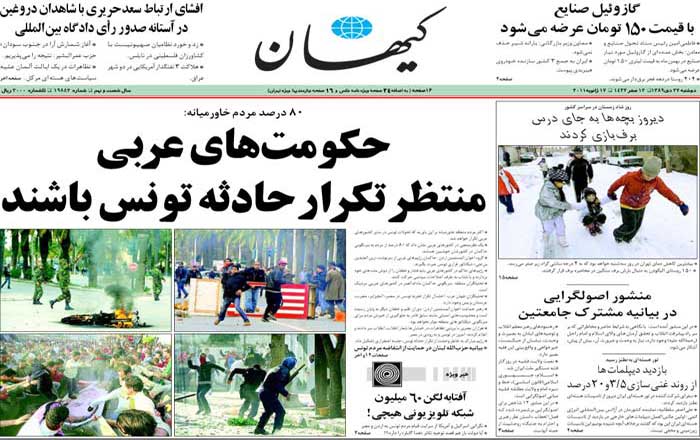
The biggest front page story of Kayhan on Monday, 17 January 2011 is headlined thus: "80% of People in the Middle East: Repeat of Tunisia Phenomenon in Store for Arab Governments."
Raja News,1 for its part, notes five similarities between the deposed Shah of Iran and the deposed Tunisian president: promoting secularism with an iron hand; supporting and being supported by the West; looting national wealth during escape; attempting to impose lifelong rule; and getting driven out from home and getting discarded by the West.
A note of general satisfaction, in short, is unmistakable among the oficialistas in Iran. The revolution in Tunisia, in their eyes, confirms their strategic assessment that "a major shift in the regional balance of power" underway favors the axis of resistance:
1 Raja News, by the way, is giving big play to the news of exiled Renaissance Party leader Rashid Ghannoushi's return to Tunisia. Its editor has apparently failed to canvass informed Arab sources such as this: "Aljazeera has [to] stop promoting Rashid Ghannushi and stop announcing his travel to Tunisia as if his impending arrival is analogous to that of Khumayni's return to Iran. No one cares about Ghannushi, from what I have seen, although I won't rule out the likelihood of the emergence of an Islamist current later on."
2 Rising youth unemployment, plus relative deprivation felt by educated youth, resulting from a combination of a youth bulge due to demographic transition, economic liberalization making decent jobs in the public sector scarcer, and slower growth of the world capitalist economy after the end of the post-WW2 boom, is a common story in the Middle East. What is peculiar to the Iranian case is both the rise and the fall of the youth bulge are sharper than in any other country: "As noted above, the current group of Iranian youth is the largest in the country's history. In 2005, the age group 20-24 was 62 percent larger than it was 10 years earlier, 9.1 million compared to 5.6 million, pushing the ratio of youth, which we define as ages 15-29, to total population to 35 percent, the highest recorded ratio in any country. Figure 1 shows that Syria has the second highest youth ratio (32 percent) while Turkey's is considerably lower, about 27 percent, having passed its peak of near 30 percent in the 1990s. By 2020, youth ratio will decline considerably, to less than 25 percent, the level observed in advanced countries. This is because the youth population is predicted to fall in absolute terms; for example, the 20-24 age group is expected to shrink by 75 percent in 2015, to 5.2 million. The reason for Iran's high youth ratio and its fluctuations is a baby boom in the early 1980s, when the revolutionary government was pro-natal, followed by a sharp decline in fertility in the 1990s, when it reversed this policy" (footnotes omitted, Djavad Salehi-Isfahani, "Iranian Youth in Times of Economic Crisis," September 2010).
3 E.g., "Iran has witnessed several spirited labor actions in recent years, well-known examples being the wildcat strikes of Tehran bus drivers and schoolteachers. But these actions have not crystallized into what can be called a coordinated, militant labor movement. Furthermore, militancy has not yet appeared in the most sensitive sectors of the economy, oil and transportation of freight. . . . These trends of diffusion of protest and relatively small-bore economic demands have held during the Ahmadinejad presidency. . . . [T]he core of the Green Movement leadership is devoted to an Iranian version of trickle-down economics, according to which the masses will eventually enjoy the good life but only if the elites prosper first and furiously. The Green Movement has offered little in terms of a redistributive vision that could motivate the working class to flex its muscles" (Mohammad Maljoo, "The Green Movement Awaits an Invisible Hand," Middle East Report, 26 June 2010).
4 Two contrasting views of the subsidy reform: Djavad Salehi-Isfahani, "Iran: Goodbye to Energy Subsidies, Hello to Price Controls?" (Tyranny of Numbers, 19 December 2010); Kevan Harris, "Iran's Subsidy Reductions: Upon Whom Will the Costs Fall?" (MRZine, 27 December 2010). It would be instructive to comparatively study Iran's subsidy reform juxtaposed with the aborted energy price reform in Bolivia and the ongoing economic reform in Cuba.
Raja News,1 for its part, notes five similarities between the deposed Shah of Iran and the deposed Tunisian president: promoting secularism with an iron hand; supporting and being supported by the West; looting national wealth during escape; attempting to impose lifelong rule; and getting driven out from home and getting discarded by the West.
A note of general satisfaction, in short, is unmistakable among the oficialistas in Iran. The revolution in Tunisia, in their eyes, confirms their strategic assessment that "a major shift in the regional balance of power" underway favors the axis of resistance:
In Tehran, there is a strong belief that the region is changing dramatically in favor of Hezbollah, the Palestinians, and the Resistance. The rise of an independent Turkey, whose government has a worldview very different from that of the U.S., German, British, and French governments, along with the relative decline of Saudi and Egyptian regional influence, signals a major shift in the regional balance of power. Saudi military incompetence during the fighting with Yemeni tribes along the border between the two countries, the general decline of the Egyptian regime in all respects, and the almost universal contempt among Arabs as a whole for the leaders of these two countries and other pro-western Arab regimes and their corrupt elites, are seen as signs that the center cannot hold. The fact that the Iranian president and the Turkish prime minister are so popular in Arab countries, while most Arab leaders are deeply unpopular, is a sign that the region is changing.Meanwhile, the Web site of the embattled Green Path Movement features Nader Marzban's opinion reflecting on "Iran and Tunisia: Superficial Similarities and Substantial Differences between the Two Movements." What is the main difference? Marzban highlights the difference between the Iranian movement's reform strategy and the Tunisian movement's revolutionary strategy. What is more important, however, is that in Tunisia the movement first began with, and has organically grown from, a protest against unemployment,2 a class battle, an aspect notable for its absence at the height of the Green Path Movement.3 As the tenth government of the Islamic Republic implements controversial subsidy reform4 in Iran, both defenders and opponents of the nezam of Iran today will have opportunities to revisit similarities and differences between Iran and Tunisia.
1 Raja News, by the way, is giving big play to the news of exiled Renaissance Party leader Rashid Ghannoushi's return to Tunisia. Its editor has apparently failed to canvass informed Arab sources such as this: "Aljazeera has [to] stop promoting Rashid Ghannushi and stop announcing his travel to Tunisia as if his impending arrival is analogous to that of Khumayni's return to Iran. No one cares about Ghannushi, from what I have seen, although I won't rule out the likelihood of the emergence of an Islamist current later on."
2 Rising youth unemployment, plus relative deprivation felt by educated youth, resulting from a combination of a youth bulge due to demographic transition, economic liberalization making decent jobs in the public sector scarcer, and slower growth of the world capitalist economy after the end of the post-WW2 boom, is a common story in the Middle East. What is peculiar to the Iranian case is both the rise and the fall of the youth bulge are sharper than in any other country: "As noted above, the current group of Iranian youth is the largest in the country's history. In 2005, the age group 20-24 was 62 percent larger than it was 10 years earlier, 9.1 million compared to 5.6 million, pushing the ratio of youth, which we define as ages 15-29, to total population to 35 percent, the highest recorded ratio in any country. Figure 1 shows that Syria has the second highest youth ratio (32 percent) while Turkey's is considerably lower, about 27 percent, having passed its peak of near 30 percent in the 1990s. By 2020, youth ratio will decline considerably, to less than 25 percent, the level observed in advanced countries. This is because the youth population is predicted to fall in absolute terms; for example, the 20-24 age group is expected to shrink by 75 percent in 2015, to 5.2 million. The reason for Iran's high youth ratio and its fluctuations is a baby boom in the early 1980s, when the revolutionary government was pro-natal, followed by a sharp decline in fertility in the 1990s, when it reversed this policy" (footnotes omitted, Djavad Salehi-Isfahani, "Iranian Youth in Times of Economic Crisis," September 2010).
3 E.g., "Iran has witnessed several spirited labor actions in recent years, well-known examples being the wildcat strikes of Tehran bus drivers and schoolteachers. But these actions have not crystallized into what can be called a coordinated, militant labor movement. Furthermore, militancy has not yet appeared in the most sensitive sectors of the economy, oil and transportation of freight. . . . These trends of diffusion of protest and relatively small-bore economic demands have held during the Ahmadinejad presidency. . . . [T]he core of the Green Movement leadership is devoted to an Iranian version of trickle-down economics, according to which the masses will eventually enjoy the good life but only if the elites prosper first and furiously. The Green Movement has offered little in terms of a redistributive vision that could motivate the working class to flex its muscles" (Mohammad Maljoo, "The Green Movement Awaits an Invisible Hand," Middle East Report, 26 June 2010).
4 Two contrasting views of the subsidy reform: Djavad Salehi-Isfahani, "Iran: Goodbye to Energy Subsidies, Hello to Price Controls?" (Tyranny of Numbers, 19 December 2010); Kevan Harris, "Iran's Subsidy Reductions: Upon Whom Will the Costs Fall?" (MRZine, 27 December 2010). It would be instructive to comparatively study Iran's subsidy reform juxtaposed with the aborted energy price reform in Bolivia and the ongoing economic reform in Cuba.
Wednesday, November 03, 2010
Dawn of the Dead Again in America
It's dawn of the dead again in America. It's not, however, because hard-pressed Americans en masse rejected "socialism," voting for austerity, against bread and peace, as the Right would have us believe. As is usually the case with mid-term elections, the turnout was low: just "42 percent of registered voters" voted. Which means this re-run of the dawn of the dead is brought to you by a minority, upper-class America mobilized by corporate America, voting against the working-class American majority, just as capitalist democracy American-style is designed to work.
Which Democrats ended up becoming zombie meals? Not the bread and peace wing of the Democratic Party: progressives in progressive districts by and large survived. Take Dennis Kucinich and Marcy Kaptur of Ohio: they even voted against the 2008 bank bailout and lived to tell about it. Who got eaten up by zombies, then? "23 of the 46 Blue Dogs up for re-election went down." In other words, the very people who fed working-class meat to living dead capitalists to reanimate them in the aftermath of the financial crisis. The lesson is clear: Don't feed the zombies -- they'll come back for more and bite your ass.
This, however, is not a moment for Marxists to indulge in schadenfreude. The rest of America has not even noticed the existence of American socialists, who have been saying: "Obama Ain't No Socialist -- We Are!" Hard as it may be to admit, we have failed to build an organized Left, under Bush or Obama, despite two shooting wars and now a nearly 10% unemployment rate.
And hard luck for the Left in hard times isn't a story of "Only in America." Whether we look at a country whose working class is powerful (France) or a country whose ruling class is weak (Greece), 20th-century socialism (Cuba) or 21st-century socialism (Venezuela), the crisis has made left-wing lives more difficult, not less.
How can American socialists help build an organized Left here, in the decades of slow growth and high unemployment ahead of us? Can we at least help squash the most voracious zombies who would like nothing better than making Americans work till death while killing Iranians to boost the economy?
Which Democrats ended up becoming zombie meals? Not the bread and peace wing of the Democratic Party: progressives in progressive districts by and large survived. Take Dennis Kucinich and Marcy Kaptur of Ohio: they even voted against the 2008 bank bailout and lived to tell about it. Who got eaten up by zombies, then? "23 of the 46 Blue Dogs up for re-election went down." In other words, the very people who fed working-class meat to living dead capitalists to reanimate them in the aftermath of the financial crisis. The lesson is clear: Don't feed the zombies -- they'll come back for more and bite your ass.
This, however, is not a moment for Marxists to indulge in schadenfreude. The rest of America has not even noticed the existence of American socialists, who have been saying: "Obama Ain't No Socialist -- We Are!" Hard as it may be to admit, we have failed to build an organized Left, under Bush or Obama, despite two shooting wars and now a nearly 10% unemployment rate.
And hard luck for the Left in hard times isn't a story of "Only in America." Whether we look at a country whose working class is powerful (France) or a country whose ruling class is weak (Greece), 20th-century socialism (Cuba) or 21st-century socialism (Venezuela), the crisis has made left-wing lives more difficult, not less.
How can American socialists help build an organized Left here, in the decades of slow growth and high unemployment ahead of us? Can we at least help squash the most voracious zombies who would like nothing better than making Americans work till death while killing Iranians to boost the economy?
Sunday, July 25, 2010
Monopoly Capital Blocks Rational Policy of Wage-led Growth
What lesson might the working classes of the global North take from what's happening in China? Canadian journalist Paul Jay spells it out in plain English.
To that Kaleckian lesson, however, we want to add a Gorzian one, especially in the United States: take productivity gains more in the form of gains in disposable time than in the form of more consumption. That's our socialist ticket out of crisis, economic and environmental.
Minimum transitional demands: retirement at 50 with full benefits; free education and social wages for students (all the way up to doctoral degrees for those who want them); paid parental leaves (six years for each new child); two months of paid vacations per year at minimum; indefinite unemployment benefits (to last till the ruling classes come up with worthy jobs at worthy wages for the unemployed).
The lesson given by Jay is a Kaleckian one, one of the most important lessons, especially today, as we struggle against the drive to austerity in the North. First of all, make clear what obstacle needs to be removed if the rational alternative is to be implemented.
Paul Jay: So we've been talking about macroeconomic policy, the G-20, austerity. And there was one little line in the G-20 document I thought was interesting, and it's sort of buried in amongst everything. It said countries could facilitate wages going up proportional to productivity, which is rather interesting, 'cause it's the only time I've ever heard it even mentioned by these guys. There's quite a big section about how wages need to go up in China. There they understand the need for increasing demand. And we've heard President Obama say, we can't be the consumer engine of the world anymore, you guys have to do it, looking at China. And they talk about increasing the social safety net in China. They even talk about allowing strike struggles in China so wages can go up, but they sure don't talk about it when it comes to their own places. . . . So the problem is -- and this is where it becomes a political problem. I mean, it's not that difficult to sit down and kind of envision a rational solution to all of this -- you just can't pass it anywhere. The way that the politics is controlled and the small gang of people that actually own the commanding heights of the economy, starting with the banks, they don't allow any of this to actually get passed, so you get to an impasse. You can talk rational visions, but you can't execute on it.
To that Kaleckian lesson, however, we want to add a Gorzian one, especially in the United States: take productivity gains more in the form of gains in disposable time than in the form of more consumption. That's our socialist ticket out of crisis, economic and environmental.
Minimum transitional demands: retirement at 50 with full benefits; free education and social wages for students (all the way up to doctoral degrees for those who want them); paid parental leaves (six years for each new child); two months of paid vacations per year at minimum; indefinite unemployment benefits (to last till the ruling classes come up with worthy jobs at worthy wages for the unemployed).
Monday, July 05, 2010
Separation of Religion and Science: US behind Iran
"Teach Evolution, Learn Science: We're ahead of Turkey, But behind Iran," according to Gerald Weissmann. Mollas are a dime a dozen in the world today, but Iran's mollas aren't just any mollas -- they are animal-cloning, robot-building, satellite-launching, stem-cell-researching, uranium-enriching mollas.
That is why there is no quick military solution for the empire comparable to Israel's attack on the Osirak reactor in Iraq and Israel's bombing of what is said to be a nuclear facility in Syria. Iran has succeeded in the tasks of both mass education and higher education, building a deeper and broader base of scientific and technological human capital than in any other country in the region except Israel. That means that Iran can rebuild what gets destroyed.
Given its rate of scientific production, as reported in NewScientist, Iran may eventually catch up with Israel, too:
That is why there is no quick military solution for the empire comparable to Israel's attack on the Osirak reactor in Iraq and Israel's bombing of what is said to be a nuclear facility in Syria. Iran has succeeded in the tasks of both mass education and higher education, building a deeper and broader base of scientific and technological human capital than in any other country in the region except Israel. That means that Iran can rebuild what gets destroyed.
Given its rate of scientific production, as reported in NewScientist, Iran may eventually catch up with Israel, too:
Scientific output has grown 11 times faster in Iran than the world average, faster than any other country. A survey of the number of scientific publications listed in the Web of Science database shows that growth in the Middle East -- mostly in Turkey and Iran -- is nearly four times faster than the world average.Is that a "threat" to Israel or the United States? Not if these two countries aren't run by people who are given to seeing the world as if it were the stage for a zero-sum game of power struggle. The question is if they are.
Science-Metrix, a data-analysis company in Montreal, Canada, has published a detailed report (PDF) on "geopolitical shifts in knowledge creation" since 1980.
Tuesday, June 15, 2010
Two, Three, Many 1960s
Check out this beautiful article by an American woman: Chelsea Szendi Schieder, "Two, Three, Many 1960s" (MRZine, 15 June 2010). This is a very fair assessment, and moving commemoration, of the New Left in Japan and the global Sixties (maybe only a gaizin-san can be this fair to both the J New Left and the JCP -- the only thing missing in the article is a mention of Kanba Michiko's own writings, so I added links to those). This is 200% better than most of the articles about May 68 in France that came out in 2008. Anyhow, as you can see from the article, it's not easy establishing a republican state, is it, even -- or perhaps especially -- in the North? All sides of the Iranian nation and their leadership sometimes sound nutty, but, still and all, they are "people to be reckoned with," so very unlike the people running the show, and people who let them run it, in Japan, who are not even as interesting as the AKP!
Friday, April 23, 2010
Chickengate: The Left and Science and Technology
By now you've probably heard of the Chickengate in Bolivia.
There is a chance that the president of Bolivia was joking about hormones in chickens causing premature baldness, reproductive developmental disorders, and other disorders due to sex hormone imbalances. ABI reports that the president was speaking "at times in a joking tone" ("a momentos en tono de guasa").
But if it was a joke, it in any case completely overshadowed what little coverage of the Summit on Climate Change in Bolivia there was in the corporate media. Seeking to counter the media coup, a gay indigenous man on the Left bravely put out a video statement: "I am a proud indigenous man, and I am a proud gay man, and I'd like to thank President Evo Morales for his leadership . . . in behalf of all humanity . . . in behalf of protection of our Mother Earth."
Evo can't be a homophobe -- especially given the new Bolivian constitution promulgated by his government specifically prohibiting discrimination based on sexual orientation and gender identity for the first time in the history of Bolivia -- and the corporate media are wrong to try to pass him off as one.
However, the Chickengate in Bolivia does remind us that there is a tendency in considerable parts of the Left today to be too alarmist about science and technology, especially when it comes to food and energy. That basically leaves the people hanging in the scientific and political vacuum between the Apocalypticist Left and the Panglossian Right.
There is a chance that the president of Bolivia was joking about hormones in chickens causing premature baldness, reproductive developmental disorders, and other disorders due to sex hormone imbalances. ABI reports that the president was speaking "at times in a joking tone" ("a momentos en tono de guasa").
But if it was a joke, it in any case completely overshadowed what little coverage of the Summit on Climate Change in Bolivia there was in the corporate media. Seeking to counter the media coup, a gay indigenous man on the Left bravely put out a video statement: "I am a proud indigenous man, and I am a proud gay man, and I'd like to thank President Evo Morales for his leadership . . . in behalf of all humanity . . . in behalf of protection of our Mother Earth."
Evo can't be a homophobe -- especially given the new Bolivian constitution promulgated by his government specifically prohibiting discrimination based on sexual orientation and gender identity for the first time in the history of Bolivia -- and the corporate media are wrong to try to pass him off as one.
However, the Chickengate in Bolivia does remind us that there is a tendency in considerable parts of the Left today to be too alarmist about science and technology, especially when it comes to food and energy. That basically leaves the people hanging in the scientific and political vacuum between the Apocalypticist Left and the Panglossian Right.
Thursday, April 22, 2010
Fiscal Crisis of States
In the wake of the financial crisis of 2008, what next? In the United States,1 a "fiscal crisis" of states and municipalities, both real (masses of public-sector workers are getting laid off even now2) and imagined (bogus public pension liabilities stats used in right-wing propaganda to attack unions3).
Money is out there, though, if only we had a powerful coalition to tax the rich!
There's a very good pro-labor, anti-racist, Green rationale to prioritize this fight above all, since one of the sectors under attack is urban mass transportation, whose workers are often unionized and, as in many other sectors of civil service, are often non-white. Needless to say, state and municipal public service is the most feminist thing in the United States, in terms of profiles of both workers and beneficiaries.
Leftists can't win everywhere pursuing this battle to tax the rich, but we can win here and there,4 which would help build more durable bases for future actions than anything else. There's nothing like victories to build a Left!
Taxing the rich is also better financial reform than any "oversight" of finance that the Democrats come up with at the federal level. The less money the rich have, the less money for their gambles. The financial reform PR message here is to tax the rich and spend their money here, so they won't spend it to bid up, say, real estate prices in China or something like that.
1 In the eurozone, the fiscal crisis expresses itself as the euro core of Germany versus the euro periphery of PIIGS. See Jayati Ghosh, Heiner Flassbeck, Joseph Halevi, Costas Lapavitsas, and Mark Weisbrot.
2 Dean Baker, "State and Local Governments Have Shed 72,000 Jobs since December," MRZine, 2 April 2010).
3 Nathan Newman, "No Crisis in Public Retirement Systems: Debunking the Hype and the Attacks on Employee Benefits" (MRZine, 17 April 2010).
4 Rick Wolff, "Oregon Counters Massachusetts" (MRZine, 27 January 2010).
Money is out there, though, if only we had a powerful coalition to tax the rich!
There's a very good pro-labor, anti-racist, Green rationale to prioritize this fight above all, since one of the sectors under attack is urban mass transportation, whose workers are often unionized and, as in many other sectors of civil service, are often non-white. Needless to say, state and municipal public service is the most feminist thing in the United States, in terms of profiles of both workers and beneficiaries.
Leftists can't win everywhere pursuing this battle to tax the rich, but we can win here and there,4 which would help build more durable bases for future actions than anything else. There's nothing like victories to build a Left!
Taxing the rich is also better financial reform than any "oversight" of finance that the Democrats come up with at the federal level. The less money the rich have, the less money for their gambles. The financial reform PR message here is to tax the rich and spend their money here, so they won't spend it to bid up, say, real estate prices in China or something like that.
1 In the eurozone, the fiscal crisis expresses itself as the euro core of Germany versus the euro periphery of PIIGS. See Jayati Ghosh, Heiner Flassbeck, Joseph Halevi, Costas Lapavitsas, and Mark Weisbrot.
2 Dean Baker, "State and Local Governments Have Shed 72,000 Jobs since December," MRZine, 2 April 2010).
3 Nathan Newman, "No Crisis in Public Retirement Systems: Debunking the Hype and the Attacks on Employee Benefits" (MRZine, 17 April 2010).
4 Rick Wolff, "Oregon Counters Massachusetts" (MRZine, 27 January 2010).
Saturday, April 03, 2010
Taliban and the Rights of Women
The dispute between Gita Sahgal and the "Human Rights for All" campaign on one hand and Moazzam Begg and Amnesty International on the other hand is a red herring, which is the reason why it has been "taken up with relish by Britain's self-styled 'decent left' of journalists and commentators, whose superior moral compasses led them to support the invasion of Iraq." All parties directly involved in the dispute profess that they are in favor of women's rights, though they may differ here and there on what exactly the said rights consist of.
But the thing is that women's rights, or lack thereof, in Afghanistan cannot decide the most important questions that Westerners have to ask themselves: will the NATO quit Afghanistan, and, if yes, when?
Under NATO, women's rights will be protected only to the extent that they don't conflict with the military logics of the parties in combat. After NATO's withdrawal, women's rights will be protected only to the extent that the parties governing post-NATO Afghan territories respect them. That probably means that Afghan women will enjoy only such rights as granted by allies of Iran-Russia-India in one part of Afghanistan and Taliban-Pakistan in another part of Afghanistan -- for decades to come.
In either case, with or without NATO, it is not possible for Sahgals, Beggs, or human rights organizations of the West to make the level of women's rights higher than it is given the prevailing objective and subjective conditions of Afghan society. It would help speed up the NATO departure once Western activists admit their inability to make a difference for Afghan women for such a realistic admission would help the Western public concentrate on the only questions on which they have at least some say.
But the thing is that women's rights, or lack thereof, in Afghanistan cannot decide the most important questions that Westerners have to ask themselves: will the NATO quit Afghanistan, and, if yes, when?
Under NATO, women's rights will be protected only to the extent that they don't conflict with the military logics of the parties in combat. After NATO's withdrawal, women's rights will be protected only to the extent that the parties governing post-NATO Afghan territories respect them. That probably means that Afghan women will enjoy only such rights as granted by allies of Iran-Russia-India in one part of Afghanistan and Taliban-Pakistan in another part of Afghanistan -- for decades to come.
In either case, with or without NATO, it is not possible for Sahgals, Beggs, or human rights organizations of the West to make the level of women's rights higher than it is given the prevailing objective and subjective conditions of Afghan society. It would help speed up the NATO departure once Western activists admit their inability to make a difference for Afghan women for such a realistic admission would help the Western public concentrate on the only questions on which they have at least some say.
Saturday, March 27, 2010
Jacobinism with Islamic Characteristics
The best way to understand the Islamic Republic of Iran is to see it not as "theocracy" but as "Jacobinism with Islamic Characteristics."
The power elite of Iran don't care about Islam as such (Islam, after all, is diverse, and some varieties of it, as conceived by Nader Hashemi, Mohsen Kadivar, Ahmad Sadri, and the like, are perfectly compatible with liberal democracy). What they care about is their revolution and their republic and their ideology (in which Islam does play a part but an increasingly smaller one). As IRGC General Mohammad Ali Jafari reportedly said:
حفظ نظام جمهوری اسلامی ایران از ادای نماز واجبتر است
They love their politico-economic order much more than prayers.
Unlike the USSR and the Eastern Bloc, whose legitimating ideology came from outside (Western Europe) and was instilled from above (the Marxist-Leninist Party), though, their ideology is one that has organically grown out of Iranian history, which is what is going for them.
My back-of-the-napkin calculation, however, says that about 20% of the Iranian population, largely of economically upper strata, are liberals who are tired of this politico-economic order and its legitimating ideology. Give Iran a couple of decades in which its social dialectic can unfold without foreign intervention, and liberals are likely to grow more numerous in the country as it undergoes its capitalist development; and liberals inside Iran might eventually transform the country in a way that liberals outside it would like, through passive revolution (much as the AKP has done in Turkey, which too was once ruled by men of the Jacobin mentalité).
Meanwhile, the duty of Iranian patriots, even liberals in exile, is not to let imperialists bomb Iran.
The power elite of Iran don't care about Islam as such (Islam, after all, is diverse, and some varieties of it, as conceived by Nader Hashemi, Mohsen Kadivar, Ahmad Sadri, and the like, are perfectly compatible with liberal democracy). What they care about is their revolution and their republic and their ideology (in which Islam does play a part but an increasingly smaller one). As IRGC General Mohammad Ali Jafari reportedly said:
حفظ نظام جمهوری اسلامی ایران از ادای نماز واجبتر است
They love their politico-economic order much more than prayers.
Unlike the USSR and the Eastern Bloc, whose legitimating ideology came from outside (Western Europe) and was instilled from above (the Marxist-Leninist Party), though, their ideology is one that has organically grown out of Iranian history, which is what is going for them.
My back-of-the-napkin calculation, however, says that about 20% of the Iranian population, largely of economically upper strata, are liberals who are tired of this politico-economic order and its legitimating ideology. Give Iran a couple of decades in which its social dialectic can unfold without foreign intervention, and liberals are likely to grow more numerous in the country as it undergoes its capitalist development; and liberals inside Iran might eventually transform the country in a way that liberals outside it would like, through passive revolution (much as the AKP has done in Turkey, which too was once ruled by men of the Jacobin mentalité).
Meanwhile, the duty of Iranian patriots, even liberals in exile, is not to let imperialists bomb Iran.
Wednesday, March 24, 2010
Sex, Drugs, Islam, Communism, and Terrorism
How does the ruling class destroy liberty, often in the name of liberalism, today? By exploiting fear, especially specters of Sex, Drugs, Islam, Communism, and Terrorism. The ruling class defines each of these categories in such a way that each becomes a mixed bag of defensible and indefensible. To take just one example, in the category of terrorism, class justice and propaganda of the Western powers insidiously merges together national liberation movements such as the Popular Front for the Liberation of Palestine (defensible) and Al Qaeda (indefensible).
Tuesday, March 09, 2010
The Iranian Diaspora after the Green Wave
So, what is the new preoccupation of the Iranian diaspora after the Green Wave? Having received 170 comments (and counting), this item posted on International Working Women's Day is the most popular thing today at Iranian.com.
Thursday, March 04, 2010
IRIB in Japanese
A funny thing about the Islamic Republic of Iran Broadcasting (IRIB) is that, of all its numerous foreign-language versions, it provides Iranian food recipes, tourist information, a detailed introduction to master musicians of Iran, elementary Persian-language lessons, etc. only on its Japanese-language site. They know my people, whose main interests generally run toward good food, sightseeing, and cultural sampling (usually in that order)!
Wednesday, February 17, 2010
Thursday, February 11, 2010
Iran: The Islamic Revolution Defeats Western Hopes for Regime Change
. . . and Hashemi's hopes for a palace coup.
Having defeated the Western hopes for regime change and the endogenous upper-class hopes for a palace coup, Salomes of Iran will have a better chance to fight for freedom.
* For the social and political character of the Green Wave, consult Iran's Last Marxist Nasser Zarafshan: Setareh Derakhshesh, "Interview with Dr. Nasser Zarafshan and Farrokh Negahdar" (VOA Persian, 6 January 2010).
| Isfahan | Tehran |
Having defeated the Western hopes for regime change and the endogenous upper-class hopes for a palace coup, Salomes of Iran will have a better chance to fight for freedom.
* For the social and political character of the Green Wave, consult Iran's Last Marxist Nasser Zarafshan: Setareh Derakhshesh, "Interview with Dr. Nasser Zarafshan and Farrokh Negahdar" (VOA Persian, 6 January 2010).
Friday, January 29, 2010
Saturday, December 19, 2009
It's about Time
Despite all the activism and writing about Copenhagen, few are putting shorter work hours (i.e., consuming productivity gains in the form of more leisure than commodified goods and services) on the environmental agenda. Why?
Thursday, December 17, 2009
Peter W. Galbraith vs Hamid Karzai
Apparently, Karzai didn't promise Galbraith as good a deal as the Iraqi Kurdish leaders: "Mr. Eide, who is set to leave his job as head of the United Nations mission in Afghanistan by early next year, said Mr. Galbraith's departure from Afghanistan in early September came immediately after he rejected what he described as Mr. Galbraith's proposal to replace Mr. Karzai and install a more Western-friendly figure" (James Glanz and Richard A. Oppel, Jr., "U.N. Officials Say American Offered Plan to Replace Karzai," New York Times, 17 December 2009).
Wednesday, December 02, 2009
A New John Brown?
"If a new John Brown arose today -- fundamentalist, patriarchal, and yet devoted to the cause of racial equality, or anti-imperialism, environmentalism, or some other good cause -- and moreover employed "direct action" (which would be naturally called "terrorism") to advance the cause, how many leftists would hail him as a hero? Would he not be scorned on account of his less than enlightened views about women, homosexuals, and so on?" -- Suleman Sheikh
Tuesday, December 01, 2009
Looking for the Boss
Ever since I began working for Monthly Review, I've had a number of opportunities to see leftists display an attitude that one wouldn't expect from those who profess to stand for freedom, democracy, and the socialist way. The attitude in question basically is one of "I'm gonna complain to the boss if I don't see an employee jump when I tell her to." Today I had it spelled out by one such self-identified leftist, who wrote me: "Please also provide me with the contact details of your supervisor / line manager."
Subscribe to:
Posts (Atom)