Iraq: We All Work for the Casino in the Green Zone
An Interview with Martin Eisenstadt
As you know, there's a talk of developing the Green Zone. The Marriott Hotel chain is here, and I too am involved in hospitality. I'm representing interests that are building a hotel. . . . Five stars, a casino, gambling, and it's going to be here in the Green Zone.
The sponsors are a Dubai-based company which has a lot of experience with hotels and casinos in the Middle East. And there's also a Las Vegas partner.
There's a lot of disposable wealth now in this region, as you must know -- a lot of foreign investors, foreign contractors, the troops are paid in dollars.
I'd call it a cultural center. We're excited to build hotels, to build golf courses, to bring Madonna, and to bring Elton John.
Money does talk. Democracy is the first step, but it needs to be followed by capitalism and entertainment, because that's what brings people together, and it's worked many times before. I noticed that now in the Green Zone there's even a Wendy's. Wendy's is a very famous American hamburger restaurant. . . . Do what tastes right! Yeah, Wendy's, it's an exciting process. I see the Green Zone transforming before my eyes.
And it's to the benefit of the Iraqi people, because that disposable income trickles down, as we say in America trickles down, when the people with the big money are spending that at roulettes they are also leaving tips to waiters. We have 6,000 rooms, we need many young girls to clean them. We're going to have a golf course, which needs gardeners, people with the gardening background.
The massage. We're gonna be able to bring people from all around the world, so your masseuse might actually be from the former Soviet Union or from Thailand. A boxer might come from America, mixed martial artists might come from Brazil. That's what I'm trying to convey. And there's been some lobbying, because there's a vote this week in the parliament. Democracy is vibrant, it's alive, and the Iraqis feel . . . right, the feeling is here, the feeling of democracy.
There's an issue of legalized gambling. I know in Kurdistan there is a casino that is very successful, and that's what we are trying to bring to Iraq. And I'm telling you, Iraq is already transforming, but soon it's gonna be like Berlin, it's gonna be like Okinawa, it's gonna be like Seoul, it's gonna be like Las Vegas, but within the Iraqi context, sensitive to the sensibilities of local people, of course. There'll be a mosque, a room for prayers, five times a day, there will be a call for prayers. We're gonna have a special section for Shesh Besh. Backgammon. Not just roulettes, blackjack, and poker, but a special section for Shesh Besh. So, we are going to incorporate local norms. And we are going to have off-track betting for the camel races in Dubai and countries nearby.
But yes, the pizzazz, the Vegas pizzazz, the American, can-do, let's-have-fun, we're-all-one attitude, yes, unapologetically, we're going to bring that here, but mixed with local sensibilities.
When you have a jack and a six, and you hit, everybody is in it together. That rush transcends your language, your culture, your religion. That I think is what's gonna really bring people together.
Whether you are Shia, Sunni, or Kurd, you're gonna be seen wearing the same casino uniform, with the same nameplates. which says we're all one, we all work for the casino, there are no differences between us. Our employment is going to be one third, one third, one third, so that all the peoples of Iraq are represented.
I haven't spoken as much about this in America, but I think here it's ok, it's gonna happen soon. I'm probably soon gonna be an advisor for the McCain campaign, because my candidate, Rudi Giuliani, dropped out. And I can assure you that John McCain supports this effort. John McCain will likely be the next American president. And I think the people here in Baghdad should understand that a future American president supports this endeavor.
John McCain as the head of the Indian Affairs Committee in the Senate knows hands-on, full well, the importance of development, how a casino, haw a sauna, how a golf course can transform a people, can transform a region and bring peace to groups that otherwise fight. We also had a racial conflict, between Indians, the white people, the Caucasians from Europe, and the Black people from Africa. And somehow casinos have managed to fix that divide. Only twenty years ago the Indians were drunk, and homeless, and committing crimes. Today, they're prosperous and wealthy, driving a Mercedes, with their kids with Game Boys and PlayStations, satellite dishes on their homes. And so too the Black people with sports have managed to advance themselves in this kind of entertainment sector. It's brought harmony between all the peoples. And we intend to bring the same thing here to Baghdad.
Iraq has changed. I think it's because of casinos. You find that today there's a wide consensus, across the board the American people are committed to helping Iraq see this problem through to its end. We're not gonna cut and run, we're partners, we're in this together for at least a hundred years. And I'll see you at the blackjack table. And what happens in the Green Zone stays in the Green Zone.
This is a partial transcript (omitting the interviewer's questions) of a program that is said to have been broadcast on Al-Iraqia in February 2008, featuring Martin Eisenstadt speaking at the "Baghdad Business 2 Business EXPO." H/T to Juan Cole, Raed Jarrar, and Rick B. The video is (most likely) a satire.
Showing posts with label Korea. Show all posts
Showing posts with label Korea. Show all posts
Friday, June 27, 2008

Friday, August 06, 2004
Remembering the Korean Atom Bomb Victims
"Among the 350,000 to 400,000 who were attacked by the atom bomb and/or exposed to the lethal post-explosion radiation, at least 50,000 were people from the Korean peninsula who had been forcibly sent to Japan as mobilized workers and soldiers, or who had left their villages following the devastation of Japan's colonial takeover of Korea in 1910. . . . Until 1990, the speeches of political elites at the annual municipal Peace Memorial Ceremony on August 6th never referred to the at least 20,000 to 30,000 Korean atom bomb victims, who comprised between ten and twenty percent of the total population estimated to have been immediately killed by the bombing" (emphasis added, Lisa Yoneyama, "Memory Matters: Hiroshima’s Korean Atom Bomb Memorial and the Politics of Ethnicity," Public Culture 7.3, Spring 1995, p. 502).
The Korean Atom Bomb Victims' Memorial has been marked not only by the struggle over memory of Hiroshima between zainichi Koreans and Japanese government officials; it also bears an inscription of the relation of power between zainichi Koreans who identify with opposite sides of the divided Korea: "On the front of the memorial is an engraving of Chinese characters which reads, 'kankokujin genbaku giseisha irei hi' or 'memorial for kankokujin . . . atom bomb victims.' Next to it is another line, also of Chinese characters but in a different style of calligraphy, which reads, 'In memory of prince Yi Gu and the other 20,000 or more souls'" (Yoneyama, p. 505). The word kankokujin is commonly used in Japan to specifically refer to nationals of the Republic of Korea. Zainichi Koreans who are politically affiliated with the Democratic People's Republic of Korea are, in contrast, described as chosenjin, which is also the term used to denote all Koreans regardless of citizenship. Moreover, Prince Yi Gu was serving as a Lieutenant-Colonel in the Japanese Imperial Army when he was killed by the bomb -- i.e., a collaborator (Yoneyama, pp. 508-509). In other words, the inscriptions on the memorial marginalize zainichi Koreans who politically identify with North Korea in particular, and class-conscious zainichi Koreans in general. Oh puts it this way: "[W[hy does only the prince receive special treatment when tens of thousands of other Koreans also died? . . . What does the memorial exist for? That there is only an inscription for the Republic of Korea's national flag [when in fact there are two separate sovereign nations for the Korean people] should also be a matter of controversy" (qtd. in Yoneyama, p. 511).
As Seoul and Pyongyang have gradually opened up channels of political communication and economic cooperation, however, the division in the zainichi community has also slowly diminished. In 2001, the pro-Seoul Mindan and the pro-Pyongyang Soren (Zainichi Chosenjin Sorengokai, the General Association of Korean Residents in Japan -- Chongryun in Korean) reached an agreement to build a new unified monument for all Korean victims of the atomic bombing.
Nevertheless, North Korean hibakusha have yet to receive any compensation from the Japanese and U.S. governments:
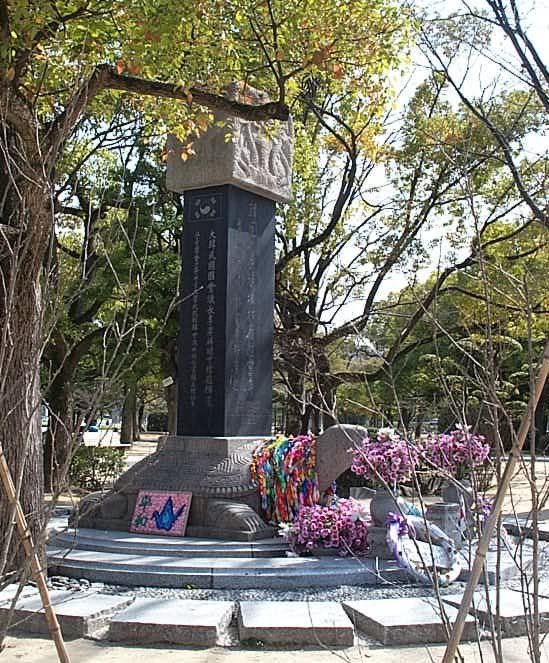
Photo by Steve Freedkin, March 19, 2002
The Korean Atom Bomb Victims' Memorial has been marked not only by the struggle over memory of Hiroshima between zainichi Koreans and Japanese government officials; it also bears an inscription of the relation of power between zainichi Koreans who identify with opposite sides of the divided Korea: "On the front of the memorial is an engraving of Chinese characters which reads, 'kankokujin genbaku giseisha irei hi' or 'memorial for kankokujin . . . atom bomb victims.' Next to it is another line, also of Chinese characters but in a different style of calligraphy, which reads, 'In memory of prince Yi Gu and the other 20,000 or more souls'" (Yoneyama, p. 505). The word kankokujin is commonly used in Japan to specifically refer to nationals of the Republic of Korea. Zainichi Koreans who are politically affiliated with the Democratic People's Republic of Korea are, in contrast, described as chosenjin, which is also the term used to denote all Koreans regardless of citizenship. Moreover, Prince Yi Gu was serving as a Lieutenant-Colonel in the Japanese Imperial Army when he was killed by the bomb -- i.e., a collaborator (Yoneyama, pp. 508-509). In other words, the inscriptions on the memorial marginalize zainichi Koreans who politically identify with North Korea in particular, and class-conscious zainichi Koreans in general. Oh puts it this way: "[W[hy does only the prince receive special treatment when tens of thousands of other Koreans also died? . . . What does the memorial exist for? That there is only an inscription for the Republic of Korea's national flag [when in fact there are two separate sovereign nations for the Korean people] should also be a matter of controversy" (qtd. in Yoneyama, p. 511).
As Seoul and Pyongyang have gradually opened up channels of political communication and economic cooperation, however, the division in the zainichi community has also slowly diminished. In 2001, the pro-Seoul Mindan and the pro-Pyongyang Soren (Zainichi Chosenjin Sorengokai, the General Association of Korean Residents in Japan -- Chongryun in Korean) reached an agreement to build a new unified monument for all Korean victims of the atomic bombing.
Nevertheless, North Korean hibakusha have yet to receive any compensation from the Japanese and U.S. governments:
They endured the atomic nightmares of Hiroshima and Nagasaki and then struggled for decades to live in one of the world's most impoverished, isolated countries. The atomic bomb survivors living in North Korea share yet one more unhappy distinction: they are the only victims of the U.S. nuclear attacks on Japan who receive no assistance from the Japanese government.Let us make a point of remembering the forgotten victims, as we commemorate the bombing of Hiroshima today.
The plight of these forgotten victims is getting more attention this year as Japan marks the 59th anniversaries of the destruction of Hiroshima on Friday and Nagasaki on Monday.
"There is one remaining issue involving overseas atomic bombing survivors, and that is North Korea," Health Minister Chikara Sakaguchi said last week.
Little is known about bomb survivors in North Korea, many of whom were repatriated to their homeland in the late 1950s. The Japanese government estimates there are about 930 of them, but support groups say the real number is twice that, 1,953.
Even less is known about their health or their access to treatment. Bomb survivors -- numbering 285,600, including 5,000 living abroad -- can develop myriad radiation-related maladies, including cancer and liver troubles.
The North Koreans were brought by the hundreds of thousands to Japan as soldiers and laborers during Tokyo's harsh 1910-1945 colonization of the Korean Peninsula.
The North Korean survivors are largely victims of politics.
Tokyo has long resisted providing full assistance to survivors who don't live in Japan, but a 2002 court ruling forced the government to funnel more relief to victims abroad.
The government provides monthly allowances of up to $1,260 and free medical checkups to survivors in Japan. Foreign-based survivors, mostly in South Korea but also in many other countries, get a smaller package of assistance.
Since 2002, the monthly allowances have been available to all survivors as long as they had special certificates available only in Japan.
Government officials say they do not know of any North Koreans who registered before leaving Japan. Under the strict communist regime in Pyongyang, citizens are not free to travel to Japan to register now.
Even with registration, officials in Tokyo say they are loathe to send them benefits in North Korea because they have no idea whether the money would be confiscated by the revenue-starved government.
Japan and North Korea have never had diplomatic relations, and the situation of the bomb victims is unlikely to change while the two countries remain estranged, government officials acknowledge.
"Realistically, there is little we can do until the diplomatic ties are normalized," said Takaaiki Kikuta, a Health Ministry official in charge of atomic bombing survivors.
"Among many uncertainties, we are not familiar with North Korea's financial system, or whether the aid money would safely reach the survivors if we sent it," he added.
Supporters, however, say that a special effort should be made for the North Koreans.
"All these years, the Japanese government has abandoned survivors in North Korea," said Lee Sil Gun, a 75-year-old pro-Pyongyang resident in Japan and himself a Hiroshima survivor.
Lee was in Japan's western port city of Kobe selling black market rice the day the bomb exploded over Hiroshima, and he was exposed to radiation when he returned home the following day. He now suffers from liver ailments.
Many of his Korean friends and neighbors who survived the bombing later moved to North Korea in a state-sponsored repatriation program beginning 1959.
Lee, who interviewed about a dozen survivors during a visit to Pyongyang two years ago, said many North Korean survivors are getting old, frail and in dire need for help as soon as possible.
"I'm sure there are ways to provide humanitarian support rather than waiting for normalization," Lee said. (Mari Yamaguchi/The Associated Press, "Isolation Strands N. Korea A-bomb Victims," The Seattle Post-Intelligencer, August 6, 2004)
Monday, July 26, 2004
Cyber One Korea
As soon as I mentioned a report on online gambling in North Korea in my previous entry "North Korea Goes Commercial Online" (July 26, 2004), skeptical readers asked whether it wasn't another myth about North Korea: e.g., "I have gone all over the site and can not find any gambling" (Macdonald Stainsby, Rad-Green, July 26, 2004). The report, however, did not say that online gambling is available at the Naenara ("My Country") site at www.kcckp.net.
The gambling site in question is www.jupae.com, reportedly "wildly popular with South Korean Internet users," who wanted not so much to gamble as to chat with North Koreans on its bulletin board:
I tried to log onto www.jupae.com today, but "the operation [got] timed out" each time. Has it gone belly up, deprived of South Korean customers?
The gambling site in question is www.jupae.com, reportedly "wildly popular with South Korean Internet users," who wanted not so much to gamble as to chat with North Koreans on its bulletin board:
The online bulletin board of an inter-Korean venture based in North Korea has become wildly popular with South Korean Internet users.It is encouraging to hear so many South Koreans wishing to have conversations with North Koreans, despite the legacy of draconian anticommunist repression in South Korea. Unfortunately, the South Korean government "cancel[led] [Hoonnet's] legal rights for the inter-Korean business altogether," as "the company did not abide by a government order to close down the website," and it "also decided to block access to the gambling site www.Jupae.com and take legal action against South Koreans using it and sending money to the North," according to an article on GamblingLicenses.com (January 10, 2004).
The site in question is a free board open to all users at www.jupae.com, a gambling site operated by North Koreans using South Korean technology and capital.
More than 14,000 messages have been posted on the bulletin board since May 2002, two months after the launch of the main site.
Most of them are written by South Koreans, excited by the fact that they can communicate with North Koreans online.
"Can you please tell us your MSN messenger address? I want to chat with a North Korean," wrote one user identified as Hanmoonki.
A site administrator replied offering their address and wishing the user a nice day.
These kind[s] of replies from administrators, who work in shifts 24 hours a day to answer questions even unrelated to their business, are another reason for the site’s popularity.
"Do you think China is justified in claiming Koguryo as part of their history?" a user identified as Diadol asked.
"Of course not. For your reference on our position on the issue, look up at this past article at www.kcna.co.jp," an administrator answered.
Some 10 North Korean women, recent college graduates, manage the bulletin board from their office in Pyongyang, according to Kim Bum-hoon, president of Hoonnet, the South Korean company which set up the site jointly with the North.
"When we first proposed to North Koreans to set up an anonymous bulletin board open to non-members, the North said it was impossible. We convinced them by stressing the need to build up confidence," he said in an interview with Mediaonul, a weekly specializing in media news.
However, the site faces closure with South Korea’s Unification Ministry set to revoke Hoonnet’s license to do business in North Korea.
Ministry officials said this is because the company never got the approval from the government to run a gambling site, with its original plan confined to developing computer software.
Hoonnet maintains that the Unification Ministry knew of its plans to open the gambling site beforehand, and is petitioning to keep the site open for the sake of inter-Korean relations.
Articles by Internet users hoping to keep the communication channel with North Koreans are flooding the site.
In addition to salvaging the site, an Internet newspaper specializing in IT, www.inews24.com, has kicked off a campaign to legalize inter-Korean communications on the Internet, called "Cyber One Korea."
The anti-communist National Security Law makes all contact with North Koreans illegal unless there is prior approval from the Unification Ministry, but that law has been lost in reality as Internet users have been surfing North Korean sites en masse.
"We know it’s impossible to investigate all of those who logged on the site," a police official said in an interview with Donga.com, a news portal. (Seo Soo-min, "NK Online Gambling Site Sparks Interest," The Korea Times, January 19, 2004)
I tried to log onto www.jupae.com today, but "the operation [got] timed out" each time. Has it gone belly up, deprived of South Korean customers?
North Korea Goes Commercial Online
According to Reuters, there is a new North Korean website -- the Naenara ("My Country") site at www.kcckp.net -- the third North Korean website, whose novelty is its emphasis on commercial opportunities in North Korea:
It is a German company KCC (Korea Computer Center)-Europe that created and maintains www.kcckp.net, which may compound translation troubles all too common in communication between East Asia and English-speaking regions of the world, if the company is translating documents from Korean to German to English. The owner of KCC-Europe is Jan Holtermann, an adventurous and optimistic entrepreneur:
Pyongyang's net venture is merely one aspect of the slow but certain transformation of North Korea into a capitalist economy.
KCNA has been available on the Internet for about five years on the Japan-based site www.kcna.co.jp. Another North Korean site, www.uriminzokkiri.com, publishes Pyongyang views from China.From the same Reuters article, the reader also learns that "[t]he launch follows the start of online gambling [!] run by the North two years ago and an online shopping mall in the South that sells goods imported from the North" (emphasis added, "N.Korea Opens Pilot Web Portal, Glitches Remain," July 14, 2004).
The new portal provides the North Korean telephone numbers of state trading companies that offer products raging from "stylish dresses of fine workmanship" to ferrous and nonferrous metals. ("N.Korea Opens Pilot Web Portal, Glitches Remain," July 14, 2004)
It is a German company KCC (Korea Computer Center)-Europe that created and maintains www.kcckp.net, which may compound translation troubles all too common in communication between East Asia and English-speaking regions of the world, if the company is translating documents from Korean to German to English. The owner of KCC-Europe is Jan Holtermann, an adventurous and optimistic entrepreneur:
A German, Jan Holtermann owner of the computer firm KCC Europe, is putting North Korea online.According to Netcraft, www.kcckp.net is run on Linux. Take that, Microsoft!
He hopes that by being there first he will be able to eventually tap into North Korean computer talent.
The country's small number of internet users currently dial-up to Chinese providers, a costly process at about £1 a minute.
Mr Holtermann's customers, who he hopes will number 2,000 by the end of the year, will have unlimited access for £400 a month.
As only a few North Koreans are permitted to have telephones, and as the internet service is costly, Mr Holtermann expects his customers to be government ministries, news agencies and aid organisations.
He has invested £530,000 in the venture, intending to get first pick when North Korean software programmers come onto the market.
"They are very talented," he says.
"It's this capacity we want to sell in Europe." (Lucy Jones, "Foreign Investors Brave North Korea," April 13, 2004)
Pyongyang's net venture is merely one aspect of the slow but certain transformation of North Korea into a capitalist economy.
The Washington Post reports on "the bustling site of North Korea's first capitalist industrial park," which it hails as "a new symbol of progress" -- the "progress" that creates winners and losers:
There is now advertising in North Korea (BBC)
[T]he $180 million project just across the three-mile-wide Demilitarized Zone separating the two Koreas marks the most profound example of a 22-month-old experiment to bring the free market to one of communism's last frontiers.
Abuzz with activity as earthmovers clear land near the North Korean town of Kaesong for the first phase of five to 10 factories, the plants at Kaesong, to be owned and operated by South Korean companies, will employ up to 1,000 North Korean workers paid in U.S. dollars and receiving raises -- or dismissal slips -- based on performance. The long-term development plan calls for apartment complexes, hotels, restaurants -- even an amusement park by 2020.
"For North Korea, this is a first," said Jang Whan Bin, senior vice president of Seoul-based Hyundai Asan Corp., financed in part by the South Korean government. "The market system in this industrial zone will be more flexible than anything now existing in North Korea. It is more than symbolic. The North Koreans are eager to understand the free market, and now we're bringing it across the border for them to take part."
The Kaesong Industrial Park underscores mounting evidence that North Korea is undergoing its boldest attempt at economic reform since Kim Il Sung founded the Stalinist nation more than half a century ago.
With the end of the Cold War, North Korea lost hefty aid from Moscow and Beijing. The funds had propped up the economy, as did trade with other communist countries, and the loss of revenue sparked a financial collapse and bouts of starvation during the 1990s estimated to have killed as many as 2 million people. Bankrupt and desperate, the secretive Pyongyang government launched an experiment with the free market in July 2002, deregulating prices and hiking salaries.
No one expects the kind of societal transformation -- or foreign investment -- seen in China or even Vietnam while North Korea remains on its current path as a renegade nuclear power. But almost two years into its experiment, the reforms have spread far more deeply and quickly than many had anticipated, according to interviews with Asian and Western diplomats, business executives, aid groups and analysts, including a series of recent visitors there.
In addition to the industrial park, they noted new steps to phase out the state's food rationing system, the rapid proliferation of deregulated markets, attempts to reform state-run factories into profit-based operations, even the launch of a Web site selling "Made In North Korea" products over the Internet.
Since reforms went into place, North Korean trade with China jumped 38 percent to $1.02 billion in 2003; trade with South Korea spiked 12 percent to $724 million. In Pyongyang, the capital, eyewitness reports suggest a consumer culture is on the rise, with a proliferation of new markets selling oranges from Spain and electronics from China without state-set or subsidized prices. Many of these enterprises deal in dollars or euros. Smaller, independently run kiosks also dot the urban landscapes, selling cigarettes and soda pop.
Capitalist advertising -- roadside billboards peddling the Whistle, a type of Fiat assembled in North Korea -- has gone up along highways peppered with more and more late-model cars. The number of cell phones in the capital has reportedly soared from 3,000 in 2002 to an estimated 20,000 today.
North Korean ruler Kim Jong Il -- who succeeded Kim Il Sung, his father, following the latter's death in 1994 -- has dispatched special emissaries to China and Vietnam to further analyze the economic openings there, according to Ban Ki Moon, South Korea's foreign minister. During a surprise summit with Chinese leaders last month, Kim spent an entire morning touring a village outside Beijing touted by the Chinese as a model for introducing private enterprise and extending ownership rights. . . .
. . . [B]y most accounts, those who thrived under the communist system had connections to the government, the military or black market. These officials have capitalized on the new system with increased access to imported goods and new ways to use their connections to benefit from the legalization of open commerce -- particularly in markets and trading on the Chinese border. Mid-level government officials, for instance, have become notorious for stripping abandoned factories of scrap metal and selling it to the Chinese, South Korean intelligence sources said.
By contrast, those at the lower rungs of society -- especially in rural regions far from the relatively prosperous capital -- face even greater challenges now, battling soaring inflation as government-set prices and state rations steadily disappear.
The U.N. World Food Program now calculates that 6.5 million of North Korea's 22 million people are facing food shortages this year. Those figures include a "new underclass" generated by the experiment with market reforms, according to Tony Branbury, the WFP's Asia director.
"When there are broad economic reforms in any society, there are going to be winners and losers, and clearly, in the case of North Korea, the reforms have created a new class of losers," said Branbury, who last month concluded an extensive fact-finding mission in North Korea.
On a rare tour through five North Korean cities including Pyongyang, Branbury and his team observed the polarizing power of the economic changes. In Pyongyang, he witnessed a proliferation of cars and cell phones -- which, according to South Korean government officials, are available almost exclusively to Communist Party members, the only North Koreans who can afford the approximately $1,000 registration fee.
At the same time, WFP officials noted the rise of urban slums populated by those living in increasingly desperate conditions. Although North Korea has raised workers' salaries approximately sixfold, prices for staples including rice have gone up ninefold or more.
North Korea once paid even idled factory workers, but many have now been reassigned to menial jobs with lower pay. "I could see workers, who we were told once worked in factories, sweeping up dirt on the sides of rural roads in the middle of nowhere," Branbury said. "The government is redistributing jobs as it can, but the North Korean authorities told us they recognize there is a problem with a new group of vulnerable people excluded from the so-called economic reforms." . . .
Nevertheless, the North Koreans appear to be forging ahead. Most of the factories still functioning in North Korea, for instance, must now meet payrolls based on their own profitability. Managers, rather than Communist Party officials, have been vested with more power to make independent business decisions. A central bank in Pyongyang is offering loans, rather than government subsidies, to state-run factories. (Anthony Faiola, "A Capitalist Sprout In N. Korea's Dust: Industrial Park to Broach Free Market," Washington Post, May 23, 2004, p. A18 )
Thursday, June 03, 2004
POTUS in Pyongyang?
The Pentagon is running out of boots on the ground, even though it has resorted to a series of unpopular measures like the stop-loss policy and use of national guards and inactive reservists, angering soldiers and military families. What's the solution? Theoretically, the next POTUS has an option of pulling a "POTUS in Pyongyang" surprise, like "Nixon in China."
John Kerry did suggest that he is open to negotiating bilaterally with North Korea: "Kerry said he would keep all options on the table for dealing with North Korea, but he reiterated his criticism of the Bush administration for its unwillingness to engage in direct talks with the North Koreans, saying he would be open to such discussions in addition to the six-party negotiations underway" (Dan Balz, "Kerry Proposes Nuclear Plan: Senator Says U.S. Must Move Faster to Safeguard Materials," Washington Post, June 2, 2004, p. A07 ), alarming South Korean conservatives (cf. The Chosun Ilbo Editorial, "Unification of Korea?" International Herald Tribune, June 3, 2004).
If Kerry can change US policy on China and North Korea, he can transfer US troops from Japan and South Korea to Iraq: "There are about 37,000 US troops in South Korea, about 47,000 in Japan" (Robert Burns/The Associated Press, "Rumsfeld: U.S. Ready for Military Change," June 3, 2004). (If he is ready to change US policy on Russia, he can withdraw 100,000 US troops from Europe and divert them to Iraq, too.)
If the bilateral talks with North Koera are designed to repeat a Clinton rather than pull a Nixon, though, Kerry can't free up the US troops in Asia for the Iraq campaign. All indications suggest that Kerry -- a man of no vision -- wants to be the second coming of Clinton: "Kerry called bioterrorism second only to the nuclear threat. Asked by AP Radio how he would deal with North Korea and its nuclear arsenal, Kerry said he would hold direct, bilateral talks with North Korea just as President Clinton did to create a process for accountability even if it is flawed" (Darlene Superville/The Associated Press, "Kerry Cites Lack of Bioterror Strategy," Washington Post, June 2, 2004).
It is no wonder, then, that the Pentagon's repeated denials can't extinguish rumors of the draft.
John Kerry did suggest that he is open to negotiating bilaterally with North Korea: "Kerry said he would keep all options on the table for dealing with North Korea, but he reiterated his criticism of the Bush administration for its unwillingness to engage in direct talks with the North Koreans, saying he would be open to such discussions in addition to the six-party negotiations underway" (Dan Balz, "Kerry Proposes Nuclear Plan: Senator Says U.S. Must Move Faster to Safeguard Materials," Washington Post, June 2, 2004, p. A07 ), alarming South Korean conservatives (cf. The Chosun Ilbo Editorial, "Unification of Korea?" International Herald Tribune, June 3, 2004).
If Kerry can change US policy on China and North Korea, he can transfer US troops from Japan and South Korea to Iraq: "There are about 37,000 US troops in South Korea, about 47,000 in Japan" (Robert Burns/The Associated Press, "Rumsfeld: U.S. Ready for Military Change," June 3, 2004). (If he is ready to change US policy on Russia, he can withdraw 100,000 US troops from Europe and divert them to Iraq, too.)
If the bilateral talks with North Koera are designed to repeat a Clinton rather than pull a Nixon, though, Kerry can't free up the US troops in Asia for the Iraq campaign. All indications suggest that Kerry -- a man of no vision -- wants to be the second coming of Clinton: "Kerry called bioterrorism second only to the nuclear threat. Asked by AP Radio how he would deal with North Korea and its nuclear arsenal, Kerry said he would hold direct, bilateral talks with North Korea just as President Clinton did to create a process for accountability even if it is flawed" (Darlene Superville/The Associated Press, "Kerry Cites Lack of Bioterror Strategy," Washington Post, June 2, 2004).
It is no wonder, then, that the Pentagon's repeated denials can't extinguish rumors of the draft.
Subscribe to:
Posts (Atom)