Iran: Condom Factory & Sex Education
Iran: A New Approach to Drugs
Showing posts with label Education. Show all posts
Showing posts with label Education. Show all posts
Wednesday, September 10, 2008
The State of the Sexual Union in Iran and America
As M. Junaid Levesque-Alam observes, Sarah Palin, the 2008 GOP vice presidential nominee, wants the state of the sexual union in the United States to be more conservative than that in the Islamic Republic of Iran.

Thursday, February 07, 2008
A Subprime Military
Iraq has been hurting military recruitment in the United States:
That is good news for people in the Third World, but unfortunately subprime recruits are renewable resources, given the way the American class system is set up to fail children at education.
The DoD classifies military recruits according to educational attainment in 'tiers.' Tier 1 recruits are those with at least a regular high school diploma. The proportion of active-duty Army recruits in tier 1 has dropped from 83.5 percent in 2005 to 70.7 percent in 2007. While the benchmark of 90 percent was also missed in 2005, the percentages have not been this low for at least 20 years. (National Priorities Project, "Military Recruiting 2007: Army Misses Benchmarks by Greater Margin")Black military recruitment went down first, but the rest of America has by now also wised up, forcing the armed forces to increasingly turn to subprime recruits.
That is good news for people in the Third World, but unfortunately subprime recruits are renewable resources, given the way the American class system is set up to fail children at education.
Wednesday, November 14, 2007
Tous contre Sarkozy
Once again French workers are on strike. Nicolas Sarkozy's "pension reform" will initially affect only "about 500,000 public sector employees" (Katrin Benhold, "Strike in France a Test of Wills," New York Times, 14 November 2007), but both the unions and the President know that this is the decisive battle: winning it will let Sarkozy divide and conquer France, the last bastion of socialism in Europe,1 introducing other reforms (including tax cuts, less health care, smaller government payrolls, longer work hours, and more anti-working-class labor laws) that will make the country less social and more liberal.
The unions can win only by countering the propaganda that this strike is about a "conflit sectoriel contre l'intérêt général" [sectoral conflict against the general interest] in the words of Stéphane Rozès of the CSA polling group (Rémi Barroux, "Les syndicats ont peur de perdre la bataille de l'opinion," Le Monde, 14 November 2007). If recent polls are to be believed, the unions are having trouble doing so: 55% of the French judge the mobilization against the reform of the special pension plans as "not justified," according to a BVA survey released on Tuesday. At the time of the 18 October strike on the same issue, 53% shared this judgment. Libération (13 November) reports that 59% are "on the side of Nicolas Sarkozy and the government" and 35% "on the side of strikers and demonstrators." That is despite the fact that "the opinion remains skeptical on the economic policy of the government," 79% judging that Nicolas Sarkozy is "a failure" on the issue of purchasing power and 59% saying the same about his policy on economic growth (Barroux, 14 November 2007).
That may be about to change.
The danger for Sarkozy is the "aggregation of diverse movements" against his overal agenda, as Rozès notes (Rémi Barroux, "Stéphane Rozès, directeur général de CSA: 'Le danger pour Sarkozy est l'agrégation de mouvements,'" Le Monde, 12 November 2007). Just such a convergence is likely to develop this month. Students, who are fighting their own battle against privatization of education as well, have threatened to block train stations in solidarity with striking workers, and civil servants will go on strike on 20 November.
1 The last bastion of socialism in terms of working people's militancy and public sentiment, not of political economy, of course:
The unions can win only by countering the propaganda that this strike is about a "conflit sectoriel contre l'intérêt général" [sectoral conflict against the general interest] in the words of Stéphane Rozès of the CSA polling group (Rémi Barroux, "Les syndicats ont peur de perdre la bataille de l'opinion," Le Monde, 14 November 2007). If recent polls are to be believed, the unions are having trouble doing so: 55% of the French judge the mobilization against the reform of the special pension plans as "not justified," according to a BVA survey released on Tuesday. At the time of the 18 October strike on the same issue, 53% shared this judgment. Libération (13 November) reports that 59% are "on the side of Nicolas Sarkozy and the government" and 35% "on the side of strikers and demonstrators." That is despite the fact that "the opinion remains skeptical on the economic policy of the government," 79% judging that Nicolas Sarkozy is "a failure" on the issue of purchasing power and 59% saying the same about his policy on economic growth (Barroux, 14 November 2007).
That may be about to change.
The danger for Sarkozy is the "aggregation of diverse movements" against his overal agenda, as Rozès notes (Rémi Barroux, "Stéphane Rozès, directeur général de CSA: 'Le danger pour Sarkozy est l'agrégation de mouvements,'" Le Monde, 12 November 2007). Just such a convergence is likely to develop this month. Students, who are fighting their own battle against privatization of education as well, have threatened to block train stations in solidarity with striking workers, and civil servants will go on strike on 20 November.
1 The last bastion of socialism in terms of working people's militancy and public sentiment, not of political economy, of course:
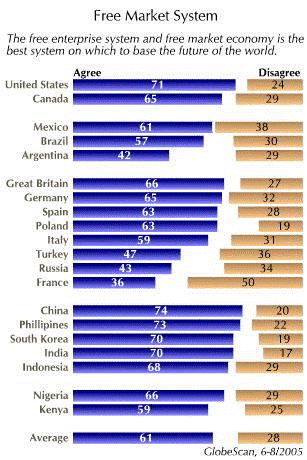
SOURCE: GlobeScan and PIPA, "20 Nation Poll Finds Strong Global Consensus: Support for Free Market System, But also More Regulation of Large Companies," 11 January 2006
Saturday, October 27, 2007
What's Good about Islam?
What's behind David Horowitz's "Islamo-Fascism Awareness" week? A short supply of pinkos in the USA, observes Alexander Cockburn: "The left in America is really in very poor shape: near zero Commies, and really only a sprinkling of radical black profs, militant Lesbians and kindred antinomians to beat up on" ("So Much for Islamo-Fascism Awareness," CounterPunch, 27-28 October 2007). Right he is.
Leftists in the USA have built neither a mass communist party nor a mass social democratic party. The Red Purge of the fifties was so successful that few Reds remain in trade unions. There are only two institutions that leftists have managed to "capture" through a "long march" in the USA: academia and mainline Protestantism.1 The former has been a target of Horowitz for a long time, as its conquest was never complete, its summit (boards of trustees and top administration) firmly in the enemy camp. It's only a matter of time before he turns to the latter.
Cockburn also contends in the aforementioned article: "Coalitions have formed to combat Horowitz's version of Awareness with superior Progressive Awareness about what is good or not so good about Islam" (27-28 October 2007). This I doubt. Rare are secular leftists who, though quick to point out what's "not so good" about Islam, wouldn't stumble if asked to explain what's "good" about it.
Average secular leftists are, in reality, as uncomfortable about encounters with Muslims as rightists. They, unlike rightists, tolerate Islam and even defend Muslims when they become victims of right-wing Islamophobia, but that is as far as they are willing to go. They still think it is a "tragedy" that Muslims, especially Muslim women, adhere to their faith, assuming it to be inferior to their own secular ideology: "Liberal-Leftist Islamophobia Watch (Part I)," Ihsan, 18 September 2007; and "Left-Liberal Islamophobia Watch (Part II)," Ihsan, 23 October 2007.2 That won't do. We expect the religious to recognize that the irreligious are morally equal to them. So would they in turn. Unless and until secular leftists realize that Islam is as good a theology of liberation as Christianity and historical materialism, and vice versa, solidarity won't be forever.
1 Left-wing Jews might have "captured" at least Reform Judaism if not other branches had they remained within their faith community, but they have tended to reject their faith altogether. Indeed, Zionists' hegemony of major institutions, secular or religious, that claim to represent Jews is so complete that some Jewish leftists, exasperated, would even consider resigning from "the Jewish people":
Leftists in the USA have built neither a mass communist party nor a mass social democratic party. The Red Purge of the fifties was so successful that few Reds remain in trade unions. There are only two institutions that leftists have managed to "capture" through a "long march" in the USA: academia and mainline Protestantism.1 The former has been a target of Horowitz for a long time, as its conquest was never complete, its summit (boards of trustees and top administration) firmly in the enemy camp. It's only a matter of time before he turns to the latter.
Cockburn also contends in the aforementioned article: "Coalitions have formed to combat Horowitz's version of Awareness with superior Progressive Awareness about what is good or not so good about Islam" (27-28 October 2007). This I doubt. Rare are secular leftists who, though quick to point out what's "not so good" about Islam, wouldn't stumble if asked to explain what's "good" about it.
Average secular leftists are, in reality, as uncomfortable about encounters with Muslims as rightists. They, unlike rightists, tolerate Islam and even defend Muslims when they become victims of right-wing Islamophobia, but that is as far as they are willing to go. They still think it is a "tragedy" that Muslims, especially Muslim women, adhere to their faith, assuming it to be inferior to their own secular ideology: "Liberal-Leftist Islamophobia Watch (Part I)," Ihsan, 18 September 2007; and "Left-Liberal Islamophobia Watch (Part II)," Ihsan, 23 October 2007.2 That won't do. We expect the religious to recognize that the irreligious are morally equal to them. So would they in turn. Unless and until secular leftists realize that Islam is as good a theology of liberation as Christianity and historical materialism, and vice versa, solidarity won't be forever.
1 Left-wing Jews might have "captured" at least Reform Judaism if not other branches had they remained within their faith community, but they have tended to reject their faith altogether. Indeed, Zionists' hegemony of major institutions, secular or religious, that claim to represent Jews is so complete that some Jewish leftists, exasperated, would even consider resigning from "the Jewish people":
Did you ever wonder what your last thought would be just before you died or believed you might die? Well, I did, and a few years ago in the waning moments before going under the knife for a life threatening operation I got my answer. As the nurses wheeled me into the operating room, what burst upon my consciousness was not, as might be expected, the fear of dying but a terrible angst at the idea of dying a Jew. I was appalled to finish my life with my umbilical cord still tied to a people with whom I can no longer identify. That this should be my "last" thought greatly surprised me at the time, and it still does.2 For secular leftists' criticisms of Islamophobia on the Left, see, for instance, Deepa Kumar, "Danish Cartoons: Racism Has No Place on the Left," MRZine, 21 February 2006; Deepa Kumar, "Fighting Islamophobia: A Response to Critics," MRZine, 3 April 2006; Richard Fidler, "Ontario's 'Sharia Law' Controversy: How Muslims Were Hung Out to Dry," MRZine 27 May 2006; Rami El-Amine, "Anti-Arab Racism, Islam, and the Left," MRZine, 3 September 2006;
What did it mean . . . and why is it so hard to resign from a people? (Bertell Ollman, "Letter of Resignation from the Jewish People," Dialectical Marxism)
Monday, September 17, 2007
Pleasure of Sex Education in Iran
In your sex education classes in schools in the USA, did you ever hear anything about techniques of pleasure, e.g., "men needed to be patient, because women need more time to become aroused"?
The secular liberal democratic government of the United States, which governs a rich industrial country in the global North, fails to provide such essential services as free contraceptives and scientific sex education, let alone a sex education that promotes sexual pleasure, which the Islamic Republic of Iran makes available.
Secular leftists tend to believe that secular liberal democracy is always better than religious government at least on the gender and sexuality front in all respects. But that is not true. It really depends on the content of each government's programs, not on whether the government is secular or religious.
The instructor held up an unfurled green condom as she lectured a dozen brides-to-be on details of family planning. But birth control was only one aspect of the class, provided by the government and mandatory for all couples before marriage. The other was about sex, and the message from the state was that women should enjoy themselves as much as men and that men needed to be patient, because women need more time to become aroused.
This is not the picture of Iran that filters out across the world, amid images of women draped in the forbidding black chador, or of clerics in turbans. But it is just as much a part of the complex social and political mix of Iranian society -- and of the state’s continuing struggle, now three decades old, to shape the identity of its people.
. . . Sex education here is not new, but the message has been updated recently to help young people enjoy each other and, the Islamic state hopes, strengthen their marriages in a time when everyday life in Iran is stressful enough. (Michael Slackman, "Molding the Ideal Islamic Citizen," New York Times, 9 September 2007)
ایران جالبترین کشور است!
The secular liberal democratic government of the United States, which governs a rich industrial country in the global North, fails to provide such essential services as free contraceptives and scientific sex education, let alone a sex education that promotes sexual pleasure, which the Islamic Republic of Iran makes available.
Secular leftists tend to believe that secular liberal democracy is always better than religious government at least on the gender and sexuality front in all respects. But that is not true. It really depends on the content of each government's programs, not on whether the government is secular or religious.
Saturday, August 25, 2007
Cited by Henry A. Giroux and Sophia A. McClennen
I just noticed that my blog entry "Conservatives: Underrepresented in Academia?" (Critical Montages, 2 April 2005) was cited by Henry A. Giroux in his article "Academic Freedom Under Fire: The Case for Critical Pedagogy" (College Literature 33.4, Fall 2006: 1-42). The same entry has also been cited in Sophia A. McClennen, "The Geopolitical War on U.S. Higher Education" (College Literature 33.4, Fall 2006: 43-75). I admire their work, so I'm happy to learn that they found my blog useful.
Another blog entry of mine, "Working-class Academics" (Critical Montages, 5 December 2004), has been mentioned in Radical Teacher (March 2005): "Right/left Campus Monopolies." I like this magazine, too, so I'm delighted to be included in it.
Another blog entry of mine, "Working-class Academics" (Critical Montages, 5 December 2004), has been mentioned in Radical Teacher (March 2005): "Right/left Campus Monopolies." I like this magazine, too, so I'm delighted to be included in it.
Tuesday, April 26, 2005
Colleges and Universities as Working-class Institutions
Have American leftists fully grasped the implications of the changed relation between the working class and post-secondary education in the United States?
(The fancy word "academia," whether used to venerate or disparage post-secondary education, doesn't quite capture its reality in the United States, as the first two years of instruction at four-year colleges and universities as well as community college education function not unlike remedial classes for deficient high school education.)
A majority of American workers today experience post-secondary education. "More than half the U.S. population 25 and over in 2000 (52 percent) had completed at least some college education" (emphasis added, US Census Bureau, "Educational Attainment: 2000," August 2003). The younger workers are, the more likely they are to have college experience: "The rate of completion of some college was 58 percent among those in the 25- to 29-year age group" (emphasis added, US Census Bureau, August 2003). That's a momentous change since the 1930s and even the 1960s, two upsurges of class struggle in the United States (as well as the rest of the world).
Given the change, it's time to consider colleges and universities as working-class institutions rather than elite redoubts, without however putting blue-collar workers who have no college education (some of whom work on campuses as janitors, food workers, clerical workers, etc., colleges and universities being main employers in many cities and towns in America) on the political back burner. Because of the declining weight of mass production factories in the US economy (reflected in the big US trade and current account deficits), colleges and universities -- along with elementary, middle, and high schools -- are among the few remaining institutions where you can still find working-class youths en masse.
It's still important to organize workers at points of production, but the points of production have become increasingly fragmented (due for instance to the rise of mini mills, deregulation, outsourcing, offshoring, etc.), so it's more crucial than ever to organize workers at other working-class institutions such as schools as well as in working-class neighborhoods (in the form of community organizing).
(The fancy word "academia," whether used to venerate or disparage post-secondary education, doesn't quite capture its reality in the United States, as the first two years of instruction at four-year colleges and universities as well as community college education function not unlike remedial classes for deficient high school education.)
A majority of American workers today experience post-secondary education. "More than half the U.S. population 25 and over in 2000 (52 percent) had completed at least some college education" (emphasis added, US Census Bureau, "Educational Attainment: 2000," August 2003). The younger workers are, the more likely they are to have college experience: "The rate of completion of some college was 58 percent among those in the 25- to 29-year age group" (emphasis added, US Census Bureau, August 2003). That's a momentous change since the 1930s and even the 1960s, two upsurges of class struggle in the United States (as well as the rest of the world).
Given the change, it's time to consider colleges and universities as working-class institutions rather than elite redoubts, without however putting blue-collar workers who have no college education (some of whom work on campuses as janitors, food workers, clerical workers, etc., colleges and universities being main employers in many cities and towns in America) on the political back burner. Because of the declining weight of mass production factories in the US economy (reflected in the big US trade and current account deficits), colleges and universities -- along with elementary, middle, and high schools -- are among the few remaining institutions where you can still find working-class youths en masse.
It's still important to organize workers at points of production, but the points of production have become increasingly fragmented (due for instance to the rise of mini mills, deregulation, outsourcing, offshoring, etc.), so it's more crucial than ever to organize workers at other working-class institutions such as schools as well as in working-class neighborhoods (in the form of community organizing).
Saturday, April 02, 2005
Conservatives: Underrepresented in Academia?
Are there fewer conservatives in academia than there ought to be? A new study that suggests that there are is making a splash in the corporate media: Stanley Rothman, S. Robert Lichter, and Neil Nevitte, "Politics and Professional Advancement among College Faculty," The Forum 3.1 (2005).
According to the Washington Post, the study was "funded by the Randolph Foundation, a right-leaning group that has given grants to such conservative organizations as the Independent Women's Forum and Americans for Tax Reform" (Howard Kurtz, "College Faculties A Most Liberal Lot, Study Finds," Washington Post, 29 Mar. 2005, C1). Caveat emptor.
What data did the study employ?
"The data come from the 1999 North American Academic Study Survey (NAASS) of students, faculty and administrators at colleges and universities in the United States and Canada. This survey was conducted in 1999 by Angus Reid (now Ipsos-Reid), a survey research firm" (Rothman, Lichter, and Nevitte, (2005, p. 3).
(The 1999 "North American Academic Study Survey" by Angus Reid? I've never heard of the study before. Has anyone? Can't find anything more about the "North American Academic Study Survey" through Google Scholar, LexisNexis, JSTOR, Project Muse, Social Science Abstracts, Sociological Abstracts, and Worldwide Political Science Abstracts. Has anyone other than Rothman, Lichter, and Nevitte gained access to the survey's data and analyzed them? If not, why not? It's a survey presumably taken six years ago, and no one has made a peep about it till now?)
Based on the obscure survey, Rothman, Lichter, and Nevitte claim that "a sharp shift to the left has taken place among college faculty in recent years" (2005, p. 4):
What if Rothman, Lichter, and Nevitte turned out to have a point, despite their small and unrepresentative sample? They find that "academic achievement matters most" in predicting "the quality of schools in which faculty teach," but "ideology is the second most powerful predictor in Model I (beta=.09, p ≤.001), accounting for more than one-fifth as much variation in quality of institutional affiliation as does achievement (beta=.39, p ≤.001)" (Rothman, Lichter, and Nevitte, 2005, p. 10). As you can see, though, the coefficient of correlation between ideology and institutional prestige is rather close to zero.
Rothman, Lichter, and Nevitte still suspect that discrimination is at work, but a minuscule correlation between professors' politics and institutional prestige doesn't necessarily mean conservative scholars are discriminated against.
Here are two hypotheses for further research:
According to the Washington Post, the study was "funded by the Randolph Foundation, a right-leaning group that has given grants to such conservative organizations as the Independent Women's Forum and Americans for Tax Reform" (Howard Kurtz, "College Faculties A Most Liberal Lot, Study Finds," Washington Post, 29 Mar. 2005, C1). Caveat emptor.
What data did the study employ?
"The data come from the 1999 North American Academic Study Survey (NAASS) of students, faculty and administrators at colleges and universities in the United States and Canada. This survey was conducted in 1999 by Angus Reid (now Ipsos-Reid), a survey research firm" (Rothman, Lichter, and Nevitte, (2005, p. 3).
(The 1999 "North American Academic Study Survey" by Angus Reid? I've never heard of the study before. Has anyone? Can't find anything more about the "North American Academic Study Survey" through Google Scholar, LexisNexis, JSTOR, Project Muse, Social Science Abstracts, Sociological Abstracts, and Worldwide Political Science Abstracts. Has anyone other than Rothman, Lichter, and Nevitte gained access to the survey's data and analyzed them? If not, why not? It's a survey presumably taken six years ago, and no one has made a peep about it till now?)
Based on the obscure survey, Rothman, Lichter, and Nevitte claim that "a sharp shift to the left has taken place among college faculty in recent years" (2005, p. 4):
Table 1. Ideological self-description of college professors and general publicTo show the "sharp shift," Rothman, Lichter, and Nevitte played a statistical trick. Their NAASS sample is far less representative than the Carnegie study that they use for the point of comparison: Carnegie Foundation for the Advancement of Teaching, The Condition of the Professoriate: Attitudes and Trends (Princeton, NJ: The Carnegie Foundation for the Advancement of Teaching, 1989). The NAASS's American sample consisted of "1643 faculty members" from "183 universities and colleges," containing "responses from 81 doctoral, 59 comprehensive and 43 liberal arts institutions" (Rothman, Lichter, and Nevitte, 2005, p. 3), whereas The Condition of the Professoriate obtained data from "over 5,000 faculty employed at a variety of institutions from Two-Year Community Colleges to Research Institutions" (Tony Palmeri, "The Engaged University: The Ideas of Ernest Boyer," 25 Jan. 2002). Research has shown that faculty and students at research institutions are more liberal than those at primarily teaching institutions (see, for instance, Gordon Shepherd and Gary Shepherd, "War and Dissent: The Political Values of the American Professoriate," The Journal of Higher Education 65.5 [September/October 1994], especially p. 586; and Richard F. Hamilton and Lowell L. Hargens, "The Politics of the Professors: Self-Identifications, 1969-1984," Social Forces 71.3 [March 1993], especially pp. 608-609, 613-614, 616), so the NAASS's exclusion of two-year colleges and overrepresentation of doctoral institutions is a recipe for accentuating the proportion of liberals. In short, comparing the Carnegie study and the NAASS sample is like comparing apples and oranges -- it is impossible to infer any shift over time from two incomparable samples.(Stanley Rothman, S. Robert Lichter, and Neil Nevitte, "Politics and Professional Advancement Among College Faculty," The Forum 3.1, 2005, p. 4)
Professors
(Carnegie 1984)Professors
(NAASS 1999)U.S. Public
(Harris 1999)U.S. Public
(Harris 2004)Left/Liberal 39% 72% 18% 18% Right/Conservative 34% 15% 37% 33%
What if Rothman, Lichter, and Nevitte turned out to have a point, despite their small and unrepresentative sample? They find that "academic achievement matters most" in predicting "the quality of schools in which faculty teach," but "ideology is the second most powerful predictor in Model I (beta=.09, p ≤.001), accounting for more than one-fifth as much variation in quality of institutional affiliation as does achievement (beta=.39, p ≤.001)" (Rothman, Lichter, and Nevitte, 2005, p. 10). As you can see, though, the coefficient of correlation between ideology and institutional prestige is rather close to zero.
Rothman, Lichter, and Nevitte still suspect that discrimination is at work, but a minuscule correlation between professors' politics and institutional prestige doesn't necessarily mean conservative scholars are discriminated against.
Here are two hypotheses for further research:
The first hypothesis is especially promising, in light of time to degree (extraordinarily long in the most liberal disciplines), attrition rates (higher in the humanities and social sciences than in science), employment opportunities (very poor for humanists and social scientists), and lifetime earnings (salaries barely keep up with inflation in academia). Take history, for instance. Rothman, Lichter, and Nevitte find 77% of history faculty members are liberal, 10% conservative, 70% Democrats, and 4% Republicans (2005, p. 6). Would conservatives want to be in a history department?
- Considering academic and non-academic career prospects carefully, the best and brightest conservative young men and women, who would be qualified for academic careers at the most celebrated universities, prefer non-academic careers in business, politics, law, and medicine to academic careers, as tenure-track appointments are hard to come by and non-academic professional careers yield higher incomes on smaller investments of time and money than academic careers.
- Conservative young men and women who do choose academic careers prefer more conservative though less prestigious institutions to more prestigious but more liberal ones and seek out the former for study and employment.
The time spent working toward the history PhD, for instance, grew longer and now surpasses every other discipline. Among the new cohort of history PhDs, the time spent registered for graduate courses increased, from an average of 9 (in 2001–02) to 9.3 years. In comparison, the average for all fields was 7.5 years. Given the extended time spent working toward the degree, it is hardly surprising that the average age of new history PhDs increased by two-tenths of a year, to 34.9 years—a year-and-a-half older than the average for new PhDs in all fields. . . .Keep in mind that the employment statistics above does not take high attrition rates into account:
Despite their years of effort, the new PhDs reported declining success in finding employment after they received the degree. The proportion of new history PhDs who reported "definite employment" fell from 52.9 percent to 51.3 percent—reversing three years of improvement. This is still well above the low point of 44.9 percent in 1998–99, but it does fit with our reporting on the declining number of jobs being advertised.2 Among the rest, 26.8 percent of the new history PhD recipients reported they were still seeking employment when they received the degree, while 14.3 percent planned to take or seek a postdoctoral fellowship, and 7.7 reported that they were uncertain about their future. (Robert B. Townsend, "Survey Shows Marked Drop in History PhDs," Perspectives 43:2, February 2005)
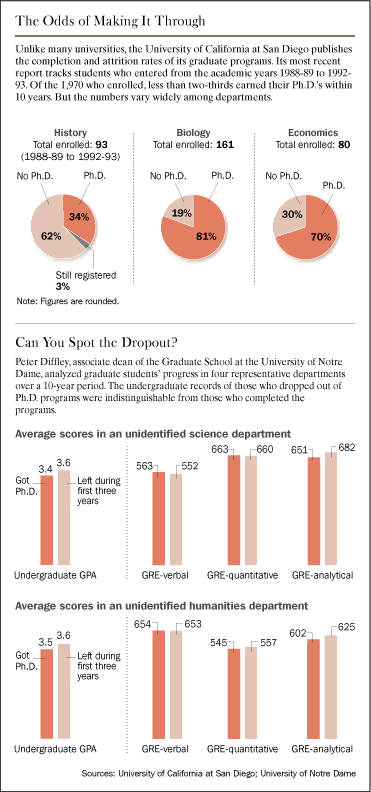
On the first day of graduate school, everyone is still a success. All of the students gunning for Ph.D.'s have lived an academic life of achievement: honor roll, summa cum laude, certificates, scholarships, and parents who praise their intellectual prowess. Yet as many as half of those bright students -- many of whom have never tasted failure -- will drop out before they can claim their prize.What is intriguing, dropouts, if anything, tend to have higher undergraduate GPAs and GRE analytical scores than those who complete Ph.D. programs!
In some humanities programs, only one of every three entering students goes on to earn a doctorate. No comprehensive national statistics are available, but studies suggest that the attrition rate for Ph.D. programs is 40 percent to 50 percent.
. . . . . . . . . . . . . . . . . . . .
Institutions that make it [information about completion rates] easily accessible are in the minority. At the University of California at San Diego, a comprehensive table of completion statistics is included in the graduate school's annual report, easily found on the Web. Duke University's Graduate School includes links to a wealth of admissions, enrollment, and completion data for prospective students on its Web site. There you can learn very specific information about individual departments -- for instance, that the Ph.D. program in literature bucks the national trend. Of the 27 students who started from 1992 through 1995, 17 earned their degrees, and only 6 have withdrawn.
. . . . . . . . . . . . . . . . . . . .
Even students who make it through the rigorous selection process to win National Science Foundation graduate-research fellowships finish their Ph.D.'s at a rate of only about 75 percent. That's just a bit higher than other doctoral students in the sciences.
. . . . . . . . . . . . . . . . . . . .
. . .[T]he pot of gold at the end of the Ph.D. rainbow may not be there for every candidate. For many of them, despite their love of the subject and their dreams of reveling in the life of the mind, the most logical decision may be to leave.
After a year in a Ph.D. program in history at City University of New York, Nicole Kalian left to take a job as a publicist with a book publisher. Hers was the sort of early attrition that almost everyone agrees is the best kind.
"I didn't see any prospects for when I graduated," says Ms. Kalian, who was shocked to read an article about new Ph.D.'s who couldn't find jobs as adjuncts on enough campuses to earn at least $25,000 a year. "It was frightening, and I could never really shake that thought from my head." (emphasis added, Scott Smallwood, "Doctor Dropout: High Attrition from Ph.D. Programs Is Sucking Away Time, Talent, and Money and Breaking Some Hearts, Too," Chronicle of Higher Education 50.19, 16 Jan. 2004, p. A10)
In conclusion, while Rothman, Lichter, and Nevitte's research exaggerates the proportion of liberals and leftists in academia today, it is true that liberals (though not leftists) traditionally outnumber conservatives in the humanities and social sciences, particularly at research institutions that require a doctoral degree as a condition of employment. What should be conservatives' response to that? I submit that conservatives ought to congratulate themselves. Thinking like the proverbial Rational Economic Man weighing opportunity costs and maximizing utility, many conservatives made the economically correct choice of staying out of Ph.D. programs, especially academic sweatshops in the humanities and social sciences. Alternatively, conservatives might apply their favorite tool, neoclassical economics, to the issue: the problem is that salaries that the best and brightest conservatives demand are too high -- lower their prices, and there will be more demand for them in the academic labor market. Liberals and leftists, on the other hand, should proffer a left-wing remedy that addresses a right-wing grievance while solving at least some of the many problems that plague the life of the mind: increase tenure-track jobs massively, and raise faculty salaries as well as teaching assistant wages (especially in the humanities and social sciences) dramatically, in order to make academic compensation packages competitive with what plastic surgeons, corporate lawyers, business executives, and politicians turned lobbyists would expect. In short, give conservatives what they do not have today: financial incentives to become academics. Turn the ivory tower into a field of conservative dreams of big money: if you build it, they will come.
(Smallwood, 16 Jan. 2004)
Friday, March 04, 2005
American Workers: Smarter but Poorer
Despite the neoliberal boomlet (the so-called "New Economy") of the 1990s, real hourly earnings are still lower than the peak of the mid-1970s. Whose fault is that? If you ask technocrats, the culprits are the working class themselves -- especially students and teachers -- who have allowed educational standards to decline and failed to match employers' demands for higher skills: "[t]he fall in real wages of people with low skills and widening earning differentials since the 1980s are also evidence of upskilling in Canada, the European Union and the United States (OECD 1996b)" (Literacy in the Information Age: Final Report of the International Adult Literacy Survey, 2000, p. 8). Especially in the United States, alarming soundbites are used to create a sense of national crisis of education: "Nearly half of all adult Americans cannot read, write, and calculate well enough to function fully in today’s society, and people in their early 20’s have poorer literacy skills than did those in a 1985 survey, according to a federal study" (Debra Viadero, "Half of Adults Lack Skills, Literacy Study Finds," Education Week, September 15, 1993). Is that really true?
The federal study in question, the 1993 National Adult Literacy Survey, however, said nothing of the sort, as Regie Stites clarifies in a working paper prepared for the National Center for Education Statistics: "First, the statement that half of all adult American lack adequate writing skills is an apparent misunderstanding of the nature of the NALS document literacy measures. Second, the association of performance at NALS Levels 1 and 2 with functional illiteracy is never made in the NALS report" ("'How Much Literacy is Enough?' Issues in Defining and Reporting Performance Standards for the National Assessment of Adult Literacy," National Center for Education Statistics Working Paper No. 2000-07, March 2000, p. 23).
There is no evidence to support the claim that Americans -- especially young Americans -- today have lower skills than those in the past. If anything, American workers are more educated and literate than ever, according to Michael J. Handel, who meticulously examined the data provided by not only the NALS but a battery of other tests.
Given that the rises in workers' educational attainment (even producing an oversupply of college graduates) and test scores took place at the same time as the proportion of well-paying manufacturing jobs contracted and that of poorly-paying service jobs expanded in the US economy, one would think that the question of "how to make work more satisfying" is even more urgent now than in the 1970s.
Instead, technocrats continue to cling to the "skills mismatch" theory, asserting that workers' skill levels fall short of the demand of the post-Fordist job market. Evidence for statistically significant upskilling in the last couple of decades -- the period of real wage stagnation and widening income inequality -- is as scant as evidence for a national literacy crisis, however: "Sum (1999) and Barton (2000:15,19) replace DOT [Dictionary of Occupational Titles] measures of occupational skills with mean NALS scores and find job literacy requirements almost completely unchanged over the periods 1990-2005 and 1986-2006, respectively, based on BLS occupational data and projections for the terminal years" (Handel, p. 27).
Besides, when it comes to hiring, employers themselves appear to value docility and servility more than anything else: "Cross-sectional studies often suggest employers are less concerned about cognitive skills deficits than what they consider poor work habits, motivation, demeanor, and attitudes" (Handel, p. 25). Lucy Kellaway put it more bluntly:
The federal study in question, the 1993 National Adult Literacy Survey, however, said nothing of the sort, as Regie Stites clarifies in a working paper prepared for the National Center for Education Statistics: "First, the statement that half of all adult American lack adequate writing skills is an apparent misunderstanding of the nature of the NALS document literacy measures. Second, the association of performance at NALS Levels 1 and 2 with functional illiteracy is never made in the NALS report" ("'How Much Literacy is Enough?' Issues in Defining and Reporting Performance Standards for the National Assessment of Adult Literacy," National Center for Education Statistics Working Paper No. 2000-07, March 2000, p. 23).
There is no evidence to support the claim that Americans -- especially young Americans -- today have lower skills than those in the past. If anything, American workers are more educated and literate than ever, according to Michael J. Handel, who meticulously examined the data provided by not only the NALS but a battery of other tests.
Taking education as the measure suggests that the workforce is considerably more skilled than in the past. In 1964, prior to the perceived deterioration of public education, the share of all Americans who were high school dropouts was 47% and the proportion of young people age 24-29 with less than high school was 31%, compared to roughly 13% for both groups in 1997 (author's calculations, March Current Population Survey). . . .Moreover, the supply of college graduates is larger than the number of jobs that require college education (the requirement that is due more to credentialism than to actual skill demands of the jobs or actual skills supplied by college education):
. . . . . . . . . . . . . . . . . . . .
IQ tests show large gains for Americans throughout this century, including every postwar decade for samples as recent as 1995, the most current, and there is no obvious recent change in the slope of growth (Flynn 1998: 27,35ff.). . . .
. . . . . . . . . . . . . . . . . . . .
One of the most frequently cited are college entrance exams, such as the SAT, whose decline beginning in the mid-1960s initiated the recent concern over the state of public education in the U.S. However, less widely reported is that math SAT scores started rising around 1980 and exceeded 1971 levels by the mid-1990s, despite the growing share of high school students taking the exam, though verbal scores did not recover, while the pattern for the rival American College Test (ACT) shows English scores exceeding earlier levels while the rebound in math did not fully offset the earlier decline (Economic Report of the President 2000:148; Boesel & Fredland 1999:72). Contrary to popular impression, the SAT and ACT test score declines are highly cohort-specific and ceased or reversed long ago.
. . . . . . . . . . . . . . . . . . . .
The best time series of inter-cohort data is the U.S. Department of Education's National Assessment of Educational Progress (NAEP), sometimes called the Nation's Report Card, which has a continuous series of reading and math scores for representative samples of 17-year olds since the early 1970s; the test instrument has remained roughly the same over this time. Reading scores did not change significantly between 1971-1999, in contrast to SAT scores. Math scores dipped about 2% between 1973-1982 and then rose until reaching a level in 1999 about 1% higher than 1973 (Campbell et al 2000). Overall test score inequality for both math and reading also declined since the 1970s, due mostly to gains at the lower percentiles, contradicting the impression that the lower part of the distribution is losing ground (Campbell et al 2000:9ff.). Black math and reading scores rose and closed roughly one-half of the black white gap during the 1980s, also contradicting popular impressions, before losing some ground in the 1990s, a development that is still poorly understood (Campbell et al 2000:36ff.)
. . . . . . . . . . . . . . . . . . . .
Contrary to popular impression, age is negatively associated with test scores even for those under 65, lending no support to the idea that younger Americans have poorer literacy skills than older ones. Those age 55-64, who would have graduated high school in the reputed golden years of American education (1946-1955), clearly have lower scores than more recent cohorts, who supposedly bear the effects of less rigorous schooling. Many fewer in the older group actually finished high school but a significant gap remains even after controlling for educational attainment (Smith 1995:214; Freeman & Schettkat 2001; cf. OECD & Stat. Can. 2000:147f.). The NALS data provide no evidence that more recent cohorts have lower cognitive skills than older cohorts. (Michael J. Handel, "Skills Mismatch in the Labor Market," December 2002 [published in Annual Review of Sociology 29, August 2003], pp. 11-14, 17)
Hecker (1992:4) found that the percentage of college grads in occupations not requiring a college degree or unemployed rose from about 12% (1967) to 18.6% (1980) during the "over-education" years, and continued to rise modestly to 19.9% during the years of ostensible shortage (1990).1 Further, the supply of college graduates grew 62 percent between 1979-90, while employment in managerial, professional, technical, and high skilled detailed occupations in other broad occupational categories grew only 57 percent (Hecker 1992:7). (Handel, p. 37)In the 1970s, when workers were on the offensive on the class struggle as well as social movement fronts, the power elite in fact fretted that workers were overeducated and overskilled relative to available jobs, breeding discontent due to relative deprivation: "A prominent government report considered the dilemma of how to make work more satisfying when job complexity at all levels seemed to fall short of workers' rising education levels and aspirations for meaningful work (US Department of Health, Education, and Welfare 1973)" (Handel, p. 3).
Given that the rises in workers' educational attainment (even producing an oversupply of college graduates) and test scores took place at the same time as the proportion of well-paying manufacturing jobs contracted and that of poorly-paying service jobs expanded in the US economy, one would think that the question of "how to make work more satisfying" is even more urgent now than in the 1970s.
Instead, technocrats continue to cling to the "skills mismatch" theory, asserting that workers' skill levels fall short of the demand of the post-Fordist job market. Evidence for statistically significant upskilling in the last couple of decades -- the period of real wage stagnation and widening income inequality -- is as scant as evidence for a national literacy crisis, however: "Sum (1999) and Barton (2000:15,19) replace DOT [Dictionary of Occupational Titles] measures of occupational skills with mean NALS scores and find job literacy requirements almost completely unchanged over the periods 1990-2005 and 1986-2006, respectively, based on BLS occupational data and projections for the terminal years" (Handel, p. 27).
Besides, when it comes to hiring, employers themselves appear to value docility and servility more than anything else: "Cross-sectional studies often suggest employers are less concerned about cognitive skills deficits than what they consider poor work habits, motivation, demeanor, and attitudes" (Handel, p. 25). Lucy Kellaway put it more bluntly:
Think what characterises the really intelligent person. They can think for themselves. They love abstract ideas. They can look dispassionately at the facts. Humbug is their enemy. Dissent comes easily to them, as does complexity. These are traits that are not only unnecessary for most business jobs, they are actually a handicap when it comes to rising through the ranks of large companies." ("Companies Don't Need Brainy People," Financial Times, November 22, 2004)The "skills mismatch" story is a red herring that seeks to deflect our attention from the real problems: union-busting, outsourcing, and subcontracting that have led to the declining rate of unionization, which, in combination with social programs starved by budget austerity, has made workers poorer and put them into a weaker bargaining position vis-a-vis employers. It's time to bury the myth.
Wednesday, February 16, 2005
Students = Customers?
Student-evaluation forms are very much like customer-complaint forms. So, it is not surprising that teachers end up behaving like salesmen and -women who know "the importance of keeping the customer satisfied":
As an assistant professor of marketing, Robert S. Owen knows the importance of keeping the customer satisfied. His job depends on it.That's a shame -- according to recent research, student evaluations aren't good measures of teaching:
That's why, in his courses at the State University of New York College at Oswego, he gives multiple-choice rather than essay exams and asks students to evaluate research papers rather than write their own. A student who questions the fairness of a question on a test might receive extra credit simply for expressing interest.
"If students come to my office," he says, "I have to make sure they walk out happy."
Dr. Owen learned that lesson the hard way. Three years ago, he lost his job at Bloomsburg University of Pennsylvania when students gave his teaching mixed reviews. He describes himself as a casualty of an era in which administrators increasingly rely on student evaluations of teaching to decide who gets tenure and who doesn't.
"The student in college is being treated as a customer in a retail environment," he says, "and I have to worry about customer complaints." (Robin Wilson, "New Research Casts Doubt on Value of Student Evaluations of Professors," Chronicle of Higher Education, January 6, 1998)
"Evaluations may encourage faculty to grade easier and make course workloads lighter," says Anthony G. Greenwald, a psychology professor at the University of Washington who wrote the article ["Grading Leniency Is a Removable Contaminant of Student Ratings"] in American Psychologist [November 1997]. He and Gerald Gilmore, director of the university's Office of Educational Assessment, examined student ratings of hundreds of courses at Washington and found that professors who are easy graders receive better evaluations than do professors who are tougher.Last month, Stanley Fish published his humorous account of civil disobedience against reduction of students to customers every semester:
. . . . . . . . . . . . . . . . . . . .
. . . Stephen J. Ceci, a Cornell University professor who wrote the article ["'How'm I Doing': Concerns about the Use of Student Ratings of Instructors and Courses"] on the study in Change [September/October 1997], the monthly magazine of the American Association for Higher Education, says one student suggested in an evaluation that he stop wearing a pair of orange corduroy pants. "You look like you work at Hardees," the student wrote.
. . . . . . . . . . . . . . . . . . . .
. . . Dr. Ceci had taught developmental psychology at Cornell for nearly 20 years and was drawing mediocre reviews. Administrators had even asked him to attend a workshop with a "media consultant" to try to spice up his lectures.
To Dr. Ceci, the situation became an opportunity for research: What if he could improve his ratings simply by being a more enthusiastic lecturer, as the media consultant had advised? What would that say about the value of student ratings?
During a recent spring semester (Dr. Ceci would not identify which one), the professor taught developmental psychology covering the same material as in the previous semester, and using the same textbook he had used for years. But he added more hand gestures to his teaching style, varied the pitch of his voice, and generally tried to be more exuberant. The outcome was astounding: Students' ratings of Dr. Ceci soared. They even gave higher marks to the textbook, a factor that shouldn't have been affected by differences in his teaching style.
Despite the higher ratings, however, Dr. Ceci found no real improvement in students' performance on exams in the spring compared to those in the fall. He concluded that his new teaching style was probably no more effective than his old one. (Wilson, January 6, 1998)
Well, I'd gone and done it again. My intentions were good (or so it seemed to me at the time). I had brought the student-evaluation forms with me on the appointed day, but when the class was over, and the students had filed out for the last time, there was the large envelope, unopened.Would conservatives object? If they do, we ought to remind them that history's first professional teachers -- sophists, Plato, Aristotle, etc. -- celebrated by conservative proponents of restoration of classics -- did not administer student evaluation forms, nor did they take attendance and give their students grades. Theirs was a pedagogy of love.
I threw it in the trash and walked back to my office. ("Who's In Charge Here?" Chronicle of Higher Education, February 4, 2005)
Sunday, December 05, 2004
Working-class Academics
Steve Philion asks: "Anyone know some good sources on class backround of profs, especially left leaning profs? On the Marc Cooper discussion blog, he [Marc Cooper] and others are trying to claim that professors who are left leaning are mostly privileged wealthy elitists with no working class background to speak of" (LBO-talk, December 5, 2004).
Jim Vander Putten's summary of research on faculty's class backgrounds tells us that, institutions of tertiary education being greatly stratified, class origins of faculty and degrees of institutional prestige of their employers are positively correlated:
Statistically, "according to 1989 survey data, approximately fifty percent of the parents of all university faculty had attended college, were college graduates, or had finished an advanced degree," Kenneth Oldfield and Richard F. Conant report ("Professors, Social Class, and Affirmative Action: A Pilot Study," 2001), citing a 1997 study by Joseph M. Stetar and Martin J. Finkelstein. Oldfield and Conant's own analysis of the parental socioeconomic status (SES) of teaching faculty at the University of Illinois at Urbana-Champaign (UIUC) shows that, while the parents of UIUC faculty had higher socioeconomic statuses and levels of education education than the national averages, from a little less than half (measured by parental socioeconomic statuses) to two thirds (measured by parental educational attainments) of the faculty are not from privileged backgrounds:
As for politics of professors, my suspicion is that academia does not want a really radical and truly rich intellectual -- like Paul Sweezy -- because a left-wing person rich enough not to have to depend upon an academic salary would feel free to spout off all kinds of stuff, undeterred by any fear of losing the job. (As a matter of fact, most professors are liberal-to-moderate Democrats, not left-wing radicals of any sort.) The maximum political freedom in a capitalist society, under ordinary circumstances, may belong to people who are too rich or too poor to fear unemployment. Under normal business conditions (excepting extremely good and bad times), people who are in the middle do not have enough to make them independent of the labor market but may have too much not to fear the possibility of losing it.
Jim Vander Putten's summary of research on faculty's class backgrounds tells us that, institutions of tertiary education being greatly stratified, class origins of faculty and degrees of institutional prestige of their employers are positively correlated:
Lipset and Ladd (1979) reported results from the 1969 and 1975 Carnegie Commission on Higher Education faculty surveys that inquired into faculty background factors (i.e., ethnic origin, religious affiliation, historical assessment of family SES). . . . [T]hey identified that social class origin continued to influence who became a faculty member and at what types of institutions they were employed. More specifically, they found parallel results between institutional prestige and social class; more prestigious research-oriented universities employed faculty from higher social class at a disproportionate rate, and faculty offspring were most likely to work at the most prestigious schools; middle-class offspring trailed the higher social class group, while faculty from working-class and farm backgrounds were most likely employed at lower-status colleges. . . .As "lower-status colleges" greatly outnumber "prestigious research-oriented universities," it is fair to hypothesize that the majority of college teachers come from working-class backgrounds, by the standards of the aforementioned researchers' works.
. . . . . . . . . . . . . . . . . . . .
There is evidence that one's social class exerts influence on the type of institution in which one can pursue the doctorate. Lang (1987) identified that higher education sustains a system with distinct status divisions that often make it difficult for individuals from modest backgrounds to enter top private universities. The findings on institutional prestige and social class have been confirmed by Boatsman and Antony’s (1995) study of the 1989 CIRP survey data on college and university faculty, in which they found that the trend of higher social class as being associated with higher institutional prestige has continued, even after controlling for age cohort, ethnicity, and gender. ("Get in the Truck: Working-class Faculty and Intent to Depart," May 29-June 1, 1999, pp. 2-3)
Statistically, "according to 1989 survey data, approximately fifty percent of the parents of all university faculty had attended college, were college graduates, or had finished an advanced degree," Kenneth Oldfield and Richard F. Conant report ("Professors, Social Class, and Affirmative Action: A Pilot Study," 2001), citing a 1997 study by Joseph M. Stetar and Martin J. Finkelstein. Oldfield and Conant's own analysis of the parental socioeconomic status (SES) of teaching faculty at the University of Illinois at Urbana-Champaign (UIUC) shows that, while the parents of UIUC faculty had higher socioeconomic statuses and levels of education education than the national averages, from a little less than half (measured by parental socioeconomic statuses) to two thirds (measured by parental educational attainments) of the faculty are not from privileged backgrounds:
Graph 1 presents the results of comparing the sample parental NPT [Nam-Powers-Terrie] SES (n = 821)6 against the national NPT SES (n = 122, 473, 499). Over half (51.6 percent) the faculty are in the two highest categories, while about twenty-two percent (21.8 percent) of the nation falls there, a 2.4:1 ratio. The differences are even more extreme for the lowest categories. Less than two percent (1.9 percent) of the faculty sample falls in the two lowest classifications, versus more than thirteen percent (13.4 percent) for the national population, about a 7:1 ratio. The KS [Kolmogorov-Smirnov goodness of fit] statistic is significant beyond .001.Lastly, it is important to keep in mind that most American social scientists who study classes (though their definitions vary) regard them as a matter of measuring and classifying individuals' incomes, social statuses, educational levels, and so on, in contrast to classical Marxists who would view all wage workers -- whether they have high or low incomes, more or less formal education, and blue-collar or white-collar occupations -- as stratified members of the working class. College teachers and researchers themselves, more often than not, subscribe to the former's understanding of classes rather than the latter's, so they believe that most of them are "middle-class" -- a belief that is an obstacle to their own unionization and solidarity with other workers.
. . . . . . . . . . . . . . . . . . . .
The findings for educational achievement are about equally divergent. Graph 2 shows the UIUC (n = 567) versus national comparisons (n = 51, 283, 636) for highest education by household. The differences are most pronounced in the highest category. Over one-third of faculty parents had more than an undergraduate degree, while only about 10 percent of Americans had this much schooling. The K-S statistic is significant beyond .001.
Graph 3 compares UIUC parental education (n = 1,133)7 against the state’s schooling (n = 7,293, 930). The UIUC parental schooling somewhat better reflects the statewide achievement, which is not surprising, since Illinois schooling exceeds the national average and the sample was not separated by higher educational attainment per household. Still, the UIUC figures for schooling-beyond-an-undergraduate-degree exceed the state’s by approximately three to one. The KS statistic is significant beyond .001.
In sum, this research shows that UIUC faculty members are highly unrepresentative for SES and educational attainment. The sample is especially heavily weighted toward the two highest occupational categories, and over half (54 percent) the respondents said that at least one parent had an undergraduate or graduate degree, versus 27 percent for the nation. These education discrepancies would have been more pronounced had we controlled for age. Thus, UIUC would be justified in using SESAA to diversify its faculty; the university should recruit and hire more lower SES candidates to be representative. ("Professors, Social Class, and Affirmative Action: A Pilot Study," 2000, pp. 17-19)
As for politics of professors, my suspicion is that academia does not want a really radical and truly rich intellectual -- like Paul Sweezy -- because a left-wing person rich enough not to have to depend upon an academic salary would feel free to spout off all kinds of stuff, undeterred by any fear of losing the job. (As a matter of fact, most professors are liberal-to-moderate Democrats, not left-wing radicals of any sort.) The maximum political freedom in a capitalist society, under ordinary circumstances, may belong to people who are too rich or too poor to fear unemployment. Under normal business conditions (excepting extremely good and bad times), people who are in the middle do not have enough to make them independent of the labor market but may have too much not to fear the possibility of losing it.
Subscribe to:
Posts (Atom)