Saturday, May 13, 2006

The Man from the Middle Ages

This is really beautiful.
The Man from the Middle Ages
by Michael Steinberg

. . . The heart of Ahmadinejad's letter is this passionate series of rhetorical questions:
The people will scrutinize our presidencies.

Did we manage to bring peace, security and prosperity for the people or insecurity and unemployment? Did we intend to establish justice, or just support special interest groups and by forcing many people to live in poverty and hardship make a few people rich and powerful -- thus trading the approval of the people and the Almighty with theirs'? Did we defend the rights of the underprivileged or ignore them? Did we defend the rights of all people around the world or impose wars on them, interfere illegally in their affairs, establish hellish prisons and incarcerate some of them? Did we bring the world peace and security or raise the specter of intimidation and threats? Did we tell the truth to our nation and others around the world or present an inverted version of it?

Were we on the side of people or the occupiers and oppressors? Did our administration set out to promote rational behavior, logic, ethics, peace, fulfilling obligations, justice, service to the people, prosperity, progress and respect for human dignity -- or the force of guns, intimidation, insecurity, disregard for the people, delaying the progress and excellence of other nations and trampling on people's rights?"
These questions have an oddly familiar ring, as they should. They pose a challenge about human communities that was first framed by Aristotle: that of making a world conducive to eudaimonia, or -- to use the most common English translation -- human flourishing. . . .

FULL TEXT:
mrzine.monthlyreview.org/steinberg120506.html
Michael, my Sheherazade, has one thousand and one nights' worth of stories about the main effects of commodity fetishism. . . .

[Don't cavil about a couple of points on which you would disagree with him. It's important for a piece like this to go online.]

Friday, May 12, 2006

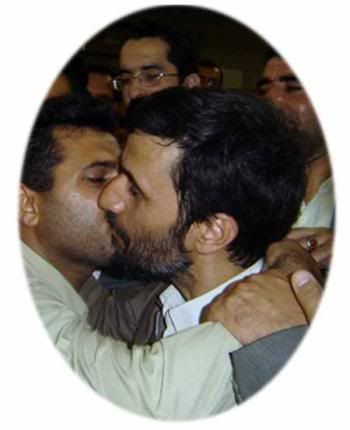
Ahmadinejad: The Kiss

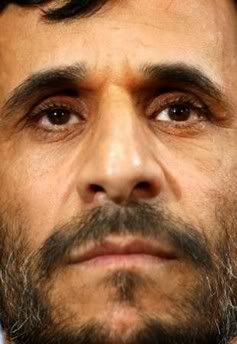
Here's a lovely photo of Mahmoud Ahmadinejad:
Mahmoud Ahmadinejad
Really, this is irresistible.

I intend to use this image on MRZine for his birthday: 28 October 1956.

I shall also send him flowers on his birthday . . . if he is still alive. (Tulips -- Iran's national flower and symbol of martyrdom and revolution -- if possible, though they are out of season in October.) Will he be? Washington will certainly try to oust him or have him killed, and he has numerous local enemies. Fidel and Chavez need to give him survival tips, too, in addition to tips on how best to offer solidarity with Palestinians, how to organize counter-hegemonic diaspora identity politics, and other subjects of importance.

Letter to Ahmadinejad

Really, I ought to give Fidel a call: "Hi, Fidel, you don't know me, but you knew Paul S, Paul B, Leo, and Harry, and I've inherited a piece of them. Here's what I implore you to do, for the good of Iranians, Palestinians, Jews, and the rest of us: talk sense into the President of Iran!" :-)

Or else write a letter to Ahmadinejad:
In the Name of God, the Compassionate, the Merciful,

Mr. Mahmoud Ahmadinejad,
President of the Islamic Republic of Iran,

Your excellency, I applaud your economic policy, defense of Iran's right to nuclear research, recent decree allowing women to attend sports events at stadiums, sympathy for US troops put into harm's way, and solidarity with Palestinians and other oppressed peoples. But, today, I write to you on a matter that concerns me and others who wish well for your republic: are you aware that Neo-Nazis are trying to appropriate your image and Palestinian suffering for their despicable cause? Please take a look at this music video: "President Ahmadinejad Music Video." Has it ever occurred to you, as you attend the World Cup in Germany next month, Neo-Nazis might try to hold a rally ostensibly for you and Palestinians, but really trying to promote only their anti-Semitic ideology? Imagine that spectacle! That's not good for you, Iranians, Palestinians, or anyone else for that matter except Washington and Tel Aviv! You would be no doubt aghast at it yourself. Please issue a statement -- before you take off for Germany -- that reiterates your solidarity with Palestinians, condemns Neo-Nazis, and extends your support to Jewish leftists in Israel and the diaspora who are fighting for one Palestine with equal rights and freedoms for Palestinians, Jews, and others.

Take good care of yourself, and please send my regards to your wife and Messers. Fidel Castro, Hugo Chavez, and Evo Morales.

Ciao,

Yoshie

Ahmadinejad as "die Sonne"

I was looking for videos of Mahmoud Ahmadinejad. I wanted to hear what he sounds like. There are a couple of good ones which have him looking all amiable and saying what he ought to be saying: "Ahmadinejad on People"; and "President Ahmadinejad Press Conference."

Then, I also found this one, "A music video made for President Ahmadinejad of Iran": "President Ahmadinejad Music Video.". The person who posted this video claims: "The video is not made by myself, I have no idea who the author is." That's a lie . . . or evidence of profound political cluelessness. The video is clearly made by Neo-Nazis trying to appropriate Ahmadinejad and the oppression of Palestinians for their despicable cause. Why do I know that? The video ends with a sequence that represents white Holocaust deniers -- Verbeke, Irving, Graf, Zundel, Rudolf -- as martyrs (superimposed on images of gun-toting IDF soldiers) and cuts to a logo of the Star of David with a legend: "Israel: Built on a Lie."

The video is set to Rammstein's "Sonne," and it cuts between scenes of Israeli oppressions of Palestinians, photographs and video clips of Ahmadinejad, and photos and video clips from mass electoral rallies for Ahmadinejad in Iran. It's edited to synchronize images of Ahmadinejad with the song's chorus:
"Hier kommt die Sonne
Hier kommt die Sonne
Sie ist der hellste Stern von allen
Hier kommt die Sonne"
[Here comes the Sun
Here comes the Sun
It is the brightest star of all
Here comes the Sun].
This really drives me up the wall! Does Ahmadinejad know that he is being used in this way? Fidel, you ought to have that talk with Ahmadinejad ASAP and bring the man to senses!

UPDATE
"Letter to Ahmadinejad" (12 May 2006)

Wednesday, May 10, 2006

Ahmadinejad's Letter

Mahmoud Ahmadinejad's letter to George W. Bush is made available to the public by Le Monde and the Council on Foreign Relations.

The President of Iran is a more rational man than the President of the United States, and much of his criticism of the US government makes sense. But why did he, or his aids, have to mix that legitimate criticism with a Holocaust denial (again!) and a 9-11 conspiracy theory? Has Fidel not had the time to pull Ahmadinejad aside and tell him: "Yo, Mahmoud, only crackpots and dumbasses believe that shit. Here, read this [Marx's Capital] instead"?

Tuesday, May 09, 2006

The End of Genocide

Genocide at the origin of its term was a term to name a racist crime, but since then it has become largely a racist term (in much of political discourse and people's consciousness) to name only crimes committed by peoples or governments outside the rich countries where relative prosperity allows relative peace, never crimes committed by peoples or governments of rich countries. "We" (of the United States, the European Union, and Japan), the civilized, try to save lives, no matter how much direct and indirect deaths and injuries our actions cause in the process; "they" (in Sudan, Rwanda, Yugoslavia, Russia, etc.), the uncivilized, just kill, kill, kill because they are hateful brutes. That's the prevailing understanding of the world that the power elite create through their usage of the term genocide.

The term genocide is useful to the power elite because it, like their anti-Semite-baiting, helps silence dissenters: "There are certain things in the world that the only appropriate response is to shut up and remain silent" in the words of Wojtek Sokolowski, a Johns Hopkins University sociologist. What are "certain things" about which one is asked to shut up and remain silent? Politics, economy, history . . . or anything else that may help us understand what's going on. So, labeling other peoples' crimes "genocides" helps the power elite of the rich countries: when one hears the term, one is supposed to condemn designated enemies without understanding what's going on, without thinking at all, in fact.

To be sure, there are leftists who apply the term genocide to past and present crimes committed by the power elite of the rich countries (e.g., the Holocaust of American Indians), but since leftists don't have power or own major media, leftist usage doesn't stick and fails to change the dominant understanding of what genocide is: "other peoples' crimes," compared to which "we" look good!

Michael Steinberg concludes his essay "The End of Genocide" (MRZine, 8 May 2006) thus:
We do not need a concept that simplifies political struggles beyond recognition or gives preferential attention to those calamities where leaders of one side happen to claim that their enemy is a specific ethnic, racial or religious group. . . . The notion of genocide emerged from an understandable sense that Nazi crimes were somehow unlike the crimes of the past and must never be repeated. But it remains too closely tied to those crimes, and to a particular explanation of them, to be of any use in today's world. There is no such thing as genocide. There are cruelty, oppression, murder, and torture. Those are real, and they need to be stopped. Genocide is imaginary. It is time we did away with it.
I once thought otherwise, but I cannot agree more.

Urbanization, Industrialization, and Feminism

Under capitalism, feminism and environmentalism may be at odds with each other: urbanization and industrialization usually are necessary conditions for the development of feminism (beyond the elite) and gender equality; but urbanization and industrialization tend to bring more energy-intensive lives and push up per capita energy use. It may be possible to urbanize and industrialize without wrecking the environment under another mode of production; but it must be noted that historical socialist records on the environment are on the whole unpromising. In any event, it doesn't look like we can switch from capitalism to a higher mode of production before capitalism really aggravates global warming. The only "solution" on the political horizon in the United States -- the "solution" that got on the political horizon thanks to underinvestment during the era of cheap oil, Washington's incessant wars and terrorism, and other social conflicts -- is higher oil prices, but even higher prices are only temporary: higher prices will eventually bring about attempts at conservation, but conservation attempts appear to end as soon as prices go down substantially.

Saturday, May 06, 2006

Ahmadinejad's "Passive Revolution"?

Juan Cole writes: "The Iranian 'president' is mostly powerless. The commander of the armed forces is the Supreme Jurisprudent, Ali Khamenei" ("Hitchens the Hacker; And, Hitchens the Orientalist; And, 'We don't Want Your Stinking War!'" Informed Comment, 3 May 2006). I've heard that before, but I wonder if it is still true or if it will be always true. Isn't what Ahmadinejad and his backers are trying to pull off a kind of "passive revolution" (cf. Antonio Gramsci): demote clerics without annihilating them?

Friday, May 05, 2006

Why Liberals Love to Hate Rich Arabs

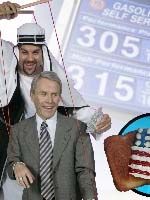
DailyKos Blog Ad of Puppet BushHere is a copy of an image for a FreedomToast blog ad featured at DailyKos (as of 5 May 2005, it's in the top ad space near the top right corner of the blog). It's an image of a rich Arab, dollars in hand, pulling the strings of a white male puppet in suits, with a sign flashing high gas prices in the background (and a FreedomToast logo in the bottom right corner). What's the visual message here? Rich Arabs are bribing and pulling the strings of Republican politicians and oil industry executives, profiting handsomely from Americans who are paying through their noses for gas.

What's wrong with this picture?

Oil price hawks are actually Caracas and Tehran, not royals, sheiks, and emirs of the Gulf who subserviently pump up as much gas as possible in response to Bush's demand.

Besides, the main political factor (aside from economic factors like supply and demand and investor speculation, over which no one really has control right now, except through attempts at conservation, which have yet to be seriously made) that has led to the rise of oil prices is Washington's ceaseless warmongering and unquenched thirst for regime changes overseas: the continuing war in Iraq, rumors of nuke strikes and threats of sanctions against Iran, Sudan (the United States being the only government to call the Darfur conflict a genocide, threatening military interventions), the list goes on. Yet, self-described "netroots" liberals let Bush's foreign policy off the hook, for powerful Democrats essentially agree with Bush on Iraq (no full US withdrawal from Iraq) and Iran (sanctions or military strikes on Iran for regime change, before Iran gets its insurance against a US invasion: nuclear weapons) and go so far as to urge Bush to send US troops to Sudan if necessary.

Moreover, scapegoating rich pro-Washington Arabs for terrorism as well as rising oil prices is a safe game: it lets Dumbocrats score a few irrelevant points against Bush without really jeopardizing Washington's essential access to Gulf oil and geopolitically strategic territories. The case in point: the extraordinarily inane Dubai WP imbroglio. After getting a big slap in the face, Dubai eagerly offered to serve as a spy station for Washington in its Iran adventure. That's the reason liberals love to hate rich Arabs.

Mind you, there is much to hate about the Arab ruling class in the Gulf. Taking one look at any of the Gulf states makes you wish someone exported revolution to it. And yet, the state of Arab politics being what it is, the only serious challenge to the pro-Washington Arab power elite in the Gulf and beyond, alas, comes from Islamists of various schools. The best case scenario, the scenario feared by Washington as well as the Arab power elite, is that Tehran will extend its Islamist populist political influence in Lebanon, Palestine, and beyond, while cementing its ties with the socialist axis of good Caracas, Havana, and La Paz (one hopes that the Latin socialist leaders will wean the President of Iran from his urge to play to the Holocaust-denying gallery) and retaining Beijing and Moscow's support. The worst case scenario is that Islamist terrorists will grow even more militarily sophisticated, one day succeeding in sabotaging Abqaiq, "the world’s biggest oil processing complex."

Chechnya, Darfur, and Jewish Activism

Take a look at my new MRZine article on Darfur and Jewish activism:
"Chechnya, Darfur, and Jewish Activism."

Tuesday, May 02, 2006

Norman G. Finkelstein: "The Lobby: It's Not Either-Or"

I just posted Norman G. Finkelstein's comment on the controversy rekindled by John Mearsheimer and Stephen Walt's essay "The Israel Lobby": "The Lobby: It's Not Either-Or" in MRZine. I think his perspective is very useful.

I attempted to put the roles played by establishment Jewish leaders in the context of similar identity-based mobilizations for imperialist foreign policy, with a glance at the tragicomic character of their coalition with evangelical Christians, in
"'Save Darfur': Evangelicals and Establishment Jews" (also in MRZine, revised from a posting here). But, boy, it's attracted quite a bit of name-calling and some wingnuts.

Had I talked mainly about, say, establishment Cubans, establishment Iranians, establishment whatever allying themselves with and actively pushing for imperialist policy, such responses would not have come. Some people appear to take mentioning Jewish identity at all, if it is in the context of criticism of a coalition for imperialist policy, to be offensive. Why can't we have rational discussion of the roles played by identity politics in imperialism?

Sunday, April 30, 2006

"Save Darfur," Don't Give Peace a Chance!

Saw a good bit of the "Save Darfur" rally on C-Span. The rally was small -- only several thousands according to Reuters ("Thousands March to Stop Darfur Killing," 30 April 2006). And it was overwhelmingly white. But, boy, it was a professionally-staged photo op, with celebs, politicos, and exiles at the podium expertly framed by the U.S. Capitol in the background.

The timing of the rally was perfect, designed to coincide with -- and scuttle -- the Abuja peace negotiations between the rebels and Khartoum brokered by the African Union, whose deadline is midnight today. And sure enough, the rebels rejected the AU peace deal:
The rebels called for changes to the deal hours before an African Union deadline -- and after the Sudanese government indicated it would accept the proposal. . . . The Sudanese government had said it was ready to sign the agreement. But a spokesman for one of Sudan's rebel factions said the proposal does not adequately address implementation nor their key demands for a vice president from Darfur and more autonomy. Hahmed Hussein, a spokesman for the Justice and Equality Movement, said he was speaking for both rebel factions. (Associated Press, "Rebels Reject Draft Darfur Peace Deal," New York Times 30 April 2006)
Really, why should the rebels accept it, when Washington, given an excuse by the pro-war rally organized by an alliance of evangelicals and establishment Jews, is pushing for NATO interventions just at this moment? "U.S. Secretary of State Condoleezza Rice said on Thursday that the African Union (AU) peacekeeping mission in Sudan's Darfur region was not strong enough and that NATO should take on a larger role there" (Reuters, "Rice urges Expanded NATO Role in Darfur," 30 April 2006). The rebels would naturally think: "Why don't we wait till Washington sends us NATO or UN or US troops to weaken the government's hands, so we can get a better deal?"

Remember how the specter of an international military intervention prolonged the civil war in Yugoslavia: "It also appears to be true the United States encouraged Izetbegovic to reject the EC-sponsored cantonization plan agreed upon in two separate meetings in late winter 1992," as General Charles G. Boyd puts it cautiously, "Making Peace with the Guilty: The Truth about Bosnia," Foreign Affiars September/October 1995)? It's the same dynamics . . . except the prize is more valuable than territories: "Sudan has proven reserves of some 563 million barrels of oil, with the potential for far more in regions of the country made inaccessible by conflict" (Esther Pan, "China, Africa, and Oil," Council on Foreign Relations, 12 January 2006).

Putting an end to the Darfur conflict now would consolidate Beijing's dominant position in Sudan's oil industry:
China has a $4 billion investment in the country widely believed to have the largest untapped oil reserves in Africa. The China National Petroleum Corp. has a 40% stake in Greater Nile Petroleum, which owns oil fields, a pipeline, a large refinery and a port. Last year, China purchased more than half of Sudan's oil exports. Conversely, Sudan accounted for 6% of China's oil imports, about 200,000-plus barrels a day. (Jon D. Markman, "How China Is Winning the Oil Race," MSN Money, 25 April 2006)
Who wants peace in Darfur? Certainly not Washington.

UPDATE
I revised this entry, retitled it "Who Wants Peace in Darfur?" and published it in MRZine.

David Kelsey Questions the Jewish Leadership of the "Save Darfur" Coalition

David Kelsey, a Jewschool blogger, courageously asks tough questions about the "Save Darfur" coalition:
Is the Jewish community helping the situation in Darfur by championing the Dafurians’ cause, or are we poisoning the well of potential solidarity through our leadership?

Obviously Jewish activism on Darfur is ecumenical. And it is certainly promoted as such.

“The Save Darfur Coalition is an alliance of over 100 faith-based, humanitarian and human rights organizations. Our mission is to raise public awareness and to mobilize an effective unified response to the atrocities that threaten the lives of two million people in the Darfur region.”

But the ecumenical language of the Coalition it is somewhat of a facade. The Save Darfur Coalition is heavily (overly?) Jewish, and was created by the United States Holocaust Memorial Museum and the American Jewish World Service.

It appears that intensive Jewish leadership and organizational support is viewed with cynicism from other possible allies for the Darfurians, including crucial African-American organizations. Like say, the NAACP, whose signature is notably absent on the Unity Statement.

Could it be that our commitment to Darfur is somehow viewed with suspicion when The Jews are calling for yet another intervention against Islamic aggression? Is it unfair to suspect that the OU might need an ulterior political motive to stand alongside the Reform Movement other than a purely moral objection to the plight of the Darfurians?

Can we at least try to understand why some might be unwilling to give us the benefit of the doubt?

In the U.S., the Holocaust is the primary lens in which to view all genocides in the past and present. In order to maintain credibility (which translates into continued and expanded Holocaust education, the major justification usually offered for Israel’s creation) don’t we have to react with alarm this way, or risk our mandate which allows us to promote our particular Jewish concerns provided we include universal ones?

If there is concern about our true intentions, and discomfort about what the Jews really want in the wake of Neocon support for the Iraq War and the broader Israeli push for U.S. pressure on Iran, including the possibility of a preemptive strike, does our heading the Save Darfur Coalition hinder, not help, its chance of receptivity?

Judging by the heavily Jewish signatures of the mission, it seems it may indeed be a hard sell, at least if The Jews are the ones selling it.

We may indeed only mean well. But we are not the best strategists. This effort needs the prominent leadership of African-American groups to succeed.

Or perhaps, just not a prominent Jewish leadership. Perhaps the moral compass of the Jewish community no longer carries a lot of weight nor enjoys widespread trust -- either internationally or domestically -– when it comes to our calls for intervention, particularly one that may require military action.

Things are different now. ("Jewish Leadership on Darfur," 17 April 2006)
I object to those who conflate neo-cons with Jewish communities. Far from being neo-cons, ordinary Jews stand to the left of almost all racial/ethnic groups in the United States except Blacks on the Iraq War or any other issue (and perhaps even to the left of Blacks when polling results are adjusted by income, given that income positively correlates with support for wars, tax cuts for the rich, social program cuts for the poor, and so on). The same cannot be said for prominent establishment Jews (i.e., those who hold leadership positions in Jewish community), however, too many of whom tend to uncritically support Tel Aviv's views on many foreign policy questions. The Sudan question is probably no exception. Can Kelsey's caution reach Jewish leaders without discouraging ordinary Jewish activists from getting involved in whatever issues they want to get involved in? I hope it will.

CAIR Asks Why No Muslim Groups to Speak at Darfur Rally

Here's a significant new development on the pro-war rally today. The Council on American-Islamic Relations belatedly realizes that it's been had:
The Council on American-Islamic Relations (CAIR) today questioned why no representatives of major American Muslim groups are listed as speakers at the Save Darfur Coalition "Rally to Stop Genocide" this afternoon in Washington, D.C.

To view the list of speakers, go to:

http://www.savedarfur.org/rally/speakers

CAIR and other American Muslim groups, including the Islamic Society of North America, the Islamic Circle of North America, the Muslim Public Affairs Council, and the Muslim American Society Freedom Foundation, are members of the coalition. But no representative from these, or any Muslim coalition member, is listed on the latest rally program. (Several Muslims will speak, but they do not represent Islamic groups that are coalition members.)

The Washington Post reported that rally organizers "rushed this week to invite two Darfurians to address the rally after Sudanese immigrants objected that the original list of speakers included eight Western Christians, seven Jews, four politicians and assorted celebrities -- but no Muslims and no one from Darfur."

Earlier this month, after noticing the lack of Muslim speakers on the program, CAIR wrote to rally organizers asking to have a representative speak at the rally. The Save Darfur Coalition never replied to CAIR's letter, despite the fact that the Washington-based Islamic civil liberties group is an original signatory of the coalition's founding "Unity Statement."

"It is unfortunate that the Save Darfur Coalition chose not to list any mainstream American Muslim groups in the rally program," said CAIR Executive Director Nihad Awad. "This disturbing omission calls into question the coalition's true agenda at the rally." Awad said rally participants would have benefited from hearing American Muslim leaders offer support for those suffering in Darfur and in neighboring areas. (Council on American-Islamic Relations, "CAIR Asks Why No Muslim Groups to Speak at Darfur Rally: Lack of Muslim Speakers Calls Into Question Rally's 'True Agenda'," Press Release, 30 April 2006)

A Twelve-Step Program for America

1. We admitted we were powerless over our addiction to wars and sanctions and interventions, real or imagined, US or multinational, with or without US troops, with our money or other people's money -- that our lives had become unmanageable.
2. We came to believe that a Power greater than ourselves could restore us to sanity.
3. We made a decision to turn our will and our lives over to the care of the rest of the World.
4. We made a searching and fearless moral inventory of ourselves.
5. We admitted to the rest of the World and to ourselves the exact nature of our wrongs.
6. We are entirely ready to have the rest of the World remove all these defects of character.
7. We humbly asked the rest of the World to remove our shortcomings.
8. We made a list of all persons we had harmed and became willing to make amends to them all.
9. We made direct amends to such people wherever possible, except when to do so would injure them or others.
10. We continued to take personal inventory and, when we were wrong, promptly admitted it.
11. We sought through prayer and meditation to improve our conscious contact with the rest of the World, praying only for knowledge of the rest of the World's will for us and the power to carry that out.
12. Having had a spiritual awakening as the result of these steps, we tried to carry this message to other addicts and to practice these principles in all our affairs.

30 April 1975

On 30 April 1975, the Vietnamese Communists finally triumphed. Whatever the rest of the world think of the subsequent history of Viet Nam (or whether they think about it at all), all of us should thank the Vietnamese for abolishing conscription in the United States and thus rendering it incapable of fighting a big war that causes millions of casualties. (Alas, Americans still have appetite for smallish wars like the Iraq and Afghanistan Wars, missile strikes on Iran, "peace-keeping" in Sudan, and so on and so forth.)

Saturday, April 29, 2006

300,000 Demonstrate against the War in NYC

"The demonstrators stretched for about 10 city blocks as they headed down Broadway. A police spokesman declined to give an estimate of the size of the crowd, although organizers claimed there were 300,000 people. There were no arrests," says Associated Press. Phew, it wasn't as small as I feared it might be! But I bet the media will give bigger space to the infernal pro-war rally in DC on the 30th.

Friday, April 28, 2006

"Save Darfur": Evangelicals and Establishment Jews

It's embarrassing that America -- and the world -- will be witnessing a PRO-WAR rally for a third oil war in Washington, D.C. on April 30 (see SaveDarfur.org) that is far more highly publicized than an anti-war one (that appears to be poorly organized) in New York City on April 29, even while Washington is still soldiering on in Afghanistan and Iraq and gunning for sanctions or war on Iran.

Who is behind this astonishing pro-war rally in war-weary America (as far as the Iraq War is concerned, that is)? A rag-tag coalition of evangelicals and establishment Jews (those whom the corporate media designate as official leaders of Jewish communities):
Keeping the peace within the diverse Save Darfur Coalition has not been easy. Tensions have arisen, in particular, between evangelical Christians and immigrants from Darfur, whose population is almost entirely Muslim and deeply suspicious of missionary activity.

Organizers rushed this week to invite two Darfurians to address the rally after Sudanese immigrants objected that the original list of speakers included eight Western Christians, seven Jews, four politicians and assorted celebrities -- but no Muslims and no one from Darfur.

Some Darfur activists also have complained about the involvement in the rally of a Kansas-based evangelical group, Sudan Sunrise.

Last week, after an inquiry from The Washington Post, Sudan Sunrise changed its Web site to eliminate references to efforts to convert the people of Darfur. Previously, it said it was engaged in "one on one, lifestyle evangelism to Darfurian Muslims living in refugee camps in eastern Chad" and appealed for money to "bring the kingdom of God to an area of Sudan where the light of Jesus rarely shines."

Although it is not formally part of the Save Darfur Coalition, Sudan Sunrise helped arrange buses and speakers, and it is co-hosting a dinner for 600 people on the rally's eve.

(Alan Cooperman, "Groups Plan Rally on Mall To Protest Darfur Violence: Bush Administration Is Urged to Intervene in Sudan," Washington Post, 27 April 2006: A21)
Wow, fascinating.
For this effort, the coalition has recruited major celebrities like George Clooney and Elie Wiesel to speak to those assembled. Though recent reports have indicated that the turnout might be lower than expected, organizers, while refusing to give a concrete number, believe it will be in "the tens of thousands."

Little known, however, is that the coalition, which has presented itself as "an alliance of over 130 diverse faith-based, humanitarian, and human rights organization" was actually begun exclusively as an initiative of the American Jewish community.

And even now, days before the rally, that coalition is heavily weighted with a politically and religiously diverse collection of local and national Jewish groups.

A collection of local Jewish bodies, including the Jewish Community Center in Manhattan, United Jewish Communities, UJA-Federation of New York and the Jewish Council for Public Affairs, sponsored the largest and most expensive ad for the rally, a full-page in The New York Times on April 15.

Though there are other major religious organizations, like the United States Conference on Catholic Bishops and the National Association of Evangelicals, both of which have giant constituencies that number in the millions, these groups have not done the kind of extensive grassroots outreach that will produce numbers.

Instead, the Jewish Community Relations Council, a national organization with local branches that coordinate communal activity all over America, has put on a massive effort to bus people to Washington on Sunday. Dozens of buses will be coming from Philadelphia and Cleveland. Yeshiva University alone, in upper Manhattan, has chartered eight buses.

Besides the Jewish origins and character of the rally - a fact the organizers consistently played down in conversations with The Jerusalem Post - the other striking aspect of the coalition is the noted absence of major African-American groups like the NAACP or the larger Africa lobby groups like Africa Action. When asked to comment, representatives of both groups insisted they were publicizing the rally but had not become part of the coalition or signed the Unity Statement declaring Save Darfur's objectives.

The coalition's roots go back to the spring of 2004 following a genocide alert, the first ever of its kind, issued by the United States Holocaust Museum. An emergency meeting was coordinated by the American Jewish World Service, an organization that serves as a kind of Jewish Peace Corps as well as an advocacy group for a variety of humanitarian and human rights issues.

At the meeting, which was attended by numerous American Jewish organizations and a few other religious groups, it was decided that a coalition would be formed based on a statement of shared principles.

After a year of programming that involved raising awareness about the genocide, the coalition came up with the idea for a rally in Washington. Planning began in the fall of 2005.
David Rubenstein, the director or "coordinator," as he prefers it, of the coalition says that, given that the groups who started the coalition were Jewish, "it's not surprising that they had the numbers of more Jewish organizations in their rolodexes."

He says that the Jewish community has been "extraordinarily responsive and are really providing the building for this thing," and yet he insists that the coalition has worked "very, very hard to be inclusive, to make sure there are people beyond the usual suspects."

This is a sentiment echoed by Ruth Messinger, president of American Jewish World Service and one-time Manhattan borough president and Democratic mayoral candidate for New York City. The world service and Messinger personally have been at the forefront of planning for the rally. Much of the Jewish turnout has been a result of her lobbying efforts.

. . . . . . . . . . . . . . . . . . . .

The fact that the aggressors in Darfur are Arab Muslims - though it should be said that the victims are also mostly Muslim - and are supported by a regime in Khartoum that is backed by the Arab League has made some people question the true motives of some of the Jewish organizations involved in the rally.

(Gal Beckerman, "US Jews Leading Darfur Rally Planning," Jerusalem Post, 27 April 2006)
Should we laugh or should we cry?

Some say America is addicted to oil, but America is even more addicted to war (or economic sanctions when war is not in the cards). "Leaders" of almost all groups in America -- Republicans or Democrats, Christians or Jews or Muslims (many of whom rooted for the war in Afghanistan in the Carter-Reagan era and the war on Yugoslavia in the Clinton era), whatever -- come up with their pet wars to promote, sooner or later.

UPDATE: I posted my two cents (an expanded version of this entry) at MRZine also, briefly featured by Google News.

Sunday, April 09, 2006

Gnostic Gospels and Conspiracy Theory

The National Geographic Society had the Gospel of Judas translated. The story has received much attention from the corporate media.

The Gospel of Judas tells us that Judas didn't really betray Jesus. Rather, Judas fulfilled the task he was given by Jesus: "sacrifice the man that clothes me." By doing so, Judas would "exceed" all other disciples, says Jesus. That is the "secret knowledge" that Jesus made Judas bear and that the Gospel of Judas purports to reveal.

But if Judas didn't betray Jesus, there would be no real conflict and no human drama!

What makes the Synoptic Gospels in the New Testament more interesting than Gnostic Gospels, to me, is that the four Gospels tell an insightful story about the politics of a community. Judas betrays Jesus for money. Peter betrays Jesus by denying him three times, and he does so, unlike Judas, out of weakness, not wanting to be associated with his teacher when the powerful really come after the teacher. Jesus expected both kinds of betrayal, not because he was the Son of God, but because he had a pretty good insight into human nature, as all good political leaders do. The empire gets Jesus, a rebel leader, executed by having the pillars of a community from which he comes demand his execution. On the day of execution, it is the marginalized and oppressed -- a condemned criminal, a former prostitute, and so on -- who stand by the man who gets martyred. Happens all the time, in the history of the left.

The structure of Gnostic Gospels, in contrast, resembles that of conspiracy theory, or rather conspiracy theory may have taken its undemocratic narrative structure from Gnostic Gospels: events are determined by the power that orchestrates both sides of a seeming opposition; and knowledge is accessible to only a chosen few, rather than all who strive to acquire it.

Moreover, the four Gospels of the New Testament are free from statements that could lend themselves to homophobia, whereas the newly translated Gospel of Judas includes them and even attributes one to Jesus:
They [said, “We have seen] a great [house with a large] altar [in it, and] twelve men -- they are the priests, we would say -- and a name; and a crowd of people is waiting at that altar, [until] the priests [… and receive] the offerings. [But] we kept waiting.”
[Jesus said], “What are [the priests] like?”
They [said, “Some …] two weeks; [some] sacrifice their own children, others their wives, in praise [and] humility with each other; some sleep with men; some are involved in [slaughter]; some commit a multitude of sins and deeds of lawlessness. And the men who stand [before] the altar invoke your [name], [39] and in all the deeds of their deficiency, the sacrifices are brought to completion […].”
After they said this, they were quiet, for they were troubled.

. . . . . . . . . . . . . . . . . . . .

Jesus said to them, “Those you have seen receiving the offerings at the altar -- that is who you are. That is the god you serve, and you are those twelve men you have seen. The cattle you have seen brought for sacrifice are the many people you lead astray [40] before that altar. […] will stand and make use of my name in this way, and generations of the pious will remain loyal to him. After hi another man will stand there from [the fornicators], and another [will] stand there from the slayers of children, and another from those who sleep with men, and those who abstain, and the rest of the people of pollution and lawlessness and error, and those who say, ‘We are like angels’; they are the stars that bring everything to its conclusion. For to the human generations it has been said, ‘Look, God has received your sacrifice from the hands of a priest’ -- that is, a minister of error. But it is the Lord, the Lord of the universe, who commands, ‘On the last day they will be put to shame.’” [41]
All in all, the Gospel of Judas brings no good news politically.

Steffie Woolhandler: Massachusetts' Health Care Reform Is "a Hoax"

Is Massachusetts' health care reform bill as good as the New York Times (Pam Belluck, "Massachusetts Sets Health Plan for Nearly All," 5 April 2006) makes it sound? Doug Henwood asks Steffie Woolhandler on his Behind the News radio show (6 April 2006).
Doug Henwood: As I was reading the New York Times the other day, boy, it sounded like the second coming of Christ or something: Governor Mitt Romney, Democrats, and Republicans of Massachusetts coming together to produce this wonderful, innovative, post-partisan universal health care system. Is it as good as it sounds?

Steffie Woolhandler: Well, I think it's really a hoax. What the bill does is it creates an individual mandate and tells people that they have to purchase their own health insurance. That will apply primarily to middle-income people. And the bill says that there are just going to be affordable comprehensive policies available. But of course there are no affordable comprehensive policies available to individuals in the state. The average individual policy costs $4,500 a year. So, it's a little like saying that the legislature is going to make chocolate chip cookies with no sugar or fat or calories. The other provisions of the bill are extremely generous toward the major hospitals in town. They are extremely generous to the private health insurance industry, since all of the new health insurance would be purchased at the private insurance industry. So, hospitals and the insurance industry lobbied pretty hard for the bill. The only piece of the bill that an advocate might like would be some modest Medicaid expansions, but they don't come anywhere close to covering the three quarters of a million people in the state who have no health insurance.
Click here to listen to the rest of the show.

See, also, Steffie Woolhandler and David U. Himmelstein, "Massachusetts' Health Bill Failed Before, Will Again" (Atlanta Journal-Constitution 7 April 2006).

Friday, April 07, 2006

Naita Aka Oni

There is a popular picture book for children in Japan, titled Naita Aka Oni [The Red Ogre Who Cried].

The story goes like this:
Once upon a time, there were two ogres. One was red, and the other was blue. The red ogre wanted to become friends with children in a village nearby. So, the red ogre put up a sign in front of his house:Naita Akaoni
Home of a Gentle Ogre
All Are Welcome
Tea and Tasty Cakes Available
But no one showed up, and the red ogre grew puzzled, sad, and angry. "I'm such a kind ogre -- why would nobody visit me?" Despairing, the red ogre even tore down the sign: "This is useless."

Moved by his friend's feelings, the blue ogre said, "Look, I have a plan."

The blue ogre's plan was for him to pretend to terrorize children and then have the red ogre chase him off, "rescuing" them from him. The plan went without a hitch, and the red ogre became the most popular creature among the children, and all came to play with him.

After a happy day of enjoying the children's company, the red ogre found a letter from the blue ogre. The letter said, "My Dear Red Ogre, if people find out that you are a friend of the Bad Blue Ogre's, they will not let the children come to you any more. So, I'm leaving. Please live happily with the children. Goodbye. Blue Ogre."

The red ogre cried out, "Blue Ogre is gone! A dear friend of mine! He is gone!" And he wept.

The red ogre and the blue ogre were never to see each other again.
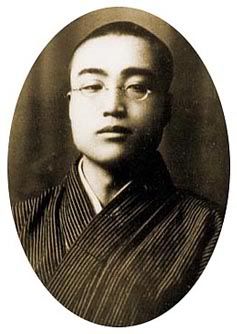
Hamada HirosukeIt's a great story about the costs of assimilation.

The story was written by Hamada Hirosuke, who wrote many other children's stories. It was first published in 1933.

I read it first (or rather my parents read it to me) when I was a child, and later I wondered if the author was gay, if he was a leftist, or if he had read Oscar Wilde's "The Selfish Giant." I never found out.

Sunday, November 13, 2005

A History of Violence

David Cronenberg's latest, A History of Violence, is a fine reworking of the Western and film noir in his "realist" turn. In a feminist twist of film noir, in this film it is a man, not a woman, who has a past. The past that the man (well played by Viggo Mortensen) thought he left behind in the East catches up with him in the West, after he becomes a "local hero" by killing two murderous robbers who threatened his life as well as his customers' and employees' in a diner he runs.

A History of Violence

The past in question is a history of violence, his service as a violent foot soldier for a gangster capitalist (who happens to be his brother). To defend his family and home in a small town in Indiana from the long arms of the gangster capitalist, he ends up resurrecting an extremely efficient killing machine that he once was and finds himself at odds with his wife and teenage son, who feel betrayed by his secrecy (he had hidden his past from them by assuming a new name) and appalled by the newly resurrected violent masculinity in him (which begins to bleed into his sex with his wife), though they love one another. The man overcomes the gangster capitalist's underlings in the West (and in the process makes his son an accomplice in violence) and the capitalist himself in the East. Then, he comes back home.

The film's ending is a tense and ambiguous scene of homecoming. His wife, son, and daughter are at dinner table. When he comes in, there is silence. After a moment that feels longer than it is, his daughter (who is too young to fully understand the meaning of trust and betrayal) makes place for him at the table. He and his wife look into each other's eyes, wordlessly, as she passes a plate to him. Fade to black.

A History of Violence makes no explicit reference to the Iraq War. Yet you keep thinking about it, as you watch the film. There must be many homes where soldiers' homecomings are as fraught as the protagonist's in A History of Violence. Divorces are sharply up in the military.

Repeated long deployments alone take their toll. And, then, there is psychological trauma: "Of the 244,054 veterans of Iraq and Afghanistan already discharged from service, 12,422 have been in VA counseling centers for readjustment problems and symptoms associated with PTSD" (William M. Welch, "Trauma of Iraq War Haunting Thousands Returning Home," USA Today, 28 February 2005).

The violent past cannot be buried and forgotten, nor can the home and hometown be insulated from the violent "outside," as the protagonist of A History of Violence, like many Americans, thought they could. The history of violence must be dealt with. But how? The film does not seek to answer that -- it wants the audience to think about it.

[This essay was first published by MRZine.org.]

Tuesday, July 05, 2005

Venezuela's Independence Day: Literacy, Petrocaribe, and the Bolivarian Alternative for the Americas

Today is the 195th anniversary of Venezuela's independence. There are three developments to mark the happy occasion.

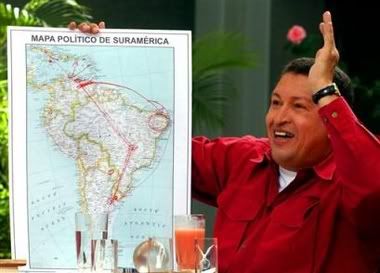
Venezuela's President Hugo Chavez Declares Venezuela Free of Illiteracy during a TV Show in Caracas, Venezuela, Sunday, July 3, 2005 (Miraflores Press/AP)Venezuela has won its battle for universal literacy, thanks to Cuba's assistance: "The two-year Robinson Mission, in the process of concluding, has taught 1.5 million adults learn to read, while Robinson Mission II will help those without prior opportunity to study to reach a sixth grade level, and the Ribas and Sucre programs are concentrating on university education" ("Venezuela´s New Independence Day," Prensa Latina, 5 Jul. 2005).

Venezuela created Petrocaribe.
"Today I propose to the Caribbean that we form an energy alliance," Chavez told the visiting leaders, saying the oil plan would be a new force for integration.

. . . . . . . . . . . . . . . . . . . .

Castro called the plan an important step toward greater solidarity, "the only method of survival for our countries" as oil prices continue to rise.

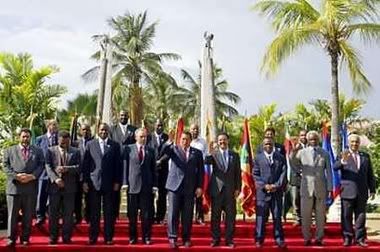
 Caribbean Leaders Pose for a Group Photo during Their Meeting in Puerto La Cruz, Venezuela, June 29, 2005. (Howard Yanes/Reuters)The initiative, called Petrocaribe, would extend and improve special financing arrangements under past oil deals and use an expanded fleet of Venezuelan tankers to deliver fuel directly to bypass costly intermediaries, Chavez said.

He said the Venezuelan state oil company had created a new affiliate called PDV Caribe to coordinate the project and that Venezuela would be willing to accept goods such as bananas or sugar for a portion of payments. He said Venezuela also was prepared to help build new oil depots in the islands to help.

The initiative could help small Caribbean countries save a projected $6 a barrel on fuel, Venezuelan Foreign Minister Ali Rodriguez said. (emphasis added, Associated Press, "Caribbean Plan for Cheap Regional Fuel," CNN, 29 Jun. 2005)
And Venezuela launched the Bolivarian Alternative for the Americas (ALBA) for a true social and economic integration of Latin America, declaring "the US-sponsored Free Trade Agreement for the Americas (ALCA) dead and impracticable in current regional conditions" ("Venezuela Celebrates Independence and Integration," Prensa Latina, 5 Jul. 2005).

Monday, July 04, 2005

Chávez Congratulates Ahmadinejad

Venezuelan President Hugo Chávez Frías called Mahmoud Ahmadinejad, whom he had met before when he visited Iran, and congratulated him on his landslide victory:
Venezuela's President Hugo Chavez congratulated his Iranian counterpart President-elect Mahmoud Ahmadinejad's landslide victory in a telephone conversation, arguing, "Your high vote secured Iran's legitimacy at international scene." Expressing his delight over President-elect Ahmadinejad's victory, Chavez added, "My government is determined to continue Venezuela's comprehensive cooperation with Iran."

The Venezuelan leader meanwhile considered the expansion of bilateral ties as a need, and asked for reviewing the two countries' already signed agreements and seeing into their proper implementation as a mutual necessity.

He added, "I would be glad to dispatch to Tehran a high ranking Venezuelan delegation to attend your excellency's Oath Taking Ceremony."

According to the report by president elect's office, Ahmadinejad, too, in the phone talk appreciate President Chavez for his kind congratulation contact, adding, "My government would continue the Islamic Republic's basic policy in expansion of relations with Venezuela, as a friend and brother nation."

Dr. Ahmadinejad meanwhile invited President Chavez to visit Iran in near future to exchange viewpoints on bilateral and international issues.

The Iranian president elect emphasized, "Your excellency's state visit to Tehran would mark a turning point in our two nations' relations, and accelerate the process of the reached agreements' implementation." ("Chavez: Ahmadinejad's Landslide Victory Secured Iran's Legitimacy Worldwide," Islamic Republic News Agency, 28 Jun. 2005)
Closer cooperation between Caracas and Teheran did not begin with Ahmadinejad's election, since it had long been part of Chávez's efforts to diminish Venezuela's dependence on the United States as its primary energy export market (e.g., Andy Webb-Vidal, "Venezuela Enlists Iran to Steer Oil to China," Financial Times, 31 Jan. 2005), diversify its trade partners (e.g., "Iran and Venezuela Sign Contracts Valued at the Equivalent of over US$1 Billion," VHeadline.com, 11 Mar. 2005; "Iran-Venezuela-Exports: Tractor Parts Shipped to Venezuela, Sunday," VHeadline.com, 18 Apr. 2005; and "Iran-Venezuela-Trade: Iran, Venezuela Discuss Agriculture Trade," VHeadline.com, 18 Apr. 2005), and support the right of self-determination (e.g., "Chavez Backs Iran's Nuclear Goals," Al Jazeera, 12 Mar. 2005). Caracas and Teheran are said to be both price hawks when it comes to oil (Oxford Analytica, "The Geopolitical Influence on Oil Prices," Forbes, 24 Mar. 2005; and "Oil in Troubled Waters," Economist, 28 Apr. 2005), which is another tie that binds.

Nonetheless, Ahmadinejad, in terms of his economic program and base of political support, has much more in common with Chávez than Mohammad Khatami, Ali Akbar Hashemi Rafsanjani, Mostafa Moin, and other elite "reformists" do with the Bolivarian revolutionary. Chávez's public salute to Ahmadinejad -- that the president elect of Iran is "a very young man who is committed to his people and struggles for sovereignty and self-determination" and that the Iranian people should be congratulated for "faith in their revolution and democracy that they have shown" -- suggests as much:
El presidente de la Republica Bolivariana de Venezuela, Hugo Chávez Frías, conversó este lunes, vía telefónica, con Mahmud Ahmadinejad, mandatario recién electo de la República Islámica de Irán.

En el acto de entrega del Premio Nacional de Periodismo, el jefe de Estado saludó públicamente al presidente electo de Irán, "y lo voy a hacer a nombre de todo el pueblo venezolano", dijo al referirse a Ahmadinejad como "un hombre muy joven y comprometido con su pueblo y por las luchas por la soberanía y la autodeterminación".

El mandatario venezolano conoció al actual presidente iraní en la última visita oficial que realizó a Teherán, cuando inauguró la Plaza Bolívar en esa ciudad, para entonces Ahmadinejad era el alcalde de la capital iraní.

"Aprovecho para felicitar al pueblo iraní y a la demostración que han dado de fe en su revolución y en su democracia", agregó Hugo Chávez al señalar el respeto que tiene al modelo de gobierno iraní, porque "nadie puede exigirles que adopten otro sistema democrático, como el norteamericano, por ejemplo". (emphasis added, Prensa Presidencial, "Venezuela saluda al nuevo presidente de Irán," 28 Jun. 2005)
Watch how their relationship will develop.

Mahmoud Ahmadinejad's Face

Since the landslide electoral victory of Mahmoud Ahmadinejad, the George W. Bush administration's propaganda machine has already gotten into high gear. All manner of allegations made by Iranian exiles (e.g., Louis Charbonneau, "Austrian Makes New Charge against Iran President-elect," Reuters, 2 Jul. 2005)* and ex-hostages in the US Embassy seizure (e.g., Brian Knowlton, "Iranians Deny Leader Is Tied to Hostage Standoff," New York Times, 30 Jun. 2005) have surfaced.

Thankfully, intelligence agencies, burned by the Iraq War, appear to be putting a brake on the Bush administration -- for the time being.
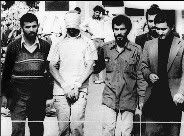
Iranian Student Radicals and an American HostageU.S. investigators have concluded that Iranian president-elect Mahmoud Ahmadinejad is not the glowering Islamic militant seen escorting an American hostage in a 1979 photograph that was widely publicized this week, officials said Friday.

The conclusion casts doubt on what had been considered a key piece of evidence indicating that Iran's new president was among the leaders of the group of students who seized control of the U.S. Embassy in Tehran and went on to hold dozens of Americans hostage for 444 days.

A U.S. official familiar with the investigation of Ahmadinejad's role said that analysts had found "serious discrepancies" between the figure in the 1979 photo and other images of the Iranian president-elect. The discrepancies included differences in facial structure and features, the official said.

If there is a case to be made that Ahmadinejad was among the hostage takers in 1979, the official said, "it doesn't look as if it will be done on the basis of those photographs." (Greg Miller, "U.S.: Photo Not of Iran Chief," Los Angeles Times, 2 Jul. 2005)
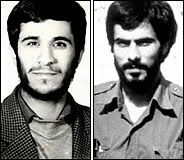
Mahmoud Ahmadinejad vs. A Hostage TakerThe ex-hostages' allegations led Iran to release a photograph of Mahmoud Ahmadinejad, circa 1979 (Knowlton, 30 Jun. 2005). The young man on the left, Ahmadinejad around 1979, bears no resemblance to the hostage taker on the right (except in the eye of a racist to whom all Iranians look alike).
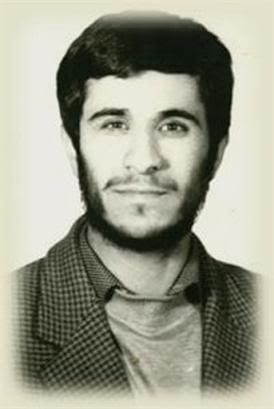
Mahmoud AhmadinejadHere is a larger image of the same photograph of Ahmadinejad. In the 1979 photograph, Ahmadinejad, then 22 or 23, looks not like a theocratic bully but like a delicate Ernesto Guevara in his Motorcycle Diaries days. The face in the photograph is enchanting. What is the punctum in this photograph, an "element which rises from the scene, shoots out of it like an arrow, and pierces me" (Roland Barthes, Camera Lucida, Trans. Richard Howard, NY: The Noonday Press, 1981, p. 26)? The young man's eyes and brows are caught by his photographer "at just the right degree of openness, the right density of abandonment" (Barthes, p. 59), freely and generously offered to the viewer. The photographer has found "the right moment, the kairos of desire" (Barthes, p. 59).

To this day, Iran, unlike the United States and other rich countries, is a nation where the ruling class are fatter than the working class. Ahmadinejad is slight, almost diminutive, which makes him look exactly like a civil engineer that he is. His well-lined face is now only a faint reminder of his youthful good looks, but, with his easy smile, he is still far more pleasant to look at than the old, ugly, and corpulent Ayatollah Ali Akbar Hashemi Rafsanjani, whose face and body, like the picture of Dorian Gray, proclaim to the whole world: "I got fat on oil profits. I'm living large . . . literally."

So must the Iranian working class have thought, whose welfare is threatened by the neoliberal economic program of Rafsanjani (who held the office of the president between 1989 and 1997) and other so-called "reformists" who backed him:
  • Food and housing subsidies, as well as public education and health care continued as long as Khomeini was alive. But with the Ayatollah’s death and the election of Hashemi Rafsanjani to the presidency of Iran, neoliberal policies replaced those of the welfare state of the Khomeini years. This marked a new era; in the late 1980s, when President Rafsanjani came to power, open-market policies led to economic measures such as devaluation of the currency (which increased the cost of living for the poor), privatization (which left many workers unprotected), and the decline of social services, all of which forced many women to enter the labour market. (Roksana Bahramitash, "Islamic Fundamentalism and Women’s Economic Role: The Case of Iran," International Journal of Politics, Culture and Society 16.4, Summer 2003, p. 565)

  • President Rafsanjani was very clear about its economic policy. He called for liberalization and he himself benefited from through easier borrowing and became a rich man. His neo-liberal policies increased female employment, but they did not necessarily bring more economic power to women, as is the case in the rest of the developing world. Throughout the Third World, the percentage of female labour is increasing but because of the liberalization of the economy, rising prices of basic goods and welfare reduction have badly affected women.24 Today, there are 1.3 billion people living on less than a dollar a day and 70 percent of them are women.25 Iran is no exception: the increase in labor force participation by women may have increased, but the poverty and income disparity that has come with liberalization of the economy remain a serious challenge to female empowerment. The fact that there are more women in the labor force in Iran is important because it does give them some degree of autonomy. But rising prices of basic goods and cutbacks on social spending have hindered the growth of women’s economic autonomy by undermining their decision-making power. (Roksana Bahramitash, "Revolution, Islamization, and Women’s Employment in Iran," The Brown Journal of World Affairs 9.2, Winter/Spring 2003, p. 238)
That is a trend readily observable in many countries, neoliberalism being a global phenomenon.

It is not the reformists' promise of freedom of expression and association that the Iranian working class rejected in the presidential election this year. "Assuming that all of the votes cast for the other rightwing candidates in the first round went to Ahmadinejad in the runoff; he still had to attract an additional five million reform and progressive votes to end up with a seven million winning margin in the final tally," as Ahmad Sadri points out ("Exact Opposite of Paranoia," Iranian.com, 28 Jun. 2005 / ZNet, 30 Jun. 2005). What they refused to tolerate any longer is deteriorating economic conditions that neoliberalism brought them, which Michael Slackman ably documents below.
They had come from very different neighborhoods and backgrounds, but they were all there for the same reason: to buy government-subsidized food.

The line ran from the basement up the stairs and out the door.

Inside, sugar and rice were selling for about one-fifth of the retail price, a huge savings in a country where according to an opposition economist more than a quarter of the people live below the poverty line - which is defined as a family of five with an income of less than $278 a month.

"I cannot make ends meet," said Hossein Ganji, 49, who works behind a counter in the food distribution center. Mr. Ganji supports his wife and three children on about $150 a month.

"I am the only person that works in my family," he said. "All the others are unemployed."

This distribution center in a crowded basement in southern Tehran and many others like it around the country represent the kind of government assistance that many people here want more of -- and that Mahmoud Ahmadinejad promised to provide in his successful campaign to become the next president of Iran.

Mr. Ahmadinejad, who catapulted to president-elect from near obscurity as the appointed mayor of Tehran, campaigned on a populist message, promising to redistribute the nation's wealth, hold down prices, raise salaries and lift state-supported benefits for the poor. He infused those pledges with the theme of social justice, which resonated in a society where aiding the poor is considered an obligation for the faithful.

. . . . . . . . . . . . . . . . . . . .

Average salaries run about $200 a month in Iran, with a salary of $300 to $500 considered generous. But costs are fast outstripping the ability to pay -- government figures put annual inflation at about 15 percent, though on some products, merchants say prices rise far faster than that.

In a food store in central Tehran, the owner, Reza Karimi, said pomegranate paste had doubled in price to nearly $2; a bottle of olive oil rose to about $4 from $3, and in the last three months a little more than a pound of rice climbed to $1.80 from $1.30.

The price of dairy products sold by a state-owned company jumped 17 percent on Wednesday alone, he said. "The prices will jump again next month," he said. "And when one company raises their prices, they all do."

Khodabaksh Jalili, 30, is typical of many people in southern Tehran who supported Mr. Ahmadinejad. He moved to the city from Asadabad, a village 200 miles west of Tehran, when the farm that had supported his family for generations failed because of drought and a shortage of supplies, he said.

He has a wife and two children and earns about $200 a month working in a food store. His rent is $50 a month, and he makes extra money on his day off ferrying passengers on his scooter. If he is lucky, he said, he takes in another $20 a month.

"I have very little," he said. "I am married eight years. I have never been to the cinema with my children."

Iran is awash in oil money, as the price of crude topped $60 a barrel this week, pumping billions into the government treasury. But this country's economy is still tied down by a system in which the state and a shadowy collection of foundations controlled by clerics monopolize the vast bulk of its industries, including oil.

. . . . . . . . . . . . . . . . . . . .

Rahim Oskui, who described himself as an opposition economist working for the Industrial Management Institute, a quasi-governmental agency, said the official figures of 10 percent unemployment and 27 percent living in poverty were most likely understated.

. . . . . . . . . . . . . . . . . . . .

Hamid Shahrabi, 31, is the kind of person Mr. Oskui was talking about. Because of Mr. Ahmadinejad's economic message, he said, he got involved in politics for the first time. "I never voted in a presidential election before," Mr. Shahrabi said. "This guy put his hand on the Koran and said he would work for poor people - so I worked for him and voted for him."

Mr. Shahrabi lives with his wife, Azam, 30, and two small children in a one-room apartment in southeastern Tehran. There is no furniture in the living room, just a carpet on the concrete floor, a few pillows along the walls and a small television on a stand. They turned a walk-in closet into a separate bedroom, where their 12-year-old daughter sleeps and where they keep their bed cushions during the day. On any given day, the family's refrigerator is almost empty, but for a pot of traditional Iranian stew -- a mix of rice, meat and vegetables -- three-day-old bread and some tomatoes. They survive on their government rations.

Mr. Shahrabi moved to the city from Arak, a province in central Iran, when he was 15 years old, following his brothers in search of work when the family farm was no longer making enough money. He found a job with a state-owned oil company, which he kept until he was laid off four years ago. He has not found work since, and rides around the city on his battered motor scooter making deliveries and carrying passengers for about $5 a day. Of that he has to set aside $3 a day for rent.

"I feel really ashamed in front of my family," Mr. Shahrabi said, without a trace of self-pity. "My doctor said I need to feed my daughter better. I cannot afford to buy my wife new dresses. My son always feels dizzy. The landlord has asked me to find another place to live."

The Ahmadinejad campaign message of economic hope -- as well as social justice -- captured the hearts not only of people like Mr. Shahrabi but also of middle-class families. Parts of the middle class have trouble meeting their own financial needs, although their support for Mr. Ahmadinejad also stems from having grown used to buying subsidized food, even if they can afford to pay market prices. (Michael Slackman, "For the Poor in Iran, Voting Was About Making Ends Meet," New York Times, 3 Jul. 2005)
It is not clear if Iran's new president has what it takes to radically improve the conditions of working-class Iranians to whom he gave economic hope, but the way he lived his life as the mayor of Teheran suggests that those who voted for him had a good reason to believe that he won't get fat at their expense:
[F]riends, supporters and neighbors here describe the diminutive, bearded man as humble and caring. Mr. Ahmadinejad has a small circle of aides, one that appears a bit overwhelmed by all the demands and preparations ahead. Nasser Hadian-Jazy, a political science professor at Tehran University, said that he had known the president-elect since childhood and that Mr. Ahmadinejad was not involved with the student hostage takers. He said they grew up together in East Tehran, and Mr. Hadian-Jazy described his old classmate as among the brightest in the neighborhood.

He called Mr. Ahmadinejad "self-confident, committed and absolutely incorruptible." He said he is very religious, but modern in his thinking. If there is a negative quality, Mr. Hadian-Jazy said, it is that he is very set in his views, and can be hard to persuade otherwise.

"If you can force him to sit down and listen, he has the capability to understand," the professor said.

While Mr. Ahmadinejad maintained a humble life style as the appointed mayor of Tehran, that is likely to change, if for no other reason than security. He lives at the end of a dead-end street, more of an alley that runs alongside a school. The alley opens onto a circle, with a small park in the middle with benches and a field of grass that now attracts those who come to ask favors of the president-elect, and serves as a spot for neighbors to socialize. These days, cars packed with sightseers drive around the circle, stopping to look down the alley, a far cry from the palatial and off-limit homes of other Iranian leaders.

On Friday, the day of prayer and rest in most Muslim countries, some of Mr. Ahmadinejad's neighbors sat on a bench, talking about their favorite son. It is almost a rule that when someone is asked about Mr. Ahmadinejad, the first thing said is that he is a modest person who has never lost touch with his roots. Security is very tight in the neighborhood, and with soldiers and plainclothes agents around, the neighbors were afraid to give their names.

One older man, who said he had lived in the neighborhood for 15 years, said that every year for the Iranian New Year, Mr. Ahmadinejad invited the neighbors over for a celebration. He is described as a devout man who lives in a three-bedroom house with two sons and a daughter. His family has little furniture, they said, and has machine-made carpets, not the more expensive hand-woven ones commonly owned by the better-off.

One son is finishing high school, and the two other children are studying in the university, the neighbors said.

Since he became mayor of Tehran, the city has had a driver pick Mr. Ahmadinejad up for work every day. But on his days off, neighbors said, he still drives the same 1977 Peugeot, without air-conditioning, that is parked in the alleyway beside the house.

People are quick to offer stories about Mr. Ahmadinejad, almost as if he was a religious figure. They say, for example, that he always brought his own lunch to work because he did not want the city to have to pay for his meals.

At the municipal building, Ahmad Esmali's job is to deliver tea to the offices. "This mayor was better than the others," he said recently. "He saw managers and workers with one eye."

In the park on Friday, one neighbor said the mayor had given money to the local butcher, at a shop called Zand, so the butcher could give poor and needy people meat at a discount. Two young men working in the butcher shop said they believed it was true.

It is a common practice in many Middle Eastern cultures for leaders to have audiences with citizens seeking help, or to accept their petitions for assistance. Mr. Ahmadinejad appears to take that custom to heart.

A small security booth sits at the mouth of the alley leading to his house. As Mr. Ahmadinejad's car pulled out, a security agent handed the president-elect a pile of letters that had been delivered that morning, from people seeking some kind of help.

Ali Ghorbani, 29, had just driven up to deliver a letter to the guard booth when Mr. Ahmadinejad pulled up. Mr. Ghorbani wanted to ask for a loan so he and a friend could open a cultural center in Tehran. He was allowed to hand the letter directly to the president-elect. "I didn't have the faintest idea I would see him," Mr. Ghorbani said as he walked away. "He took the letter and told me I would have a reply in two weeks." (Michael Slackman, "Iranian Leader Denies He Took Embassy Hostages," New York Times, 2 Jul. 2005)

Update

* A spokesman for the Austrian public prosecutor's office, Ernst Kloiber, appears to find the allegation (that Mahmoud Ahmadinejad was involved in the 1989 assassination in Vienna of Abdul Rahman Ghassemlou, leader of the Kurdistan Democratic Party of Iran) doubtful.
Kloiber cast doubt on the strength of the journalist's testimony.

"According to our information, he has third-hand information on the murder," Kloiber said. "It would therefore be very difficult" to open an investigation against Ahmadinejad, he said. (Agence France-Presse, "Austria Seeks to Interview Journalist over Ahmadinejad Murder Accusations," 5 Jul. 2005)
The "journalist" is said to be an unnamed Iranian whom the Austrian Green party's spokesman on security, Peter Pilz, claims to have "met on May 20 in Versailles, France" (Agence France-Presse, 5 Jul. 2005). Sounds like a potboiler concocted by the Fake News machine.

Saturday, July 02, 2005

Sandra Day O'Connor Resigns: Will Bush Hit Another Trifecta?

Sandra Day O'Connor drops a bombshell: she quits ("O'Connor's Retirement Letter to President Bush," New York Times, 1 Jul. 2005).

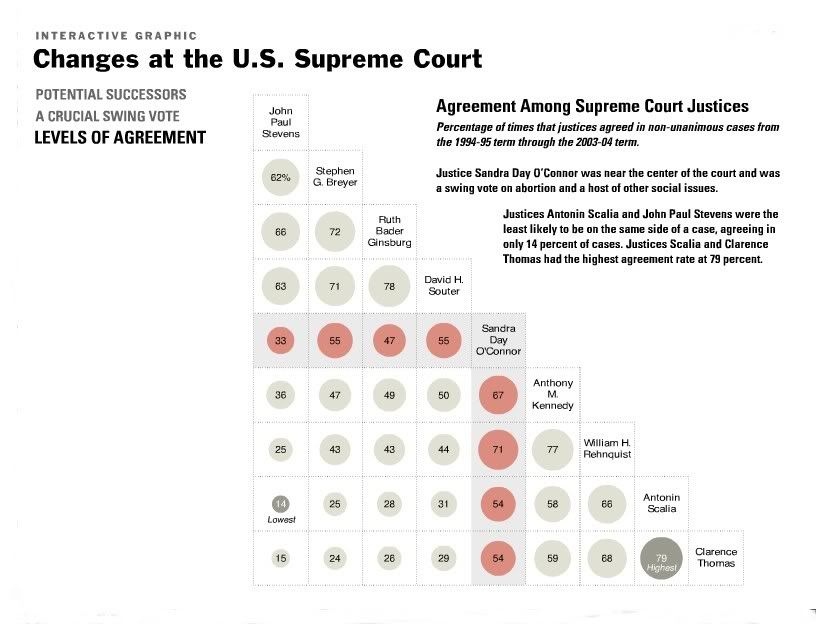
The only consolation is that O'Connor, surprising as it may be to Democrats and Republicans alike, is to the right of Anthony M. Kennedy (Jason DeParle, "In Battle to Pick Next Justice, Right Says, Avoid a Kennedy," New York Times, 27 Jun. 2005). Kennedy agreed with John Paul Stevens (a registered Republican in 1975 when he became a justice but he sits on the farthest left end of the court now) oftener (36% of the times) than O'Connor did (33% of the times) from the 1994-5 term through the 2003-2004 term.
Agreement among Supreme Court Justices
"Agreement among Supreme Court Justices," New York Times, 1 Jul. 2005 [Click on the link or image above to enlarge the graphic]
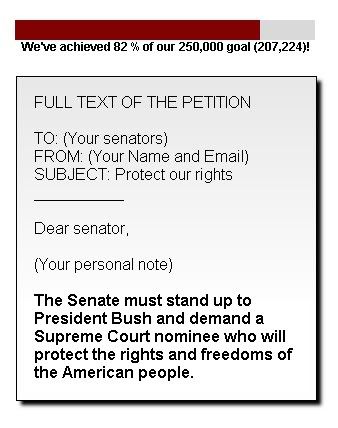
MoveOn, for once, comes up with a petition that I can sign without reservations (signed by 207,223 others as of 2:15 PM today):
MoveOn: Protect Our Rights
It's doubtful that it will do any good, Senate Democrats being who they are (e.g., they failed to filibuster Alberto Gonzalez and six -- Mary Landrieu [D-LA], Joe Lieberman [D-CT], Bill Nelson [D-FL], Ben Nelson [D-NE], Mark Pryor [D-AR], and Ken Salazar [D-CO] -- even voted for the advocate of torture), but it can't hurt, so I recommend that you do as well.

O'Connor's resignation won't be the last vacancy that George W. Bush will fill.

William H. Rehnquist, afflicted with thyroid cancer, missed "44 oral arguments before the court in late 2004 and early 2005" ("William Rehnquist, a Biography," Justice News Daily, 2005) and is unlikely to last very long; and Stevens, who had prostate cancer, is 85 years old, still vigorous though he appears to be.

In February 2002, Bush joked:
You know, I was campaigning in Chicago and somebody asked me, is there ever any time where the budget might have to go into deficit? I said only if we were at war or had a national emergency or were in recession. (Laughter.) Little did I realize we'd get the trifecta. (Laughter.) ("President's Remarks at GOP Luncheon: Remarks by the President to Robin Hayes for Congress and Elizabeth Dole for Senate North Carolina Republican Party Luncheon," Charlotte, North Carolina, 27 Feb. 2002)
Will Bush, one lucky SOB, hit another trifecta?

America was once a revolutionary nation. Prepare to defend your liberty by any means necessary. That should be your pledge of allegiance on the Fourth of July.

Friday, July 01, 2005

Poll: Democrats Weaken More than Republicans

As a host of issues, from major (the Iraq War and Social Security) to minor (the Terri Schiavo affair), do real damage to Republicans, Democrats still manage to sink lower than them in a new poll:
Though 56% of Americans say the country is headed in the wrong direction, a new Democracy Corps poll also shows that voters have more positive feelings about Republicans. Specifically, 43% of voters favor the Republican Party, while 38% had positive feelings about Democrats.

The Christian Science Monitor quotes pollster Stan Greenberg: "Republicans weakened in this poll... but it shows Democrats weakening more." Greenberg attributes the decline to the perception that Democrats have "no core set of convictions or point of view." ("Democrats Still Not Seen as Alternative," Taegan Goddard's Political Wire, 30 Jun. 2005)
No mean feat, but that is to be expected.

Thursday, June 30, 2005

Obama Yo Mama

The 2004 elections, among other things, ushered in the twilight of Black broker politics: "Having virtually shut down the activist wing of the Civil Rights/Black Power Movement in favor of electoral and broker politics at the dawn of the Seventies, Black leadership now finds itself blackballed from the $200 million-plus soft money Democratic campaign feast. Essentially, they have been sidelined from the only mass action game they chose to play" ("Black Anger, White Money: A Crisis for Black Leadership," The Black Commentator 109, 14 Oct. 2004).

Barack Obama Having dumped Black brokers who emerged from movement politics, the Democratic Party cultivated the great white hope of a Black politician, Barack Obama, whose message on race and class would never alarm even the most anxious white mind: "There's not a black America and white America and Latino America and Asian America; there's the United States of America" (Barack Obama, Keynote Speech at the Democratic National Convention, Boston, 27 Jul. 2004).

What does Obama have to say about George W. Bush's latest speech on the Iraq War?

Obama waxes hawkish: "I believe the president must take a realistic look at our current strategy and reshape it into an aggressive and workable plan that will ensure success in Iraq" (emphasis added, Barack Obama, qtd. in Dori Meinert/Copley News Service, "Dems, GOP Differ on Bush Speech," The Lincoln Courier, 29 Jun. 2005). In other words, No Exit. What's his plan, then?
"It is a challenge now to try to fix the mess that has been made by this administration," Sen. Barack Obama (D-Ill.) said in an interview. "There aren't any easy answers. It would be irresponsible to just spout off without having thought through what all the alternatives -- and implications of those alternatives -- might be." (Charles Babington and Dan Balz, "Democrats Press Bush Harder on Iraq: Words Reflect Drop in Public Support for War," Washington Post, 22 Jun. 2005, p. A6)
Should he not have thought about "all the alternatives" to the continuing occupation of Iraq and their "implications" by now, especially since he had already thought about what to do about Iran (David Mendell, "Obama Would Consider Missile Strikes on Iran," Chicago Tribune, 25 Sept. 2004)?

Surely, the American people "want and deserve better answers about where we go from here in Iraq" (Barack Obama, qtd. in Mark Silva, "Bush: Iraq Is Worth Sacrifice: President Invokes Sept. 11 in Appeal for Support," Chicago Tribune, 29 Jun. 2005) than Bush's insistence that their sacrifice is worth it; but they also want and deserve better answers than what Obama delivers.

Uzbekistan: GUUAM, the Andijan Riots, and the Elephant in the Room

Uzbekistan joined GUAM in 1999, but, in 2002, it announced an intention to withdraw from GUUAM (Maria Tsvetkova, "Central Asia Comes Back to Russia," Gazeta.ru, 17 Jun. 2002).
GUUAM
Then, Islam Karimov took his fateful step this year: "On May 5, 2005, Uzbekistan finally gave an official notice of withdrawal from the organization to the Moldovan presidency" ("GUUAM," Wikipedia). The corporate media in the United States maintained studied silence on the fact that "the Andijan riots ensued just a week after Karimov's decision to quit GUUAM" (Sergei Blagov, "An Iron Fist, Without the Glove," 17 May 2004), refusing to connect the dots.

But now the plot thickens -- here comes talk of a meeting between George W. Bush and Mohammed Salih (Salai Madaminov). . . .
A test of the extent of Bush's commitment to this hands-on approach could come in the next two weeks when Mohammed Salih, chairman of the Democratic Erk Party of Uzbekistan, a leading opponent of the Central Asian government, visits Washington. The Bush administration has been torn over how forcefully to respond to the recent massacre of hundreds of protesters in the Uzbek city of Andijan, with the State Department pushing for a firm repudiation and the Pentagon resisting for fear of jeopardizing its base there.

Salih, who received a U.S. visa on Monday and will be in the United States from June 27 to June 30, hopes to meet with senior Bush administration officials and to describe the situation in Uzbekistan, where President Islam Karimov has banned genuine opposition parties and independent media and imprisoned thousands of government critics.

"We have calls out to everybody, and, right now, we don't have a yes or no from anybody," said Frank Howard, a media liaison for Erk. A high-level meeting, he added, "has not only symbolic importance, it has potential real importance."

Karimov's government has curtailed U.S. military flights at the Uzbek base in response to the Bush administration criticism, but Rice promised rights groups yesterday not to ease up on calls for an international investigation of the Andijan massacre.

"I told her that the State Department approach was absolutely right, but they're being completely undercut by the Pentagon, and the Uzbeks are playing them," said Tom Malinowski, the Washington director for Human Rights Watch. "She looked me in the eye and said, 'We will not let Karimov play us.'" (Peter Baker and Glenn Kessler, "Bush Meets Dissidents in Campaign for Rights," Washington Post, 15 Jun. 2005, A1)
That compels Karimov, finally, to resolve to talk openly about the elephant in the room:
"The events in Andizhan were organized by the scriptwriters and directors of the 'colored' revolutions," Uzbek President Islam Karimov said on Tuesday.

"It doesn't matter what we call these revolutions -- tulip or orange ones. I would call them simply operations. These operations are being conducted on CIS territory most flagrantly and without any punishment," Karimov said while meeting with Russian President Vladimir Putin at Novo-Ogaryovo near Moscow.

In Karimov's view, recent events "might have been speeded up by Uzbekistan's more independent policy and the rejection of some proposals." (Interfax, "Andizhan Plotted by Authors of Colored Revolutions -- Karimov," 28 Jun. 2005)
As Reuters hints, Karimov probably crossed the Rubicon:
Karimov had earlier blamed his radical opponents for stoking Andizhan revolt and denied suggestions that it was akin to peaceful revolutions, which had changed governments in ex-Soviet Ukraine and Georgia in the past two years.

But Karimov, who sees himself as a U.S. ally in the war against terror, had so far carefully avoided making any links between the West and Andizhan violence. (Oleg Shchedrov, "Uzbekistan Points Finger at West over May Violence," Reuters, 28 Jun. 2005)
Putin makes a big show of backing up Karimov:
Vowing all help to Tashkent to fight terrorism, President Vladimir Putin has said that armed Afghan militants were concentrating near the borders with Uzbekistan and infiltrating into the Central Asian countries.

During talks with Uzbek President Islam Karimov, at the Presidential residence at Novo-Ogaryovo, outside Moscow, Putin said that Russian special services had information about the concentration of militants in Afghanistan before the Andizhan events, in Uzbekistan, on May 13.

"We confirm the information that militants infiltrated from bases in Afghanistan. They were concentrating on border territories. Our secret services confirm that it is true," Putin said emphatically. (Dadan Upadhyay, "Armed Militants from Afghanistan Infiltrating C. Asia," Indian Express, 30 Jun. 2005)
The question is whether Putin will stand by Karimov, when push comes to shove.

Sanjar G. Umarov, a pro-Washington oligarch who heads up "Sunshine Uzbekistan" (an opposition group of neoliberal business leaders), is visiting Moscow at the same time as Karimov:
By the invitation from Russian business and political circles Mr. S.G. Umarov the Chairman of coalition for National Unity “Sunshine Uzbekistan” will visit Moscow beginning June 27 to July 3.

Considering interests of Russia in different sectors including the Oil and Gas, cotton, mining, as well as in communication and transportation infrastructure of Central Asia, meetings are expected on the different level, anticipated topics will be participation of Russian organizations in peaceful resolution, from the political crises in which Uzbekistan has fallen following Andijan tragedy. (Sunshine Uzbekistan, Press Release, 25 Jun. 2005)
At a minimum, Moscow is hedging its bets.

Then, there is a question of the relation between Umarov and Gulnara Karimova -- Karimov's daughter and one of the most powerful Uzbek industrialists -- which remains murky. Is it an alliance, an antagonism, or a mixture of both (Gulnoza Saidazimova, "Uzbekistan: Sanjar Umarov -- An Oligarch Angling for The Presidency?" Radio Free Europe/Radio Liberty, 2 June 2005; Dmitry Kamtsev, "Professor Aleksei Malashenko: Gulnara Karimova Is One of Preferable Candidates for Successor to the President of Uzbekistan," Ferghana.ru, 9 Jun. 2005; and Daniil Kislov/Ferghana.Ru, "The US Will Listen to the Uzbek Opposition Leader While Putin Is Meeting with Karimov," Journal of Turkish Weekly, 28 Jun. 2005)?

The Great Game in the Caspian Sea Region is stranger than a potboiler, but the intricate intrigue with many subplots will soon come to a boil, so stay tuned.