Thursday, March 10, 2005

Why the Anti-War Movement Must Confront Bipartisan Support for the Twin Occupations

Among anti-war coalitions and organizations, there have always been voices that said that activists should focus squarely on the Iraq War, putting all other problems on the back burner, in the interest of broadening participation in the anti-war movement. United for Peace and Justice, the largest national anti-war coalition in the United States, changed its strategic framework to do just that: compare UfPJ's 2003 framework with its new framework adopted at the National Assembly on February 19-21, 2005. "Given our limited resources and our central focus on ending the Iraq war, we are not likely to initiate or anchor major campaigns on these issues [other than the Iraq War]," such as "U.S. support for the illegal Israeli occupation of the Palestinian territories," says the new framework, while promising support (e.g., endorsement and publicity) for coalitions and organizations that do take them up and "seek opportunities to articulate the linkages" among them and the Iraq War.

A sharp focus on Iraq may make sense in theory, in as much as resources of anti-war organizers are indeed limited. In practice, however, Washington will not let us focus on Iraq alone, and the recent development in Lebanon, as well as the rest of the Middle East (such as the election of Mahmoud Abbas, the candidate supported by Israel and the United States), is the case in point. Whether anti-war organizers wishing to unite all who can be united in opposition to the Iraq War like it or not, Israel is the anchor of Washington's Middle East policy. Nicholas Blanford's essay "Hizballah in the Firing Line" was prophetic: "The overthrow of Saddam Hussein's regime in Iraq and Washington's recent pressure on Syria have placed Lebanon's Hizballah organization firmly in the firing line in the next phase of George W. Bush's war on terrorism. . . . Hizballah potentially faces the greatest challenge of its 18-year history, with the US viewing the organization as a possible threat to its position in Iraq, a continuing menace to its ally Israel and an impediment to the successful implementation of a peace agreement between Israel and the Palestinians" (emphasis added, Blanford, Middle East Report Online, April 28, 2003). Washington's perception of Hezbollah that Blanford succinctly sums up above is exactly what has fueled its policy toward Syria and Lebanon: the Syria Accountability and Lebanese Sovereignty Restoration Act of 2003 (which the Senate voted for 89-4 -- notice that there was only one Democrat among four No votes: Chafee [R-RI], Enzi [R-WY], Jeffords [I-VT], and Byrd [D-WV]); the United Nations Security Council Resolution 1559 (September 2, 2004); and support for the so-called "Cedar Revolution" (cf. Kurt Nimmo, "Lebanon’s Franchised Cedar Revolution," Another Day in the Empire, March 1, 2005), the pro-Zionist rationale of which is clearly expressed by Hillary Rodham Clinton's statement and letter to George W. Bush ("Senator Clinton Condemns Syrian Support for Terrorism: Urges Tighter Sanctions," March 2, 2005).

If Washington had gotten its wish regarding Syria and Lebanon, that would have certainly strengthened its hands in its continuing occupation of Iraq as well as support for the Israeli occupation. Unlike in Serbia, Georgia, and Ukraine, however, Hezbollah managed to sabotage Washington's interference in Lebanon spectacularly:
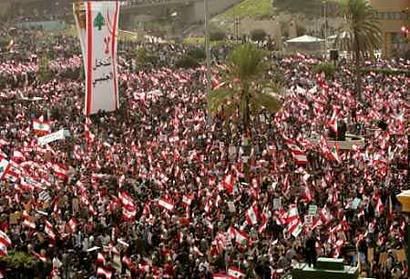
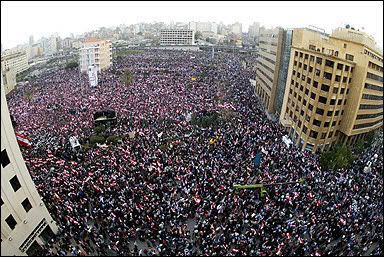
At least 500,000 people demonstrated against Western interference in Lebanon and denounced United Nations Security Council Resolution 1559, which calls for all foreign forces to leave Lebanon and for armed militias to be dismantled. The United States and France introduced 1559 last year; the council passed it in September.

The crowd that packed central Beirut dwarfed earlier rallies against Syria. . . .

. . . [T]he huge pro-Syria demonstration sent a message to the Lebanese opposition and the international community that Hezbollah remains a powerful political force. "The majority of Shiites are behind Hezbollah, and if we want to talk about democracy and people power, we are witnessing this," said Amal Saad-Ghorayeb, a professor of politics at Lebanese American University. "Is the U.S. going to turn around and say, ... 'That's the kind of democracy we are not interested in?'" (emphasis added, Nicholas Blanford/The Christian Science Monitor, "Supporters of Syria Rally 500,000 Strong in Beirut," USA Today, March 8, 2005)
Brian Whitaker of The Guardian gives a similar estimate -- "Trying to estimate the number was futile, but half a million would be plausible and a million not unbelievable" -- and adds an important observation on the class content of the demonstration: "The anti-Syrian protesters who have attracted worldwide attention are mostly Christians, plus Sunni Muslims and Druze, and they are generally from the better-off sections of Lebanese society. Yesterday's masses were overwhelmingly the poorer -- and historically downtrodden -- Shia, who form 40% of the population" ("500,000 Mass for Hizbullah in Beirut," March 9, 2005).

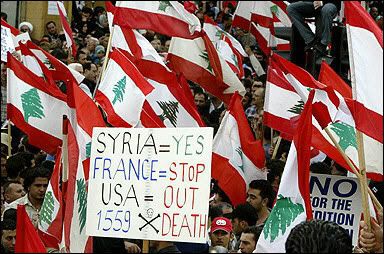
Photographs bear witness to the crowd estimate given by Blanford and Whitaker, and the message of the demonstration is unmistakable:

A general view of hundreds of thousands of protesters taking part in a demonstration organized by pro-Damascus movements led by the Shiite Muslim Hezbollah group in downtown Beirut.(Anwar Amro/AFP)


Lebanese people wave flags as they gather for a pro-Syrian rally in central Beirut March 8, 2005. Hundreds of thousands of flag-waving Lebanese flooded central Beirut for a pro-Syrian rally called by Hizbollah that dwarfed previous protests demanding that Syrian troops quit Lebanon. (Mohamed Azakir/Reuters)


Protestors hold a poster against U.S. President George W. Bush and wave Lebanese flags in a central Beirut square, Lebanon, Tuesday March 8, 2005. Nearly 200,000 pro-Syrian protesters gathered, chanting anti-American slogans and wildly waving Lebanon's flag in answer to a nationwide call by the militant Shiite Muslim Hezbollah group to demonstrate against foreign intervention and counter weeks of massive anti-Syrian rallies. Arabic text reads the same as the english.(Mahmoud Tawil/AP)


A banner against the United States, France and UN Security Council resolution 1559 which calls for Syria to remove its troops from Lebanon is seen during a pro-Damascus demonstration led by the Shiite Muslim group Hezbollah in Beirut.(AFP/Ramzi Haidar)


A protestor holds a portrait of Syrian President Bashar Assad as others wave Lebanese flags in a central Beirut square, Lebanon, Tuesday March 8, 2005. Hundred of thousands pro-Syrian protesters gathered, chanting anti-American slogans and waving Lebanon's flag in answer to a nationwide call by the militant Shiite Muslim Hezbollah group to demonstrate against foreign intervention and counter weeks of massive anti-Syrian rallies. (AP Photo)


Lebanese people wave flags during a pro-Syrian rally in central Beirut March 8, 2005. Hundreds of thousands of flag-waving Lebanese flooded central Beirut for a pro-Syrian rally called by Hizbollah. (Damir Sagolj/Reuters)


Lebanese protesters wave flags and banners during a pro-Syrian rally in central Beirut March 8, 2005. Hundreds of thousands of flag-waving Lebanese flooded central Beirut for a pro-Syrian rally called by Hizbollah that dwarfed previous protests demanding that Syrian troops quit Lebanon. (Damir Sagolj/Reuters)
Ignoring Hezbollah's demonstration in which 13-26% of the 3.8 million Lebanese population participated, however, both Democrats and Republicans are united in support of the twin occupations and policies toward Lebanon and Syria that go with them:
His [George W. Bush's] two predecessors in the Oval Office, his father [George Herbert Walker Bush] and Bill Clinton, both spoke of the latest signs of progress in an appearance at the White House. The first President Bush was restrained, pronouncing himself "very pleased," but cautioning that much work remained to be done.

Mr. Clinton was more ebullient, noting that the Iraqi elections "went better than anyone could have imagined." In Lebanon, he said, "the Syrians are going to have to get out of there and give the Lebanese their country back, and I think the fact that the Lebanese are in the street demanding it is wonderful."

Asked about huge demonstrations on Tuesday, sponsored by Hezbollah, that demanded just the opposite, Mr. Clinton said: "I find it inconceivable that most Lebanese wouldn't like it if they had their country back. You know, they want their country back and they ought to get it." (Todd S. Purdum, "For Bush, No Boasts, but a Taste of Vindication," New York Times, March 9. 2004)
An anti-war movement worth its name in the United States cannot avoid confronting this bipartisan support for the twin occupations head on.

Wednesday, March 09, 2005

A Very Long Engagement

A Very Long Engagement (Dir. Jean-Pierre Jeunet, 2004), set in World War 1 and its aftermath, is an improbable mixture of sweetness and shadow -- an unabashedly romantic "chick film" with palpable commercial ambitions that nevertheless more successfully conveys working-class sentiments against war than more cooly artistic films like Paths of Glory (Dir. Stanley Kubrick, 1957). The heroine Mathilde's fiancé Manech (Gaspard Ulliel), together with four other French soldiers, gets sentenced to be thrown out and left to die in No Man's Land between the French and German lines, on account of self-mutilation to escape the front line and go home.

A Very Long Engagement

Mathilde (played by Audrey Tautou) is convinced that Manech didn't die, so the film is plotted along her search for her beloved. (I wouldn't be giving away anything if I say she finds him in the end -- what film starring Tautou can have less than a happy ending?) Mathilde's search parallels that of a prostitute Tina Lombardi, whose lover was one of the five condemned soldiers and who is determined to avenge his death (which she does, killing two officers who blocked news of the pardon that would have saved the five men's lives, and she gets guillotined -- the sentence she faces with courage and dignity). Following their searches (for the most part Mathilde's rather than Tina's), the audience encounters various French and German characters, most of whom are peasants and workers, and finds out how the war impacted their lives.

A Very Long Engagement has two distinctions. First, one of the five condemned men, played by Denis Lavant, is a socialist welder. Very few films have represented any working-class individuals -- even minor characters -- as socialists. Films, as well as other forms of fiction, tend to portray socialists as middle-class intellectuals and workers as indifferent to politics -- the tendency that not only erases working-class socialists from history but also harbors a condescending view of workers' intellectual capacity. A Very Long Engagement is an interesting partial exception (partial in so far as the socialist welder is represented as unable to reach his fellow workers except by joining them symbolically through an act of individual refusal). Here's an excerpt from Sébastien Japrisot's book of the same title on which the film is based -- it says a little more about the welder than the film:
Before the nightmare he'd been a corporal, because they'd needed one and the fellows in his platoon had chosen him, but he hated military ranks. He was certain that one day all men, including welders, would be free and equal among themselves. He was a welder in Bagneux, near Paris, with a wife, two daughters, and marvelous phrases in his head, phrases learned by heart, that spoke of the workingman throughout the world, that said. . . . For more than thirty years he'd known perfectly well what they said, and his father, who'd so often told him about the Paris Commune, had known this, too.

It was in their blood. His father had had it from his father, and had passed it on to his son, who had always known that the poor manufacture the engines of their own destruction, but it's the rich who sell them. He'd tried to talk about this in the billets, in the barns, in the village cafés, when the proprietress lights the kerosene lamps and the policeman pleads with you to go home, you're all good folks, so let's be reasonable now, it's time to go home. He wasn't a good speaker, he didn't explain things well. And they lived in such destitution, these poor people, and the light in their eyes was so dimmed by alcohol, the boon companion of poverty, that he'd felt even more helpless to reach them.

A few days before Christmas, as he was going up the line, he'd heard a rumor about what some soldiers had done. So he'd loaded his gun and shot himself in the left hand, quickly, without looking, without giving himself time to think about it, simply to be with them. In that classroom where they'd sentenced him, there had been twenty-eight men who'd all done the same thing. He was glad, yes, glad and almost proud that there had been twenty-eight of them. Even if he would never live to see it, since the sun was setting for the last time, he knew that a day would come when the French, the Germans, the Russians -- "and even the clergy" -- would refuse to fight, ever again, for anything. Well, that's what he believed. He had those very pale blue eyes flecked with tiny red dots that welders sometimes have. (Sébastien Japrisot, A Very Long Engagement, trans. Linda Coverdale, NY: Plume, 1993 [originally published in France in 1991])
The second distinction, the more extraordinary, is that A Very Long Engagement shows a French soldier killing a French officer during an offensive. The soldier, Benoît Notre-Dame (played by Clovis Cornillac), sees the officer kicking the bodies of dead French soldiers whom the officer curses as incompetent cowards, and, outraged, he suffocates the officer in the mud. Nobody sees his act (except the audience), so he does not get charged with murder. And, among the five condemned men, he is the most resourceful survivor, saving Manech's life and escaping himself. What other film has shown a soldier kill a superior and get away with it?

French soldiers' rebellious refusal to continue fighting the futile war as well as an understanding between French and German soldiers hinted at in A Very Long Engagement is rooted in history, except that French soldiers in the real world became eventually more collectively revolutionary than individual refusers in the fiction.

A Very Long Engagement begins with the sentencing of the aforementioned five soldiers in January 1917, as they are marched down a trench to Bingo Crépuscule. That's mere four months before mutinies in the French Army that began on May 27, 1917, involving as many as 30,000 soldiers:
Official archives give the figures of 3,427 soldiers convicted of offences relating to the mutinies, some 554 receiving death sentences of which 49 were executed.65 However, these figures have been contested by historians of the mutinies.
. . . executions involved in the suppression of revolt could be covered up by listing the death under some category other than execution, such as 'died of wounds' or 'killed in an accident.'66. . . .
(Peter Edwards, "'Mort pour la France': Conflict and Commemoration in France after the First World War," University of Sussex Journal of Contemporary History 1, 2000, p. 8)
That was not the only rank-and-file rebellion during World War 1. Shortly after the war began, German, British, French, and other soldiers organized a Christmas truce in December 1914 (see, for instance, "The Christmas Truce," BBC, November 3, 1999; and Harvey Thompson, "War, Football and the 1914 Christmas Truce," WSWS.org, July 17, 2003). By 1917, the war further radicalized many more soldiers, sparking mutinies in the Russian, French, German, British, Italian, and other forces in 1917-1919. Of course, the Russian Revolution itself could not have happened without mutinous Russian soldiers who refused orders to crush strikers and protesters and deserted from the front.

A Very Long Engagement, whose whimsically romantic plot and enchanting visual set pieces at times overwhelm its political substance, is nevertheless one of the few films in which mutinous soldiers of World War 1 make their ghostly presence felt -- the presence that some viewers of the film may be led to discover in historical documents neglected by national histories.

Tuesday, March 08, 2005

Black Army Recruits Down 41% since 2000

Here is an extremely important fact: Black volunteers for the Army "have fallen 41 percent" (Tom Philpott, "Military Update: Black Army Recruits Down 41 Percent since 2000," The Daily Press, March 6, 2005). To be more precise, "[f]rom 22.7 percent at the time of the Sept. 11, 2001 terrorist attacks, the share [of Blacks among recruits] slid to 19.9 percent in 2002; 16.4 percent in 2003 and 15.9 percent last year, according to figures provided by Army Recruiting Command spokesman Douglas Smith. The slide has continued, dropping to 13.9 percent as of Feb. 9." -- a severe blow to the Army, since it depends upon Blacks to supply "about 23 percent" of its active-duty troops today (Robert Burns/Associated Press, "Young Blacks Less Willing to Join the Army," Detroit Free Press, Tuesday, March 8, 2005). "Officer recruiting is hit, too. Black soldiers enrolled in the Army Reserve Officers' Training Corps program is down 36 percent since 2001" (Philpott, March 6, 2005). Women are also shunning the Army: "the share of females in Army recruiting classes falling for four years running, from 21.6 percent in 2001 to 19.2 percent last year. It has slipped still further this year to 17.1 percent" (Burns, March 8, 2005). The plan to increase active-duty Army soldiers by 30,000, approved by Congress last year, is now in danger. The Army is about "6 percent behind schedule to meet its 2005 recruiting goal" (Burns, March 8, 2005).

The Iraq War -- especially fear of killing and dying in combat -- made all categories of youths less likely to join the military: fear of death and injury is "the top reason to avoid service for 26 percent of youth in 2004, almost double the 14 percent reported in 2000" (Philpott, March 6, 2005). Blacks' reasons for refusing to join the military, however, show a higher level of political consciousness than those of other groups: "Black youth were less supportive of U.S. troops' presence in Iraq, less likely to feel the war was justified, more disapproving of the Bush administration's handling of foreign affairs and more disapproving of its use of U.S. military forces than were whites or Hispanics," according to the Defense Department's Youth and Influencer Polls (qtd. in Philpott, March 6, 2005). Counter-recruitment activists should take note of the fact that parents -- particularly mothers -- are the most important influence, especially in Black communities: "A July 2004 study of parents' influence on young people of recruiting age found that black parents have more say in their child's career decisions than is the case with white parents. Also, black parents trust the military less and have more moral objections to military service" (Burns, March 8, 2005). It makes sense to emphasize community organizing more than campus organizing for the purpose of counter-recruitment.

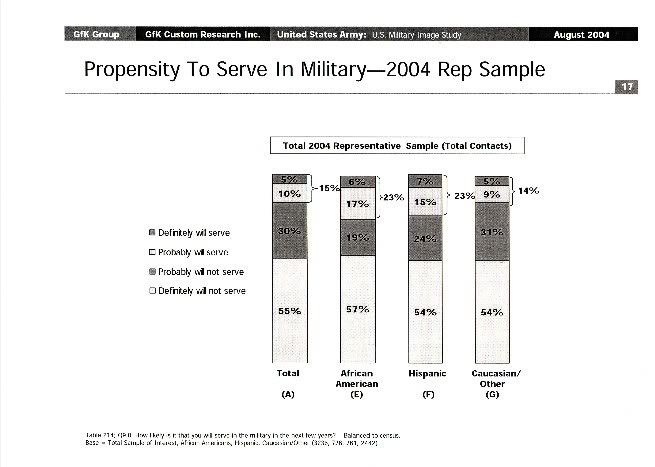
The "propensity to serve" is thankfully very low, according to the "U.S. Military Image Study" (August 4, 2004) prepared for the Army (which both Burns and Philpott cite in the aforementioned articles).


What makes a minority of young people still consider enlistment? The top reason is, not surprisingly, money for college: 42% mention "education," and 27% specifically say that "pay for education/$ for college" is the top-of-mind reason for joining the military ("U.S. Military Image Study," August 4, 2004). That means that the anti-war movement is inseparable from a movement for economic justice. Already, the equivalent of four-year scholarships at public universities for "7,499,971 students" (National Priorities Project, Cost of War, March 8, 2005) has been spent on the Iraq War! Activists have to struggle harder for more state subsidies to higher education and lower tuitions and fees, so that all who want to go to college can do so without risking their lives in Iraq or anywhere else.

Last not the least, the "U.S. Military Image Study" is worth reading in its entirety, as it presents many fascinating findings that have not been reported by the media. To take just one example, the study, in the inimitable language of marketing experts, offers an unintentionally funny recommendation to the Army in its conclusion: "For the Army to achieve its mission goals with Future Force Soldiers, it must overhaul its image as well as its product offering" . . . because, "[i]n today's reality, the risk/reward ratio is even more out of balance" than usual (emphasis added, August 4, 2004, p. 98).

Monday, March 07, 2005

Rules of Engagement

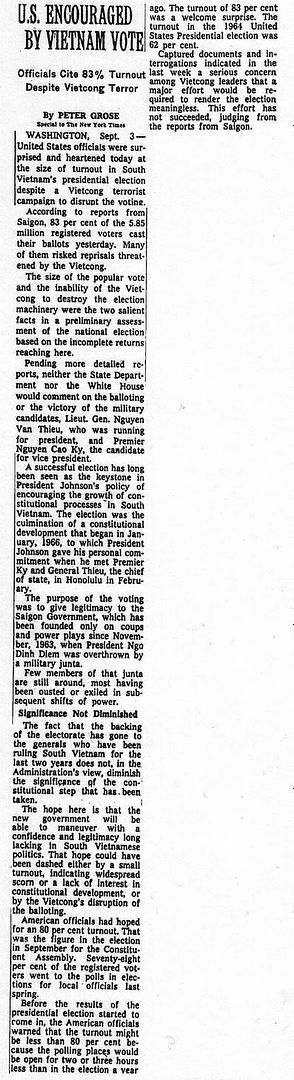
Iraqis hate American checkpoints. The New York Times says that "[n]ext to the scandal of prisoner abuse at Abu Ghraib, no other aspect of the American military presence in Iraq has caused such widespread dismay and anger among Iraqis" (John F. Burns, "U.S. Checkpoints Raise Ire in Iraq," March 7, 2005). No wonder -- the US rules of engagement give soldiers "authority to open fire whenever they have reason to believe that they or others in their unit may be at risk of suicide bombings or other insurgent attacks" (Burns, March 7, 2005). Paranoid fear comes easily to soldiers in counter-insurgency warfare, making them think that all moving shadows are cast by elusive guerrillas.

Two Iraq Children, Whose Parents Are Killed by US Soldiers
Two children are held by G.I.'s after their parents were killed when soldiers fired on the family's car near Tal Afar, Iraq, on Jan. 18. (Chris Hondros/Getty Images)

The incident of US soldiers opening fire on the car carrying an Il Manifesto correspondent Giuliana Sgrena, wounding her and killing Nicola Calipari, the Italian security agent who secured her release from insurgents who had held her hostage, demonstrates that no one is safe at US checkpoints in Iraq. There is no official statistics of the numbers of Iraqi and foreign civilians killed like Calipari, but, according to the New York Times, "[d]aily reports compiled by Western security companies chronicle many incidents in which Iraqis with no apparent connection to the insurgency are killed or wounded by American troops who have opened fire," and "a series of unclassified government reports that receive extremely restricted circulation" document "at least six incidents since December in which American troops have fired on vehicles carrying Westerners in the area around the airport" (Burns, March 7, 2005).

Sunday, March 06, 2005

Giuliana Sgrena's Truth

Giuliana Sgrena, Il Manifesto's Baghdad correspondent who was shot and wounded by US troops, published her reflections on "la guerra che uccide la comunicazione," the war that kills communication:
Ho vissuto in una enclave in cui non avevo più certezze. Mi sono ritrovata profondamente debole. Avevo fallito nelle mie certezze. Io sostenevo che bisognava andare a raccontare quella guerra sporca. E mi ritrovavo nell'alternativa o di stare in albergo ad aspettare o di finire sequestrata per colpa del mio lavoro. «Noi non vogliamo più nessuno», mi dicevano i sequestratori. Ma io volevo raccontare il bagno di sangue di Falluja dalle parole dei profughi. E quella mattina già i profughi, o qualche loro «leader» non mi ascoltavano. Io avevo davanti a me la verifica puntuale delle analisi su quello che la società irachena è diventata con la guerra e loro mi sbattevano in faccia la loro verità: «Non vogliamo nessuno, perché non ve ne state a casa, che cosa ci può servire a noi questa intervista?». L'effetto collaterale peggiore, la guerra che uccide la comunicazione, mi precipitava addosso. A me che ho rischiato tutto, sfidando il governo italiano che non voleva che i giornalisti potessero raggiungere l'Iraq, e gli americani che non vogliono che il nostro lavoro testimoni che cosa è diventato quel paese davvero con la guerra e nonostante quelle che chiamano elezioni.

Ora mi chiedo. E' un fallimento questo loro rifiuto? (emphasis added, Giuliana Sgrena, "La mia verità," Il Manifesto, March 6, 2005)
I now live with no more certainties. I find myself deeply weak. I failed in my belief. I had always claimed there was need to go tell about that dirty war. And I had to decide whether to stay in the hotel or . . . chance being abducted because of my work. "We don't want anyone any more," the abductors told me. But I wanted to tell about the bloodbath in Falluja through the refugees' tales. And that morning the refugees and some of their "leaders" didn't listen to me. I had in front of me the evidence of what the Iraqi society has become with the war and they threw their truth in my face: "We don't want anyone. Why don't you stay home? What such interview can be useful for?" The worst collateral damage, the war killing communication, was falling on me. On me, who had risked it all, challenging the Italian government that didn't want reporters gong to Iraq, and the Americans who don't want our work that gives witness to what that country has really turned into with the war, despite what they call elections.

Now I wonder. Is their refusal a failure? (emphasis added, Giuliana Sgrena, "My Truth (La mia verità)," trans. Eva Milan, Online Journal, March 6, 2005)

Giuliana Sgrena, donna di pace

Saturday, March 05, 2005

The Need for "Reform"

A wonderful letter to the New York Times ("The Need for 'Reform,'" February 26, 2005, p. A14), from James O. Freedman:
To the Editor:

More than half a century ago, George Orwell warned, in his essay "Politics and the English Language," against the immorality implicit in the use, especially by government officials, of intentionally misleading words. I think of Orwell's essay every time that President Bush speaks of the need for "reform" of Social Security and tort law.

Orwell's contemporary George Bernard Shaw got it right when he reputedly retorted to an adversary whom he was debating: "Do not speak to me, sir, of reform. Things are bad enough as they are!"

JAMES O. FREEDMAN
Cambridge, Mass., Feb. 24, 2005

The writer is president emeritus of Dartmouth College and the University of Iowa.
The apocryphal remark on "reform" is actually more often attributed to Lord Salisbury and employed to promote the very sort of Orwellian attempt to destroy a social program in the name of "reforming" it that Freedman criticizes, but Freedman's letter memorably turns the remark into one of the sharpest arrows in the working-class quiver.

Friday, March 04, 2005

American Workers: Smarter but Poorer

Despite the neoliberal boomlet (the so-called "New Economy") of the 1990s, real hourly earnings are still lower than the peak of the mid-1970s. Whose fault is that? If you ask technocrats, the culprits are the working class themselves -- especially students and teachers -- who have allowed educational standards to decline and failed to match employers' demands for higher skills: "[t]he fall in real wages of people with low skills and widening earning differentials since the 1980s are also evidence of upskilling in Canada, the European Union and the United States (OECD 1996b)" (Literacy in the Information Age: Final Report of the International Adult Literacy Survey, 2000, p. 8). Especially in the United States, alarming soundbites are used to create a sense of national crisis of education: "Nearly half of all adult Americans cannot read, write, and calculate well enough to function fully in today’s society, and people in their early 20’s have poorer literacy skills than did those in a 1985 survey, according to a federal study" (Debra Viadero, "Half of Adults Lack Skills, Literacy Study Finds," Education Week, September 15, 1993). Is that really true?

The federal study in question, the 1993 National Adult Literacy Survey, however, said nothing of the sort, as Regie Stites clarifies in a working paper prepared for the National Center for Education Statistics: "First, the statement that half of all adult American lack adequate writing skills is an apparent misunderstanding of the nature of the NALS document literacy measures. Second, the association of performance at NALS Levels 1 and 2 with functional illiteracy is never made in the NALS report" ("'How Much Literacy is Enough?' Issues in Defining and Reporting Performance Standards for the National Assessment of Adult Literacy," National Center for Education Statistics Working Paper No. 2000-07, March 2000, p. 23).

There is no evidence to support the claim that Americans -- especially young Americans -- today have lower skills than those in the past. If anything, American workers are more educated and literate than ever, according to Michael J. Handel, who meticulously examined the data provided by not only the NALS but a battery of other tests.
Taking education as the measure suggests that the workforce is considerably more skilled than in the past. In 1964, prior to the perceived deterioration of public education, the share of all Americans who were high school dropouts was 47% and the proportion of young people age 24-29 with less than high school was 31%, compared to roughly 13% for both groups in 1997 (author's calculations, March Current Population Survey). . . .

. . . . . . . . . . . . . . . . . . . .

IQ tests show large gains for Americans throughout this century, including every postwar decade for samples as recent as 1995, the most current, and there is no obvious recent change in the slope of growth (Flynn 1998: 27,35ff.). . . .

. . . . . . . . . . . . . . . . . . . .

One of the most frequently cited are college entrance exams, such as the SAT, whose decline beginning in the mid-1960s initiated the recent concern over the state of public education in the U.S. However, less widely reported is that math SAT scores started rising around 1980 and exceeded 1971 levels by the mid-1990s, despite the growing share of high school students taking the exam, though verbal scores did not recover, while the pattern for the rival American College Test (ACT) shows English scores exceeding earlier levels while the rebound in math did not fully offset the earlier decline (Economic Report of the President 2000:148; Boesel & Fredland 1999:72). Contrary to popular impression, the SAT and ACT test score declines are highly cohort-specific and ceased or reversed long ago.

. . . . . . . . . . . . . . . . . . . .

The best time series of inter-cohort data is the U.S. Department of Education's National Assessment of Educational Progress (NAEP), sometimes called the Nation's Report Card, which has a continuous series of reading and math scores for representative samples of 17-year olds since the early 1970s; the test instrument has remained roughly the same over this time. Reading scores did not change significantly between 1971-1999, in contrast to SAT scores. Math scores dipped about 2% between 1973-1982 and then rose until reaching a level in 1999 about 1% higher than 1973 (Campbell et al 2000). Overall test score inequality for both math and reading also declined since the 1970s, due mostly to gains at the lower percentiles, contradicting the impression that the lower part of the distribution is losing ground (Campbell et al 2000:9ff.). Black math and reading scores rose and closed roughly one-half of the black white gap during the 1980s, also contradicting popular impressions, before losing some ground in the 1990s, a development that is still poorly understood (Campbell et al 2000:36ff.)

. . . . . . . . . . . . . . . . . . . .

Contrary to popular impression, age is negatively associated with test scores even for those under 65, lending no support to the idea that younger Americans have poorer literacy skills than older ones. Those age 55-64, who would have graduated high school in the reputed golden years of American education (1946-1955), clearly have lower scores than more recent cohorts, who supposedly bear the effects of less rigorous schooling. Many fewer in the older group actually finished high school but a significant gap remains even after controlling for educational attainment (Smith 1995:214; Freeman & Schettkat 2001; cf. OECD & Stat. Can. 2000:147f.). The NALS data provide no evidence that more recent cohorts have lower cognitive skills than older cohorts. (Michael J. Handel, "Skills Mismatch in the Labor Market," December 2002 [published in Annual Review of Sociology 29, August 2003], pp. 11-14, 17)
Moreover, the supply of college graduates is larger than the number of jobs that require college education (the requirement that is due more to credentialism than to actual skill demands of the jobs or actual skills supplied by college education):
Hecker (1992:4) found that the percentage of college grads in occupations not requiring a college degree or unemployed rose from about 12% (1967) to 18.6% (1980) during the "over-education" years, and continued to rise modestly to 19.9% during the years of ostensible shortage (1990).1 Further, the supply of college graduates grew 62 percent between 1979-90, while employment in managerial, professional, technical, and high skilled detailed occupations in other broad occupational categories grew only 57 percent (Hecker 1992:7). (Handel, p. 37)
In the 1970s, when workers were on the offensive on the class struggle as well as social movement fronts, the power elite in fact fretted that workers were overeducated and overskilled relative to available jobs, breeding discontent due to relative deprivation: "A prominent government report considered the dilemma of how to make work more satisfying when job complexity at all levels seemed to fall short of workers' rising education levels and aspirations for meaningful work (US Department of Health, Education, and Welfare 1973)" (Handel, p. 3).

Given that the rises in workers' educational attainment (even producing an oversupply of college graduates) and test scores took place at the same time as the proportion of well-paying manufacturing jobs contracted and that of poorly-paying service jobs expanded in the US economy, one would think that the question of "how to make work more satisfying" is even more urgent now than in the 1970s.

Instead, technocrats continue to cling to the "skills mismatch" theory, asserting that workers' skill levels fall short of the demand of the post-Fordist job market. Evidence for statistically significant upskilling in the last couple of decades -- the period of real wage stagnation and widening income inequality -- is as scant as evidence for a national literacy crisis, however: "Sum (1999) and Barton (2000:15,19) replace DOT [Dictionary of Occupational Titles] measures of occupational skills with mean NALS scores and find job literacy requirements almost completely unchanged over the periods 1990-2005 and 1986-2006, respectively, based on BLS occupational data and projections for the terminal years" (Handel, p. 27).

Besides, when it comes to hiring, employers themselves appear to value docility and servility more than anything else: "Cross-sectional studies often suggest employers are less concerned about cognitive skills deficits than what they consider poor work habits, motivation, demeanor, and attitudes" (Handel, p. 25). Lucy Kellaway put it more bluntly:
Think what characterises the really intelligent person. They can think for themselves. They love abstract ideas. They can look dispassionately at the facts. Humbug is their enemy. Dissent comes easily to them, as does complexity. These are traits that are not only unnecessary for most business jobs, they are actually a handicap when it comes to rising through the ranks of large companies." ("Companies Don't Need Brainy People," Financial Times, November 22, 2004)
The "skills mismatch" story is a red herring that seeks to deflect our attention from the real problems: union-busting, outsourcing, and subcontracting that have led to the declining rate of unionization, which, in combination with social programs starved by budget austerity, has made workers poorer and put them into a weaker bargaining position vis-a-vis employers. It's time to bury the myth.

Thursday, March 03, 2005

Nu, Zayats, Pogodi!

Click on the picture below, and you'll be able to watch an excellent example of Soviet animation, courtesy of Wellesley College's Russian Department:
Nu, zayats, pogodi!
Zayats, the hare, is a survivor like Brer Rabbit, unlike the old Soviet Union, which got finally captured and devoured by Volk in 1991.

Wednesday, March 02, 2005

The Dollar and the American Language

Foreign students come to American universities and teach American students science in English, and foreign-born engineers work for American corporations, speaking and writing in English -- all of them having learned English mostly in their homelands. That's a remarkable development that is too often taken for granted (or was until "homeland security" began to curtail supplies: "In the past year overseas applications to US universities have declined by 28%, while at the same time they have surged in competitor countries, including the UK and Germany. Enrolment of all foreign students in America fell for the first time in three decades, and graduate student enrolment dropped by 6%" [Rebecca Holman, "Overseas Students Shun US Universities," The Guardian, December 22, 2004]).

BBC says that "[a] third of people on the planet will be learning English in the next decade":
Researcher David Graddol says two billion people will be learning English as it becomes a truly "world language".

This growth will see French declining internationally, while German is set to expand, particularly in Asia.

. . . . . . . . . . . . . . . . . . . .

The Future of English report, launched in Edinburgh at a British Council conference on international education, has used computer modelling to forecast the onset of a "wave" of English-learning around the world.

In the year 2000, the British Council says there were about a billion English learners -- but a decade later, this report says, the numbers will have doubled.

The research has looked at the global population of young people in education -- including 120 million children in Chinese primary schools -- and how many countries are embedding English-language learning within their school systems.

The linguistic forecast points to a surge in English learning, which could peak in 2010. (Sean Coughlan, "English 'World Language' Forecast," December 9, 2004)
Which variety of English are people learning, though? Most likely, the English of multinational corporations:
As she searched for the English words to name the razor-tooth fish swimming around her stomach on her faded blue and white T-shirt, 10-year-old Urantsetseg hardly seemed to embody an urgent new national policy.

"Father shark, mother shark, sister shark," she recited carefully as the winter light filled her classroom. Stumped by a smaller, worried-looking fish, she paused, frowning. Then she cried out, "Lunch!"

Even here on the edge of the nation's capital, in this settlement of dirt tracks, plank shanties and the circular felt yurts of herdsmen, the sounds of English can be heard from the youngest of students -- part of a nationwide drive to make it the primary foreign language learned in Mongolia, a landlocked expanse of open steppe sandwiched between Russia and China. "We are looking at Singapore as a model," Tsakhia Elbegdorj, Mongolia's prime minister, said in an interview, his own American English honed in graduate school at Harvard. . . .

Its camel herders may not yet be referring to one another as "dude," but this Central Asian nation, thousands of miles from the nearest English-speaking country, is a reflection of the steady march of English as a world language. . . .

. . . . . . . . . . . . . . . . . . . .

. . . Until the collapse of the Soviet Union, Russian was universally taught in Mongolia and was required for admission to universities.

"Russia is going downhill very fast," said Tom Dyer, 28, an Australian teacher at the Lotus Children's Center, the orphanage where Urantsetseg was describing the shark family.

Russia, leery of immigration from Asia, has imposed visa requirements on Mongolians. China has not. Today, it is hard to find a Mongolian under 40 who speaks better than broken Russian. Within a decade, Mongolia is expected to convert its written language to the Roman alphabet from Cyrillic characters. "Everyone knows that Russian was the official foreign language here," T. Layton Croft, Mongolia's representative for The Asia Foundation, said in an interview. "So by announcing that English is the official foreign language, it is yet another step in a way of consolidating Mongolia's independence, autonomy and identity."

So far, Beijing has adopted a laissez-faire stance toward Mongolia's flirtation with English, even though China is now the country's leading source of foreign investment, trade and tourism. Such a stance is easy to maintain because Chinese-language studies also are undergoing a boom here.

. . . . . . . . . . . . . . . . . . . .

With official encouragement, the American Embassy, the British Embassy, and a private Swiss group have all opened English-language reading rooms here in the past 18 months.

. . . . . . . . . . . . . . . . . . . .

After trying in the 1990's to retrain about half of Mongolia's 1,400 Russian-language teachers to teach English, Mongolia now is embarking on a program to attract hundreds of qualified teachers from around the world to teach here.

"I need 2,000 English teachers," said Puntsag Tsagaan, Mongolia's minister of education, culture and science. Mr. Tsagaan, a graduate of a Soviet university, laboriously explained in English that Mongolia hoped to attract English teachers, not only from Britain and North America, but from India, Singapore and Malaysia. Getting visas for teachers, a cumbersome process, will be streamlined, he said.

Mr. Tsagaan spins an optimistic vision of Mongolia's bilingual future if he can lure English teachers. "If we combine our academic knowledge with the English language, we can do outsourcing here, just like Bangalore," he said. (James Brooke, "For Mongolians, E Is for English, F Is for Future," New York Times, February 15, 2005)
The US Empire has three pillars: the Dollar, the Sword, and the American Language. The three pillars support one another. Just as the dollar, made the global reserve currency by the sword, has allowed Washington to run an empire on budget and trade deficits, the American Language, the chief inheritor of the linguistic estate of the British Empire and its colonial subjects, has allowed Washington to manage the empire on foreign language education deficits, sparing it the costs of establishing a British-style colonial civil service.

As the dollar goes south, however, will fewer people in the world be studying American English, and will Americans be finally compelled to learn a foreign language or two?

Wednesday, February 16, 2005

Students = Customers?

Student-evaluation forms are very much like customer-complaint forms. So, it is not surprising that teachers end up behaving like salesmen and -women who know "the importance of keeping the customer satisfied":
As an assistant professor of marketing, Robert S. Owen knows the importance of keeping the customer satisfied. His job depends on it.

That's why, in his courses at the State University of New York College at Oswego, he gives multiple-choice rather than essay exams and asks students to evaluate research papers rather than write their own. A student who questions the fairness of a question on a test might receive extra credit simply for expressing interest.

"If students come to my office," he says, "I have to make sure they walk out happy."

Dr. Owen learned that lesson the hard way. Three years ago, he lost his job at Bloomsburg University of Pennsylvania when students gave his teaching mixed reviews. He describes himself as a casualty of an era in which administrators increasingly rely on student evaluations of teaching to decide who gets tenure and who doesn't.

"The student in college is being treated as a customer in a retail environment," he says, "and I have to worry about customer complaints." (Robin Wilson, "New Research Casts Doubt on Value of Student Evaluations of Professors," Chronicle of Higher Education, January 6, 1998)
That's a shame -- according to recent research, student evaluations aren't good measures of teaching:
"Evaluations may encourage faculty to grade easier and make course workloads lighter," says Anthony G. Greenwald, a psychology professor at the University of Washington who wrote the article ["Grading Leniency Is a Removable Contaminant of Student Ratings"] in American Psychologist [November 1997]. He and Gerald Gilmore, director of the university's Office of Educational Assessment, examined student ratings of hundreds of courses at Washington and found that professors who are easy graders receive better evaluations than do professors who are tougher.

. . . . . . . . . . . . . . . . . . . .

. . . Stephen J. Ceci, a Cornell University professor who wrote the article ["'How'm I Doing': Concerns about the Use of Student Ratings of Instructors and Courses"] on the study in Change [September/October 1997], the monthly magazine of the American Association for Higher Education, says one student suggested in an evaluation that he stop wearing a pair of orange corduroy pants. "You look like you work at Hardees," the student wrote.

. . . . . . . . . . . . . . . . . . . .

. . . Dr. Ceci had taught developmental psychology at Cornell for nearly 20 years and was drawing mediocre reviews. Administrators had even asked him to attend a workshop with a "media consultant" to try to spice up his lectures.

To Dr. Ceci, the situation became an opportunity for research: What if he could improve his ratings simply by being a more enthusiastic lecturer, as the media consultant had advised? What would that say about the value of student ratings?

During a recent spring semester (Dr. Ceci would not identify which one), the professor taught developmental psychology covering the same material as in the previous semester, and using the same textbook he had used for years. But he added more hand gestures to his teaching style, varied the pitch of his voice, and generally tried to be more exuberant. The outcome was astounding: Students' ratings of Dr. Ceci soared. They even gave higher marks to the textbook, a factor that shouldn't have been affected by differences in his teaching style.

Despite the higher ratings, however, Dr. Ceci found no real improvement in students' performance on exams in the spring compared to those in the fall. He concluded that his new teaching style was probably no more effective than his old one. (Wilson, January 6, 1998)
Last month, Stanley Fish published his humorous account of civil disobedience against reduction of students to customers every semester:
Well, I'd gone and done it again. My intentions were good (or so it seemed to me at the time). I had brought the student-evaluation forms with me on the appointed day, but when the class was over, and the students had filed out for the last time, there was the large envelope, unopened.

I threw it in the trash and walked back to my office. ("Who's In Charge Here?" Chronicle of Higher Education, February 4, 2005)
Would conservatives object? If they do, we ought to remind them that history's first professional teachers -- sophists, Plato, Aristotle, etc. -- celebrated by conservative proponents of restoration of classics -- did not administer student evaluation forms, nor did they take attendance and give their students grades. Theirs was a pedagogy of love.

Tuesday, February 15, 2005

It's Been a Hard Day's Night

What makes people work hard? In Britain, "managers" and "fellow workers" have surged ahead from 1988 to 1997 as "sources of work pressure," now relegating "customers" to the fourth rank on the hierarchy of work pressures:
Green (2001: 64-8) brings together a range of these surveys and also highlights their data on why people work hard. The evidence over time shows an increase in the reporting of all forms of pressure (see Table 2). Green also shows that the number of sources of pressure cited (i.e. between zero and seven) correlates with the extent to which increased effort is reported -- which is one indicator that these self-reports are statistically valid.
Table 2: Reported Sources of Work Pressure, 1986 and 1997
per cent mentioning
19881997
Machinery etc
7
10
Customers
37
34
Management
27
41
Fellow workers
29
57
Own discretion
61
68
Pay
15
30
Reports and appraisal
15
24
Source: Green (2001: 69), in turn based on the 1986 Social Change and Economic Life Initiative study and the 1997 Skills Survey.

Several points stand out from this table. First, pressures from markets and customers are widely, and correctly, seen as imposing increasing disciplines on employees. It appears from these results, however, that direct pressures remain limited, and it seems that they are mediated through the expectations of managers and fellow workers. Second, there has also been interest in the role of appraisal and monitoring systems, as means of measuring performance against pre-defined targets. The importance of such systems has indeed increased, but their direct impact remains relatively small. Third, in the light of discussion of performance-related pay, the doubling in the proportion of people citing pay as an influence on how hard they work is notable. Finally, the role of fellow workers is most striking, suggesting at first sight that peer discipline has become the predominant force, outside individuals themselves, in working hard. Yet there may be some uncertainty in the data here; a 1992 survey reported by Green put the figure at 36 per cent which implies an unlikely jump in the next five years. (Note also that ‘customers’ were cited by 50 per cent of respondents in 1992: it is not clear why this figure is out of line with those for 1986 and 1997). Detailed research evidence suggests that it is not the case that traditional managerial discipline has been replaced by team- or peer-based discipline in the sense of there being well-entrenched and formalized team systems embracing the establishment and enforcement of norms of behaviour and taking over the role of management (Geary, forthcoming).

. . . . . . . . . . . . . . . . . . . .

Geary, J. F. (Forthcoming) New Forms of Work Organization, in P. Edwards, ed., Industrial Relations, 2nd edn. Oxford: Blackwell.

. . . . . . . . . . . . . . . . . . . .

Green, F. (2001) It’s Been a Hard Day’s Night: the Concentration and Intensification of Work in Late Twentieth Century Britain. British Journal of Industrial Relations, 39, 53-80. (Paul Edwards, "The Puzzle of Work: Autonomy and Commitment Plus Discipline and Insecurity," SKOPE Research Paper No.16, Summer 2001, pp. 15-16)
It is striking that workers' "own discretion" has remained the chief source of work pressure since the late 80s and that work pressure due to it has become more intense than ever in Britain, according to self-reports of British workers. "The dull compulsion of economic relations completes the subjection of the labourer to the capitalist," so much so that, in some cases, the worker's own subjectivity, as well as her fellow workers', becomes the most efficient wage-slave driver?

Friday, February 11, 2005

Free Lynne Stewart!

This is terrible news: Lynne Stewart, as well as all her co-defendants, was found guilty on all counts, "a major victory for Justice Department prosecutors" (Julia Preston, "Lawyer of Terrorist Found Guilty," New York Times, February 12, 2005). The case doesn't concern Stewart alone -- it is a threat to all lawyers who represent defendants accused of terrorism:
  • "It's a dark day for civil liberties and for civil liberties lawyers in this country," attorney Ron Kuby said on Thursday following the verdict in federal court in Manhattan. "In the post 9-11 era, where dissidents are treated as traitors, it's perhaps no surprise that a zealous civil rights lawyer becomes a convict."

    Kuby -- who briefly represented Sheik Omar Abdel-Rahman after the sheik's 1993 arrest -- said the verdict was a "terrible message to send at a time when we need civil rights lawyers more than ever."

    . . . . . . . . . . . . . . . . . . . .

    "The purpose of this prosecution ... was to send a message to lawyers who represent alleged terrorists that it's dangerous to do so," said Michael Ratner, president of the Center for Constitutional Rights, who was not involved in the case.

    "It would be bad if the government interjected themselves in the attorney-client relationship on a regular basis. It would be a sad day if that became the norm," said Andrew Patel, who worked alongside Stewart at Abdel-Rahman's trial and represents Jose Padilla, an alleged terror plotter detained in a Navy brig. "I pray to God it doesn't." (Larry Neumeister/Associated Press, "Verdict in Lynne Stewart Case Shakes Legal Community," Newsday, February 11, 2005)

  • Activist attorney and radio talk show personality Ron Kuby, who once represented Stewart's client Sheikh Omar Abdel-Rahman, said the verdict will intimidate attorneys handling unpopular political clients.

    "It makes it that much more easier for the government to intimidate activist lawyers," Kuby said. "The threat of 20 years incarceration is a terrible deterrent against zealous advocacy."

    Kuby, who, along with the late William Kunstler, has represented his share of political clients, said he would continue to help unpopular litigants. But he said other lawyers, faced with criticism from the media, their families and other attorneys, might choose not to push a client's cause vociferously.

    "It reflects the tenor of the times," said Jonathan Marks, who is representing Mohammed Ali Hassan al-Moayad in a terrorism-related case in federal court in Brooklyn.

    Marks said the Stewart verdict illustrates the tremendous prejudice faced by people linked to Islamic fundamentalism.

    Attorney Anthony Ricco, who has worked on several terror-related cases and currently represents Uzair Paracha, who is accused of providing material support to terrorists, agreed.

    "It will definitely have a chilling effect," Ricco said - if not on experienced lawyers, on those unfamiliar with the boundaries who may defer to the government rather than face criminal charges themselves. (Anthony M. DeStefano, "Activist Lawyers Fear 'Chilling Effect' from Verdict," Newsday, February 11, 2005)
When the state starts locking up lawyers for zealously defending their clients, it begins to cross a fine line that separates a normal capitalist state from an authoritarian dictatorship. Free Lynne Stewart!

Wednesday, February 09, 2005

Applications to Military Academies Down Substantially

Will the United States military eventually face a shortage of lieutenants?
Cadets don't have to study the opinion polls to know they're heading off to an unpopular war. Applications to the military academies are down substantially. At West Point, applications hit a post-9/11 high of 12,383 for the school year that began 2003. The 10,412 applications for the coming school year represent a 16 percent drop in two years. The Naval Academy is down 2,852 applicants, a 20 percent drop in just a year, and the Air Force Academy is down 3,054 applicants from 2004, a 24 percent drop.

After two years at West Point, a cadet is given a last chance to leave without having to serve in the military. Last summer, 52 members of the sophomore class of 963 left, compared with 32 the year before and 18 the year before that. West Point officials were relieved it wasn't more. (emphasis added, Michael Winerip, "For Cadets, Iraq Doubts Bow to Duty," New York Times, February 9, 2005)
The attrition rate for the Class of 2006 at West Point is 25%, an increase of 5% from the previous five classes:
West Point is the only service academy dealing with an above-average attrition rate for its Class of 2006 as of the start of this academic year. Of the 1,197 cadets who entered West Point in the summer of 2002, 904 remained by the end of August. The loss rate of 25 percent is greater than the previous five classes, which averaged a 20 percent loss rate.

Of two recent West Point dropouts who spoke on the condition of anonymity, one cited disenchantment with Army life and the other said Iraq was a major factor in his decision.

"I didn't want to be deployed in a war I didn't believe in," he said. (emphasis added, Associated Press, "Military Academy Admissions Down," Military.com, November 23, 2004)
According to one of the cadets interviewed by Michael Winerip of the New York Times, half of the remaining class are highly critical of the Iraq War, especially the lack of an "exit strategy":
Among the 13 cadets I interviewed, Jarick Evans was the most openly critical. "The thing that disturbs me most, we don't have an exit strategy," he says. "When all we're told is we'll leave when the job's done, it leaves a bad taste in mouths of soldiers. That's the reason a lot don't want to go back the second and third times."

Cadet Evans estimates that half his class may feel that way. "There's a big fear we'll go back and forth, back and forth our entire military career because there is no clear mission," he says. (Winerip, February 9, 2005)

Saturday, February 05, 2005

Customers -- More Demanding Than Ever?

"Consumer complaints to the Better Business Bureau against US retail stores doubled -- a jump of 104 percent overall -- between 2000 and 2003. Many of those involve customer interactions with sales people" (Clayton Collins, "With Customers Griping, Retailers Finally Get the Message," Christian Science Monitor, January 31, 2005).

Are US retail workers surlier than before, having lost yet more rounds of class struggle, or are US customers more demanding than ever, seeing that US retail workers are in a weaker position than before?

Friday, February 04, 2005

Uniquely American

An exchange between George W. Bush and Mary Mornin, "a divorced, single mother with three grown, adult children," one of whom, Robbie, is "mentally challenged":
THE PRESIDENT: You work three jobs?

MS. MORNIN: Three jobs, yes.

THE PRESIDENT: Uniquely American, isn't it? I mean, that is fantastic that you're doing that. (Applause.) Get any sleep? (Laughter.) ("President Discusses Strengthening Social Security in Nebraska," February 4, 2005)

Thursday, February 03, 2005

"Dare to Compare": the Nazi Holocaust and the American Genocide

No two atrocities are exactly alike. For instance, the Nazi reign of terror that murdered the mentally disabled, Communists, Jews, homosexuals, and other "undesirables" escalated faster and lasted shorter than centuries of massacres and oppressions committed against American Indians since 1492. This major difference is rooted in the fact that the genocide of American Indians began long before the full-blown industrial revolution -- which rendered not just mass production but also mass murder industrial and efficient -- started.

Does it mean, however, that it is wrong to compare these two atrocities or that there is nothing to be learned from comparison between them?

Not necessarily. When we compare the consequences of National Socialism in Germany and settler colonialism in the New World, we aren't asserting their identity, just as we aren't saying that the Vietnam and Iraq Wars are exactly the same in every respect when we compare them.

What, then, does it mean to compare two atrocities? What is at stake in the act of comparing them as well as that of refusing to do so?

On this subject of the significance of comparison in general and that of the Nazi Holocaust and the American genocide in particular, Lilian Friedberg, a "German-Jewish-Native-American-(Anishinabe)" scholar, wrote an excellent article: "Dare to Compare: Americanizing the Holocaust" (American Indian Quarterly 24.3, Summer 2000).

Many Jewish writers have often compared Jews to American Indians, before and after the Holocaust.
In German-speaking literary circles, the examples of Else Lasker-Schüler, who stylized herself as an American Indian, and Franz Kafka’swish to be a “Red Indian” are well known. George Tabori’s 1990 stage production of the Jewish Western Weisman und Rotgesicht wittily pitted [Jewish] white man against [partly Jewish] red man in a verbal duel in which the protagonists exchange a hilarious blow-for-blow account of injuries and insults suffered by the victim-ized populations they represent. But the phenomenon of conflating Jewish and “Indian” identity is not unique to foreign-language publications. As Seth Wolitz points out, in his discussion of Weisman und Rotgesicht, this “tradition of spoofing Jewish-Indian interrelations . . . reaches back to a Yiddish playlet, Tsvishn Indianer.” 2 This 1895 play, “Among the Indians, or The Country Peddler,” as its translator states, “is not an anomaly, but rather a pathbreaker in a well-defined line of Jewish-American entertainment that leads to the films of Mel Brooks and others.” 3 The American leg of this lineage includes Eddie Cantor’s redface minstrelsy in Whoopie! (1930) and Woody Allen’s Zelig (1983). Fanny Brice sang herself to stardom with “I’m an Indian,” and Bernard Malamud’s The People provides a classic example of the phenomenon.

Most recently perhaps, Raphael Seligmann has gone on record stating that the Jews are “the Indians of Germany.” 4 (endnotes omitted, Friedberg, pp.353-354)
However, the reverse has not been deemed acceptable, particularly since the birth of what Norman G. Finkelstein calls the Holocaust Industry in the Six Day War:
Lucy Dawidowicz charges those who would dare to compare [the American genocide of Indians and the Nazi Holocaust of Jews] with “a vicious anti-Americanism.”5 Rabbi Irving Greenberg, founder of the Holocaust Resource Center and first director of the U.S. Holocaust Memorial Commission, has described the comparison of the Nazi Holocaust with other acts of genocide as “blasphemous.”6 In The Holocaust in American Life, Jewish historian Peter Novik describes the way in which any attempt to compare is dismissed as a “felonious assault” on truth and memory.7 (endnotes omitted, Friedberg, p. 354)
Friedberg asks us to think about why Jews as well as others have often found emotional resonance in comparing themselves to American Indians while comparing the American genocide of Indians to the Nazi Holocaust of Jews is often condemned in the strongest terms, as "blasphemous," "felonious," "anti-American" attacks on truth and memory.

Why the predominance of one-way comparison? Friedberg suggests that it is in part the result of unequal power between Jews and Indians: Jews, a far more privileged group here and elsewhere than Indians, can freely appropriate the American Indian identity and iconography and engage in redface minstrelsy politically and artistically, but not vice versa. It is not, at bottom, a matter of racial hierarchy of Jews over Indians, though. Many Jews accept and even themselves employ comparisons of the Nazi Holocaust of Jews and the American genocide of Indians, and many who condemn such comparisons are not at all Jewish. A more important factor is the strength of American exceptionalism: not only It Can't Happen Here, but It Couldn't Have Happened Here. American exceptionalism is accompanied by another exceptionalism at work in the United States because of its utility to US foreign policy: Zionism. For Israel to justify its existence as the Jewish state, the Holocaust of Jews must be a unique event, separable from Nazi massacres of other groups and incomparable to any other atrocity in history -- so it alone demands the establishment of an ethnically exclusive state for its victims to compensate for it. "The rate of attrition of Jewish populations in Europe is commonly calculated at between 60 and 65 percent. Put in terms of survival rates, this means that two-thirds of the global Jewish population and about one third of the European Jewish population survived the Nazi Holocaust, whereas a mere remnant population of 1 to 2 percent survived the American Holocaust," Friedberg reminds us (p. 358), but both American and Zionist exceptionalisms tell us that what happened to American Indians wasn't, and wasn't even really like, the Holocaust and that, while the Holocaust justifies the founding of Israel and continuing US economic, military, and diplomatic support for it, American Indians are barely entitled to what's left of their impoverished reservations.

The denial of the American Holocaust in the past goes hand in hand with indifference to the oppression and marginalization of American Indians in the present, who, unlike American Jews, are among the poorest in the United States:
Native Americans, by contrast, have long been subject to the most extreme poverty of any sector in the present North American population, and still have the highest rate of suicide of any other ethnic group on the continent.50 High school dropout rates are as high as 70 percent in some communities. As Anishinabeg activist and Harvard-educated scholar Winona LaDuke notes with regard to the Lakota population in South Dakota: “Alcoholism, unemployment, suicide, accidental death and homicide rates are still well above the national average.”51 Alcoholism, intergenerational posttraumatic stress, and a spate of social and economic ills continue to plague these communities in the aftermath of the American Holocaust. (endnotes omitted, Friedberg, pp. 365-366)
Then, there is a question of the ideology of "progress." Today, the catastrophic magnitude of what happened to Indians through the conquest of the Americas is widely admitted and even regretted, but it is still common to represent it as "a justifiable sacrifice made in the name of 'progress'" (Friedberg, p. 363) or "a sad, but both inevitable and 'unintended consequence' of human migration and progress" in the words of David E. Stannard (qtd. in Friedberg, p.359), and, tellingly, such whitewashing elicits no "moral outrage in the scholarly community and in public consciousness" (p. 363) comparable to unanimous condemnation of denials of the Nazi Holocaust. Friedberg, like Stannard, thinks that is evidence of the continuing power of "what Alexander Saxton recently has described as the 'soft-side of anti-Indian racism' that emerged in America in the nineteenth century and that incorporated 'expressions of regret over the fate of Indians into narratives that traced the inevitability of their extinction. Ideologically,' Saxton adds, 'the effect was to exonerate individuals, parties, nations, of any moral blame for what history had decreed'" (Stannard, qtd. in Friedberg, p.359).

Moreover, to regard -- consciously or unconsciously -- the genocide of American Indians as inevitable is to think of the rise and development of capitalism as inevitable. The rise and development of capitalism, however, was not predetermined -- it was, rather, a contingent outcome of class struggles as well as other social struggles. From the point of view that sees history as contingent rather than teleological, the common representation of the genocide of American Indians as a matter of "a sad, but both inevitable and 'unintended consequence' of human migration and progress" (Stannard, qtd. in Friedberg, p.359) is a serious intellectual error as well as a grave moral crime.

Those who question the virtue of comparison between the Nazi Holocaust of Jews and the American genocide of Indians make much of the question of intention and planning on the part of perpetrators. What are we to think of that?

Firstly, the work of Stannard and other scholars has already made clear that the genocide of American Indians was more intended and planned than had been commonly thought and that, while the American genocide was not as efficient as the Nazi Holocaust, cumulative effects of plans and intentions on small scales played a larger role in nearly exterminating American Indians than many Americans would admit.

Secondly, the Nazi Holocaust of Jews took place in a more cumulative fashion than popular conceptions of it as well as "intentionalist" historians' arguments suggest. Alex Callinicos summarizes recent research in his essay "Plumbing the Depths: Marxism and the Holocaust" (Yale Journal of Criticism 14.2, 2001):
The development of research into the Holocaust over the past few years has, in my view, definitively settled the long-running debate among historians of the Third Reich between "functionalists" and "intentionalists." 67 The extermination of the Jews, rather than emerging fully formed from Hitler's long-term plans, was a piecemeal process driven to a large extent, "from below," by initiatives from rival power-centres within the highly fragmented Nazi bureaucracy. To say this is not to absolve Hitler of responsibility for the Holocaust. His notorious "prophecy" to the Reichstag on 30 January 1939 -- "if international finance Jewry inside and outside Europe should succeed in plunging the nations once more into a world war, the result will be not the bolshevization of the earth and thereby the victory of Jewry, but the annihilation of the Jewish race in Europe!" -- was frequently cited by both Hitler and his subordinates as they sought to fulfil his prediction. 68 But recognition of Hitler's role is not inconsistent with an analysis that highlights the complexity of the process that led to Auschwitz. To that extent, the portrayal of the Holocaust by Martin Broszat and Hans Mommsen as the outcome of what the latter famously called a "cumulative spiral of radicalization" is correct. 69

. . . . . . . . . . . . . . . . . . . .


67. See, for an overview of this debate, see T.W. Mason, "Intention and Explanation: A Current Controversy about the Interpretation of National Socialism," in id., Nazism, Fascism and the Working Class.

68. Kershaw, Hitler, II. 153. See ibid., II. 520-23, on Hitler's awareness of (but refusal explicitly to acknowledge) the
extermination of the Jews.

69. H. Mommsen, From Weimar to Auschwitz (Cambridge: Polity, 1991), 175; see esp. id., "The Realization of the Unthinkable," in ibid., and M. Broszat, "Hitler and the Genesis of the 'Final Solution,'" in H. Koch, ed., Aspects of the Third Reich (Houndmills: Macmillan, 1985) (Callinicos, p. 399)
If the Holocaust, too, was a "cumulative spiral of radicalization" (Mommsen, qtd. in Callinicos, p. 399), a "piecemeal process driven to a large extent, 'from below,' by initiatives from rival power-centres within the highly fragmented Nazi bureaucracy" (Callinicos, p. 399) especially in the context created by "the invasion of the USSR on 22 June 1941" (Callinicos, p. 400), perhaps it's time to revise the commonsense, i.e. "intentionalist," understanding of the term genocide.

Thirdly, we need to rethink the prevailing moral standard, which tends to emphasize individual guilt and innocence rather than structural problems and solutions. To elevate the moral gravity of intended and planned massacres above equally murderous but unintended and unplanned consequences of actions of myriad human beings is accepted practice in criminal justice. Both a pedestrian killed by a negligent drunk driver and a gay man murdered by a homophobe in a premeditated fashion are equally dead, but criminal justice would give a heavier sentence to the homophobic murderer than the negligent drunk driver. Focus on the intention and planning on the part of the responsible party is to a certain extent necessary in criminal justice, but, even here, problems arise. It is the same reasoning that leads criminal justice to send more and more poor individuals to prison while allowing corporations to literally get away with most murders they commit. Corporations intend to make profits, rather than kill workers, consumers, and residents exposed to pollution. Yes, lives and deaths of human beings are cooly weighed on the scales of cost-benefit calculations by managers, accountants, actuaries, and bureaucrats, but where is malice, an aggravating factor? Or so the thinking goes. In an even bigger picture, the normal workings of global capitalism create poverty and inequality on massive scales, consigning countless people to premature deaths due to lack of access to food, clean water, medicine, education, and so on -- the number of such preventable deaths is larger than the number of deaths caused by murderous individuals, greedy corporations, and tyrannical governments combined. And yet, the latter arouses anger, while the former escapes attention. We will never be able to drive home the fact that capitalism as a mode of production, which has no plan and no intention, is genocidal as long as we think of only what is consciously planned and intended as genocide.

Even if we acknowledge the insidiousness of the American Holocaust denial and recognize the intellectual validity of comparison between the Nazi and American Holocausts, however, we may still wonder what purpose the comparison serves. Friedberg makes an intriguing suggestion. What if we learn to avoid sad competition for the top rank in the hierarchy of sufferings and foster, instead, "a 'solidarity of memory' that might fundamentally challenge" (Friedberg, p. 369) the dominant culture, a "solidarity of memory" of displacement and dispossession that can unite, rather than divide, Jews and Palestinians as well as Jews and American Indians? Yes, each tale of displacement and dispossession is particular, and yet expropriation of land and expulsion of those who worked and yet did not possess their lands as private owners -- the displaced and dispossessed becoming proletarians -- has become a process that encompasses the entire planet since the beginning of capitalism. Experience of exile, far from an exception, is now the past, present, or future of all peoples except the rich few -- the potential emotional foundation of a solidarity of memory that recognizes struggles in the past as concerns of the present and grasps the constellations that our own era has formed with definite earlier ones (Walter Benjamin, "On the Concept of History," 1940).
Wednesday, February 02, 2005

Journalists -- Hungry for What?

"Hungry journalists" is an old cliche. Like most cliches, it has some truth in it.

To begin with, many of the college graduates who majored in journalism and mass communication must be literally starving. According to the "2003 Annual Survey of Journalism & Mass Communication Graduates," their median salary is a paltry $26,000, unchanged since 2000 (Lee B. Becker, Tudor Vlad, Amy Jo Coffey, and Heidi Hennink-Kaminski, August 5, 2004, p. 1) -- adjusted for inflation, "salaries have actually declined by $1,600 since 2000" (August 5, 2004, p. 10). Worse, "[o]nly 56.1% of the 2003 journalism and mass communication bachelor’s degree recipients" and "64.6%" of the master's degree recipients held a full-time job on October 31, 2003 (August 5, 2004, p. 2, 4), and "[l]ess that eight in ten" lucky full-timers "reported having a basic medical plan as part of their employment" (August 5, 2004, p. 1). Even journalists who managed to survive lean years at the beginning of their careers are doing worse than their counterparts in 1970: "The median salary for journalists rose to $43,588 in 2001. . . . [However, i]n 2001, journalists would have needed to earn a median salary of about $50,700 to have had the same buying power as in 1970, according to the U.S. Bureau of Labor Statistics" (David Weaver, Randal Beam, Bonnie Brownlee, Paul Voakes, and G. Cleveland Wilhoit, "The American Journalist in the 21st Century: Key Findings," April 2003).

Moreover, it must be said that, notwithstanding most American journalists' abject failure to challenge Washington's censorship of the coverage of the Iraq War and other burning issues, there are still courageous journalists -- like Dahr Jamail, Jeffrey St. Clair, Tim Shorrock, Jane Slaughter, JoAnn Wypijewski, and the late Gary Webb, to name a few -- who are truly hungry for truth.

I'm afraid, though, that the most comfortably employed journalists -- and those who aspire to join their rank -- in the United States today may be just hungry for well-catered parties. Dave Zirin calls attention to a specimen of this species: T. A. Frank of The New Republic ("New Republic Calls for Death and Torture of Arundhati Roy and Stan Goff," CounterPunch, January 31, 2005). Frank was dying to attend "a genuine inaugural ball with tuxedos and presidential seal-emblazoned square napkins and succulent miniature crab cakes" ("Left Out," The New Republic, February 7, 2005). His genuine longing for pomp and circumstances, disguised as humor, is certainly in keeping with the business ethos of The New Republic, the ethos that comes into intriguing contradiction with the magazine's bedrock commitment to uncritical Zionism:
Participants in a panel discussion sponsored by The New Republic and Saudi Arabia are claiming that their most hard-hitting criticisms of the kingdom were edited out of a transcript that appeared in the magazine.

. . . . . . . . . . . . . . . . . . . .

For the past two years, The New Republic has held monthly public policy discussions in conjunction with business sponsors such as United Parcel Service, the Nuclear Energy Institute and the American Gas Association.

Through September The New Republic reportedly had suffered a 14.1% drop in advertising pages over the prior year. The magazine, according to the Mediaweek Monitor, an industry trade publication, entered into a mid-six-figure deal with the Saudi government in exchange for running 12 ad pages and four panel discussions. (Eric Marx, "Panelists Claim New Republic Cut Their Anti-Saudi Remarks," Forward, January 9, 2004)
Anyhow, left out of the ball due to his failure to meet "certain press-credentialing deadlines" and consequently "missing what might be lovely canapes (or perhaps spring rolls brought about on trays with delectable dipping sauce)," Frank takes it all out on the subjects that he was assigned to cover instead: anti-war activists and organizers at a counter-inauguration event held "in a low-budget church on G Street in downtown Washington" (Frank, February 7, 2005).

According to the article, Frank became incensed when Stan Goff reportedly said, "We ain't never resolved nothing through an election" (Frank, February 7, 2005), and he dreamt of a Republican Terminator "like Arnold, who would walk up to him [Goff] and punch him in the face" (February 7, 2005). Never mind the fact that the majority of Americans, sensibly suspecting that US elections costing billions of dollars are confirmations of plutocracy rather than democracy, refuse to participate in them. Such a blasphemous thought must be beaten out of the heretic's system in this land of the Buy-One-Get-One-Free -- except that Frank doesn't have the guts to challenge Goff -- a former soldier in Army Special Operations (Delta Force, Rangers, and Special Forces) turned the author of the acclaimed Hideous Dream: A Soldier's Memoir of the US Invasion of Haiti and other works -- to a fight.

Perhaps not so coincidentally, it was women on the left -- Sherry Wolf pointing out that Iraqis have the right to resist foreign occupation and quoting from a speech by Arundhati Roy who argues that, "if we are only going to support pristine movements, then no resistance will be worthy of our purity" -- that really made Frank see Red. Frank "even forgot about the Constitution Ball for a minute" and could think of nothing but a proper measure to purge the Reds: "I wanted John Ashcroft to come busting through the wall with a submachine gun to round everyone up for an immediate trip to Gitmo, with Charles Graner on hand for interrogation" (February 7, 2005). His hyperbolic conclusion ends with a more violent fantasy: "sometimes, you just want to be on the side of whoever is more likely to take a bunker-buster to Arundhati Roy" (February 7, 2005).

What to do about a hatchet piece like Frank's? Zirin suggests that letters to the editor and information pickets may be in order:
E-mail letters@tnr.com to let them know what you think. We are also considering a picket of the New Republic Offices, for those interested. (January 31, 2005)
Kurt Nimmo, answering Zirin's call, has already written a letter: "New Republic Writer Threatens the Lives of Anti-war Activists" (Another Day in the Empire, January 31, 2005).

Censoring the Coverage of the Iraqi Elections: "Limited to Filming at Only Five Polling Stations"

American journalism sank to a new low in its coverage of the "demonstration elections" in Iraq, measured by the number of American journalists who challenged Washington's micro-managing of election coverage while on air: zero.

Just watching broadcast and cable television in the United States, you had no way of knowing that journalists were "limited to filming at only five polling stations," unless you happened to catch ITN's Julian Manyon on CNN International's program International Correspondents:
MANYON: . . . You know, I have been out in the last couple of days a couple of times, but one goes out fearfully in the knowledge that one might either be shot at or in the extreme worst case -- one prays it will never happen -- actually kidnapped.

Beyond that, it must be said, there is also another wide range of factors which are actually preventing journalists from covering this election properly, and one of those factors, for example, is the way in which the American handlers who are actually running the Ministry of Information's affairs here in real terms, have designed the whole thing. I would say that along with the violence, it is just as serious an impediment for journalists.

Why, for example, we've been limited to filming at only five polling stations, and we discovered when the list of the five polling stations was published that four of those five polling stations are actually in Shia areas, and therefore by definition will shed very little light on whether Sunnis vote or not. (emphasis added, "Media Coverage of Iraq," Interantional Correspondents, CNN International, January 29, 2005, 21:00:00 ET)
Few Americans would have heard Manyon's sharp criticism of US censorship because CNN International (CNNI) is "the branch of CNN the rest of the world sees but which Americans normally don't" (Brendan Bernhard, "Box Populi: How AMERICAN Is It? Fox News vs. CNN International," LA Weekly, May 2 - 8, 2003).

What's the difference between CNN and CNNI? "On CNNI, which reaches 170 million households in over 200 countries, there is no Aaron Brown or Judy Woodruff, and retired generals are as scarce as bleeding hearts on Fox. Instead there are anchors with names like Zain Verjee (a woman, in case you're wondering), Daljit Dhaliwal (ditto), Anand Naidoo (male) and Michael Holmes (Aussie, mate)" (Bernhard, May 2 - 8, 2003). More importantly, CNNI "dwelled at length on civilian casualties" in the Iraq War, from which CNN, as well as other networks, apparently must protect Americans (Bernhard, May 2 - 8, 2003).

The biggest difference, however, is CNNI's freedom of criticism. CNNI, for instance, allowed journalists to discuss the "demonstration elections" staged by Washington in light of "international standards." Manyon's candid assessment of the Iraqi elections is that "it's disturbing quite frankly because it's very difficult to see how these elections can live up to international standards in terms of dispassionate supervision and policing of the polls" (emphasis added, "Media Coverage of Iraq," January 29, 2005, 21:00:00 ET). What makes him say that?
MANYON: . . . I mean, we've got a situation in Mosul, for example, where American troops, we now discover because the Iraqi employees of the election organization have deserted en masse, it's American soldiers who will be transporting the ballot boxes around when they are full of votes. This is really very far from ideal, and if it were happening in any other country -- I mean, one could mention Ukraine, for example -- there would be a wild chorus of international protest (emphasis added, "Media Coverage of Iraq," January 29, 2005, 21:00:00 ET)
The difference between CNN and CNNI is an example that illuminates the US power elite's contempt for, as well as fear of, Americans. On one hand, the power elite, of whom the media elite are part, hold the intelligence of Americans in lower regard than they do that of the rest of the world, as they evidently believe that Americans, unlike all others, are content with the narrowest range of information and political opinion available on the corporate media in the world. On the other hand, the power elite fear how Americans would react were they to see the naked reality of the American empire. As Daniel Ellsberg says in Hearts and Minds, a 1974 documentary film about the Vietnam War directed by Peter Davis, "It is a tribute to the American people that our leaders perceived that they had to lie to us, it is not a tribute to us that we were so easily misled."

Tuesday, February 01, 2005

"U.S. Encouraged by Vietnam Vote"

Take a look at an object rescued from the memory hole. It's a New York Times article from the era of the Vietnam War: Peter Grose, "U.S. Encouraged by Vietnam Vote" (September 4, 1967, p. 2). Its lead paragraphs read:
United States officials were surprised and heartened today at the size of turnout in South Vietnam's presidential election despite a Vietcong terrorist campaign to disrupt the voting.

According to reports from Saigon, 83 per cent of the 5.85 million registered voters cast their ballots yesterday. Many of them risked reprisals threatened by the Vietcong.
Sounds familiar?

Here is an image of the clipping:
U.S. Encouraged by Vietnam Vote
The corporate media's coverage of the January 30, 2005 elections in Iraq bears eerie resemblance to what they said about the September 3, 1967 elections in South Vietnam.

"Demonstration elections" today follow the script developed through Washington's long experience of staging them, down to such details as how to report voter turnouts. Notice that the reported 83% turnout in the 1967 presidential election in South Vietnam very closely matches the 80% turnout that "the American officials hoped for" (Grose, September 4, 1967), just as the estimated turnout figure of 8 million voters in the 2005 elections in Iraq is virtually identical to the "respectable" turnout desired by Washington and dutifully predicted by the Independent [sic] Election Commission of Iraq.

There is a difference between 1967 and 2005, however: the corporate media are cheerleading for Washington now more strenuously than they did in 1967. The New York Times article shown above speaks merely of "a constitutional process." That's a humbler euphemism than wild slogans -- "historic" elections for "freedom" and "democracy"! -- splashed in the post-election coverage of Iraq with abandon.