See how they have sold out sincere reformers of Iran: "Rafsanjani, Mousavi Vow Support to End Unrest" (Press TV, 25 June 2009)?
The only freedom that men like Rafsanjani and Mousavi care about is investor freedom, so Iranian reformers had no business lining up behind them against the will of the poorer two thirds of Iran, but all too many did. That is anti-democratic. This kind of incoherent anti-democratic coalition happens in every country where economic neoliberals succeed in conning
politico-social-cultural liberals and occasionally some foolish leftists into backing them, from Nepal to Venezuela, Thailand to Yugoslavia, Moldova to the OPTs.
Saturday, June 27, 2009

Tuesday, June 23, 2009
Iran: This Is Not a Revolution
Let the Iranian people solve their conflict on their own. Defend Iran -- including both sides of the conflict -- from the Western powers. Then, one day, the Iranian people will perhaps choose a man -- or even a woman -- who is truly worthy of their fidelity, someone who thinks like Arshin Adib-Moghaddam and is capable of synthesizing the aspirations of those who voted for Mir-Hossein Mousavi (freedom) and those who voted for Mahmoud Ahmadinejad (faith and democracy) and uniting people behind the new synthesis.
Iran: This Is Not a Revolution
by Arshin Adib-Moghaddam
Political power is never good or bad, never really just or unjust; political power is arbitrary, discriminatory, and most of the time violent. In Iran, the ongoing demonstrations sparked by the election results in favor of Mahmoud Ahmadinejad indicate that such power can never really be monopolized by the state. Iran's civil society is fighting; it is giving blood for a just cause. It is displaying its power, the power of the people. Today, Iran must be considered one of the most vibrant democracies in the world because it is the people who are speaking. The role of the supporters of the status quo has been reduced to reaction, which is why they are lashing out violently at those who question their legitimacy.
In all of this, the current civil unrest in Iran is historic, not only because it has already elicited compromises by the state, but also because it provides yet more evidence of the way societies can empower themselves against all odds. These brave men and women on the streets of Tehran, Shiraz, Isfahan, and other cities are moved by the same utopia that inspired their fathers and mothers three decades ago: the utopia of justice. They believe that change is possible, that protest is not futile. Confronting the arrogance of the establishment has been one of the main ideological planks of the Islamic revolution in 1979. It is now coming back to haunt those who have invented such slogans without necessarily adhering to them in the first place.
And yet the current situation in Iran is profoundly different from the situation in 1978 and 1979. First, the Islamic Republic has proven to be rather responsive to societal demands and rather flexible ideologically. I don't mean to argue that the Iranian state is entirely reflective of the will of the people. I am saying that is it is not a totalitarian monolith that is pitted against a politically unified society. The fissures of Iranian politics run through all levers of power in the country, which is why the whole situation appears scattered to us. Whereas in 1979 the bad guy (the Shah) was easily identifiable to all revolutionaries, in today's Iran such immediate identification is not entirely possible. Who is the villain in the unfolding drama? Ahmadinejad? Those who demonstrated in support of him would beg to differ. Ayatollah Ali Khamenei? I would argue that he commands even stronger loyalties within the country and beyond. The Revolutionary Guard or the Basij? Mohsen Rezai, one of the presidential candidates and an opponent of Mahmoud Ahmadinejad who is contesting the election results, used to be the head of the former institution.
The picture becomes even more complicated when we take into consideration that some institutions of the state such as the parliament -- via its speaker, Ali Larijani -- have called for a thorough investigation of the violence perpetrated by members of the Basij and the police forces in a raid of student dormitories of Tehran University earlier this week. "What does it mean that in the middle of the night students are attacked in their dormitory?" Larijani asked. The fact that he said that "the interior ministry . . . should answer for it" and that he stated that the "parliament is seriously following the issue" indicate that the good-vs-bad verdict in today's Iran is more blurred than in 1979.
There is a second major difference to 1979. Today, the opposition to Ahmadinejad is fighting the establishment with the establishment. Mir Hossein Mousavi himself was the prime minister of Iran during the first decade of the revolution, during a period when the current supreme leader, Ayatollah Khamenei, was president. Mohammad Khatami, one of the main supporters of Mousavi, was president between 1997 and 2005. Ayatollah Hashemi Rafsanjani, another political ally, is the head of the Assembly of Experts and another former president. They are the engineers of the Islamic revolution and would never devour their project. When some commentators say that what we are witnessing is a revolution they are at best naive and at worst following their own destructive agenda. The dispute is about the future path of the Islamic Republic and the meaning of the revolution -- not about overthrowing the whole system. It is a game of politics and the people who are putting their lives at risk seem to be aware of that. They are aware, in other words, that they are the most important force in the hands of those who want to gain or retain power.
Thus far the Iranian establishment has shown itself to be cunningly adaptable to crisis situations. Those who have staged a revolution know how to sustain themselves. And this is exactly what is happening in Iran. The state is rescuing its political power through a mixture of incentives and pressure, compromise and detention, due process and systematic violence. Moreover, when push comes to shove, the oppositional leaders around Mousavi would never question the system they have built up. As Mousavi himself said in his fifth and most recent letter to the Iranian people: "We are not against our sacred regime and its legal structures; this structure guards our independence, freedom, and Islamic Republic."
Born in Istanbul and educated at the University of Hamburg, American Universtiy (Washington DC), and Cambridge, Arshin Adib-Moghaddam lectures on politics and international relations at the School of Oriental and African Studies (SOAS), University of London. The author of Iran in World Politics: The Question of the Islamic Republic (Hurst/ Columbia University Press, 2007/2008) and The International Politics of the Persian Gulf (Routledge, 2006), he was the first Jarvis Doctorow Fellow at St Edmund Hall, University of Oxford. He was also elected Honorary Fellow of the Cambridge European Trust Society at the University of Cambridge. His latest publication Iran in World Politics: The Question of the Islamic Republic is now available for worldwide distribution from Hurst & Co., Amazon.com, and Columbia University Press.
Monday, June 22, 2009
What Western Leftists Lost in the Iranian Elections
. . . is a chance to gain the trust of Muslims, such as Al Musawwir, regarding Western leftists' commitment to truth, democracy, and class solidarity:
Wittingly (for the most part) and (a few) unwittingly, the "western" left is, in essence, siding with the elite, upper classes, against the working class. Now, why are they supporting these elites -- well, the twisted logic is that this has "politicized the Iranian people" and that civil strife of this kind is good, even if the cause they are supposedly fighting for is not real "fraud or no fraud". This is like saying, that running towards a mirage is good, hey, at least you are running, it'll get you energized. That is the kind of nonsense one would expect from those who engage in psyop destabilization, because their aim is to create a chaotic situation, and then swoop down and take the spoils.Strange as it may seem to some, these days, Muslims are, probably on average, better at being historical materialist than Western leftists, who prefer fantasy to reality.
Friday, June 19, 2009
Be Like Rostam
Had I lived in Iran at the time of the Iranian Revolution, the Islamic republicans running Iran today would have killed me at worst or put me under house arrest at best, like Iran's Red Princess Maryam Firuz in her last years, because I'm a socialist. But still and all, a majority of the masses supported, and still support, the Islamic republicans, because they are populist Muslims, not socialists.
In the history of social revolutions, it often happened that leftists helped to bring about social revolution (socialist or nationalist), and then, after the overthrow of the ancient regime, a faction of revolutionaries (usually centrists) liquidated left-wing and right-wing revolutionaries as well as defenders of the ancient regime.
That's what happened in Iran, too. The revolution did in its leftists, as well as rightists. But, over all, the Iranian Revolution has done more good than bad for a majority of Iranians, making Iran the best country -- the most democratic! -- in the Middle East today.
The fate of leftists in many countries (excepting Cuba) is often the fate of Rostam: serve the rulers who are unworthy of your support, because the nation ruled by the unworthy rulers still must be defended from its many enemies.
Friday, June 12, 2009
Ahmadinejad Won
Iran's election commission still hasn't counted all the votes (roughly 32 million votes in total), but, according to the official results based on about 28 million votes counted so far, Ahmadinejad (18,302,924 votes) defeated Mousavi (8,929,232 votes).
Most of the Western media were predicting a close race, and some were even suggesting that a landslide for Mousavi might be possible. But the actual results were presaged by those of the telephone survey of Iranian voters conducted by Terror Free Tomorrow: The Center for Public Opinion, the New America Foundation, and KA Europe SPRL about a month before election day.
UPDATE
Based on the counting of nearly 31 million votes, the results are 19,761,433 votes for Ahmadinejad, 9,841,056 votes for Mousavi, 633,048 votes for Mohsen Rezaei, and 270,885 votes for Mehdi Karrubi.
Most of the Western media were predicting a close race, and some were even suggesting that a landslide for Mousavi might be possible. But the actual results were presaged by those of the telephone survey of Iranian voters conducted by Terror Free Tomorrow: The Center for Public Opinion, the New America Foundation, and KA Europe SPRL about a month before election day.
TFT/NAF/KA Survey
Official Results as Reported by BBC Persian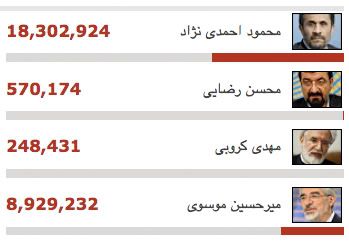
UPDATE
Based on the counting of nearly 31 million votes, the results are 19,761,433 votes for Ahmadinejad, 9,841,056 votes for Mousavi, 633,048 votes for Mohsen Rezaei, and 270,885 votes for Mehdi Karrubi.
Official Results as Reported by BBC Persian
Wednesday, June 10, 2009
Statement by a Group of Iranian Anti-war Activists about Iran's Presidential Elections
Statement by a Group of Iranian Anti-war Activists about Iran's Presidential Elections
Monday 8 June 2009
We are a group of Iranian academic and antiwar activists in Europe and the United States who, in the past few years, have consistently defended Iran's national interests in all areas including its right to develop peaceful nuclear technology. Our varied activities in the face of anti-Iran propaganda by the neoconservatives in the West have included organizing press conferences, taking part in radio and TV debates, creating antiwar websites, publishing bulletins and newsletters, writing opinion pieces and letters to editors, attending national and international antiwar conferences and petitioning and lobbying Western politicians and parliamentarians.
We have campaigned against the policies of the United States and its Western allies which have unjustifiably targeted Iran -- including sending Iran's nuclear dossier to the United Nations Security Council, issuing UNSC resolutions against Iran, secret and public efforts to provoke strife in Iran and destabilize the country, and threats by the United States and Israel for military intervention and bombing of Iran's nuclear facilities. As we approach Iran's presidential elections, we are duty bound to share the lessons of our antiwar activities and highlight what national policies can defend Iran's interests effectively in the international arena without isolating it or enduring U.N. sanctions.
In order to safeguard Iran's national rights successfully, we think Iran's president elect must give priority to the following policies in his programs and plans:
(1) Questioning the Holocaust, which has greatly aided the hawks in the West, must be discarded and replaced with a constructive foreign policy devoid of any provocative rhetoric.
(2) Release of all political prisoners, freedom of press, organization and political parties, as well as peaceful meetings and gatherings. Recognizing the right of all citizens to run for election without any political vetting.
(3) Abolishing medieval punishments, such as stoning and cutting limbs, public executions and execution of minors.
(4) Recognizing full and unconditional equality in all areas for women and ethnic minorities. Recognizing the full citizenship and civic rights of official and unofficial religious minorities.
Disregarding these tasks will seriously hinder the social and political development of the country, and will divide the Iranian people in their resistance against the unwarranted neo-colonial pressure and double standards of the Western powers. It will also provide powerful propaganda tools to hawks and their allies in mainstream media for isolating Iran and denying its fundamental rights in international organizations.
Taking steps to carry out these measures, on the other hand, will put our country on a fast track to progress, will unite Iranians of all walks of life, and disarm the neoconservatives in their aggressive propaganda against Iran.
Signed
Professor Ervand Abrahamian, City University of New York
Dr Arshin Adib-Moghaddam, School of Oriental and African Studies
Professor Haleh Afshar, University of York
Professor Mohammad Ala, Persian Gulf Task Force
Professor Hamid Dabashi, Columbia University
Professor Abbas Edalat, Imperial College London
Ali Fathollah-Nejad, University of Muenster and School of Oriental and African Studies
Dr Mehri Honarbin, Canterbury Christ Church University
Dr Farhang Jahanpour, University of Oxford
Mohammad Kamaali, Campaign Against Sanctions and Military Intervention in Iran
Professor Mahmoud Karimi-Hakkak, Siena College, New York
Professor Fatemeh Keshavarz, Washington University in St. Louis.
Dr Ziba Mir-Hosseini, School of Oriental and African Studies
Professor Pirouz Mojtahedzadeh, Tarbiyat Modarres University
Professor Davood Nabi-Rahni, Pace University in New York
Professor Azam Niroomand-Rad, Georgetown University
Dr Ali Rastbeen, International Institute of Strategic Studies Paris
Dr Elaheh Rostami, School of Oriental and African Studies
Professor Nader Sadeghi, George Washington University Hospital
Shirin Saeidi, University of Cambridge
Professor Muhammad Sahimi, University of Southern California
Leila Zand, Fellowship of Reconciliation
Download the statement in PDF:
English, <mrzine.monthlyreview.org/iran-election-statement-en.pdf>;
Persian, <mrzine.monthlyreview.org/iran-election-statement-fa.pdf>.
Thursday, May 28, 2009
Interview with Farian Sabahi
Interview with Farian Sabahi
by LibrInTerra
Here we publish an interview with Farian Sabahi, an Italian-Iranian professor at Sapienza University of Rome and the University of Turin. A professional journalist, Sabahi has been writing for Corriere della Sera for several months. She was a guest of LibrInTerra on the 26th of March, presenting her two books Storia dell'Iran [A History of Iran] and Un'estate a Teheran [A Summer in Tehran] and showing her two documentary films "Out of Place" and "Che ne facciamo di Teheran?" [What Should We Do with Tehran?]. These days, Iran is again under the spotlight, especially due to its difficult relation with Israel, so this interview should be of greater interest to the public, given its timeliness.
Q: In recent months, Iran has been harshly criticized and continually commented on by the media, especially with regard to its nuclear program and difficult relation with the United States. Does Iran need to produce energy through nuclear power or is the fear about its nuclear program justified?
A: The biggest problem is the lack of trust in Iran on the part of the international community. That said, Iran's electricity demand amounts to 40,000 megawatts, so it would need forty nuclear power plants like Bushehr.
Q: To what extent can Obama's video message create a new channel of dialogue with Iran, especially in view of the upcoming elections, which will take place on the 12th of June? What will happen, politically, in Iran?
A: It's difficult to make a prediction ahead of the presidential elections on 12 June, especially since the predictions of analysts have regularly turned out to be mistaken. But I wouldn't directly link the Obama video to the elections because foreign policy is, like the nuclear program, the exclusive prerogative of the Supreme Leader, Ali Khamenei, not of the President of the Islamic Republic.
Q: The difficult relation between Iran and Israel is dealt with in your report "Che ne facciamo di Teheran?" But the Jewish presence in Iran is proportionally the largest in the Middle East outside Israel. What is the real relationship between the Jewish minority and the other Iranians?
A: The Jews living in Iran numbered 80,000 at the time of the creation of Israel in 1948, and now the number is estimated to be 25,000. They have a deputy in the parliament, and they are a recognized minority who have their own schools, hospitals, and nursing homes. There are families who have for generations -- we might say for millennia -- been living in Iran. Iranian Jews are considered to be Iranians first and of the Jewish faith second. And as Iranians they enjoy civil, political, and religious rights and thus have their synagogues and cemeteries.
Q: In "Out of Place," you tell the story of an Iranian-Jewish woman living in Israel since 1987, who would like to return to her country. What, conversely, are the relations between the other Israelis and the Iranian minority in Israeli territory?
A: According to a study by the Center for Iranian Studies in Tel Aviv, the Iranian Jews living in Israel would number 250,000. Some hold positions of prestige, even in politics and the armed forces, while others are simply merchants. Among them is Rachel, the protagonist of my short film "Out of Place," in which I deliberately left international politics in the background to foreground the issue of motherhood. And I believe that from the video it clearly comes across that Iran is, for Rachel, a metaphor for her own now faded youth. In any case on my Web site www.fariansabahi.com, you can find, in the "Journalism" section, my article "Essere e non essere israeliani" [To Be and Not To Be Israeli], published in Ventiquattro, the monthly supplement of Il Sole 24 Ore.
Q: You wrote that the color of Iran is black, the black color of women's chador. Iranian women play different roles in Iranian society, but since the elections of 2005 what has changed regarding the female part of society? Has the situation worsened in terms of personal freedom, for women?
A: Since the 2005 elections, a campaign against the bad-hejabi, the so-called "ill veiled," has been put into effect. But at the same time the One Million Signatures campaign was launched to repeal those rules within the legal system of the Islamic Republic that penalize women.
The original interview "Intervista a Farian Sabahi" was published by LibrInTerra on 21 April 2009. Translation by Yoshie Furuhashi.
by LibrInTerra
Here we publish an interview with Farian Sabahi, an Italian-Iranian professor at Sapienza University of Rome and the University of Turin. A professional journalist, Sabahi has been writing for Corriere della Sera for several months. She was a guest of LibrInTerra on the 26th of March, presenting her two books Storia dell'Iran [A History of Iran] and Un'estate a Teheran [A Summer in Tehran] and showing her two documentary films "Out of Place" and "Che ne facciamo di Teheran?" [What Should We Do with Tehran?]. These days, Iran is again under the spotlight, especially due to its difficult relation with Israel, so this interview should be of greater interest to the public, given its timeliness.
Q: In recent months, Iran has been harshly criticized and continually commented on by the media, especially with regard to its nuclear program and difficult relation with the United States. Does Iran need to produce energy through nuclear power or is the fear about its nuclear program justified?
A: The biggest problem is the lack of trust in Iran on the part of the international community. That said, Iran's electricity demand amounts to 40,000 megawatts, so it would need forty nuclear power plants like Bushehr.
Q: To what extent can Obama's video message create a new channel of dialogue with Iran, especially in view of the upcoming elections, which will take place on the 12th of June? What will happen, politically, in Iran?
A: It's difficult to make a prediction ahead of the presidential elections on 12 June, especially since the predictions of analysts have regularly turned out to be mistaken. But I wouldn't directly link the Obama video to the elections because foreign policy is, like the nuclear program, the exclusive prerogative of the Supreme Leader, Ali Khamenei, not of the President of the Islamic Republic.
Q: The difficult relation between Iran and Israel is dealt with in your report "Che ne facciamo di Teheran?" But the Jewish presence in Iran is proportionally the largest in the Middle East outside Israel. What is the real relationship between the Jewish minority and the other Iranians?
A: The Jews living in Iran numbered 80,000 at the time of the creation of Israel in 1948, and now the number is estimated to be 25,000. They have a deputy in the parliament, and they are a recognized minority who have their own schools, hospitals, and nursing homes. There are families who have for generations -- we might say for millennia -- been living in Iran. Iranian Jews are considered to be Iranians first and of the Jewish faith second. And as Iranians they enjoy civil, political, and religious rights and thus have their synagogues and cemeteries.
Click here to watch an excerpt from the film "Out of Place." |
A: According to a study by the Center for Iranian Studies in Tel Aviv, the Iranian Jews living in Israel would number 250,000. Some hold positions of prestige, even in politics and the armed forces, while others are simply merchants. Among them is Rachel, the protagonist of my short film "Out of Place," in which I deliberately left international politics in the background to foreground the issue of motherhood. And I believe that from the video it clearly comes across that Iran is, for Rachel, a metaphor for her own now faded youth. In any case on my Web site www.fariansabahi.com, you can find, in the "Journalism" section, my article "Essere e non essere israeliani" [To Be and Not To Be Israeli], published in Ventiquattro, the monthly supplement of Il Sole 24 Ore.
Q: You wrote that the color of Iran is black, the black color of women's chador. Iranian women play different roles in Iranian society, but since the elections of 2005 what has changed regarding the female part of society? Has the situation worsened in terms of personal freedom, for women?
A: Since the 2005 elections, a campaign against the bad-hejabi, the so-called "ill veiled," has been put into effect. But at the same time the One Million Signatures campaign was launched to repeal those rules within the legal system of the Islamic Republic that penalize women.
The original interview "Intervista a Farian Sabahi" was published by LibrInTerra on 21 April 2009. Translation by Yoshie Furuhashi.
Sunday, April 05, 2009
Why Neoliberalism Is Alive and Kicking
Neoliberalism is alive and kicking -- kicking the asses of American workers, hard. And it's no wonder. Read the "Kick Me" sign slapped on the backs of all US workers:
Leo Gerard, president of the United Steelworkers, said there were smarter things to do than demonstrating against layoffs -- for instance, pushing Congress and the states to make sure the stimulus plan creates the maximum number of jobs in the United States.
"I actually believe that Americans believe in their political system more than workers do in other parts of the world," Mr. Gerard said. He said large labor demonstrations are often warranted in Canada and European countries to pressure parliamentary leaders. Demonstrations are less needed in the United States, he said, because often all that is needed is some expert lobbying in Washington to line up the support of a half-dozen senators. (Steven Greenhouse, "In America, Labor Has an Unusually Long Fuse," New York Times, 5 April 2009)
Tuesday, March 31, 2009
Whose Crisis? Our Crisis!
The crisis in which we find ourselves is not a crisis of the capitalist class, much less a crisis of the capitalist mode of production. Nor is it even a crisis of neoliberalism. It's a crisis of the working class, plain and simple.
What's in store for us, especially in the United States (where the working class has virtually ceased industrial action), is "a dramatic pro-capital redistribution" of the sort seen in Japan after the collapse of its asset bubbles -- only much more brutal.
As Rahm Emanuel said, "You never want a serious crisis to go to waste," and, sure enough, the Barack H. Obama administration is doing all it can to make it easy for the capitalist class to make the best of the opportunities presented by this crisis and to further cut back the wages and benefits of workers in the primary labor market. Above all, the United States government is leading by example: Mary Williams Walsh and Jonathan Glater, "Contracts Now Seen as Being Rewritable" (New York Times, 30 March 2009). The attack on autoworkers sets the tone.
Monday, March 16, 2009
Ervand Abrahamian: Why the Islamic Republic Has Survived
This is the aspect of Iran that one does not learn from most corporate media or even left-wing media.
The real answer [to the question of why the Islamic Republic of Iran has survived] lies not in religion, but in economic and social populism. By the early 1970s, Iran had produced a generation of radical intelligentsia that was revolutionary not only in its politics -- wanting to replace the monarchy with a republic -- but in its economic and social outlook. It wanted to transform the class structure root and branch. The trailblazer was a young intellectual named Ali Shariati, who did not live to see the revolution but whose teachings fueled the revolutionary movement. Inspired by the Algerians, Che Guevara and Ho Chi Minh, Shariati spent his short life reinterpreting Shi'ism as a revolutionary ideology and synthesizing it with Marxism. He produced what can be termed a Shi'i version of Catholic liberation theology. His teachings struck a chord not just among college and high school students, but also among younger seminary students. These budding theologians could easily accept his teachings (except his occasional anti-clericalism). One theology student went so far as to describe Imam Husayn as an early Che Guevara and Karbala' as the Sierra Madre. Most of those who organized demonstrations and confrontations in the streets and bazaars during the turbulent months of 1978 were college and high school students inspired mainly by Shariati. His catch phrases -- which had more in common with Third World populism than with conventional Shi'ism -- found their way, sometimes via Khomeini, into slogans and banners displayed throughout the revolution. . . .In some respects, left-wing media have more trouble foregrounding the gains of the revolution than even corporate media due to their own perceived socialist propaganda needs. Leftists tend to think that the way to win over workers of Iran is to hammer on only or mainly human rights violations or remaining socio-economic problems, though there is no evidence that their approach is doing any good to their own political prospect (as it doesn't help leftists speak to the experience of working people), let alone the working people of Iran (as it doesn't help working people take an objective look at their own country in comparison to others outside the core of the capitalist system and think strategically about how to make more social change to their benefit). Instead, why not properly recognize the gains of the revolution as such (as Ervand Abrahamian does above) and seek to defend and develop the remaining gains, win back the ones that have been eroded or taken back by the ruling class, and make new gains?
This populism helps explain not only the success of the revolution but also the continued survival of the Islamic Republic. The Republic's constitution -- with 175 clauses -- transformed these general aspirations into specific inscribed promises. It pledged to eliminate poverty, illiteracy, slums and unemployment. It also vowed to provide the population with free education, accessible medical care, decent housing, pensions, disability pay and unemployment insurance. "The government," the constitution declared, "has a legal obligation to provide the aforementioned services to every individual in the country." In short, the Islamic Republic promised to create a full-fledged welfare state -- in its proper European, rather than derogatory American, sense.
In the three decades since the revolution, the Islamic Republic -- despite its poor image abroad -- has taken significant steps toward fulfilling these promises. It has done so by giving priority to social rather than military expenditures, and thus dramatically expanding the Ministries of Education, Health, Agriculture, Labor, Housing, Welfare and Social Security. The military consumed as much as 18 percent of the gross domestic product in the last years of the shah. Now it takes up as little as 4 percent. The Ministry of Industries has also grown in most part because in 1979-1980 the state took over numerous large factories whose owners had absconded abroad. The alternative would have been to close them down and create mass unemployment. Since most of these factories had functioned only because of subsidies from the old regime, the new regime had no choice but to continue subsidizing them.
In three decades the regime has come close to eliminating illiteracy among the post-revolutionary generations, reducing the overall rate from 53 percent to 15 percent. The rate among women has fallen from 65 percent to 20 percent. The state has increased the number of students enrolled in primary schools from 4,768,000 to 5,700,000, in secondary schools from 2.1 million to over 7.6 million, in technical schools from 201,000 to 509,000, and in universities from 154,000 to over 1.5 million. The percentage of women in university student populations has gone up from 30 percent to 62 percent. Thanks to medical clinics, life expectancy at birth has increased from 56 to 70, and infant mortality has decreased from 104 to 25 per 1,000. Also thanks to medical clinics, the birth rate has fallen from an all-time high of 3.2 to 2.1, and the fertility rate -- the average number of children born to a woman in her lifetime -- from 7 to 3. It is expected to fall further to 2 by 2012 -- in other words, Iran in the near future will achieve near zero population growth.
The Islamic Republic has bridged the chasm between urban and rural life in part by raising the prices of agricultural goods relative to other commodities and in part by introducing schools, medical clinics, roads, electricity and piped water into the countryside. For the first time ever, villagers can afford consumer goods, even motorbikes and pickup trucks. According to one economist who, on the whole, is critical of the regime, 80 percent of rural households own refrigerators, 77 percent televisions and 76 percent gas stoves. Some 220,000 peasant families, moreover, have received 850,000 hectares of land confiscated from the old elite. They, together with the some 660,000 families who had obtained land under the earlier White Revolution, form a substantial rural class that has benefited not only from these new social services but also from state-subsidized cooperatives and protective tariff walls. This class provides the regime with a rural social base.
The regime has also tackled problems of the urban poor. It has replaced slums with low-income housing, beautified the worst districts and extended electricity, water and sewage lines to working-class districts. As an American journalist highly critical of the regime's economic policies admits, "Iran has become a modern country with few visible signs of squalor." What is more, it has supplemented the income of the underclass -- both rural and urban -- by generously subsidizing bread, fuel, gas, heat, electricity, medicines and public transport. The regime may not have eradicated poverty nor appreciatively narrowed the gap between rich and poor but it has provided the underclass with a safety net. In the words of the same independent-minded economist, "Poverty has declined to an enviable level for middle-income developing countries."
In addition to substantially expanding the central ministries, the Islamic Republic has also set up numerous semi-independent institutions, such as the Mostazafin (Oppressed), Martyrs', Housing, Alavi and Imam Khomeini Relief Foundations. Headed by clerics or other persons appointed by and loyal to the Supreme Leader, these foundations together account for as much as 15 percent of the national economy and control budgets that total as much as half that of the central government. Much of their assets are businesses confiscated from the former elite. The largest of them, the Mostazafin Foundation, administers 140 factories, 120 mines, 470 agribusinesses, 100 construction companies and innumerable rural cooperatives. It also owns the country's two leading newspapers, Ettelaat and Keyhan. According to the Guardian, in 1993 the foundation employed 65,000 and had an annual budget of over $10 billion.5 Some of these foundations also lobby effectively to protect university quotas for war veterans and together they provide hundreds of thousands with wages and benefits, including pensions, housing and health insurance. In other words, they are small welfare states within the larger welfare state. (endnotes omitted, Ervand Abrahamian, "Why the Islamic Republic Has Survived," Middle East Report 250, Spring 2009)
Wednesday, March 11, 2009
Do Communists Have Better Sex?
In a word, yes, according to André Meier's 2006 documentary film comparing sex in East and West Germany. Just watch:
Now, that's an uplifting message as we face the prospect of the Greatest Depression!
But the film is only about heterosexuals. Among the 20th-century communists, only the Cubans have survived long enough to begin to get the question of sexual diversity right (after many trials and errors).
Saturday, March 07, 2009
Obama, Your Package Is Too Small
If you are a Keynesian, here's what you should put on your protest sign:
"Obama, Your Package Is Too Small."
"[T]he GDP gap will be as much as 12 percent of GDP, with no recovery in sight. This is shown in Figure One. This gap is compatible with unemployment rates near ten percent, indefinitely." -- James K. Galbraith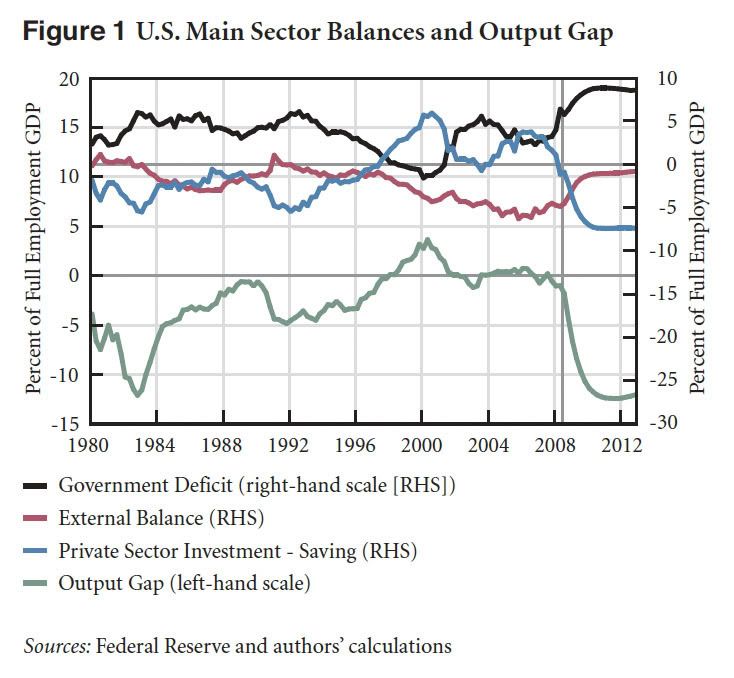
Sunday, February 15, 2009
Islamophobia, Anti-Semitism, and Zionism
One of the best illustrations of Empire, Inc.'s motto -- no permanent enemies, no permanent friends -- is its about-face on Afghanistan. Today's a good day to remember it:
Similarly, capitalism and imperialism has no structural need for either Zionism or anti-Semitism. They can rise or fall depending on the perceived self-interests of the power elite of Empire, Inc. Classic anti-Semitism is already a residual ideology, and so will Zionism be, as it has already lost its original raison d'être (the inability of Jews to obtain equal rights in the West), and as it begins to lose, slowly but surely, Western elite support, with Israel starting to get in the way of Empire, Inc.'s ability to rule the Arab masses through its Arab clients.
Twenty years ago today, the commander of the Soviet Limited Contingent in Afghanistan Boris Gromov crossed the Termez Bridge out of Afghanistan, thus marking the end of the Soviet war which lasted almost ten years and cost tens of thousands of Soviet and Afghan lives. . . . The documents suggest that the Soviet decision to withdraw occurred as early as 1985, but the process of implementing that decision was excruciatingly slow, in part because the Soviet-backed Afghan regime was never able to achieve the necessary domestic support and legitimacy -- a key problem even today for the current U.S. and NATO-supported government in Kabul. ("Afghanistan and the Soviet Withdrawal 1989: 20 Years Later," National Security Archive)Capitalism and imperialism has no structural necessity for Islamophobia. Islamophobia is ascendant today because Empire, Inc. is fighting wars against predominantly Muslim nations. When it was fighting against godless Communists, in contrast, it celebrated even the most reactionary Islamist extremists as "freedom fighters."
Similarly, capitalism and imperialism has no structural need for either Zionism or anti-Semitism. They can rise or fall depending on the perceived self-interests of the power elite of Empire, Inc. Classic anti-Semitism is already a residual ideology, and so will Zionism be, as it has already lost its original raison d'être (the inability of Jews to obtain equal rights in the West), and as it begins to lose, slowly but surely, Western elite support, with Israel starting to get in the way of Empire, Inc.'s ability to rule the Arab masses through its Arab clients.
Sunday, February 08, 2009
Dead Man Walking?
America does its imperialism as it does its capitalism: when a business fails, blame employees.
A White House favorite -- a celebrity in flowing cape and dark gray fez -- in each of the seven years that he has led this country since the fall of the Taliban, Mr. Karzai now finds himself not so favored at all. Not by Washington, and not by his own.Mr. Karzai may have sealed his fate by finally beginning to show signs of independent thinking last year and coming up with a sensible strategy to boot:
In the White House, President Obama said he regarded Mr. Karzai as unreliable and ineffective. Secretary of State Hillary Rodham Clinton said he presided over a "narco-state." The Americans making Afghan policy, worried that the war is being lost, are vowing to bypass Mr. Karzai and deal directly with the governors in the countryside.
. . . . . . . . . . . . . . . . . . . .
Meanwhile, the Obama administration will have to decide what it wants from Mr. Karzai as it tries to make good on its promise to reverse the course of the war. Or whether it wants him at all. (Dexter Filkins, "Afghan Leader Finds Himself Hero No More," New York Times, 8 February 2009)
At a news conference in Kabul, the Afghan capital, Mr. Karzai coupled his offer of safe passage to Mr. Omar with a warning to the Western nations that support his government, saying that if they opposed an assurance of safety for Mr. Omar they would have to remove Mr. Karzai as president or withdraw their troops from Afghanistan.
. . . . . . . . . . . . . . . . . . . .
Mr. Karzai has recently toughened his tone when speaking of the American-led coalition in ways that appear to have been aimed at gaining wider support at home. Among other things, he has demanded that the coalition make more measured use of air power to reduce civilian casualties from bomb and missile attacks. With his warning that he would guarantee Mr. Omar's safety, he appeared to have taken one step further in marking his distance from the coalition. (John F. Burns, "Karzai Offers Safe Passage to Taliban Leader If He Agrees to Talks" New York Times, 17 November 2008)
Thursday, January 22, 2009
Israel: A State of Irresponsibility
Look for "Gaza" and "collateral damage" in Google News now, and you'll get 640 results (as of 22 January 2009, 8:15 PM). Search for "Gaza" and "human shield," and you'll get 6,741 results. That does not bode well for Israel.
"Collateral damage" and "human shield" are, among other things, both terms employed by belligerents to excuse themselves of responsibility for civilian casualties they caused. But they are not the same excuse.
The idea of "collateral damage" says that we aimed to kill enemy combatants but have ended up accidentally killing hapless civilians, too, who happened to be in a wrong place at a wrong time. The deaths of civilians, for which no one can be held responsible, are to be regretted.
The idea of "human shield," on the other hand, says that it is enemy combatants who caused not only deaths of civilians on our side but those on their own side as well. In the case of Gaza, it goes like this:
Palestinian civilians killed by Israel = Hamas's responsibility.
In short, Israel is proclaiming to the world: it is irresponsible, less by accident ("We are not responsible for accidental collateral damage") than by nature ("Hamas made us do it, whatever it is. We are helpless. Israel is a victim of Hamas, and so are Palestinian civilians"), and all responsibility belongs to its enemy.
Israel says it wants the world, including Arabs, to recognize its right to exist -- in other words, it wants legitimacy in the eyes of the world and normal relations with other states, especially Arab states. Arabs, however, must wonder: Israel takes no responsibility for the choices it has made -- the choice to occupy other people's territories, the choice to keep building settlements on them, the choice to blockade and impoverish people, the choice to make war to begin with and the choice to bomb schools and other civilian infrastructure in the course of it. Should a state that claims only rights and no responsibility enjoy legitimacy in the eyes of the world? Should the state of irresponsibility be normalized?
And it is not just Arabs who wonder about such questions. In one European Commission survey, taken a little over a year after Israel's "Operation Defensive Shield," during which it reduced Jenin to rubble, nearly 60% of the respondents said: "Israel is the greatest threat to world peace." Imagine how many more will say so after Gaza.
"Collateral damage" and "human shield" are, among other things, both terms employed by belligerents to excuse themselves of responsibility for civilian casualties they caused. But they are not the same excuse.
The idea of "collateral damage" says that we aimed to kill enemy combatants but have ended up accidentally killing hapless civilians, too, who happened to be in a wrong place at a wrong time. The deaths of civilians, for which no one can be held responsible, are to be regretted.
The idea of "human shield," on the other hand, says that it is enemy combatants who caused not only deaths of civilians on our side but those on their own side as well. In the case of Gaza, it goes like this:
Hamas uses despicable tactics -- such as targeting Israeli civilians while using Palestinian civilians as human shields. As a result, the Israeli Defense Forces are forced to combat the terror infrastructure in the midst of the civilian Palestinian population. This leads to pain and suffering not only on the Israeli side, but also to innocent Palestinians, who are forced by means of violence and dictatorship to collaborate with Hamas and its commanders. (Histadrut -- General Federation of Labour in Israel)Israeli civilians killed by Hamas = Hamas's responsibility.
Palestinian civilians killed by Israel = Hamas's responsibility.
In short, Israel is proclaiming to the world: it is irresponsible, less by accident ("We are not responsible for accidental collateral damage") than by nature ("Hamas made us do it, whatever it is. We are helpless. Israel is a victim of Hamas, and so are Palestinian civilians"), and all responsibility belongs to its enemy.
Israel says it wants the world, including Arabs, to recognize its right to exist -- in other words, it wants legitimacy in the eyes of the world and normal relations with other states, especially Arab states. Arabs, however, must wonder: Israel takes no responsibility for the choices it has made -- the choice to occupy other people's territories, the choice to keep building settlements on them, the choice to blockade and impoverish people, the choice to make war to begin with and the choice to bomb schools and other civilian infrastructure in the course of it. Should a state that claims only rights and no responsibility enjoy legitimacy in the eyes of the world? Should the state of irresponsibility be normalized?
And it is not just Arabs who wonder about such questions. In one European Commission survey, taken a little over a year after Israel's "Operation Defensive Shield," during which it reduced Jenin to rubble, nearly 60% of the respondents said: "Israel is the greatest threat to world peace." Imagine how many more will say so after Gaza.
Saturday, December 20, 2008
A Bailout in Exchange for Wage and Benefit Reductions
A bailout in exchange for wage and benefit reductions, especially retirees' pensions and health care benefits -- that's the ruling-class program for auto workers . . . and all other workers, union or non-union, in the primary labor market in the United States.
Even while the ruling class deviates from the neoliberal orthodoxy in monetary and fiscal policies, lowering interest rates, monetizing debt, and creating temporary jobs and extending temporary benefits in an attempt to stimulate the economy, it continues to push to structurally transform labor in its neoliberal image (the strongest weapon of neoliberalism is its ability to pit the workers in the primary labor market -- the public sector and oligopolistic industries -- against workers who are excluded from it to begin with, weakening the former even while extending thin new benefits to the latter to maintain the neoliberal hegemonic bloc, at which Brazil's Lula and Turkey's AKP for instance are expert). That is what the ruling class did to workers in Japan, increasing poverty and aggravating inequality.
Needless to say, making labor more precarious is a recipe for prolonging rather than exiting deflationary stagnation, no matter how much fiscal and monetary stimuli the government applies at the same time. The crisis doesn't automatically bring an end to neoliberalism. It's up to the working class to end it, or else the economy won't even recover.
Right to Food, "180 in favour to 1 against (United States)"
Why did the USG vote against the right to food at the United Nations, braving the embarrassment of standing literally alone against women and children? "After the vote, the representative of the United States said he was unable to support the text because he believed the attainment of the right to adequate food was a goal that should be realized progressively" (emphasis added, Sixty-third General Assembly, Third Committee, "Approves 8 Resolutions for General Assembly Adoption; Right to Food, Mercenaries, Combating Religious Defamation Among Issues," 24 November 2008)
Friday, December 19, 2008
Statement by Iranian Bloggers on Hossein Derakhshan
Statement by Iranian Bloggers on Hossein Derakhshan
We, the undersigned, view the circumstances surrounding the Iranian authorities' arrest of Hossein Derakhshan aka Hoder, one of the most prominent Iranian bloggers, as extremely worrying. Derakhshan's disappearance, detention at an unknown location, lack of access to his family and attorneys, and the authorities' failure to provide clear information about his potential charges is a source of concern for us.
The Iranian blogging community is one of the largest and most vibrant in the world. From ordinary citizens to the President, a diverse and large number of Iranians are engaged in blogging. These bloggers encompass a wide spectrum of views and perspectives, and they play a vital role in open discussions of social, cultural and political affairs.
Unfortunately, in recent years, numerous websites and blogs have been routinely blocked by the authorities, and some bloggers have been harassed or detained. Derakhshan's detention is but the latest episode in this ongoing saga and is being viewed as an attempt to silence and intimidate the blogging community as a whole.
Derakhshan's own position regarding a number of prisoners of conscience in Iran has been a source of contention among the blogging community and has caused many to distance themselves from him. This, however, doesn't change the fact that the freedom of expression is sacred for all not just the ones with whom we agree.
We therefore categorically condemn the circumstances surrounding Derakhshan's arrest and detention and demand his immediate release.
Signed, in alphabetical order:
Arash Abadpour
Niki Akhavan
Hossein Bagher Zadeh
Sanam Dolatshahi
Mehdi Jami
Jahanshah Javid
Abdee Kalantari
Sheema Kalbasi
Nazli Kamvari
Nazy Kaviani
Peyvand Khorsandi
Nikahang Kowsar
Omid Memarian
Pedram Moallemian
Ali Moayedian
Ebrahim Nabavi
Masoome Naseri
Shahrnush Parsipur
Khodadad Rezakhani
Leva Zand
This statement first appeared in Pedram Moallemian's blog Eyeranian.net on 18 December 2008. The links to the text of the statement are added for informational purposes.
Tuesday, December 16, 2008
The Shoes Heard round the World
Some commentators say that a defiant use of shoes is an Arab thing, and others say that it's a Muslim thing, but the idea has an undeniable universal appeal, and it might ecumenically catch on across cultures and religions.
As the POTUS spoke nonsense into the void,
His final insult to Iraqis unfurled,
There the embattled journalist stood,
And fired the shoes heard round the world.
Muntadar al-Zeidi's shoes are the Lexington and Concord of creative anti-imperialist resistance in the age of YouTube.
As the POTUS spoke nonsense into the void,
His final insult to Iraqis unfurled,
There the embattled journalist stood,
And fired the shoes heard round the world.
Muntadar al-Zeidi's shoes are the Lexington and Concord of creative anti-imperialist resistance in the age of YouTube.

Sunday, December 07, 2008
Azar 16
"In fact, Azar 16 became a useful gauge for measuring the regime's unpopularity and, conversely, the opposition's strength among the young intelligentsia." -- Ervand Abrahamian, Iran between Two Revolutions
Subscribe to:
Posts (Atom)