Friday, May 06, 2011
What Youth Revolt?
The 2010-2011 Arab revolts were billed as youth revolts, a kind of belated sixties for the Arab world so to speak, but the new leaders that they are likely to bring into power -- including in Tunisia and Egypt, the most successful cases -- will be all older than Bashar al-Assad. Very ironic.

Sunday, May 01, 2011
How Secular Is Post-revolutionary Tunisia?
Not very, according to Graham Usher's dispatch: "The Reawakening of Nahda in Tunisia" (MERIP, 30 April 2011). A few days before the publication of this article, moreover, the Financial Times reported: "Politicians . . . agree that the Islamist party [Nahda] could well emerge as the single largest in the assembly. Secular parties, both liberal and leftist, are fragmented while traditional parties are just learning how to run for genuine elections." Tunisia is said to be among the most secular countries in North Africa and West Asia. But even here the balance of ideological and organizational forces does not appear to favor secular leftists after the revolution.
Thursday, April 28, 2011
"Overpaying the Poor"
I submit what the empire likes the least about the Islamic Republic of Iran is not its nuclear program but its being prone to "overpaying [sic] . . . the poorer members of Iranian society." Cf. Najmeh Bozorgmehr, "Iran's Handouts Prove Costly" (Financial Times, 28 April 2011):
Iran's populist government is backing away from a plan to phase out subsidies on energy and other basic commodities, analysts say. Instead, it is overpaying cash compensation to the poorer members of Iranian society to maintain political support.
Official estimates admit that for decades Iran spent $100bn a year on subsidising basic commodities -- although the support was widely viewed as unsustainable and distorting supply and demand signals.
In December last year, Mahmoud Ahmadi-Nejad, the president, embarked on a parliament-approved plan under which subsidies on energy products and foodstuffs were to be phased out gradually over a five-year period.
The plan was backed by all Iranian political groups as well as the International Monetary Fund and was viewed as a much-needed reform to the country's state-dominated economy.
However, economic analysts believe the government's populist approach has ended up inflicting a heavier burden on the economy and say that the government is moving away from the initial goal of making prices more realistic.
Under the plan, half of the government's savings from the cuts in subsidies were to be redistributed to those who registered to receive financial assistance, regardless of means. Now every man, woman and child can receive IR445,000 ($42.30) a month.
The remainder of the savings were to go to the industrial, agricultural and services sectors as well as state-owned organisations to help them cope with higher costs.
But analysts say the only section of the scheme which has been implemented is the cash payment to people.
Now, about 70m out of Iran's 75m-strong population is in receipt, which is generally considered to cost more than the old subsidies.
"People now receive cash two times more than their consumption which means our goal of managing consumption of energy products is not being achieved," Jamshid Ansari, a reform-minded parliamentarian, tells the Financial Times.
The cash payments have so far been benefiting up to 30m mainly rural poor.
They and their counterparts in the cities are even net winners because the per capita consumption of their populous families is low.
"The government is buying political support through an uneconomic and illogical way of extra subsidies payments despite the budget deficit this policy has been creating," says an analyst, who asked not to be named.
Akbar, a janitor in an affluent neighbourhood in northern Tehran, says he has not yet spent his family's payments which are almost equal to half of his monthly salary. "We have saved it so far," he says.
However, the middle class who are estimated to be also about 30m in number usually live in apartments equipped with gas and electricity for heating and cooling systems. They may own at least one car and do not have many children.
Officially, the price of gas has risen fivefold, electricity and water by three times, flour by 40 times and petrol between four and seven times.
Wednesday, April 27, 2011
Deterrence
Many critics of the Libya war, as was the case in the Iraq and Afghanistan wars, are seeking to explain the empire's motive by looking at what the target country has (especially natural resources), which the empire might want to have, and what the target country does, which the empire might want to stop.
In my view, rather than trying to explain each case of the empire's military invasions with ad-hoc explanations, it's better to emphasize as a given the fact that within the power elites of the Western powers, especially the United States, there is an influential bloc that is constantly advocating military "solutions" to states that those power elites regard as "problems." Let's call them "militarists."
The rest of the power elites, sometimes called "realists," also generally share the same goal -- regime change -- as militarists but they prefer "soft power" (support for in-country and in-exile "civil society" opposition + propaganda), economic sanctions, covert actions, military coups, proxy wars, etc. to the direct use of their own armed forces (mainly due to concerns about political and financial costs).
Sometimes the militarists get their way as in Iraq, Afghanistan, and Libya; other times they don't, as in Cuba, Iran, Syria, North Korea, etc. so far in recent decades. The difference is that the latter are tougher nuts to crack, for various reasons (such as the strength of the spirit of independences, the extent of political cohesion and the depth of ideological commitment, the number and power of international allies and supporters . . . and the demonstrated possession of nuclear weapons in the case of North Korea in particular). In other words, the question to be asked is which state in the South enjoys the power of deterrence and which doesn't.
Saturday, April 23, 2011
Pax Sinica for the Beijing Consensus
Theoretically, China can pursue global Keynesian policy in addition to domestic Keynesian policy, which would go some way toward countering austerity in the US and Europe and be good for China as well as the rest of the world. China says that "By the end of 2009, China had provided a total of 256.29 billion yuan in aid to foreign countries, including 106.2 billion yuan in grants, 76.54 billion yuan in interest-free loans and 73.55 billion yuan in concessional loans" (the figures are cumulative -- unfortunately no annual figure is given). For such a global Keynesian purpose, China should give away 5% of its GDP in grants.
Then, China would also have to learn to veto all Western wars, so that what it helps build won't get bombed. Pax Sinica based on the Beijing Consensus would be welcomed by the axis of resistance in the Middle East, North Africa, and Latin America; the rest of BRIC, Turkey, and South Africa; and anyone else who prefers peace for profit to war for power.
Tuesday, April 19, 2011
Intelligence Failure Due to Wishful Thinking
In an article posted on 19 April 2011, Simon Assaf of the SWP (UK) says that "accepting the deployment of Western ground forces remains a line that no [Libyan] rebels are yet prepared to cross." On Libya, this organization has so far distinguished itself among left-wing voices by being consistently at odds with the real world, due to a combination of intelligence failure and wishful thinking (the latter, imho, is the cause of the former). On the same day as Assaf's statement above, the Wall Street Journal reports: "Rebels in Misrata Call for Foreign Troops."
Sunday, April 10, 2011
Leftists for Chaos?
There is an opinion like this on the left side of the blogosphere:
If you want chaos, you can find it in Somalia, for instance, and increasingly in Libya as well, but Libya and Somalia (unlike Egypt and Tunisia), if anything, are in all likelihood disincentives, not incentives, for would-be left-wing revolutionaries elsewhere.
Arab regimes (and Iran) often warn against change and revolutions: they try to scare us by warning of the potential for chaos. I say: we should work for the overthrow of all those regimes (Arab regimes and Iran) because chaos is far superior to those regime. At least, under chaos there is a stronger chance for change and sabotage (sabotage of oppression and injustice and occupation and conspiracies).But I doubt that most leftists in the oppositions in Iran and the Arab world are looking for "chaos." In any case, they are too few in number and too unorganized to take advantage of it if that's the idea. Instead, such leftists as exist there are looking to establish better governments than they have and wish to lead organized mass action for that purpose, though in most cases they end up following rather than leading rebellious largely-non-left-wing crowds when such arise.
If you want chaos, you can find it in Somalia, for instance, and increasingly in Libya as well, but Libya and Somalia (unlike Egypt and Tunisia), if anything, are in all likelihood disincentives, not incentives, for would-be left-wing revolutionaries elsewhere.
Friday, March 25, 2011
Are the Libyan Rebels for Us or against Us?
Here's a comic footnote to the Libya war: Neither side of the Libyan conflict was actually looking for any real solidarity with leftists (least of all Marxists), but somehow one side (the regime) got a lot of gratuitous, undeserved Latin American leftist support and the other side (the rebels) got a lot of gratuitous, undeserved Western leftist as well as (both secular and religious) Arab and Iranian support.
As a matter of fact, both the regime and the rebels were looking for Western imperialist support, and they didn't hide it either. The Western imperialists -- unlike the world Left, the Arabs, and the Iranians, who all jumped into the Libyan fray without examining what they were jumping into -- first took a good, hard look at both sides and then decided to back the rebels.
The rebels got what they wanted, and that's that.
In recent days, though, I have noticed that the propaganda machine of the Islamic Republic of Iran began to change tack. Maybe the IRI establishment finally realized that the Libyan rebels aren't pro-Iranian -- in fact, the rebels are as likely to be against Shia Muslims as against Africans, Marxists, and so on. Hezbollah and Trotskyists, perhaps more selflessly idealistic than IRI officials, apparently have yet to ask a crucial question of international solidarity, which unlike charity is a two-way street: Are the rebels for us or against us?
Tuesday, March 15, 2011
Japan
I did what I could for my family and other people in Japan.
I managed to contact my brother on the 11th and persuaded my sister-in-law and nephew to leave for Kyushu (my brother, a Japanese Red Cross worker, refused to leave because he got "work to do"). I got through to my parents on the 12th and talked them into heading south, either to stay with my favorite aunt (my mother's sister) in Iwakuni, Yamaguchi, or to head further south. Those were the last phone calls, and since then I have not been able to get in touch with them. I hope by now they got where they needed to go, far away from Chiba (where they normally live, only about 150 miles from the Fukushima Nuclear Power Plants).
The clock is ticking, and there is little time left to do more.
Friday, February 11, 2011
Post-Vanguard
First Ben Ali, and now Mubarak. The empire has failed to stop the momentum of the Arab revolt that started in Sidi Bouzid. It is a time of great transition in West Asia and North Africa. What kind of transition will it be?
Samir Amin fears that, in the case of Egypt and perhaps elsewhere if not in Tunisia, it may result in the ascent of religious obscurantists into power, bringing about a new alliance of religious forces with the military establishment, a kind of Pakistanization so to speak. Aijaz Ahmad, on the other hand, hails the revolutionary wave as an upsurge of "secularity" as well as of democracy. Both appear to miss the most striking feature of what is going on: the absence of any vanguard ideology or vanguard party, religious or secular.
Some have named this absence "post-ideological," but that does not quite capture the fluidity of the moment. Ideologies are at work in the intifadas in the region today -- what is clear is that none is in hegemony. No single ideology is in the vanguard, nor is any political party seeking to be the vanguard party of the kind that led 20th-century revolutions. Competing political currents all appear to sense that people are not looking for a charismatic leader, a new Lenin or a new Khomeini. There is a refreshing absence of the quintessential iconography of past revolutions: larger-than-life images of the leader of the revolution.
The question is if the leaderless revolts, without any vanguard party or ideology, can fully dismantle the ancien regimes, which are decapitated but are otherwise more or less intact, establish new ones, and defend and develop them.
Monday, January 17, 2011
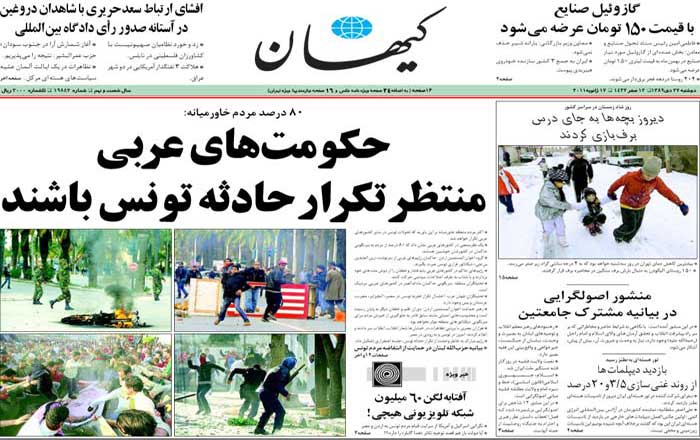
The Tunisian Revolution: Views from Iran
The biggest front page story of Kayhan on Monday, 17 January 2011 is headlined thus: "80% of People in the Middle East: Repeat of Tunisia Phenomenon in Store for Arab Governments."
Raja News,1 for its part, notes five similarities between the deposed Shah of Iran and the deposed Tunisian president: promoting secularism with an iron hand; supporting and being supported by the West; looting national wealth during escape; attempting to impose lifelong rule; and getting driven out from home and getting discarded by the West.
A note of general satisfaction, in short, is unmistakable among the oficialistas in Iran. The revolution in Tunisia, in their eyes, confirms their strategic assessment that "a major shift in the regional balance of power" underway favors the axis of resistance:
1 Raja News, by the way, is giving big play to the news of exiled Renaissance Party leader Rashid Ghannoushi's return to Tunisia. Its editor has apparently failed to canvass informed Arab sources such as this: "Aljazeera has [to] stop promoting Rashid Ghannushi and stop announcing his travel to Tunisia as if his impending arrival is analogous to that of Khumayni's return to Iran. No one cares about Ghannushi, from what I have seen, although I won't rule out the likelihood of the emergence of an Islamist current later on."
2 Rising youth unemployment, plus relative deprivation felt by educated youth, resulting from a combination of a youth bulge due to demographic transition, economic liberalization making decent jobs in the public sector scarcer, and slower growth of the world capitalist economy after the end of the post-WW2 boom, is a common story in the Middle East. What is peculiar to the Iranian case is both the rise and the fall of the youth bulge are sharper than in any other country: "As noted above, the current group of Iranian youth is the largest in the country's history. In 2005, the age group 20-24 was 62 percent larger than it was 10 years earlier, 9.1 million compared to 5.6 million, pushing the ratio of youth, which we define as ages 15-29, to total population to 35 percent, the highest recorded ratio in any country. Figure 1 shows that Syria has the second highest youth ratio (32 percent) while Turkey's is considerably lower, about 27 percent, having passed its peak of near 30 percent in the 1990s. By 2020, youth ratio will decline considerably, to less than 25 percent, the level observed in advanced countries. This is because the youth population is predicted to fall in absolute terms; for example, the 20-24 age group is expected to shrink by 75 percent in 2015, to 5.2 million. The reason for Iran's high youth ratio and its fluctuations is a baby boom in the early 1980s, when the revolutionary government was pro-natal, followed by a sharp decline in fertility in the 1990s, when it reversed this policy" (footnotes omitted, Djavad Salehi-Isfahani, "Iranian Youth in Times of Economic Crisis," September 2010).
3 E.g., "Iran has witnessed several spirited labor actions in recent years, well-known examples being the wildcat strikes of Tehran bus drivers and schoolteachers. But these actions have not crystallized into what can be called a coordinated, militant labor movement. Furthermore, militancy has not yet appeared in the most sensitive sectors of the economy, oil and transportation of freight. . . . These trends of diffusion of protest and relatively small-bore economic demands have held during the Ahmadinejad presidency. . . . [T]he core of the Green Movement leadership is devoted to an Iranian version of trickle-down economics, according to which the masses will eventually enjoy the good life but only if the elites prosper first and furiously. The Green Movement has offered little in terms of a redistributive vision that could motivate the working class to flex its muscles" (Mohammad Maljoo, "The Green Movement Awaits an Invisible Hand," Middle East Report, 26 June 2010).
4 Two contrasting views of the subsidy reform: Djavad Salehi-Isfahani, "Iran: Goodbye to Energy Subsidies, Hello to Price Controls?" (Tyranny of Numbers, 19 December 2010); Kevan Harris, "Iran's Subsidy Reductions: Upon Whom Will the Costs Fall?" (MRZine, 27 December 2010). It would be instructive to comparatively study Iran's subsidy reform juxtaposed with the aborted energy price reform in Bolivia and the ongoing economic reform in Cuba.
Raja News,1 for its part, notes five similarities between the deposed Shah of Iran and the deposed Tunisian president: promoting secularism with an iron hand; supporting and being supported by the West; looting national wealth during escape; attempting to impose lifelong rule; and getting driven out from home and getting discarded by the West.
A note of general satisfaction, in short, is unmistakable among the oficialistas in Iran. The revolution in Tunisia, in their eyes, confirms their strategic assessment that "a major shift in the regional balance of power" underway favors the axis of resistance:
In Tehran, there is a strong belief that the region is changing dramatically in favor of Hezbollah, the Palestinians, and the Resistance. The rise of an independent Turkey, whose government has a worldview very different from that of the U.S., German, British, and French governments, along with the relative decline of Saudi and Egyptian regional influence, signals a major shift in the regional balance of power. Saudi military incompetence during the fighting with Yemeni tribes along the border between the two countries, the general decline of the Egyptian regime in all respects, and the almost universal contempt among Arabs as a whole for the leaders of these two countries and other pro-western Arab regimes and their corrupt elites, are seen as signs that the center cannot hold. The fact that the Iranian president and the Turkish prime minister are so popular in Arab countries, while most Arab leaders are deeply unpopular, is a sign that the region is changing.Meanwhile, the Web site of the embattled Green Path Movement features Nader Marzban's opinion reflecting on "Iran and Tunisia: Superficial Similarities and Substantial Differences between the Two Movements." What is the main difference? Marzban highlights the difference between the Iranian movement's reform strategy and the Tunisian movement's revolutionary strategy. What is more important, however, is that in Tunisia the movement first began with, and has organically grown from, a protest against unemployment,2 a class battle, an aspect notable for its absence at the height of the Green Path Movement.3 As the tenth government of the Islamic Republic implements controversial subsidy reform4 in Iran, both defenders and opponents of the nezam of Iran today will have opportunities to revisit similarities and differences between Iran and Tunisia.
1 Raja News, by the way, is giving big play to the news of exiled Renaissance Party leader Rashid Ghannoushi's return to Tunisia. Its editor has apparently failed to canvass informed Arab sources such as this: "Aljazeera has [to] stop promoting Rashid Ghannushi and stop announcing his travel to Tunisia as if his impending arrival is analogous to that of Khumayni's return to Iran. No one cares about Ghannushi, from what I have seen, although I won't rule out the likelihood of the emergence of an Islamist current later on."
2 Rising youth unemployment, plus relative deprivation felt by educated youth, resulting from a combination of a youth bulge due to demographic transition, economic liberalization making decent jobs in the public sector scarcer, and slower growth of the world capitalist economy after the end of the post-WW2 boom, is a common story in the Middle East. What is peculiar to the Iranian case is both the rise and the fall of the youth bulge are sharper than in any other country: "As noted above, the current group of Iranian youth is the largest in the country's history. In 2005, the age group 20-24 was 62 percent larger than it was 10 years earlier, 9.1 million compared to 5.6 million, pushing the ratio of youth, which we define as ages 15-29, to total population to 35 percent, the highest recorded ratio in any country. Figure 1 shows that Syria has the second highest youth ratio (32 percent) while Turkey's is considerably lower, about 27 percent, having passed its peak of near 30 percent in the 1990s. By 2020, youth ratio will decline considerably, to less than 25 percent, the level observed in advanced countries. This is because the youth population is predicted to fall in absolute terms; for example, the 20-24 age group is expected to shrink by 75 percent in 2015, to 5.2 million. The reason for Iran's high youth ratio and its fluctuations is a baby boom in the early 1980s, when the revolutionary government was pro-natal, followed by a sharp decline in fertility in the 1990s, when it reversed this policy" (footnotes omitted, Djavad Salehi-Isfahani, "Iranian Youth in Times of Economic Crisis," September 2010).
3 E.g., "Iran has witnessed several spirited labor actions in recent years, well-known examples being the wildcat strikes of Tehran bus drivers and schoolteachers. But these actions have not crystallized into what can be called a coordinated, militant labor movement. Furthermore, militancy has not yet appeared in the most sensitive sectors of the economy, oil and transportation of freight. . . . These trends of diffusion of protest and relatively small-bore economic demands have held during the Ahmadinejad presidency. . . . [T]he core of the Green Movement leadership is devoted to an Iranian version of trickle-down economics, according to which the masses will eventually enjoy the good life but only if the elites prosper first and furiously. The Green Movement has offered little in terms of a redistributive vision that could motivate the working class to flex its muscles" (Mohammad Maljoo, "The Green Movement Awaits an Invisible Hand," Middle East Report, 26 June 2010).
4 Two contrasting views of the subsidy reform: Djavad Salehi-Isfahani, "Iran: Goodbye to Energy Subsidies, Hello to Price Controls?" (Tyranny of Numbers, 19 December 2010); Kevan Harris, "Iran's Subsidy Reductions: Upon Whom Will the Costs Fall?" (MRZine, 27 December 2010). It would be instructive to comparatively study Iran's subsidy reform juxtaposed with the aborted energy price reform in Bolivia and the ongoing economic reform in Cuba.
Wednesday, November 03, 2010
Dawn of the Dead Again in America
It's dawn of the dead again in America. It's not, however, because hard-pressed Americans en masse rejected "socialism," voting for austerity, against bread and peace, as the Right would have us believe. As is usually the case with mid-term elections, the turnout was low: just "42 percent of registered voters" voted. Which means this re-run of the dawn of the dead is brought to you by a minority, upper-class America mobilized by corporate America, voting against the working-class American majority, just as capitalist democracy American-style is designed to work.
Which Democrats ended up becoming zombie meals? Not the bread and peace wing of the Democratic Party: progressives in progressive districts by and large survived. Take Dennis Kucinich and Marcy Kaptur of Ohio: they even voted against the 2008 bank bailout and lived to tell about it. Who got eaten up by zombies, then? "23 of the 46 Blue Dogs up for re-election went down." In other words, the very people who fed working-class meat to living dead capitalists to reanimate them in the aftermath of the financial crisis. The lesson is clear: Don't feed the zombies -- they'll come back for more and bite your ass.
This, however, is not a moment for Marxists to indulge in schadenfreude. The rest of America has not even noticed the existence of American socialists, who have been saying: "Obama Ain't No Socialist -- We Are!" Hard as it may be to admit, we have failed to build an organized Left, under Bush or Obama, despite two shooting wars and now a nearly 10% unemployment rate.
And hard luck for the Left in hard times isn't a story of "Only in America." Whether we look at a country whose working class is powerful (France) or a country whose ruling class is weak (Greece), 20th-century socialism (Cuba) or 21st-century socialism (Venezuela), the crisis has made left-wing lives more difficult, not less.
How can American socialists help build an organized Left here, in the decades of slow growth and high unemployment ahead of us? Can we at least help squash the most voracious zombies who would like nothing better than making Americans work till death while killing Iranians to boost the economy?
Sunday, July 25, 2010
Monopoly Capital Blocks Rational Policy of Wage-led Growth
What lesson might the working classes of the global North take from what's happening in China? Canadian journalist Paul Jay spells it out in plain English.
To that Kaleckian lesson, however, we want to add a Gorzian one, especially in the United States: take productivity gains more in the form of gains in disposable time than in the form of more consumption. That's our socialist ticket out of crisis, economic and environmental.
Minimum transitional demands: retirement at 50 with full benefits; free education and social wages for students (all the way up to doctoral degrees for those who want them); paid parental leaves (six years for each new child); two months of paid vacations per year at minimum; indefinite unemployment benefits (to last till the ruling classes come up with worthy jobs at worthy wages for the unemployed).
The lesson given by Jay is a Kaleckian one, one of the most important lessons, especially today, as we struggle against the drive to austerity in the North. First of all, make clear what obstacle needs to be removed if the rational alternative is to be implemented.
Paul Jay: So we've been talking about macroeconomic policy, the G-20, austerity. And there was one little line in the G-20 document I thought was interesting, and it's sort of buried in amongst everything. It said countries could facilitate wages going up proportional to productivity, which is rather interesting, 'cause it's the only time I've ever heard it even mentioned by these guys. There's quite a big section about how wages need to go up in China. There they understand the need for increasing demand. And we've heard President Obama say, we can't be the consumer engine of the world anymore, you guys have to do it, looking at China. And they talk about increasing the social safety net in China. They even talk about allowing strike struggles in China so wages can go up, but they sure don't talk about it when it comes to their own places. . . . So the problem is -- and this is where it becomes a political problem. I mean, it's not that difficult to sit down and kind of envision a rational solution to all of this -- you just can't pass it anywhere. The way that the politics is controlled and the small gang of people that actually own the commanding heights of the economy, starting with the banks, they don't allow any of this to actually get passed, so you get to an impasse. You can talk rational visions, but you can't execute on it.
To that Kaleckian lesson, however, we want to add a Gorzian one, especially in the United States: take productivity gains more in the form of gains in disposable time than in the form of more consumption. That's our socialist ticket out of crisis, economic and environmental.
Minimum transitional demands: retirement at 50 with full benefits; free education and social wages for students (all the way up to doctoral degrees for those who want them); paid parental leaves (six years for each new child); two months of paid vacations per year at minimum; indefinite unemployment benefits (to last till the ruling classes come up with worthy jobs at worthy wages for the unemployed).
Monday, July 05, 2010
Separation of Religion and Science: US behind Iran
"Teach Evolution, Learn Science: We're ahead of Turkey, But behind Iran," according to Gerald Weissmann. Mollas are a dime a dozen in the world today, but Iran's mollas aren't just any mollas -- they are animal-cloning, robot-building, satellite-launching, stem-cell-researching, uranium-enriching mollas.
That is why there is no quick military solution for the empire comparable to Israel's attack on the Osirak reactor in Iraq and Israel's bombing of what is said to be a nuclear facility in Syria. Iran has succeeded in the tasks of both mass education and higher education, building a deeper and broader base of scientific and technological human capital than in any other country in the region except Israel. That means that Iran can rebuild what gets destroyed.
Given its rate of scientific production, as reported in NewScientist, Iran may eventually catch up with Israel, too:
Scientific output has grown 11 times faster in Iran than the world average, faster than any other country. A survey of the number of scientific publications listed in the Web of Science database shows that growth in the Middle East -- mostly in Turkey and Iran -- is nearly four times faster than the world average.Is that a "threat" to Israel or the United States? Not if these two countries aren't run by people who are given to seeing the world as if it were the stage for a zero-sum game of power struggle. The question is if they are.
Science-Metrix, a data-analysis company in Montreal, Canada, has published a detailed report (PDF) on "geopolitical shifts in knowledge creation" since 1980.
Tuesday, June 15, 2010
Two, Three, Many 1960s
Check out this beautiful article by an American woman: Chelsea Szendi Schieder, "Two, Three, Many 1960s" (MRZine, 15 June 2010). This is a very fair assessment, and moving commemoration, of the New Left in Japan and the global Sixties (maybe only a gaizin-san can be this fair to both the J New Left and the JCP -- the only thing missing in the article is a mention of Kanba Michiko's own writings, so I added links to those). This is 200% better than most of the articles about May 68 in France that came out in 2008. Anyhow, as you can see from the article, it's not easy establishing a republican state, is it, even -- or perhaps especially -- in the North? All sides of the Iranian nation and their leadership sometimes sound nutty, but, still and all, they are "people to be reckoned with," so very unlike the people running the show, and people who let them run it, in Japan, who are not even as interesting as the AKP!
Friday, April 23, 2010
Chickengate: The Left and Science and Technology
By now you've probably heard of the Chickengate in Bolivia.
There is a chance that the president of Bolivia was joking about hormones in chickens causing premature baldness, reproductive developmental disorders, and other disorders due to sex hormone imbalances. ABI reports that the president was speaking "at times in a joking tone" ("a momentos en tono de guasa").
But if it was a joke, it in any case completely overshadowed what little coverage of the Summit on Climate Change in Bolivia there was in the corporate media. Seeking to counter the media coup, a gay indigenous man on the Left bravely put out a video statement: "I am a proud indigenous man, and I am a proud gay man, and I'd like to thank President Evo Morales for his leadership . . . in behalf of all humanity . . . in behalf of protection of our Mother Earth."
Evo can't be a homophobe -- especially given the new Bolivian constitution promulgated by his government specifically prohibiting discrimination based on sexual orientation and gender identity for the first time in the history of Bolivia -- and the corporate media are wrong to try to pass him off as one.
However, the Chickengate in Bolivia does remind us that there is a tendency in considerable parts of the Left today to be too alarmist about science and technology, especially when it comes to food and energy. That basically leaves the people hanging in the scientific and political vacuum between the Apocalypticist Left and the Panglossian Right.
Thursday, April 22, 2010
Fiscal Crisis of States
In the wake of the financial crisis of 2008, what next? In the United States,1 a "fiscal crisis" of states and municipalities, both real (masses of public-sector workers are getting laid off even now2) and imagined (bogus public pension liabilities stats used in right-wing propaganda to attack unions3).
Money is out there, though, if only we had a powerful coalition to tax the rich!
There's a very good pro-labor, anti-racist, Green rationale to prioritize this fight above all, since one of the sectors under attack is urban mass transportation, whose workers are often unionized and, as in many other sectors of civil service, are often non-white. Needless to say, state and municipal public service is the most feminist thing in the United States, in terms of profiles of both workers and beneficiaries.
Leftists can't win everywhere pursuing this battle to tax the rich, but we can win here and there,4 which would help build more durable bases for future actions than anything else. There's nothing like victories to build a Left!
Taxing the rich is also better financial reform than any "oversight" of finance that the Democrats come up with at the federal level. The less money the rich have, the less money for their gambles. The financial reform PR message here is to tax the rich and spend their money here, so they won't spend it to bid up, say, real estate prices in China or something like that.
1 In the eurozone, the fiscal crisis expresses itself as the euro core of Germany versus the euro periphery of PIIGS. See Jayati Ghosh, Heiner Flassbeck, Joseph Halevi, Costas Lapavitsas, and Mark Weisbrot.
2 Dean Baker, "State and Local Governments Have Shed 72,000 Jobs since December," MRZine, 2 April 2010).
3 Nathan Newman, "No Crisis in Public Retirement Systems: Debunking the Hype and the Attacks on Employee Benefits" (MRZine, 17 April 2010).
4 Rick Wolff, "Oregon Counters Massachusetts" (MRZine, 27 January 2010).
Saturday, April 03, 2010
Taliban and the Rights of Women
The dispute between Gita Sahgal and the "Human Rights for All" campaign on one hand and Moazzam Begg and Amnesty International on the other hand is a red herring, which is the reason why it has been "taken up with relish by Britain's self-styled 'decent left' of journalists and commentators, whose superior moral compasses led them to support the invasion of Iraq." All parties directly involved in the dispute profess that they are in favor of women's rights, though they may differ here and there on what exactly the said rights consist of.
But the thing is that women's rights, or lack thereof, in Afghanistan cannot decide the most important questions that Westerners have to ask themselves: will the NATO quit Afghanistan, and, if yes, when?
Under NATO, women's rights will be protected only to the extent that they don't conflict with the military logics of the parties in combat. After NATO's withdrawal, women's rights will be protected only to the extent that the parties governing post-NATO Afghan territories respect them. That probably means that Afghan women will enjoy only such rights as granted by allies of Iran-Russia-India in one part of Afghanistan and Taliban-Pakistan in another part of Afghanistan -- for decades to come.
In either case, with or without NATO, it is not possible for Sahgals, Beggs, or human rights organizations of the West to make the level of women's rights higher than it is given the prevailing objective and subjective conditions of Afghan society. It would help speed up the NATO departure once Western activists admit their inability to make a difference for Afghan women for such a realistic admission would help the Western public concentrate on the only questions on which they have at least some say.
Saturday, March 27, 2010
Jacobinism with Islamic Characteristics
The best way to understand the Islamic Republic of Iran is to see it not as "theocracy" but as "Jacobinism with Islamic Characteristics."
The power elite of Iran don't care about Islam as such (Islam, after all, is diverse, and some varieties of it, as conceived by Nader Hashemi, Mohsen Kadivar, Ahmad Sadri, and the like, are perfectly compatible with liberal democracy). What they care about is their revolution and their republic and their ideology (in which Islam does play a part but an increasingly smaller one). As IRGC General Mohammad Ali Jafari reportedly said:
حفظ نظام جمهوری اسلامی ایران از ادای نماز واجبتر است
They love their politico-economic order much more than prayers.
Unlike the USSR and the Eastern Bloc, whose legitimating ideology came from outside (Western Europe) and was instilled from above (the Marxist-Leninist Party), though, their ideology is one that has organically grown out of Iranian history, which is what is going for them.
My back-of-the-napkin calculation, however, says that about 20% of the Iranian population, largely of economically upper strata, are liberals who are tired of this politico-economic order and its legitimating ideology. Give Iran a couple of decades in which its social dialectic can unfold without foreign intervention, and liberals are likely to grow more numerous in the country as it undergoes its capitalist development; and liberals inside Iran might eventually transform the country in a way that liberals outside it would like, through passive revolution (much as the AKP has done in Turkey, which too was once ruled by men of the Jacobin mentalité).
Meanwhile, the duty of Iranian patriots, even liberals in exile, is not to let imperialists bomb Iran.
Wednesday, March 24, 2010
Sex, Drugs, Islam, Communism, and Terrorism
How does the ruling class destroy liberty, often in the name of liberalism, today? By exploiting fear, especially specters of Sex, Drugs, Islam, Communism, and Terrorism. The ruling class defines each of these categories in such a way that each becomes a mixed bag of defensible and indefensible. To take just one example, in the category of terrorism, class justice and propaganda of the Western powers insidiously merges together national liberation movements such as the Popular Front for the Liberation of Palestine (defensible) and Al Qaeda (indefensible).
Subscribe to:
Posts (Atom)