The following is an extremely good and timely statement, signed by Iranian patriots, some of whom have taken one side or the other regarding the presidential election and post-election conflicts, and others of whom have taken a neutral stand on them. I encourage non-Iranian leftists to support this attempt and others like it.
Truth and Reconciliation for Iran
We are a group of university educators and antiwar activists with diverse political views who are based in Europe and North America. During the past few years we have been active in defending Iran's national rights -- particularly those relating to the peaceful use of nuclear energy -- against the pervasive deception created by western and Israeli-influenced media and official statements. We have consistently taken a stand against the policies of the United States and its allies, including the improper submission of Iran's nuclear file to the United Nations security council, the imposition of sanction resolutions against Iran, covert destabilisation inside the country and repeated threats of military intervention and bombing of nuclear centres on the part of US and Israel.
At the same time, we have advocated the human rights of individuals and democratic rights for various groups and constituencies in Iran. We have emphasised that the guarantee of such rights is necessary not only for Iran's social and political advancement, but also for the vital unity of our people against foreign pressures.
In the current post-election crisis, we see it as our duty to share our views based on years of defending Iran's national rights, and to help develop realistic solutions for the benefit of all our compatriots of whatever political persuasion.
The background to the current situation is the longstanding belligerent policies of the US and its allies, encouraged by the neoconservatives and the Israeli lobby, which peaked during eight years of Republican rule in the White House. Despite President Khatami's conciliatory approach, exemplified by his promotion of "Dialogue Among Civilisations", and despite Iran's co-operation in the overthrow of the Taliban in neighbouring Afghanistan, the administration of George W Bush labelled the Islamic Republic a member of the "axis of evil". Following the illegal invasion of Iraq, Bush pushed for regime change in Iran. These provocative and confrontational policies played a key role in the defeat of Iranian reformists in the parliamentary elections of 2003 and the presidential election of 2005.
During the past four years, a whole series of policies have targeted Iran's right to produce nuclear fuel for peaceful energy, including illegitimate UN/US sanctions, repeated implicit and overt threats of military attack by the United States and Israel, overt and covert well-funded US destabilisation operations, and aid to terrorist forces seeking to overthrow the government of Iran. These policies have created fears of an externally-instigated "velvet revolution" in the leadership ranks of the Islamic Republic. These fears were used to justify restrictions of civil and political freedoms promoted by the reformist administration of Khatami and, as a result, civil society and non-governmental organisations suffered a setback.
According to critics, these social and political pressures, along with government mismanagement caused by the removal of competent technocrats, have negatively impacted the public interest and put enormous pressure on the middle class, the educated class, journalists and artists. These people must be allowed a more open and free environment in order to fulfil their instrumental roles in service of the country.
On the external front, the Obama administration, facing neoconservative pressure and keeping many of his predecessor's policies against Iran, has nevertheless declared its readiness for unconditional negotiations with Iran. He has for the first time referred to Iran as the "Islamic Republic" and indicated that he is not pursuing regime change in Iran. Furthermore, shortly before the Iranian elections, in a first for an American president, Obama admitted the role of his country in the 1953 coup that overthrew the democratically elected prime minister Muhammad Mossadegh. These changes in US politics have created room for active and constructive diplomacy for the purpose of solving conflicts and disagreements between Iran and the United States, and for creating a nuclear-free Middle East.
This year, there was in Iran a record level of participation in the elections, unprecedented television debates and, most important of all, widespread participation in election campaigns. Despite some restrictions, the elections took place in an overall constructive climate, perhaps making Iran a model democracy among Islamic nations of the region. A day before the elections, Senator John Kerry, a key US statesman, was so impressed that he dismissed as "ridiculous" Bush's policy of denying Iran peaceful nuclear energy, which in itself exposes the baseless nuclear accusations levelled against Iran and proves the illegitimacy of security council resolutions against Iran.
However, in the view of a considerable number of Iranians who are discontented and frustrated with the restrictions on civil and political freedoms, there were various irregularities in the elections, including the suspension of reformist newspapers and mobile telephone SMS service on election day. This caused mass public demonstrations in support of nullifying the election. The unrest has created a major rift between the supporters of Ahmadinejad, who deem Iran's national sovereignty to be of the highest priority, and the supporters of the two reform candidates Karroubi and Mousavi, who demand increased civil and political freedoms above all.
Each of these two major wings of the body politic includes millions of people and both play a vital role in Iran's progress. The rift between these two must heal in an environment of calm, without agitation and mudslinging, for the sake of Iran's future. This healing must be pursued through the path of constructive dialogue and reconciliation, so that the unity of our people for safeguarding national rights can be achieved.
Unfortunately, a large number of our protesting fellow countrymen have been attacked and injured and even more regrettably, a significant number of them have been killed. Also, a large group of reformist activists and leaders have been arrested and imprisoned after the elections.
Both Mousavi and Karroubi have stressed that all protests must remain within the law. Following the request of the reformist and Green leaders, almost all protesters rallied completely peacefully, and in the tradition of Mahatma Gandhi, condemned all types of violence, calling the Basijis and Revolutionary Guards their own brothers. Extremist elements who used the opportunity to create chaos and engaged in the destruction of public property were condemned by Mousavi.
The western media, by their one-sided coverage of the post-election developments, portrayed the street demonstrations protesting the election results as the start of a "velvet" revolution against the Islamic Republic. Regime-change advocates also tried to piggy-back on the protests outside Iran for their own purposes. The British government, which claims to follow a policy of non-interference in Iran's internal affairs, did its part by confiscating nearly £1bn of Iranian assets. To make matters worse, the neoconservatives demanded a re-evaluation of the Obama administration's policy of unconditional negotiations with Iran. The US state department also used this crisis to justify its continuation of Bush-era policies of financing anti-Iranian government organisations for the purposes of "spreading democracy, human rights and a government of law and order". For "security reasons" they refused to release the identities of the recipients of the funds. The Iranian government, for their part, deported two British diplomats, accusing them of interference in Iranian affairs and pointing to western governments as the root of the post-election unrest.
Whatever the role of the western media, governments, and regime change forces, it cannot detract from the legitimacy of the massively popular protests. In fact, Mousavi has emphasised his complete loyalty to the Islamic Republic and admonished his supporters abroad to stay away from the anti-Islamic Republic groups. To attribute the roots of the demonstrations by hundreds of thousands of Iranians to external interference or to regime-change groups amounts to questioning the independence of the country which has been gained and consolidated by the sacrifices of hundreds of thousands.
In the opinion of millions of Iranians, the current crisis has been caused by restrictions on political freedoms, particularly freedom of the press, economic discontent, and deficiencies in transparency and accountability on the part of government institutions. Although these issues have been aggravated by the US political, military and economic encirclement and the CIA's destabilisation programmes, in the view of this segment of society the problems are ultimately rooted in the government's own policies. After their unprecedented participation in the elections, millions of Iranians have lost their confidence in the system. Awareness of this reality was expressed by the speaker of the Iranian parliament Ali Larijani, who indicated on live national television that some members of the Guardian Council openly supported a certain candidate, instead of being neutral during the investigation of the election complaints. He also added that the large segments of society who distrust the declared election results should not be regarded in the same manner as the rioters.
On the basis of the above assessment, and in the interest of resolving the present crisis, we direct all officials and fellow countrymen to the following proposals:
1) Arrests and assaults of reformist and Green movement activists and any use of deadly weapons against the protesters are against the national interest and must be stopped and condemned by the authorities. Of the government of the Islamic Republic, we demand, in accordance with the constitution and for the preservation of national unity, that it release the reformist leaders from detention and observe freedom of the press and other civil rights. Iranian state television and radio must provide time to the protesters to express their views. Permits for nonviolent assembly must be given to the protesters. The government must guarantee the safety of the demonstrators against any violence and those responsible for battering and murdering students and demonstrators must be identified and prosecuted.
2) The current division among the people that separates government supporters and dissenters, under conditions of economic, military and political encirclement, must be reconciled with calm and patient negotiations and reasoning, by condemning any kind of violence and by renouncing name-calling and inflammatory rhetoric. We call on the political forces of both sides to move toward building such a constructive climate and toward creation of an economic, political, and cultural agenda that can respond to all social needs.
3) Of the government of the Islamic Republic, we request that in view of the distrust on the part of a great segment of the country's population, it form an independent truth and national reconciliation commission with representation from all candidates, such that it can gain the trust of the people of Iran and find a reasonable solution for the conflict. The votes of a great portion of the Iranian society for both Ahmadinejad and Mousavi show that the best solution is negotiations for reconciliation and creation of a government of national unity from the ranks of Principalists and the Green movement and reformists. With a comprehensive programme based on Iran's national rights and on people's civil rights, such a government of national unity must address the current challenges facing the country and mobilise in an effective way the totality of human resources and expertise for national development.
4) Of western governments, we request that they cease any and all interference in Iranian affairs and end all their illegitimate economic, political and military pressures aimed at the internal destabilisation of Iran. They need to cease any support for the anti-Islamic Republic opposition and lift the economic and scientific sanctions. The Obama administration should emphasise unconditional negotiations and take steps toward creating a nuclear weapons-free Middle East. Only under these conditions, without any foreign threats, can the Iranian people reach their aspirations of freedom and establish their unity in a framework of independence and national sovereignty.
5) To the leaders of the reformists and the Green movement, we suggest that in order to prevent exploitation of the current crisis by western propaganda and opportunist groups, they unambiguously oppose all sanctions and condemn regime change operations and any foreign support for the anti-Islamic Republic opposition.
Signed:
Dr Arshin Adib-Moghaddam, SOAS, University of London
Professor the Baroness Afshar, York University
Mojtaba Aghamohammadi, researcher, University of Arizona
Professor Mohammad Ala, Persian Gulf Task Force
Esfandiar Bakhtiar, Georgia Institute of Technology
Professor Abbas Edalat, Imperial College London
Javad Fakharzadeh, Iran Heritage
Dr Farideh Farhi, University of Hawaii at Manoa
Massy Homayouni, independent antiwar activist
Dr Mehri Honarbin-Holliday, Canterbury Christ Church University
Mojgan Janani, independent antiwar activist
Mohammad Kamaali, Campaign Against Sanctions and Military Intervention in Iran
Fareed Marjaee, writer and democracy activist
Masoud Modarres, independent activist
Professor Pirouz Mojtahedzadeh, Tarbiyat Modarres University
Daniel Pourkesali, Campaign Against Sanctions and Military Intervention in Iran
Rostam Pourzal, Campaign Against Sanctions and Military Intervention in Iran
Dr Mohammad Purqurian, LaaL.org
Manijeh Saba, independent human rights activist
Professor Mehdi Shariati, Kansas College
Professor Nader Sadeghi, George Washington University Hospital
Shirin Saeidi, University of Cambridge
Soraya Sepahpour-Ulrich, independent antiwar activist
Reza Shirazi, Goftogoo TV
Safa Shoaee, Imperial College London
Saeed Soltanpour, Iranian TV Canada
Dr Alireza Rabi, Middle-East Citizens Assembly
Dr Elaheh Rostami, SOAS, University of London
Professor Rahmat Tavakol, Rutgers University
Professor Farzin Vahdat, Harvard University
Leila Zand, Fellowship of Reconciliation
Showing posts with label Media. Show all posts
Showing posts with label Media. Show all posts
Saturday, August 01, 2009

Wednesday, July 29, 2009
It Could Happen Here
Normally, the Western mass media love the stories of any old conflicts -- from electoral disputes to ethnic conflicts to even workers' uprisings -- in Southern nations of interest to the West, but they don't appear to find this story so amusing, as is suggested by the terseness of the report.
The riot, at the Tonghua Iron and Steel Works in Jilin Province in northern China, broke out after a visiting steel executive from a related company threatened mass layoffs at the Tonghua steel mills as part of a major restructuring of the state-owned company, China Daily said.That is not surprising. Shortly before this incident in China, "Workers at collapsed French car parts maker New Fabris threatened on Sunday to blow up their factory if they did not receive payouts by July 31 from auto groups Renault and Peugeot to compensate for their lost jobs" ("French Workers Threaten to Blow Up Factory," Reuters, 12 July 2009). It could happen here.
The riot followed a pattern of massive demonstrations that have taken place in various parts of the country over the past few years, many involving citizens outraged over government corruption or threatened with layoffs or orders to relocate.
The China Daily report said Chen Guojun, the steel executive who was beaten to death, had threatened 3,000 Tonghua steelworkers with layoffs, which he had said could take place within three days. He also had signaled that larger jobs cuts were likely at the struggling steel mill.
The report said the rioters blocked the police, ambulances and government officials from reaching Mr. Chen before he died. (David Barboza, "China Steel Executive Killed as Workers and Police Clash," New York Times, 27 July 2009)
Monday, July 27, 2009
A Secret Conspiracy of International Leftists against Imperialism
Khanome Yoshie wrote this yesterday for your entertainment:
How Many Leftists Are "United for Iran"?
So, how many leftists are United for Iran? "8,000 people at the event in Paris, 4,000 in Stockholm, 3,000 in Amsterdam, more than 2,500 in Washington DC, 2,500 in New York, 2,000 in London. . . ," says United4Iran.org, the sponsor of the global day of action on 25 July 2009. The low numbers1 (in marked contrast to the high turnouts of protests against Israel's recent assault on Gaza) suggest that few non-Iranian leftists bothered to show up.
While a number of leftists have made impassioned pleas for solidarity with Iran's Green Movement, (throwing themselves into an obligatory intra-left battle royal that has, alas, eclipsed any battle against the illegitimate authority of unelected clerics in Iran), most leftists still appear to find it -- how shall we put it? -- on balance inadvisable to join such protests against the Iranian government as United4Iran's, devoid as they are of an anti-imperialist point of unity emphasizing "Hands Off Iran" as much as -- nay more than -- criticisms of the Iranian government.
It should be also noted that international leftists were evidently unmoved by an offer of free "Free Iran" t-shirts courtesy of American Apparel. We find that most meritorious. Let it never be said that international leftists fail to valiantly resist hipster capitalism.
For more information on the mixed bags of mixed nuts as well as unexpected beauties found on both sides of the current political divide in Iran, consult MRZine.org.
How Many Leftists Are "United for Iran"?
So, how many leftists are United for Iran? "8,000 people at the event in Paris, 4,000 in Stockholm, 3,000 in Amsterdam, more than 2,500 in Washington DC, 2,500 in New York, 2,000 in London. . . ," says United4Iran.org, the sponsor of the global day of action on 25 July 2009. The low numbers1 (in marked contrast to the high turnouts of protests against Israel's recent assault on Gaza) suggest that few non-Iranian leftists bothered to show up.
While a number of leftists have made impassioned pleas for solidarity with Iran's Green Movement, (throwing themselves into an obligatory intra-left battle royal that has, alas, eclipsed any battle against the illegitimate authority of unelected clerics in Iran), most leftists still appear to find it -- how shall we put it? -- on balance inadvisable to join such protests against the Iranian government as United4Iran's, devoid as they are of an anti-imperialist point of unity emphasizing "Hands Off Iran" as much as -- nay more than -- criticisms of the Iranian government.
It should be also noted that international leftists were evidently unmoved by an offer of free "Free Iran" t-shirts courtesy of American Apparel. We find that most meritorious. Let it never be said that international leftists fail to valiantly resist hipster capitalism.
By the way, it has also come to our attention that a notorious unrepentant Marxist and self-appointed scourge of "flunkies for Ahmadinejad" apparently refused to attend any of the United for Iran protests, curtly dismissing the whole Dutch-linked2 enterprise as "Darfur-like crapola."
Well, that certainly settles it for us: shocking as it may seem to some, there still is a secret conspiracy3 of international leftists against imperialism, whether they are for, against, or just plain indifferent to the President of Iran.4 We hope that this little known conspiracy proves a dangerous one that will grow ever larger, someday putting the fear of the Twelfth Imam into the international capitalists.
1 The turnouts were so underwhelming that the Associated Press felt obliged to mention protests of 20 Iranians each in Brazil and Pakistan to make it sound as if it wasn't the Western Thing that the global South just didn't understand: "In the Pakistani capital, Islamabad, some 20 Iranians -- among them refugees and students -- gathered outside the local press club to protest the Iranian crackdown, yelling 'Death to the dictator!' . . . About 20 gathered in a small square in Sao Paulo, Brazil, to take part in a 30-minute rally" (Jill Lawless, "Protesters Call for End to Iranian Rights Abuses," 25 July 2009).
2 The primary sponsor of the United for Iran protests, the International Campaign for Human Rights in Iran, is a project of the Dutch Foundation for Human Security in the Middle East. Note that "the Netherlands and the United States are the only countries in the world that openly budget funds to promote political changes" in Iran, e.g., the Hague contributing "630,000 euros" to Freedom House in 2003 for the purpose of establishing Gozaar, "a platform for Iranian opposition figures." That grant was "part of a larger Dutch project" aimed at "promoting media pluralism in Iran," for which "15 million euros" was budgeted thanks to a bill introduced by "Farah Karimi (Green) and Hans van Baalen (VVD) in the Lower House in 2004" (Thomas Erdbrink and Thalia Verkade, "Haagse subsidie tegen regime Iran," NRC Handelsblad, first published on 16 September 2006, updated on 22 August 2008, Trans. Yoshie Furuhashi). Ms. Karimi, a former member of the Iranian Mojahedin, just so happens to be a board member of the aforementioned Foundation for Human Security in the Middle East. For more information about the collaboration of Ms. Karimi with Mr. van Baalen of the People's Party for Freedom and Democracy (VVD), "the most vocal supporter of private enterprise in the Netherlands," see Harm Ede Botje and Joël Broekaert, "Nederlandse steun mediaprojecten in Iran gaat door" (Vrij Nederland, 7 July 2007); and "Iran boos over hulp Den Haag aan radio oppositie" (NRC Handelsblad, 25 June 2009).
3 Objecting to the notion of an international left-wing conspiracy, some cavilers may dare suggest: Aren't most leftists just really too lazy to get up and protest against anything? Isn't it actually the case that most of them are lacking in sympathy for and solidarity with the oppressed, such as Iranians and Darfurians? We dismiss such baseless accusations out of hand, which can only originate in the ill wishers on the Right plotting the destruction of the Left.
4 For reasons unknown to us, the international media, across the political spectrum, have found Dr. Mahmoud Ahmadinejad really irresistible, as demonstrated by the fact that he has never been out of the spotlight since his 2005 election, no matter how many disasters -- such as the ongoing global economic crisis -- that ought to steal at least a little bit of media attention away from him befall the international proletariat. We suggest that, in addition to many other much-debated factors such as social classes, perhaps might have also put his rival Mr. Mir-Hossein Mousavi, a man of considerable charms himself, at electoral disadvantage, though we are also aware of the noted Iranshenas and Mousavi supporter Dr. Hamid Dabashi's observations on Mr. "Mousavi's poorly run presidential campaign": "ill-advised, ill-prepared, sentimental, full of necessary colour symbolism but lacking substance, a clearly articulated platform, economic detail, political programming or an attempt to reach out to a wider spectrum of his constituency. His campaign was too elitist, tied in its visual paraphernalia to a northern Tehran sensibility and lacking appeal across an oil-based economy. . . . [During the presidential debates, he] rambled along, read from written statements in a barely audible voice, ran out of things to say before his time was over."
For more information on the mixed bags of mixed nuts as well as unexpected beauties found on both sides of the current political divide in Iran, consult MRZine.org.
Friday, July 24, 2009
25 July 2009
Two protests on 25 July 2009. One is a grassroots protest against the US-backed coup in Honduras, spearheaded by SOA Watch South Florida. The other is a slickly packaged campaign to "to demand respect for the human rights of the Iranian people and to demonstrate worldwide solidarity with the civil rights movement in Iran" (a topic pleasing to Western powers), spearheaded by the International Campaign for Human Rights in Iran, which is a project of the highly suspect Dutch Foundation for Human Security in the Middle East. You know which one gets more corporate media coverage.
Thursday, July 09, 2009
From Iran to China, Skipping Honduras
As far as the Western mass media are concerned, they went from Iran (electoral conflict in an oil-rich country) to China (ethnic conflict in an oil-rich region), skipping Honduras (a coup d'état in an oil-poor country dependent on foreign aid and remittances where the USG has a military base).
Friday, June 12, 2009
Ahmadinejad Won
Iran's election commission still hasn't counted all the votes (roughly 32 million votes in total), but, according to the official results based on about 28 million votes counted so far, Ahmadinejad (18,302,924 votes) defeated Mousavi (8,929,232 votes).
Most of the Western media were predicting a close race, and some were even suggesting that a landslide for Mousavi might be possible. But the actual results were presaged by those of the telephone survey of Iranian voters conducted by Terror Free Tomorrow: The Center for Public Opinion, the New America Foundation, and KA Europe SPRL about a month before election day.
UPDATE
Based on the counting of nearly 31 million votes, the results are 19,761,433 votes for Ahmadinejad, 9,841,056 votes for Mousavi, 633,048 votes for Mohsen Rezaei, and 270,885 votes for Mehdi Karrubi.
Most of the Western media were predicting a close race, and some were even suggesting that a landslide for Mousavi might be possible. But the actual results were presaged by those of the telephone survey of Iranian voters conducted by Terror Free Tomorrow: The Center for Public Opinion, the New America Foundation, and KA Europe SPRL about a month before election day.
TFT/NAF/KA Survey
Official Results as Reported by BBC Persian


UPDATE
Based on the counting of nearly 31 million votes, the results are 19,761,433 votes for Ahmadinejad, 9,841,056 votes for Mousavi, 633,048 votes for Mohsen Rezaei, and 270,885 votes for Mehdi Karrubi.
Official Results as Reported by BBC Persian

Thursday, May 28, 2009
Interview with Farian Sabahi
Interview with Farian Sabahi
by LibrInTerra
Here we publish an interview with Farian Sabahi, an Italian-Iranian professor at Sapienza University of Rome and the University of Turin. A professional journalist, Sabahi has been writing for Corriere della Sera for several months. She was a guest of LibrInTerra on the 26th of March, presenting her two books Storia dell'Iran [A History of Iran] and Un'estate a Teheran [A Summer in Tehran] and showing her two documentary films "Out of Place" and "Che ne facciamo di Teheran?" [What Should We Do with Tehran?]. These days, Iran is again under the spotlight, especially due to its difficult relation with Israel, so this interview should be of greater interest to the public, given its timeliness.
Q: In recent months, Iran has been harshly criticized and continually commented on by the media, especially with regard to its nuclear program and difficult relation with the United States. Does Iran need to produce energy through nuclear power or is the fear about its nuclear program justified?
A: The biggest problem is the lack of trust in Iran on the part of the international community. That said, Iran's electricity demand amounts to 40,000 megawatts, so it would need forty nuclear power plants like Bushehr.
Q: To what extent can Obama's video message create a new channel of dialogue with Iran, especially in view of the upcoming elections, which will take place on the 12th of June? What will happen, politically, in Iran?
A: It's difficult to make a prediction ahead of the presidential elections on 12 June, especially since the predictions of analysts have regularly turned out to be mistaken. But I wouldn't directly link the Obama video to the elections because foreign policy is, like the nuclear program, the exclusive prerogative of the Supreme Leader, Ali Khamenei, not of the President of the Islamic Republic.
Q: The difficult relation between Iran and Israel is dealt with in your report "Che ne facciamo di Teheran?" But the Jewish presence in Iran is proportionally the largest in the Middle East outside Israel. What is the real relationship between the Jewish minority and the other Iranians?
A: The Jews living in Iran numbered 80,000 at the time of the creation of Israel in 1948, and now the number is estimated to be 25,000. They have a deputy in the parliament, and they are a recognized minority who have their own schools, hospitals, and nursing homes. There are families who have for generations -- we might say for millennia -- been living in Iran. Iranian Jews are considered to be Iranians first and of the Jewish faith second. And as Iranians they enjoy civil, political, and religious rights and thus have their synagogues and cemeteries.
Q: In "Out of Place," you tell the story of an Iranian-Jewish woman living in Israel since 1987, who would like to return to her country. What, conversely, are the relations between the other Israelis and the Iranian minority in Israeli territory?
A: According to a study by the Center for Iranian Studies in Tel Aviv, the Iranian Jews living in Israel would number 250,000. Some hold positions of prestige, even in politics and the armed forces, while others are simply merchants. Among them is Rachel, the protagonist of my short film "Out of Place," in which I deliberately left international politics in the background to foreground the issue of motherhood. And I believe that from the video it clearly comes across that Iran is, for Rachel, a metaphor for her own now faded youth. In any case on my Web site www.fariansabahi.com, you can find, in the "Journalism" section, my article "Essere e non essere israeliani" [To Be and Not To Be Israeli], published in Ventiquattro, the monthly supplement of Il Sole 24 Ore.
Q: You wrote that the color of Iran is black, the black color of women's chador. Iranian women play different roles in Iranian society, but since the elections of 2005 what has changed regarding the female part of society? Has the situation worsened in terms of personal freedom, for women?
A: Since the 2005 elections, a campaign against the bad-hejabi, the so-called "ill veiled," has been put into effect. But at the same time the One Million Signatures campaign was launched to repeal those rules within the legal system of the Islamic Republic that penalize women.
The original interview "Intervista a Farian Sabahi" was published by LibrInTerra on 21 April 2009. Translation by Yoshie Furuhashi.
by LibrInTerra
Here we publish an interview with Farian Sabahi, an Italian-Iranian professor at Sapienza University of Rome and the University of Turin. A professional journalist, Sabahi has been writing for Corriere della Sera for several months. She was a guest of LibrInTerra on the 26th of March, presenting her two books Storia dell'Iran [A History of Iran] and Un'estate a Teheran [A Summer in Tehran] and showing her two documentary films "Out of Place" and "Che ne facciamo di Teheran?" [What Should We Do with Tehran?]. These days, Iran is again under the spotlight, especially due to its difficult relation with Israel, so this interview should be of greater interest to the public, given its timeliness.
Q: In recent months, Iran has been harshly criticized and continually commented on by the media, especially with regard to its nuclear program and difficult relation with the United States. Does Iran need to produce energy through nuclear power or is the fear about its nuclear program justified?
A: The biggest problem is the lack of trust in Iran on the part of the international community. That said, Iran's electricity demand amounts to 40,000 megawatts, so it would need forty nuclear power plants like Bushehr.
Q: To what extent can Obama's video message create a new channel of dialogue with Iran, especially in view of the upcoming elections, which will take place on the 12th of June? What will happen, politically, in Iran?
A: It's difficult to make a prediction ahead of the presidential elections on 12 June, especially since the predictions of analysts have regularly turned out to be mistaken. But I wouldn't directly link the Obama video to the elections because foreign policy is, like the nuclear program, the exclusive prerogative of the Supreme Leader, Ali Khamenei, not of the President of the Islamic Republic.
Q: The difficult relation between Iran and Israel is dealt with in your report "Che ne facciamo di Teheran?" But the Jewish presence in Iran is proportionally the largest in the Middle East outside Israel. What is the real relationship between the Jewish minority and the other Iranians?
A: The Jews living in Iran numbered 80,000 at the time of the creation of Israel in 1948, and now the number is estimated to be 25,000. They have a deputy in the parliament, and they are a recognized minority who have their own schools, hospitals, and nursing homes. There are families who have for generations -- we might say for millennia -- been living in Iran. Iranian Jews are considered to be Iranians first and of the Jewish faith second. And as Iranians they enjoy civil, political, and religious rights and thus have their synagogues and cemeteries.
Click here to watch an excerpt from the film "Out of Place." |
A: According to a study by the Center for Iranian Studies in Tel Aviv, the Iranian Jews living in Israel would number 250,000. Some hold positions of prestige, even in politics and the armed forces, while others are simply merchants. Among them is Rachel, the protagonist of my short film "Out of Place," in which I deliberately left international politics in the background to foreground the issue of motherhood. And I believe that from the video it clearly comes across that Iran is, for Rachel, a metaphor for her own now faded youth. In any case on my Web site www.fariansabahi.com, you can find, in the "Journalism" section, my article "Essere e non essere israeliani" [To Be and Not To Be Israeli], published in Ventiquattro, the monthly supplement of Il Sole 24 Ore.
Q: You wrote that the color of Iran is black, the black color of women's chador. Iranian women play different roles in Iranian society, but since the elections of 2005 what has changed regarding the female part of society? Has the situation worsened in terms of personal freedom, for women?
A: Since the 2005 elections, a campaign against the bad-hejabi, the so-called "ill veiled," has been put into effect. But at the same time the One Million Signatures campaign was launched to repeal those rules within the legal system of the Islamic Republic that penalize women.
The original interview "Intervista a Farian Sabahi" was published by LibrInTerra on 21 April 2009. Translation by Yoshie Furuhashi.
Friday, December 19, 2008
Statement by Iranian Bloggers on Hossein Derakhshan
Statement by Iranian Bloggers on Hossein Derakhshan
We, the undersigned, view the circumstances surrounding the Iranian authorities' arrest of Hossein Derakhshan aka Hoder, one of the most prominent Iranian bloggers, as extremely worrying. Derakhshan's disappearance, detention at an unknown location, lack of access to his family and attorneys, and the authorities' failure to provide clear information about his potential charges is a source of concern for us.
The Iranian blogging community is one of the largest and most vibrant in the world. From ordinary citizens to the President, a diverse and large number of Iranians are engaged in blogging. These bloggers encompass a wide spectrum of views and perspectives, and they play a vital role in open discussions of social, cultural and political affairs.
Unfortunately, in recent years, numerous websites and blogs have been routinely blocked by the authorities, and some bloggers have been harassed or detained. Derakhshan's detention is but the latest episode in this ongoing saga and is being viewed as an attempt to silence and intimidate the blogging community as a whole.
Derakhshan's own position regarding a number of prisoners of conscience in Iran has been a source of contention among the blogging community and has caused many to distance themselves from him. This, however, doesn't change the fact that the freedom of expression is sacred for all not just the ones with whom we agree.
We therefore categorically condemn the circumstances surrounding Derakhshan's arrest and detention and demand his immediate release.
Signed, in alphabetical order:
Arash Abadpour
Niki Akhavan
Hossein Bagher Zadeh
Sanam Dolatshahi
Mehdi Jami
Jahanshah Javid
Abdee Kalantari
Sheema Kalbasi
Nazli Kamvari
Nazy Kaviani
Peyvand Khorsandi
Nikahang Kowsar
Omid Memarian
Pedram Moallemian
Ali Moayedian
Ebrahim Nabavi
Masoome Naseri
Shahrnush Parsipur
Khodadad Rezakhani
Leva Zand
This statement first appeared in Pedram Moallemian's blog Eyeranian.net on 18 December 2008. The links to the text of the statement are added for informational purposes.
Thursday, June 26, 2008
Free Press
Not only are the US media largely free from any fundamental criticism of the Iraq War (their criticism, such as it is, by and large focuses only on the White House's tactics rather than its goal or even strategy), but they are becoming virtually free from any coverage of Iraq whatsoever. It gives a new meaning to the term "free press."
According to data compiled by Andrew Tyndall, a television consultant who monitors the three network evening newscasts, coverage of Iraq has been "massively scaled back this year." Almost halfway into 2008, the three newscasts have shown 181 weekday minutes of Iraq coverage, compared with 1,157 minutes for all of 2007. The "CBS Evening News" has devoted the fewest minutes to Iraq, 51, versus 55 minutes on ABC's "World News" and 74 minutes on "NBC Nightly News." (The average evening newscast is 22 minutes long.)
CBS News no longer stations a single full-time correspondent in Iraq, where some 150,000 United States troops are deployed.
. . . . . . . . . . . . . . . . . . . .
Journalists at all three American television networks with evening newscasts expressed worries that their news organizations would withdraw from the Iraqi capital after the November presidential election. They spoke only on the condition of anonymity in order to avoid offending their employers. (Brian Stelter, "Reporters Say Networks Put Wars on Back Burner," New York Times, 23 June 2008)
Friday, June 06, 2008
Lost in Translation
Iran desperately needs to train a corps of capable Persian-English translators. Otherwise, the heartbreakingly beautiful country can get wiped off the map:
Postscript:
The Americans who laugh at Iran and other foreign nations for their occasional production of sometimes hilarious, sometimes dangerous errors in English ought to pause and reflect: but for a great quantity of spelling-bee prodigies that India exports to the United States, you, too, may find yourself in the same predicament. Confusing "desperate" and "disparate" is a common error among native speakers of English in the USA, perhaps especially under this education president who once asked: "Is our children learning?"
The inflammatory "wiped off the map" quote was first disseminated not by Iran's enemies, but by Iran itself. The Islamic Republic News Agency, Iran's official propaganda arm, used this phrasing in the English version of some of their news releases covering the World Without Zionism conference. (Arash Norouzi, "'Wiped off the Map' -- The Rumor of the Century," The Mossadegh Project)Sometimes, however, errors in translation are more than entertaining. Take the headline of this dispatch from the Islamic Republic News Agency: "Ayat. Jannati: Enemies Disparate over Iran's N-program" (6 June 2008). The ayatollah, of course, said the enemies are "desperate" (ناامیدیی) (as is correctly rendered in the text of the dispatch itself) -- not "disparate" (which means "markedly distinct") -- in a propaganda attempt to raise the morale of Iranians. But, in this case, the error in the headline comes closer to reality than the most faithful translation of Ayatollah Jannati's own words: though enemies of Iran are far from desperate, they do have disparate interests and different positions, so the Iranians need to drive a wedge among them and divide and conquer them.
Postscript:
The Americans who laugh at Iran and other foreign nations for their occasional production of sometimes hilarious, sometimes dangerous errors in English ought to pause and reflect: but for a great quantity of spelling-bee prodigies that India exports to the United States, you, too, may find yourself in the same predicament. Confusing "desperate" and "disparate" is a common error among native speakers of English in the USA, perhaps especially under this education president who once asked: "Is our children learning?"
Tuesday, March 18, 2008
NED's WMD
The National Endowment for Democracy, in its tireless effort to give democracy a bad name, initiated a project called "World Movement for Democracy" in 1999. The project's acronym, WMD, may very well be a bad inside joke among the guardians of the empire today.
On WMD's steering committee sits Mahnaz Afkhami, President of "Women's Learning Partnership for Rights, Development and Peace." One of WMD's projects is "International Women's Democracy Network," whose "secretariat [is] to be housed at an existing network with a substantial trans-regional membership, currently the Women's Learning Partnership." Iran must be close to the heart of this circle.
Afkhami, the first Minister for Women's Affairs under the Pahlavi regime, is naturally a friend of Reza Pahlavi, the son of the deposed Shah, who has not given up on the dream of restoration and is busily trying to organize Iranian exiles, not just monarchists but also leftists and separatists, in a vain attempt at regime change (Connie Bruck, "Exiles: How Iran's Expatriates Are Gaming the Nuclear Threat," New Yorker, 6 March 2006). What does Afkhami say about the former crown prince? "He's a regular guy" (qtd. in Franklin Foer, "Reza Pahlavi's Next Revolution: Successor Story," The New Republic, 3 January 2002). That says everything about the kind of world she lives in.
The NED's WMD is holding a conference in Kiev, Ukraine, one of the laboratories of "color revolutions," on 6-9 April 2008. At this conference it will pay tribute to "Irans One Million Signature Campaign" among other movements, says the NED's press release ("World Movement for Democracy to Meet in Kyiv,", 12 March 2008).
Only fools or knaves would accept a tribute from a combo of imperialists and monarchists. Those of you who have friends among the leadership or rank and file of the One Million Signatures Campaign should let them know that and encourage them to publicly repudiate it. Friends don't let friends get suckered into developing a political WMD.
Some of you may say, "They weren't born yesterday -- they are intellectuals who know what they are doing. How dare you patronize them?" But history shows that the empire has perfected the art of deceptive marketing, and some very good activists have become victims of it:
What's wrong with that, you may ask. How is that different from, say, speaking to the New York Times or the Wall Street Journal? All ruling-class media of the West, to be sure, have biases for imperialism, and it is clear that the US government plants its fake news in the commercial media ostensibly independent of it: e.g., Greg Mitchell, "'NYT' Reporter Who Got Iraqi WMDs Wrong Now Highlights Iran Claims," Editor & Publisher, 10 February 2007; and Glenn Greenwald, "Michael Gordon Trains His Stenographer Weapons on Iran," Salon.com 2 July 2007.
Radio Farda and VOA Persian, as well as others like them, however, are in another league, being expressly funded for regime change. "$36.1 million of the democracy money" went to just these two regime change media (Azimi, 24 June 2007). They are not even subtle about it, featuring monarchists and terrorists on their programs, so much so that some of the smarter neo-conservatives despair of their efficacy:
Now, is it a good idea for Iran's feminist leaders to get on the media that are too right-wing for this WINEP man? Would that make feminism popular among working people of Iran, the very people who must be won over to the idea of gender equality in order to decisively reform the state and civil society in Iran? These questions have apparently not occurred to the One Million Signatures Campaign leaders, which is another reason why a warning about the NED's WMD may not be out of place.
On WMD's steering committee sits Mahnaz Afkhami, President of "Women's Learning Partnership for Rights, Development and Peace." One of WMD's projects is "International Women's Democracy Network," whose "secretariat [is] to be housed at an existing network with a substantial trans-regional membership, currently the Women's Learning Partnership." Iran must be close to the heart of this circle.
Afkhami, the first Minister for Women's Affairs under the Pahlavi regime, is naturally a friend of Reza Pahlavi, the son of the deposed Shah, who has not given up on the dream of restoration and is busily trying to organize Iranian exiles, not just monarchists but also leftists and separatists, in a vain attempt at regime change (Connie Bruck, "Exiles: How Iran's Expatriates Are Gaming the Nuclear Threat," New Yorker, 6 March 2006). What does Afkhami say about the former crown prince? "He's a regular guy" (qtd. in Franklin Foer, "Reza Pahlavi's Next Revolution: Successor Story," The New Republic, 3 January 2002). That says everything about the kind of world she lives in.
The NED's WMD is holding a conference in Kiev, Ukraine, one of the laboratories of "color revolutions," on 6-9 April 2008. At this conference it will pay tribute to "Irans One Million Signature Campaign" among other movements, says the NED's press release ("World Movement for Democracy to Meet in Kyiv,", 12 March 2008).
Only fools or knaves would accept a tribute from a combo of imperialists and monarchists. Those of you who have friends among the leadership or rank and file of the One Million Signatures Campaign should let them know that and encourage them to publicly repudiate it. Friends don't let friends get suckered into developing a political WMD.
Some of you may say, "They weren't born yesterday -- they are intellectuals who know what they are doing. How dare you patronize them?" But history shows that the empire has perfected the art of deceptive marketing, and some very good activists have become victims of it:
[Ramin] Ahmadi and a group of partners were among the earlier recipients of State Department democracy financing, securing initial grants of $1.6 million in 2004 to start the Iran Human Rights Documentation Center. Its offices are now in a vast oblong space overlooking Yale's gothic campus. When I recently visited the center, its executive director, Tom Parker, emphasized that Ahmadi does not speak for the organization. But Ahmadi remains on the center's board. In early 2005, he brought the board a proposal to hold a human rights workshop in Dubai. . . .Moreover, some of the leaders of the One Million Signatures Campaign have been rather careless. To take one example, they have given interviews to Radio Farda and VOA Persian: e.g., "Iranian Activist Parvin Ardalan Tells VOA Women in Iran Struggle to Obtain Their Rights" (Press Release, VOA, 22 February 2008).
Emadeddin Baghi, who at that time was running a center for the defense of prisoners' rights in Tehran, sent members of his family -- including his wife and daughter -- to Dubai. "I was under the impression that this was a U.N.-sponsored event and that it would work on basic human rights reporting and documentation," he told me. "When the participants arrived, there was no trace of the U.N. And they had more in mind than reporting and documenting. We were lied to."
Upon arrival, he said, participants were kept sequestered in small groups, housed in separate hotels across Dubai. Over three sets of sessions, they were not only given some basic human rights and health training but also a session on successful popular revolts in places like Serbia, conducted by the International Center on Nonviolent Conflict, a Washington-based group. At least two members of Otpor -- the Serbian youth movement instrumental in ousting Slobodan Milosevic -- were present. Portions of "A Force More Powerful," a three-hour documentary series featuring civil-resistance movements overcoming authoritarian rule around the world, was also screened.
Further sessions included a lesson on how to use Hushmail (an encrypted e-mail account) and a secure open-source software called Martus designed to store information about human rights abuses. With the press of a single button, you can upload information to a server and erase any trace of the file from your computer. Each participant was given the software to take back to Tehran. One participant recently told me: "We were certain that we would have trouble once we went back to Tehran. This was like a James Bond camp for revolutionaries."
Two years later, at least two persons have been arrested in connection with attending the Dubai workshops. To this day, Ahmadi's name continues to come up in interrogations. (emphasis added, Negar Azimi, "Hard Realities of Soft Power," New York Times Magazine, 24 June 2007)
What's wrong with that, you may ask. How is that different from, say, speaking to the New York Times or the Wall Street Journal? All ruling-class media of the West, to be sure, have biases for imperialism, and it is clear that the US government plants its fake news in the commercial media ostensibly independent of it: e.g., Greg Mitchell, "'NYT' Reporter Who Got Iraqi WMDs Wrong Now Highlights Iran Claims," Editor & Publisher, 10 February 2007; and Glenn Greenwald, "Michael Gordon Trains His Stenographer Weapons on Iran," Salon.com 2 July 2007.
Radio Farda and VOA Persian, as well as others like them, however, are in another league, being expressly funded for regime change. "$36.1 million of the democracy money" went to just these two regime change media (Azimi, 24 June 2007). They are not even subtle about it, featuring monarchists and terrorists on their programs, so much so that some of the smarter neo-conservatives despair of their efficacy:
On occasion, V.O.A. has lurched toward Reza Pahlavi, the shah's son. The 40-something would-be monarch, who lives in Maryland, is often on the program and on occasion is invited to bestow New Year’s wishes on the Iranian people. And on April 1 of this year V.O.A. featured Abdolmalek Rigi, the head of Jondollah, a militant Sunni group that operates inside Iran’s southeastern border and claims to advance the interests of the Baluch minority. Jondollah is responsible for dozens of hostage takings and terrorist attacks. On this particular round-table program, Rigi was introduced as the leader of an armed national resistance group. Two days later, ABC News reported that the United States was funneling covert support to the group. (The U.S. immediately denied this.) Mehdi Khalaji, currently a fellow at the Washington Institute for Near East Policy, worked at Radio Farda for three years and has spent the past months studying the Persian-language media. The new administrators at V.O.A. "do not seem to be able to distinguish between journalism and propaganda," Khalaji told me. "If you host the head of Jondollah and call him a freedom fighter or present a Voice of America run by monarchists, Iranians are going to stop listening." (Azimi, 24 June 2007)If Mehdi Khalaji, a fellow at a notoriously pro-Israel and anti-Iranian think thank, thinks that these media are too recklessly imperialist, it is safe to conclude that they indeed are. (Khalaji has made a detailed study of them: "Through the Veil: The Role of Broadcasting in U.S. Public Diplomacy toward Iranians," The Washington Institute for Near East Policy, April 2007.)
Now, is it a good idea for Iran's feminist leaders to get on the media that are too right-wing for this WINEP man? Would that make feminism popular among working people of Iran, the very people who must be won over to the idea of gender equality in order to decisively reform the state and civil society in Iran? These questions have apparently not occurred to the One Million Signatures Campaign leaders, which is another reason why a warning about the NED's WMD may not be out of place.
Sunday, December 16, 2007
Japan, a Blogging Nation
The Japanese apparently blog more than anyone else.
There are some Japanese blogs worthy of your attention, however. My favorite is イランという国で [In a Country Called Iran], kept by a Japanese woman who has been living in Iran since 1996, teaching the Japanese language at the University of Tehran. She's been blogging about her life in Iran, her observations on Iranian culture and society, and her conversations with Iranians since 2004, her topics ranging from her grocery shopping to her argument with campus security guards who check on whether her outfit is up to the codes. In a good old expat fashion, she complains a lot -- especially about Iranian students, who like to avoid homework and come to class late -- but she also demystifies how things are, giving her audience verbal and visual images of everyday life of Iranians that are missing from the Western media.
Although English speakers outnumber Japanese speakers by more than 5-1, slightly more blog postings are written in Japanese than in English, according to Technorati, the Internet search engine that monitors the blogosphere.What are they blogging about? Mainly about "cats, kids and lunch." Blogs in Japanese are largely media of phatic communication meant to be read only by friends of bloggers, or so suggests research on comparative blogging behavior cited in this article. No doubt because nothing -- n o t h i n g -- politically interesting, let alone world-historical, happens in Japan.
By some estimates, as much as 40 percent of Japanese blogging is done on mobile phones, often by commuters staring cross-eyed at tiny screens for hours as they ride the world's most extensive network of subways and commuter trains.
. . . . . . . . . . . . . . . . . . . .
Technorati found that of all recorded blog postings in the fourth quarter of last year, 37 percent were written in Japanese, 36 percent in English and 8 percent in Chinese.
This was not an aberration. In the past three years, Japanese has been running ahead of or about even with English as the dominant language of blogging, according to Technorati. About 130 million people understand Japanese, while about 1.1 billion understand English. (Blaine Harden, "Japan's Bloggers: Humble Giants of the Web," Washington Post, 6 December 2007, A01)
There are some Japanese blogs worthy of your attention, however. My favorite is イランという国で [In a Country Called Iran], kept by a Japanese woman who has been living in Iran since 1996, teaching the Japanese language at the University of Tehran. She's been blogging about her life in Iran, her observations on Iranian culture and society, and her conversations with Iranians since 2004, her topics ranging from her grocery shopping to her argument with campus security guards who check on whether her outfit is up to the codes. In a good old expat fashion, she complains a lot -- especially about Iranian students, who like to avoid homework and come to class late -- but she also demystifies how things are, giving her audience verbal and visual images of everyday life of Iranians that are missing from the Western media.
Wednesday, November 28, 2007
Critical Montages in Iran
BTW, have I mentioned that, according to Alexa, 23.1% of the Critical Montages readers (as of 28 November 2007) come from Iran?

Tuesday, November 27, 2007
MR in Iran
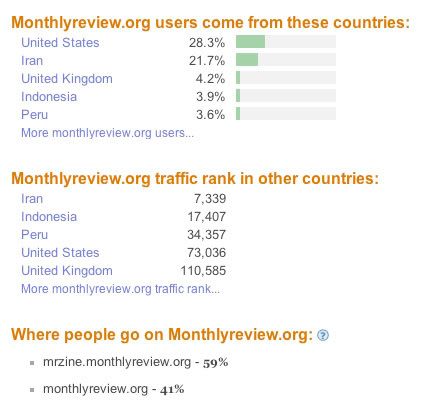
According to Alexa, as of 27 November 2007, 21.7% of online readers of Monthly Review and MRZine are from Iran:
Thursday, November 15, 2007
IAEA on Iran
The International Atomic Energy Agency's latest report on Iran is in: "Implementation of the NPT Safeguards Agreement and relevant provisions of Security Council resolutions 1737 (2006) and 1747 (2007) in the Islamic Republic of Iran," Report by the Director General (15 November 2007). Activists should emphasize these points from the IAEA report, keeping in mind that weapons-grade uranium must be enriched to about 90% U-235:
Update
This just in: "A meeting of world powers on tougher sanctions on Iran has been cancelled after China pulled out, European diplomatic sources said on Friday, revealing tensions after a key report into Tehran's atomic activities" (Sophie Walker, "UPDATE 2 -- Iran Sanctions Meeting Cancelled -- European Diplomats," Reuters, 16 November 2007). Great news.
- "While Iran has stated that it has reached enrichment levels up to 4.8% U-235 at FEP, the highest U-235 enrichment measured so far from the environmental samples taken by the Agency from cascade components and related equipment is 4.0%" (emphasis added, p. 6).
- "The Agency has been able to verify the non-diversion of declared nuclear material in Iran" (p. 8).
- "The Agency has been able to conclude that answers provided on the declared past P-1 and P-2 centrifuge programmes are consistent with its findings" (p. 8).
- "Iran has provided sufficient access to individuals and has responded in a timely manner to questions and provided clarifications and amplifications on issues raised in the context of the work plan" (p. 8).
- "Elbaradei's Report Confirms Tehran's Co-op with IAEA" (Xinhua)
- "Ahmadinejad Hails IAEA Report on Iranian Nuclear Program" (RIA Novosti)
- "Gute Noten: Die Internationale Atomenergiebehörde bescheinigt dem Iran Fortschritte bei der Zusammenarbeit" (Vanity Fair)
- "IAEA Praises Iranian Cooperation but Admits Tehran Still Enriching Uranium" (Yitzhak Benhorin, Ynetnews)
- "IAEA: Iran Generally Truthful on Nukes" (George Jahn, Associated Press, ABC)
- "IAEA Says Iranian Data Has Been Mostly Accurate" (Associated Press, Wall Street Journal)
- "Iran 'Improves' Atomic Transparency" (Agencies, Al Jazeera)
- "Iran Reveals How It Built Nuclear Program, U.N. Says" (Maggie Farley, Los Angeles Times)
- IAEA Sees Progress but Says Iran Still Enriching Uranium (AFP)
- "Iran More Transparent But Expands Nuclear Campaign" (Mark Heinrich, Reuters)
- "IAEA: Iran Was Cooperative with UN Nuclear Probe, But Still Defying Demands" (Agencies and Ha'aretz)
- IAEA Report: Teheran Is Coming Clean" (Yaakov Katz, Jerusalem Post)
- "Nucléaire iranien : Téhéran a fait des "progrès substantiels" mais insuffisants selon l'AIEA" (Le Monde with AFP)
- "U.N. Releases Report on Iran’s Nuclear Program" (Elaine Sciolino and William J. Broad, New York Times)
- "Report Exposes 'Nuclear-ready' Iran" (AFP, The Age)
- "Iran Fails to Resolve Nuclear Questions" (James Blitz, Daniel Dombey, and Najmeh Bozorghmehr, Financial Times)
- "Report Raises New Doubts on Iran Nuclear Program" (Elaine Sciolino and William J. Broad, New York Times, A1)
- "IAEA: Iran Providing 'Diminishing' Information on Its Nuclear Program" (Robin Wright, Washington Post)
- "U.N. Losing Grip on Iran Nuke Plan" (CNN)
- "IAEA: Iran Not Open About Nuke Program" (George Jahn, Associated Press)
- Julian Borger, "Decision Time for US over Iran Threat: UN Nuclear Report Heightens Tension" (Guardian)
- "Iran Could Build Atom Bomb within One Year, Says Nuclear Watchdog" (Tom Baldwin and Michael Theodoulou, Times)
Update
This just in: "A meeting of world powers on tougher sanctions on Iran has been cancelled after China pulled out, European diplomatic sources said on Friday, revealing tensions after a key report into Tehran's atomic activities" (Sophie Walker, "UPDATE 2 -- Iran Sanctions Meeting Cancelled -- European Diplomats," Reuters, 16 November 2007). Great news.
Monday, November 12, 2007
Aijaz Ahmad on Iran, the IAEA, and the Empire
Watch Aijaz Ahmad dissect the empire's determined refusal to listen to the IAEA ("El Baradei and Iran's Nuclear Ambition," The Real News, 12 November 2007):
Saturday, November 10, 2007
Le mystère Hezbollah
| Le mystère Hezbollah par Anne-Laure Fournier Un an après la dernière guerre au Liban, le parti Hezbollah reste un mystère. Pour la première fois, son leader, Hassan Nasrallah, a accepté la présence de caméras occidentales au sein de l'organisation et répond, sous haute surveillance, aux questions les plus délicates. En retraçant l'histoire de ce mouvement, ce documentaire exceptionnel donne les clés pour comprendre ce qui se joue dans cette région. Qui sont ces "fous de Dieu" qui ont résisté aux attaques de l'armée israélienne en 2006 ? Des "terroristes" selon Bush, de "dangereux fondamentalistes" d'après l'opinion internationale, ou de simples militants d'obédience islamiste chiite engagés dans la vie démocratique de leur pays pour leurs partisans ? La réalité est sans doute aussi complexe que l'histoire du Hezbollah, un mouvement qui suscite les réactions les plus contrastées dans cette société multiculturelle caractérisée par la coexistence de différents courants religieux. A l'issue de longs mois de négociations, Jean-François Boyer, grand reporter et réalisateur, et Alain Gresh, écrivain et journaliste au Monde diplomatique, ont reçu l'autorisation de filmer les installations du mouvement, de diffuser certaines de ses archives inédites et d'interroger son dirigeant charismatique, Hassan Nasrallah. N'éludant aucune question, celui-ci s'exprime sur ses relations avec le gouvernement libanais, les Palestiniens, l'Iran, la provenance de ses fonds et de ses armes, mais aussi sur sa position vis-à-vis de l'Etat d'Israël, dont le Hezbollah a toujours officiellement nié la légitimité. Au coeur du "parti de Dieu" Formé chez les mollahs iraniens, le leader chiite a conservé des liens très forts avec l'ayatollah Khamenei. Ce qui vaut toujours au mouvement libanais l'accusation d'être le "bras armé de la révolution iranienne". Sur ce point, la réponse de Nasrallah est pour le moins ambiguë : "Donnez-moi un seul exemple en vingt-cinq ans d'existence où le Hezbollah aurait servi les intérêts de l'Iran contre ceux du Liban ?"... Issu de différents groupes chiites, le Hezbollah a vécu dans l'ombre durant les quinze premières années de son existence. A la fin de la guerre civile, il est le seul autorisé par la Syrie à poursuivre le combat à la frontière israélienne dans le sud du pays. En 1992, Nasrallah engage son mouvement dans le processus électoral pour lui donner une légitimité démocratique. En 2007, le Hezbollah forme l'un des grands groupes parlementaires libanais avec quatorze députés. Aujourd'hui, il manifeste, avec le principal parti chrétien, pour un gouvernement d'union nationale. Sur son rôle militaire, la position de Nasrallah est claire : "La question des armes est liée au conflit avec l'ennemi israélien. . . Le Hezbollah ne les a jamais utilisées à l'intérieur du pays. Toutes les élections auxquelles il a pris part montrent vraiment que nous sommes engagés dans le processus électoral et la vie du pays." Dans le sud du Liban, les troupes du Hezbollah, moins visibles mais toujours superarmées, restent prêtes à agir. "Tant que l'armée libanaise est capable de gérer le problème, nous n'intervenons pas. Mais si l'armée libanaise et la Finul n'arrivent pas à le résoudre, alors la résistance entre en action." Le terme résume bien une des principales raisons d'être du Hezbollah : un mouvement libanais de résistance contre Israël. Un objectif que partagent beaucoup d'autres Libanais, à en croire Michel Samaha, numéro deux des chrétiens maronites, alliés du "parti de Dieu". De Beyrouth au sud du Liban, les deux journalistes sont partis à la rencontre des combattants du Hezbollah, objet d'un vrai culte, et de leurs familles mais aussi des représentants des principaux partis politiques du pays et de leurs militants. Leur enquête les a menés également sur les lieux de l'action sociale du Hezbollah -- écoles et hôpitaux financés majoritairement par l'organisation -- ainsi que dans les locaux de la chaîne Al-Manar, la plus regardée au Liban et considérée comme le média du parti. Dans un pays où les tensions sont toujours vives, le Hezbollah montre qu'il demeure un acteur incontournable des forces en présence. Première diffusion : dimanche 15 juillet 2007 à 12:25 (hertzien et TNT). | The Mystery of Hezbollah by Anne-Laure Fournier One year after the last war in Lebanon, Hezbollah remains a mystery. For the first time, its leader, Hassan Nasrallah, accepted the presence of Western cameras inside the organization and answers, under high security, the most delicate questions. By retracing the history of this movement, Le Mystère Hezbollah [The Mystery of Hezbollah], an exceptional documentary, provides the keys to understanding what comes into play in this region. Who are these "fanatics of God" who resisted the Israeli army's attacks in 2006? "Terrorists" according to Bush, "dangerous fundamentalists" according to the international opinion, or simple militants of the Shi'i Islamic persuasion engaged in the democratic life of their country for their supporters? The reality is undoubtedly as complex as the history of Hezbollah, a movement which provokes the most contradictory reactions in this multicultural society characterized by the coexistence of various religious currents. After months-long negotiations, Jean-François Boyer, international journalist and film maker, and Alain Gresh, writer and journalist of Le Monde Diplomatique, received an authorization to film Hezbollah installations, to publish some of its previously unpublished archives, and to question its charismatic leader, Hassan Nasrallah. Not evading any question, Nasrallah himself speaks about not only Hezbollah's relations with the Lebanese government, the Palestinians, Iran, and the source of its funds and weapons, but also its position on the state of Israel, whose legitimacy Hezbollah has always officially denied. At the Heart of the "Party of God" Educated by Iranian clerics, the Shi'i leader has maintained very strong bonds with Ayatollah Khamenei. The accusation of being the "armed hands of the Iranian revolution" always gets applied to the Lebanese movement. On this point, the response of Nasrallah is at the very least ambiguous: "Give me a single example in the twenty-five years of its existence where Hezbollah served the interests of Iran against those of Lebanon.". . . A product of various Shi'i groups, Hezbollah lived in the shadow during the first fifteen years of its existence. At the end of the civil war, it became the only one authorized by Syria to continue armed struggle at the Israeli border in southern Lebanon. In 1992, Nasrallah committed his movement to the electoral process to give it democratic legitimacy. In 2007, Hezbollah is one of the major Lebanese parliamentary factions with its fourteen deputies. Today, it is mobilizing, with the principal Christian party, for a national unity government. On its military role, the position of Nasrallah is clear: "The question of weapons is tied to the conflict with the Israeli enemy. . . . Hezbollah has never used them inside Lebanon. All the elections in which it has taken part really show that we are committed to the electoral process and the life of the nation." In the south of Lebanon, Hezbollah troops, less visible but always well armed, remain ready to act. "As long as the Lebanese army can manage the problem, we do not intervene. But if the Lebanese army and the UNFIL are unable to solve it, then the resistance goes into action." The term well summarizes one of Hezbollah's principal raisons d'être: a Lebanese movement of resistance against Israel. An objective shared by many other Lebanese, if we are to believe Michel Samaha, the number two leader of Maronite Christians, allied with the "Party of God." From Beirut to southern Lebanon, the two journalists traveled to meet not only Hezbollah combatants, the object of a veritable cult worship, and their families but also representatives of the main political parties of Lebanon and their militants. Their investigation equally led them to the scenes of Hezbollah's social action -- schools and hospitals financed mainly by the organization -- as well as the premises of the Al-Manar network, the most watched network in Lebanon, considered to be the Hezbollah media. In a country where tensions are always high, Hezbollah shows that it remains an actor impossible to ignore among the opposing forces. First broadcast: Sunday, 15 July 2007 at 12:25 (network and TNT). |
Watch Le Mystère Hezbollah
The French text originally appeared on the Web site of France 5. English translation by Yoshie Furuhashi. You can also watch this documentary at Alterinfo.net.
Friday, November 09, 2007
Still Waiting for Godot
It is said that Hossein Derakhshan's decision to concentrate more on attacking the US-led multinational empire's campaign against Iran than criticizing Iran's government has cost him political capital in the Iranian diaspora:
Such Iranian leftists are not unlike Vladimir and Estragon waiting for Godot, trapped in the plot that immobilizes them rather than sets them in motion:
After that, my Persian teacher decided to stop waiting for Godot. He visited Iran last year, welcomed by hundreds of his family and friends at home, and saw how his country had changed -- for better or worse, Iran is not what it used to be. And he will visit Iran again, probably next year. For him, Iran is no longer an idea, the idea of unfinished revolution. But, for some in the diaspora, it still is.
Update
See, also, Richard Seymour, "Tough Times for Iranian Blogger," Lenin's Tomb, 15 November 2007.
All this has left him [Hossein Derakhshan] isolated from the community of politically active expatriate Iranians who formerly supported him. Some bloggers have removed links to his blog. Others have actively urged readers to boycott him. Interview requests from western-based Iranian media have dried up, as have invitations to ex-pat events and panel discussions. (Don Butler, "The Blogfather: Times Are Hard for Iran's Online Free-speech Pioneer," Ottawa Citizen, 2 November 2007)That is unfortunate, as Hoder has a great deal of useful information to offer, even to those who disagree with him politically, but his exile from exile is all too predictable. Many in the Iranian diaspora have yet to come to terms with the Islamic Republic, and some Iranian leftists are still waiting for a second Iranian Revolution, which makes them unable to listen to, let alone accept, Hoder's new position on the Islamic Republic: "Iran's Islamic republic is still a very new concept and remains a work in progress, he says. Given the chance, 'the major force that could democratize the region is a successful Islamic republic rather than an oppressive, colonizing United States'" (Butler, 2 November 2007).
Such Iranian leftists are not unlike Vladimir and Estragon waiting for Godot, trapped in the plot that immobilizes them rather than sets them in motion:
VLADIMIR: Well? Shall we go?Even my Persian teacher, who, unlike many secular Iranians, does not dismiss Islam or despise Muslims, once fell for a mirage of the second Iranian Revolution: in 1999, he told his wife, to her dismay, that another revolution was about to happen and that he had to go home to join it. 18 Tir, however, was over within a week.
ESTRAGON: Yes, let's go.
They do not move.
After that, my Persian teacher decided to stop waiting for Godot. He visited Iran last year, welcomed by hundreds of his family and friends at home, and saw how his country had changed -- for better or worse, Iran is not what it used to be. And he will visit Iran again, probably next year. For him, Iran is no longer an idea, the idea of unfinished revolution. But, for some in the diaspora, it still is.
Update
See, also, Richard Seymour, "Tough Times for Iranian Blogger," Lenin's Tomb, 15 November 2007.
Friday, September 21, 2007
Inflation: Iran and Venezuela
Endless economic propaganda against populism is the order of the day, especially when it comes to Iran. A case in point is Robert Tait's latest article in the Guardian1:
It's basically the same domestic policy of low interest rates as Venezuela's, and the same global economic trends, that are adding to the price pressures in Iran, and the same policy of large subsidies as Venezuela's also cushions inflation's impacts on the poor in Iran, despite economists, technocrats, and journalists speaking in the name of the poor but actually rooting for neoliberal solutions -- namely raising interest rates and cutting subsidies for the poor.
Mark Weisbrot and Luis Sandoval write in "The Venezuelan Economy in the Chávez Years" (July 2007) that "[r]eal interest rates have been negative throughout the recovery as measured by the 90-day deposit rate or most of the recovery, as measured by the lending rate" (p. 17). Pushed also by expansive fiscal policy, Venezuela's inflation, currently running at 19.4 percent, exceeds the government's target. But they also note that "it should be emphasized that double-digit inflation rates in a developing country such as Venezuela are not comparable to the same phenomenon occurring in the United States or Europe," pointing out that Venezuela experienced far worse inflation in the 1990s (p. 2).
Why have Weisbrot and Sandoval made efforts to clarify the economic history of Venezuela? Because they know that journalism heightening economic anxieties, which in turn will have negative impacts on real economy, is part of the ruling class propaganda that needs to be countered.2
Leftists ought to be doing the same about Iran's economy, but they don't. Rather, most of them do the opposite, apparently having convinced themselves that any economic propaganda against the "Iranian regime" is in the interest of Iran's working class, which isn't true. All that propaganda against populism does is to help Iran's ruling class push for neoliberal economics and help Washington in its campaign to economically isolate Iran.
1 One learns that Tait has an agenda of promoting Rafsanjani, which in part explains how he reports on Iran's economy and domestic faction fights: Hossein Derakhshan, "Robert Tait Markets Rafsanjani to Americans," Editor: Myself, 21 August 2007.
2 They know their history: "Predictions of economic collapse under Allende were replayed in CIA-generated articles in European and Latin American newspapers" (Church Report, "Covert Action in Chile 1963-1973," 18 December 1975). But nowadays the hegemony of neoliberal economics is such that the CIA doesn't even need to plant a story. The media do it all on their own.
The Islamic Revolution Devotees Society -- a fundamentalist grouping of revolutionary veterans co-founded by Mr Ahmadinejad -- has added its voice to a rising chorus of economic discontent by warning the president that spiralling living costs are hurting the poor and undermining his stated goal of social justice.The rift, however, is no news. The Islamic Revolution Devotees Society (Jamiyat-e Isargaran-e Inqilab-e Islami), the group most of whose members' views are not fundamentalist in any recognizable sense but, if anything, technocratic, didn't back Ahmadinejad in the first round of the 2005 presidential elections, endorsing Mohammad Baqer Qalibaf instead:
The society says the government is to blame because it embarked on extravagant projects while failing to control the money supply. . . .
The latest report implicitly criticises his contemptuous view of economics by describing it as a "specialised science" and says Iran's inflationary problems cannot be solved by "ad hoc decisions". That may partly refer to one of Mr Ahmadinejad's most controversial recent moves in which he ordered banks to cut interest rates to 12% - below inflation, which is estimated at between 20% and 30%. ("Party Turns on Ahmadinejad over Attitude to Inflation," 20 September 2007)
Neither is the current level of inflation -- which Tait exaggerates, citing no sources -- new in Iran, which has seen much worse. According to none other than the International Monetary Fund:
- The Isargaran eventually backed the candidacy of national police chief and former Revolutionary Guard Mohammad Baqer Qalibaf, announcing that he won out over Ahmadinejad, Larijani, Ali-Akbar Velayati, Mohsen Rezai, and Ahmad Tavakoli, 'Siyasat-i Ruz' reported on 30 May. (Bill Samil, "Iran: A Rising Star In Party Politics," Radio Free Europe/Radio Liberty, 7 November 2005)
- The Devotees Society held its third congress in early March, but Ahmadinejad was in Malaysia at the time. But 'Sharq' suggested on March 4 that the president's absence could be traced to the society's failure to support him in the first round of the June 2005 election in favor of Mohammad Baqer Qalibaf. (Bill Samil, "Analysis: Rivalries Heat Up Among Iran's Conservatives," Radio Free Europe/Radio Liberty, 25 April 2006)
Iran has a history of relatively high inflation, with CPI inflation averaging more than 17 percent since the 1979 revolution. . . . The 1979 revolution clearly represents a breaking point in the money-inflation relationship. Inflation increased significantly following the revolution (from 6.6 percent to 17.4 percent on average), but the acceleration in money growth was almost negligible (from 23.8 percent to 24.6 percent on average). After the dramatic increase experienced in the mid-1990s, when it reached a peak of 50 percent, inflation declined up until the first quarter of 2006/07, though the annual average remained in the double digits. (Leo Bonato, "Money and Inflation in the Islamic Republic of Iran," IMF Working Paper, May 2007, p. 3-5)See, also, "Figure 1. Money Growth and Inflation, 1958/59-2005/06" on page 4 of the same paper.
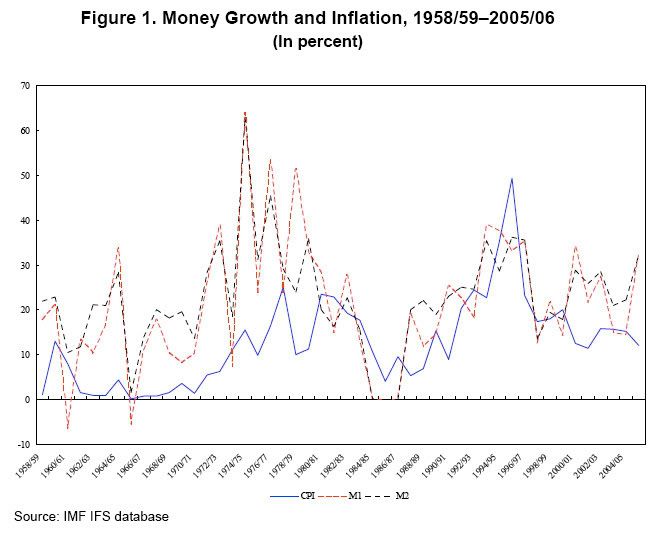
It's basically the same domestic policy of low interest rates as Venezuela's, and the same global economic trends, that are adding to the price pressures in Iran, and the same policy of large subsidies as Venezuela's also cushions inflation's impacts on the poor in Iran, despite economists, technocrats, and journalists speaking in the name of the poor but actually rooting for neoliberal solutions -- namely raising interest rates and cutting subsidies for the poor.
Mark Weisbrot and Luis Sandoval write in "The Venezuelan Economy in the Chávez Years" (July 2007) that "[r]eal interest rates have been negative throughout the recovery as measured by the 90-day deposit rate or most of the recovery, as measured by the lending rate" (p. 17). Pushed also by expansive fiscal policy, Venezuela's inflation, currently running at 19.4 percent, exceeds the government's target. But they also note that "it should be emphasized that double-digit inflation rates in a developing country such as Venezuela are not comparable to the same phenomenon occurring in the United States or Europe," pointing out that Venezuela experienced far worse inflation in the 1990s (p. 2).
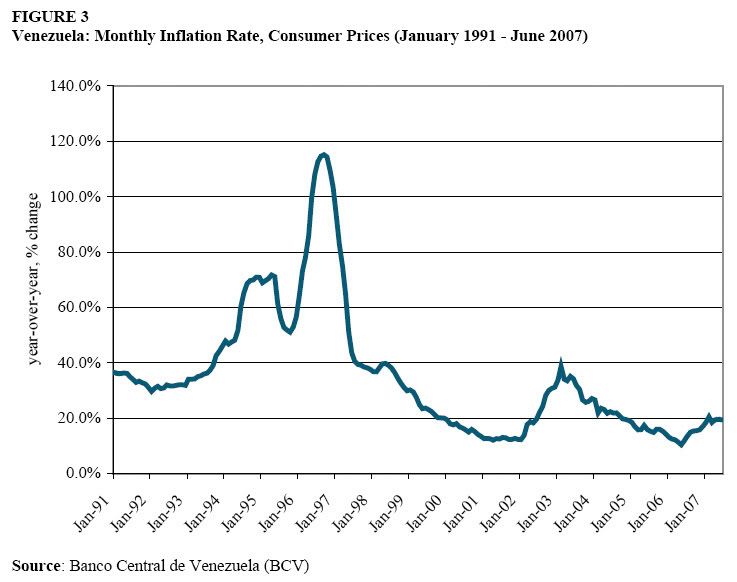
Why have Weisbrot and Sandoval made efforts to clarify the economic history of Venezuela? Because they know that journalism heightening economic anxieties, which in turn will have negative impacts on real economy, is part of the ruling class propaganda that needs to be countered.2
Leftists ought to be doing the same about Iran's economy, but they don't. Rather, most of them do the opposite, apparently having convinced themselves that any economic propaganda against the "Iranian regime" is in the interest of Iran's working class, which isn't true. All that propaganda against populism does is to help Iran's ruling class push for neoliberal economics and help Washington in its campaign to economically isolate Iran.
1 One learns that Tait has an agenda of promoting Rafsanjani, which in part explains how he reports on Iran's economy and domestic faction fights: Hossein Derakhshan, "Robert Tait Markets Rafsanjani to Americans," Editor: Myself, 21 August 2007.
2 They know their history: "Predictions of economic collapse under Allende were replayed in CIA-generated articles in European and Latin American newspapers" (Church Report, "Covert Action in Chile 1963-1973," 18 December 1975). But nowadays the hegemony of neoliberal economics is such that the CIA doesn't even need to plant a story. The media do it all on their own.
Tuesday, September 11, 2007
A Question from Iran: "What Do They Know of Us in the West?"
Many Iranian readers come to MRZine, a webzine I edit. According to Alexa today, 7.8 % of all visitors to MRZine and Monthly Review are from Iran.

That's a really large proportion, considering that none of the pages has been translated into Persian and that Iran's population is merely 66 million out of the total world population of 6.6 billion. No other secular leftist publication has such a readership profile as MR's.
What are the Iranians who come to MR/MRZine reading? Noam Chomsky's criticism of American imperialism? John Bellamy Foster's thoughts on Marxism and nature? Samir Amin's world systems perspective? Economic analysis of capitalism by the founders of Monthly Review? Albert Einstein's personal statement on socialism (which is a perennial favorite among first-time visitors who come to MR through Google)? Many criticisms of politics in the Middle East, including Iran?
No.
The most popular article for Iranian visitors to MR/MRZine, read by a majority of them, is "Iran's Quiet Revolution" by Deborah Campbell, with photography by Alfred Yaghobzadeh (10 November 2006). Some of what Campbell says is probably new to many Western readers, and Yaghobzadeh's photographs capture aspects of everyday life in Iran that seldom appear in the Western media. But neither the content of Campbell's observations nor Yaghobzadeh's photographs can be a revelation to Iranians. They must be familiar to them.
That very familiarity, I submit, is what makes this article attractive to Iranian readers.
Iran in the article is a country that is recognizable to them as their own, with its many contradictions, economic and cultural, and, even as Campbell takes note of the experience of Iran's dissidents, neither text nor photographs make Iran out to be a living hell unlike any other country, whose people either suffer or rebel against oppression by irrational fanatics, which is an impression one gets from much of the Western media, be they commercial or non-profit. All Iranians portrayed in this article, officials as well as common people, some liberals on both cultural and economic matters, others culturally conservative and economically populist, come across as ordinary human beings.
The writer's and photographer's love of the Iranian people is also well communicated in the article, which ends on this note:
Iran is a land of contradictions, and it's hard to imagine any country in the world where a Westerner would enjoy a more gracious welcome. To be in a shared taxi in any part of Iran is to have your sleeve plucked by someone who says, as an opening gambit, "I would die for you" (a standard greeting in the poetics of Farsi etiquette). And then: "Come to my home." In my six-month journey from the mountains of Kurdistan in the northwest to the bazaars of Kerman in the east to the oil regions on the border with Iraq, it is impossible to catalogue how many meals and accommodations were offered by strangers of a half-hour's acquaintance.What do they know of us in the West? Iranians ask this question, probably because they know that what the Western media typically do is to prepare the Western public for what the US-led multinational empire will do to a Third World country, in this case their own. Are leftists offering the public images, visual or verbal, that counter what the rulers of the empire would like all of us to think and feel, portraits in which ordinary Iranians can recognize their own country?
And as often as I attempted to interview them, they turned the tables: What do they know of us in the West? Do they think we are all terrorists?
What could I tell them in return?
Subscribe to:
Posts (Atom)


