The riot, at the Tonghua Iron and Steel Works in Jilin Province in northern China, broke out after a visiting steel executive from a related company threatened mass layoffs at the Tonghua steel mills as part of a major restructuring of the state-owned company, China Daily said.That is not surprising. Shortly before this incident in China, "Workers at collapsed French car parts maker New Fabris threatened on Sunday to blow up their factory if they did not receive payouts by July 31 from auto groups Renault and Peugeot to compensate for their lost jobs" ("French Workers Threaten to Blow Up Factory," Reuters, 12 July 2009). It could happen here.
The riot followed a pattern of massive demonstrations that have taken place in various parts of the country over the past few years, many involving citizens outraged over government corruption or threatened with layoffs or orders to relocate.
The China Daily report said Chen Guojun, the steel executive who was beaten to death, had threatened 3,000 Tonghua steelworkers with layoffs, which he had said could take place within three days. He also had signaled that larger jobs cuts were likely at the struggling steel mill.
The report said the rioters blocked the police, ambulances and government officials from reaching Mr. Chen before he died. (David Barboza, "China Steel Executive Killed as Workers and Police Clash," New York Times, 27 July 2009)
Showing posts with label France. Show all posts
Showing posts with label France. Show all posts
Wednesday, July 29, 2009
It Could Happen Here
Normally, the Western mass media love the stories of any old conflicts -- from electoral disputes to ethnic conflicts to even workers' uprisings -- in Southern nations of interest to the West, but they don't appear to find this story so amusing, as is suggested by the terseness of the report.

Saturday, September 20, 2008
Le Divorce
"French, Russian PMs Bond over Economy" (AFP, 20 September 2008). Maybe this is the beginning of a beautiful friendship. Little did we know that it would take the most American of all French presidents to initiate Europe's divorce from the Atlantic Alliance.
By the way, it was on 20 September 1792 when the French Revolution made divorce lawful, to the happiness of women, like Europe, trapped in unhappy marriages:
By the way, it was on 20 September 1792 when the French Revolution made divorce lawful, to the happiness of women, like Europe, trapped in unhappy marriages:
During the radical years of the Revolution a number of pieces of legislation were designed to improve family life, deemed hitherto to have been cruel and immoral, like the Ancient Régime itself. Family courts were instituted to deal with family conflict, penalties for wife beating were introduced which were twice as heavy as for assaulting a man, and the age of majority was reduced from 25 to 21. Of greatest importance was a divorce law voted at the last session of the Legislative Assembly, on 20 September 1792. This gave women remarkably broad grounds for leaving an unhappy or violent marriage. Nationally, perhaps 30,000 divorces were decreed under this legislation, especially in towns; in Paris, there were nearly 6,000 in 1793-5. (Philip G. Dwyer and Peter McPhee, The French Revolution and Napoleon: A Sourcebook, Routledge, 2002, p. 84)
Wednesday, May 28, 2008
Louise Michel
28 May 1871 was the last day of the "semaine sanglante," which put an end to the Paris Commune. Tens of thousands of Communards were summarily executed or imprisoned, and about 4,000 were deported to New Caledonia, a penal colony of France.
In New Caledonia, the exiled Communards encountered the Kanaks, the indigenous people of the islands, who were also oppressed by the same ruling class that had crushed the Commune. When the Kanaks rose up in rebellion in 1878, however, most of the Commundards "rallied to the French state," with a few exceptions such as Louise Michel, who wrote: "The Kanaks were seeking the same liberty we had sought in the Commune."
Can the rebels of the North side with the rebels of the South? The history of the metropolitan Left in imperialism gives an ambiguous answer to this question.
In New Caledonia, the exiled Communards encountered the Kanaks, the indigenous people of the islands, who were also oppressed by the same ruling class that had crushed the Commune. When the Kanaks rose up in rebellion in 1878, however, most of the Commundards "rallied to the French state," with a few exceptions such as Louise Michel, who wrote: "The Kanaks were seeking the same liberty we had sought in the Commune."
Can the rebels of the North side with the rebels of the South? The history of the metropolitan Left in imperialism gives an ambiguous answer to this question.
Thursday, April 10, 2008
Nepal on the Brink of Modernity
Citing opinion surveys,1 a Le Monde article claims that the question of monarchy in Nepal is far from settled, with nearly one in two Nepalis professing loyalty to the royalty, and that the conservative Congress Party, if it gets a dominant position in the elections for a Constitutional Assembly, will temporize on the matter (Frédéric Bobin, "Les Népalais aux urnes pour abolir la monarchie," 10 April 2008). While its assessment of the Congress Party is probably not far from the truth and is therefore useful, the tone of the article isn't exactly a ringing endorsement of republicanism. Coming from a good paper in France, the origin of modern republicanism, it's a little disappointing. Isn't it about time for the rest of the world to welcome the Nepalese into modernity, which has been long denied them thanks in large part to the influences of the United States and India?
1 Opinion surveys can be tricky even in rich countries, and those in very poor countries, such as Nepal where modern transportation and communication are out of reach of the majority, can be hardly reliable, as they marginalize voices of the poor and magnify those of the rich. In any case, if similar surveys had been taken in France on the eve of the French Revolution and the French had followed the survey results, France itself might have become a constitutional monarchy rather than a republic. It's a good thing that polling didn't exist back then.
1 Opinion surveys can be tricky even in rich countries, and those in very poor countries, such as Nepal where modern transportation and communication are out of reach of the majority, can be hardly reliable, as they marginalize voices of the poor and magnify those of the rich. In any case, if similar surveys had been taken in France on the eve of the French Revolution and the French had followed the survey results, France itself might have become a constitutional monarchy rather than a republic. It's a good thing that polling didn't exist back then.
Saturday, November 17, 2007
Bahman Nirumand: The Danger of War against Iran Grows
| Die Kriegsgefahr wächst: Das Szenario erinnert an den Irak-Krieg von Bahman Nirumand Die ständigen Mitglieder des UN-Sicherheitsrats hatten sich im Atomstreit mit dem Iran Anfang Oktober geeinigt: Die Entscheidung über verschärfte Sanktionen wird vertagt, bis die Internationale Atomenergiebehörde (IAEO) einen neuen Bericht über das Atomprogramm Irans vorgelegt hat. Aber so viel Geduld wollten die USA nicht aufbringen. Im Alleingang verschärften sie die Wirtschaftssanktionen, stuften die Revolutionsgarden als terroristisch ein und übten zudem Druck aus auf ausländische Banken und Unternehmen, ihre Geschäfte mit dem Iran einzustellen. US-Außenministerin Rice nannte Iran das gefährlichste Land der Welt. Nun legte IAEO-Generalsekretär el-Baradei seinen neuen Bericht vor. In ihm bescheinigte er dem Iran zwar Fortschritte bei der Zusammenarbeit, fügte aber auch hinzu, dass Teheran sich weiterhin weigere, der Forderung des UN-Sicherheitsrats nach Einstellung der Urananreicherung nachzukommen. Nichts Neues also. Iran pocht auf sein Recht, die Atomenergie friedlich zu nutzen. El-Baradei und seine Behörde sollten jedoch noch etwas anderes herausfinden: Hat Iran die Absicht, Nuklearwaffen herzustellen. Darüber konnte der Generalsekretär keine klare Auskunft geben. Nur dies: Vorläufig gehe von Iran keine unmittelbare Gefahr aus, und es gebe Zeit genug, den Streit auf diplomatischem Weg zu lösen. Aus amerikanischer Sicht hätte es dieses Berichts nicht bedurft. Schon im Vorfeld wurde aus Washington verkündet, die Kooperationsbereitschaft Irans reiche nicht aus, Iran müsse die Urananreicherung einstellen, andernfalls würden die Sanktionen verschärft. Sollten diese auch zu keinem Ergebnis führen, stünden andere Optionen offen -- militärische eben. Der Streit wird also weiter eskalieren. Da höchstwahrscheinlich Russland und China weitere Sanktionen nicht mittragen wollen, werden die USA am Sicherheitsrat vorbei ihren Kurs fortsetzen. Haben wir nicht ein ähnliches Szenario vor dem Irakkrieg erlebt? Nur dieses Mal sollen Frankreich und Deutschland auch mit ins Boot geholt werden. | The Danger of War Grows: The Scenario Reminiscent of the Iraq War by Bahman Nirumand The permanent members of the Security Council had agreed on the nuclear controversy over Iran at the beginning of October: the decision over escalation of sanctions is to be postponed until the International Atomic Energy Agency (IAEA) submits a new report on Iran's nuclear program. But the USA did not want to exercise so much patience. Unilaterally, it intensified the economic sanctions, classified the Revolutionary Guards as terrorist, and put more pressure on foreign banks and other enterprises to stop their business with Iran. US Secretary of State Rice called Iran the most dangerous country in the world. Now, IAEA Director General El-Baradei submitted his new report. He certified Iran's progress in cooperation, adding that that Tehran still refuses to comply with the Security Council's demand to cease uranium enrichment. Nothing new in this. Iran hammers on its right to use nuclear energy peacefully. El-Baradei and the IAEA should find out something else, however: whether Iran has the intention to build nuclear weapons. The Director General could not give clear information on this question. This much is certain: there is no immediate danger from Iran, and there is enough time to solve the controversy diplomatically. From the American point of view, this report was irrelevant. Even before the release of the IAEA report, Washington already announced: Iran's willingness to cooperate is not enough -- Iran must stop uranium enrichment, or else the sanctions will be intensified. Should the sanctions fail to yield results, there would be other options, even military ones. The controversy will thus continue to escalate. Since Russia and China most likely do not want to impose further sanctions, the USA will continue its course outside the Security Council. Didn't we experience a similar scenario before the Iraq war? Only this time France and Germany will also be in the same boat. |
Bahman Nirumand, born in 1936 in Tehran, is an Iranian-German writer. The article in German appeared in Taz on 17 November 2007. Translation by Yoshie Furuhashi.
Wednesday, November 14, 2007
Tous contre Sarkozy
Once again French workers are on strike. Nicolas Sarkozy's "pension reform" will initially affect only "about 500,000 public sector employees" (Katrin Benhold, "Strike in France a Test of Wills," New York Times, 14 November 2007), but both the unions and the President know that this is the decisive battle: winning it will let Sarkozy divide and conquer France, the last bastion of socialism in Europe,1 introducing other reforms (including tax cuts, less health care, smaller government payrolls, longer work hours, and more anti-working-class labor laws) that will make the country less social and more liberal.
The unions can win only by countering the propaganda that this strike is about a "conflit sectoriel contre l'intérêt général" [sectoral conflict against the general interest] in the words of Stéphane Rozès of the CSA polling group (Rémi Barroux, "Les syndicats ont peur de perdre la bataille de l'opinion," Le Monde, 14 November 2007). If recent polls are to be believed, the unions are having trouble doing so: 55% of the French judge the mobilization against the reform of the special pension plans as "not justified," according to a BVA survey released on Tuesday. At the time of the 18 October strike on the same issue, 53% shared this judgment. Libération (13 November) reports that 59% are "on the side of Nicolas Sarkozy and the government" and 35% "on the side of strikers and demonstrators." That is despite the fact that "the opinion remains skeptical on the economic policy of the government," 79% judging that Nicolas Sarkozy is "a failure" on the issue of purchasing power and 59% saying the same about his policy on economic growth (Barroux, 14 November 2007).
That may be about to change.
The danger for Sarkozy is the "aggregation of diverse movements" against his overal agenda, as Rozès notes (Rémi Barroux, "Stéphane Rozès, directeur général de CSA: 'Le danger pour Sarkozy est l'agrégation de mouvements,'" Le Monde, 12 November 2007). Just such a convergence is likely to develop this month. Students, who are fighting their own battle against privatization of education as well, have threatened to block train stations in solidarity with striking workers, and civil servants will go on strike on 20 November.
1 The last bastion of socialism in terms of working people's militancy and public sentiment, not of political economy, of course:
The unions can win only by countering the propaganda that this strike is about a "conflit sectoriel contre l'intérêt général" [sectoral conflict against the general interest] in the words of Stéphane Rozès of the CSA polling group (Rémi Barroux, "Les syndicats ont peur de perdre la bataille de l'opinion," Le Monde, 14 November 2007). If recent polls are to be believed, the unions are having trouble doing so: 55% of the French judge the mobilization against the reform of the special pension plans as "not justified," according to a BVA survey released on Tuesday. At the time of the 18 October strike on the same issue, 53% shared this judgment. Libération (13 November) reports that 59% are "on the side of Nicolas Sarkozy and the government" and 35% "on the side of strikers and demonstrators." That is despite the fact that "the opinion remains skeptical on the economic policy of the government," 79% judging that Nicolas Sarkozy is "a failure" on the issue of purchasing power and 59% saying the same about his policy on economic growth (Barroux, 14 November 2007).
That may be about to change.
The danger for Sarkozy is the "aggregation of diverse movements" against his overal agenda, as Rozès notes (Rémi Barroux, "Stéphane Rozès, directeur général de CSA: 'Le danger pour Sarkozy est l'agrégation de mouvements,'" Le Monde, 12 November 2007). Just such a convergence is likely to develop this month. Students, who are fighting their own battle against privatization of education as well, have threatened to block train stations in solidarity with striking workers, and civil servants will go on strike on 20 November.
1 The last bastion of socialism in terms of working people's militancy and public sentiment, not of political economy, of course:
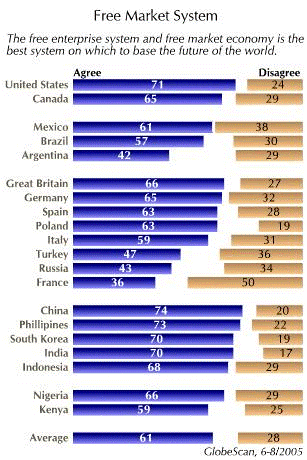
SOURCE: GlobeScan and PIPA, "20 Nation Poll Finds Strong Global Consensus: Support for Free Market System, But also More Regulation of Large Companies," 11 January 2006
Monday, October 29, 2007
How Can Anybody Be Persian?
| Comment peut-on être Persan ? par Manouchehr Mottaki Dans son chef-d'oeuvre Les Lettres persanes, publié en 1721, le grand philosophe français Charles-Louis de Montesquieu s'interroge sur les comportements surprenants des Français : lorsque Rica, son voyageur iranien arrivé à Paris, décide de s'habiller à la française, il constate avec étonnement que ses amis français ne le traitent plus avec l'admiration qu'ils lui portaient auparavant. Ce dualisme dans le comportement de la société française du XVIIIe siècle conduit le voyageur à se demander comment il est possible d'être iranien et de vivre dans un autre monde, à savoir l'Occident. L'histoire du dossier nucléaire iranien repose la même question. En effet, il y a trente ans, alors qu'un régime dictatorial régnait sur l'Iran, la décision de la République française de coopérer à la politique nucléaire d'un tel régime avait reçu l'approbation de tous les hommes politiques jusqu'au plus haut niveau. Au cours de ces années, les Français ne se sont posé aucune question concernant les objectifs du chah. Bien au contraire : la France proposa la participation iranienne à Framatome, puis à Eurodif, allant même jusqu'à inviter le chah à visiter les sites nucléaires français à Saclay et ne montrant aucune inquiétude concernant la coopération dans le domaine nucléaire, y compris militaire. Des années plus tard, lorsque le peuple iranien a mis fin au régime dictatorial et, s'inspirant des principes suprêmes de l'islam, a décidé de fonder une République ayant pour principe l'indépendance et la liberté (les valeurs mêmes de la Révolution française et de la Ve République), il s'attendait à ce que les dirigeants français accueillent positivement ce grand soulèvement, oeuvrant pour le développement de la démocratie en Orient. Or, la véritable tragédie est survenue lorsque l'Iranien de l'ère nouvelle, comme le personnage de Montesquieu, décida de bénéficier des moyens modernes du développement. Depuis, les coopérations pour le développement se sont arrêtées et les relations bilatérales se sont assombries au point que les armements français ont été généreusement mis à la disposition d'un autre tyran, nommé Saddam Hussein, afin qu'il prenne pour cible le peuple sans défense des villes iraniennes et détruise avec des armes françaises une partie du patrimoine historique grandiose d'un pays aussi ancien que la Perse. Un pays tel que la République islamique d'Iran, avec son potentiel régional et international, n'a pas besoin de se livrer à des marchandages pour défendre ses droits et poursuivre son développement économique et social. Œuvrer pour l'avenir des générations futures est notre devoir sacré et ne tolère aucune hésitation. Bien évidemment, dans cette voie, la République islamique d'Iran n'a pas opté pour une logique de confrontation. La coopération avec l'Agence internationale de l'énergie atomique, l'acceptation de l'initiative des pays européens en 2003, la mise en oeuvre volontaire du protocole additionnel et la suspension de l'enrichissement pendant deux ans, etc. sont des illustrations de la bonne foi de l'Iran. La question est donc de savoir ce qui s'est passé pour qu'un certain nombre de nos amis français, sans prendre en compte la place historique de leur pays en Europe, aient opté pour un ton très éloigné de celui qu'on pouvait attendre d'une vieille diplomatie. Nos documents de négociations démontrent qu'à l'été 2003, au début des négociations avec les Européens, nos amis français ont précisé qu'ils prenaient en main ce dossier afin de renforcer le poids de l'Europe sur la scène internationale et de tirer le bateau britannique vers le continent. Or, lorsque j'ai entendu le ministère britannique des affaires étrangères annoncer qu'il soutenait avec enthousiasme la demande française pour des sanctions unilatérales, et qu'en face l'Espagne, l'Italie, l'Autriche et l'Allemagne ont annoncé leur préférence pour davantage d'efforts diplomatiques, je me suis demandé si ce n'était pas le bateau britannique qui depuis 2003 tire le continent désemparé vers lui ? Même s'il convient de patienter un peu avant de se prononcer sur l'attitude du nouveau gouvernement britannique. Le président de la République française estime, à juste titre, que le développement insuffisant des pays de la région entraîne l'instabilité et l'accroissement de l'insécurité. Ce développement passe par celui de l'énergie nucléaire. La République islamique d'Iran ne souhaite donc pas que sa politique en matière nucléaire fasse l'objet d'une vision discriminatoire de la part de la France. Aussi, l'Iran poursuivra ses activités nucléaires et l'enrichissement d'uranium à des fins civiles, dans le respect des accords de sauvegarde et sous la supervision de l'AIEA, et en coopération avec les autres pays du monde. Il le fera sans se préoccuper de l'éventualité d'une attitude discriminatoire. Les préoccupations de la République islamique d'Iran ne sont nullement hypothétiques. Dans l'histoire des relations bilatérales, il existe en effet de nombreux exemples d'une approche discriminatoire de la part de la France (notamment l'embargo sur la vente d'avions de transport civil, de matériels médicaux et des radars pour la lutte contre le trafic des stupéfiants ou l'immigration clandestine). "Comment peut-on être Persan ?", se demandait l'ami français du voyageur des Lettres persanes. Montesquieu en tirait la conclusion que la pensée étroite de cet homme ne lui permettait pas d'admettre qu'il y ait, dans l'univers, d'autres personnes que des Français. | How Can Anybody Be Persian? by Manouchehr Mottaki In his masterpiece Persian Letters, published in 1721, the great French philosopher Charles-Louis de Montesquieu ponders the surprising behaviors of the French: his Iranian traveler Rica, arriving in Paris, decides to dress like the French and learns with astonishment that his French friends no longer treat him with admiration that they previously had for him. This dualism in the behavior of French society of the 18th century leads the traveler to wonder how it is possible to be Iranian and to live in another world, namely the West. The history of the Iranian nuclear issue raises the same question. Indeed, thirty years ago, when a dictatorial regime reigned in Iran, the French Republic's decision to cooperate with such a regime on nuclear policy received the approval of all the politicians up to the highest level. In those years, the French did not ask any question about the objectives of the Shah. Quite to the contrary: France proposed the Iranian participation in Framatome, then in Eurodif, even going so far as to invite the Shah to visit the French nuclear sites in Saclay, without exhibiting any unease about cooperation in the nuclear field, including military. Years later, when the Iranian people put an end to the dictatorial regime and, inspired by the highest principles of Islam, decided to found a republic on the principles of independence and freedom (the very values of the French Revolution and the Fifth Republic), we expected the French leaders to positively welcome this great uprising, working for the development of democracy in the East. However, a veritable tragedy occurred when the Iranians of the new era, like Montesquieu's character, decided to benefit from modern means of development. Thereafter, cooperation for development was halted, and the bilateral relations darkened, so much so that French weapons were generously placed at the disposal of another tyrant, named Saddam Hussein, so that the tyrant could target the defenseless people of Iranian cities and destroy, with French arms, a part of the magnificent historical heritage of a country as old as Persia. A country such as the Islamic Republic of Iran, with its regional and international potential, has no need to give itself up to haggling in order to defend its rights and to continue its economic and social development. Work for the future of coming generations is our sacred duty, and it doesn't admit any hesitation. Obviously, in this path, the Islamic Republic of Iran did not choose a logic of confrontation. Its cooperation with the International Atomic Energy Agency, its acceptance of the initiative of the European countries in 2003, its voluntary implementation of the additional protocol, its suspension of enrichment for two years, etc. illustrate the good faith of Iran. The question is thus what caused a certain number of our French friends to -- without taking their country's historic place in Europe into account -- choose a tone very far from what we would expect from venerable diplomacy. Our documents of negotiations show that, in the summer of 2003, at the beginning of the negotiations with the Europeans, our French friends explained that they took charge of this issue in order to reinforce the weight of Europe on the international scene and to pull the British ship towards the continent. However, when I heard the British Ministry of Foreign Affairs announce that it enthusiastically supported the French demand for unilateral sanctions, though Spain, Italy, Austria, and Germany in opposition announced their preference for more diplomatic efforts, I wondered whether it wasn't the British ship that, since 2003, had been drawing the lost continent towards it. Even if it is advisable to have a little patience before coming to a conclusion about the attitude of the new British government. The president of the French Republic rightly believes that insufficient development of countries leads to regional instability and heightened insecurity. This development goes through that of nuclear energy. The Islamic Republic of Iran thus does not wish its nuclear policy to become the target of a discriminatory vision on the part of France. Therefore, Iran will continue its nuclear activities and uranium enrichment for civilian purposes, respecting the safeguard agreements and under the supervision of the IAEA, and in cooperation with other countries of the world. It will do so without worrying about the possibility of a discriminatory behavior. The concerns of the Islamic Republic of Iran are by no means hypothetical. In the history of bilateral relations, there indeed exist many examples of a discriminatory approach on the part of France (in particular embargo on the sale of civil transport aircraft, medical equipment, and radars to combat drug trafficking or illegal immigration). "How can anybody be Persian?" wondered the French friend of the traveler of Persian Letters. Montesquieu drew the conclusion from it that the narrow thought of this man did not permit him to admit that there are, in the universe, other people besides the French. |
Manouchehr Mottaki is the Foreign Minister of the Islamic Republic of Iran. This essay was first published in Le Monde on 25 October 2007. English translation by Yoshie Furuhashi. Read it in Persian at Entekhab News.
Saturday, October 27, 2007
The Labor Wing of the Empire
The history of the labor wing of the US-led multinational empire -- such as the International Trade Union Confederation (the result of the 2006 merger of the International Confederation of Free Trade Unions and the World Confederation of Labour) with which the International Transport Workers' Federation is allied -- claiming to promote free, independent trade unions, i.e., trade unions that are independent of Communist parties and governments, and to act in solidarity with workers of the global South has not been a pretty one: see, for instance, Beth Sims, Workers of the World Undermined: American Labor's Role in U.S. Foreign Policy (South End Press, 1992). The end of state socialism and the Cold War did not change its fundamental role. A more recent history of it has been documented by such labor writers as Harry Kelber and Kim Scipes among others. Here is an example from Haiti: Jeb Sprague, "Failed Solidarity: The ICFTU, AFL-CIO, ILO, and ORIT in Haiti" (Labor Notes, June 2006). Leftists inside and outside Iran ought to be aware of what the labor wing of the empire does.1
The labor wing of the empire, like other vehicles of "democracy assistance," seizes upon a real problem of most post-revolutionary governments, whether they are Communist, nationalist, or Islamic: the fact that space for autonomy for organizations of workers and others is restricted to various degrees for reasons of national security (lack of autonomy is nearly complete under a one-party state-socialist state). The absence of autonomy eventually undermines the social gains of revolution when either the rulers abandon their commitment to the ideology that made revolution possible or the ruled become depoliticized and self-centered or both (the history of state socialism in China, Russia, and Eastern Europe is a cautionary tale for the Iranians, just as the history of the overthrows of Mossadegh, Arbenz, Allende, and others is). However, workers who turn to the labor wing of the empire to solve this undeniable problem usually come to grief.
Workers of the North, especially in the USA, are normally unaware of the dilemma faced by workers under post-revolutionary government in the South, who must fight for their class interests without undermining their national interests (especially defending their nation from the empire). In many cases, trade union members in the USA aren't even aware of what their unions are doing at home, let alone abroad. Naturally, they do not realize that intensified global competition, workers of formerly socialist or nationalist countries now competing with them for jobs, has come about in part because of the exertion of top labor bureaucrats of the North who were supposed to protect their interests.
In the meantime, workers of the North are also finding out how good their free, independent unions are, some of which are going far beyond business as usual of concession bargaining and giving up the right to strike altogether. See, for instance, Sam Gindin, "The CAW and Magna: Disorganizing the Working Class" (MRZine, 22 October 2007).
It is possible that, in the near future in the North, only French workers will remember how to strike, if not to win new gains, at least to defend their way of life. Even the still impressive national solidarity of French workers, however, may eventually be undermined by the gap between the public and private sectors: "nearly 20 points separates the rate of sympathy [for the 18 October 2007 strike] in the public sector (69%) from that in the private sector (49%)" (Christelle Chabaud, "The Majority Strike in Public Opinion," MRZine, 18 October 2007).
1 For instance, "On 15 February 2006, the ICFTU and its International Transport Workers' Federation coordinated rallies and protests outside Iranian legations world-wide" (Andreas Malm and Shora Esmailian, Iran on the Brink: Rising Workers and Threats of War, Pluto Press, 2007, p. 120), officials of the AFL-CIO and James P. Hoffa of the US Teamsters Union taking the lead. Malm and Esmailian celebrate this as "an unequalled manifestation of global solidarity with a labour movement in the Middle East" and "the most awe-inspiring show of global opposition to the labour politics of the Islamic Republic ever recorded" (Malm and Esmailian, pp. 120-121). Note, however, that nothing of the sort was done for any other Iranian workers, let alone workers of other countries in the Middle East, especially those of the empire's client states like Egypt.
Other Iranian labor activists took note of this contrast. Malm and Esmailian report that "The activists of Mohsen Hakimi and the other council communists of Komiteye Hamahangi, on the other hand, limited themselves to issuing a few statements, one of which was a condemnation of the global day of action" mentioned above (Malm and Esmailian, p. 121). The condemnation in question stated: "It means that the ICFTU . . . in the realm of the current conflict among the bourgeois government of Iran and other bourgeois governments [sic] has wanted the false defense of the demands of workers in Iran [to] be made a pretext in order to support one sector of the bourgeoisie in contrary to another sector" (qtd. in Malm and Esmailian, p. 121). While the translation is awkward, you get the drift. Malm and Esmailian cite it only to dismiss it as "[u]ltra-leftist gibberish," but that says more about their own lack of understanding of the labor wing of the empire, of which some Iranian workers are aware.
So do some workers of the North. Take Zenroren, an ally of the Japanese Communist Party, for instance. This year, there was an "ITF/ITUC International Action Day on Thursday 9 August in solidarity with union leaders Mansour Osanloo and Mahmoud Salehi," the day of action in part organized by the State Department-funded Solidarity Center. Rengo joined them, but Zenroren did not. Communists of Japan, no longer Marxists, still know better than getting involved in labor imperialism.
Far from it, JCP leaders actually attend the celebrations of the Iranian Revolution held at the Iranian Embassy in Japan and take other actions for the purpose of what they call Yato Gaikou, "opposition party diplomacy": see, for instance, "イラン革命記念レセプションに 志位委員長が出席," Akahata, 11 February 2003; "イラン革命記念レセプション: 不破議長が出席," Akahata, 11 February 2004; "イラン革命記念レセプション: 志位委員長が出席、ハラジ外相とあいさつ," Akahata, 11 February 2005; "イラン大使と志位委員長が懇談," Akahata, 21 December 2005; and "イラン革命記念レセプション: 市田書記局長が出席", Akahata, 10 February 2007.
Not that they agree on everything. The JCP, like most political parties in the world, is committed to a two-state idea on Israel/Palestine, whereas Iran is just about the only country in the world whose government is officially committed to a one-state solution based on the referendum of all people who live in historic Palestine and Palestinian refugees (though Iran's government adds that, whatever the Palestinians accept, it will also accept it), and the party candidly discusses its concerns with Iran's ambassadors (see "イラン大使と志位委員長が懇談," Akahata, 21 December 2005).
The labor wing of the empire, like other vehicles of "democracy assistance," seizes upon a real problem of most post-revolutionary governments, whether they are Communist, nationalist, or Islamic: the fact that space for autonomy for organizations of workers and others is restricted to various degrees for reasons of national security (lack of autonomy is nearly complete under a one-party state-socialist state). The absence of autonomy eventually undermines the social gains of revolution when either the rulers abandon their commitment to the ideology that made revolution possible or the ruled become depoliticized and self-centered or both (the history of state socialism in China, Russia, and Eastern Europe is a cautionary tale for the Iranians, just as the history of the overthrows of Mossadegh, Arbenz, Allende, and others is). However, workers who turn to the labor wing of the empire to solve this undeniable problem usually come to grief.
Workers of the North, especially in the USA, are normally unaware of the dilemma faced by workers under post-revolutionary government in the South, who must fight for their class interests without undermining their national interests (especially defending their nation from the empire). In many cases, trade union members in the USA aren't even aware of what their unions are doing at home, let alone abroad. Naturally, they do not realize that intensified global competition, workers of formerly socialist or nationalist countries now competing with them for jobs, has come about in part because of the exertion of top labor bureaucrats of the North who were supposed to protect their interests.
In the meantime, workers of the North are also finding out how good their free, independent unions are, some of which are going far beyond business as usual of concession bargaining and giving up the right to strike altogether. See, for instance, Sam Gindin, "The CAW and Magna: Disorganizing the Working Class" (MRZine, 22 October 2007).
It is possible that, in the near future in the North, only French workers will remember how to strike, if not to win new gains, at least to defend their way of life. Even the still impressive national solidarity of French workers, however, may eventually be undermined by the gap between the public and private sectors: "nearly 20 points separates the rate of sympathy [for the 18 October 2007 strike] in the public sector (69%) from that in the private sector (49%)" (Christelle Chabaud, "The Majority Strike in Public Opinion," MRZine, 18 October 2007).
1 For instance, "On 15 February 2006, the ICFTU and its International Transport Workers' Federation coordinated rallies and protests outside Iranian legations world-wide" (Andreas Malm and Shora Esmailian, Iran on the Brink: Rising Workers and Threats of War, Pluto Press, 2007, p. 120), officials of the AFL-CIO and James P. Hoffa of the US Teamsters Union taking the lead. Malm and Esmailian celebrate this as "an unequalled manifestation of global solidarity with a labour movement in the Middle East" and "the most awe-inspiring show of global opposition to the labour politics of the Islamic Republic ever recorded" (Malm and Esmailian, pp. 120-121). Note, however, that nothing of the sort was done for any other Iranian workers, let alone workers of other countries in the Middle East, especially those of the empire's client states like Egypt.
Other Iranian labor activists took note of this contrast. Malm and Esmailian report that "The activists of Mohsen Hakimi and the other council communists of Komiteye Hamahangi, on the other hand, limited themselves to issuing a few statements, one of which was a condemnation of the global day of action" mentioned above (Malm and Esmailian, p. 121). The condemnation in question stated: "It means that the ICFTU . . . in the realm of the current conflict among the bourgeois government of Iran and other bourgeois governments [sic] has wanted the false defense of the demands of workers in Iran [to] be made a pretext in order to support one sector of the bourgeoisie in contrary to another sector" (qtd. in Malm and Esmailian, p. 121). While the translation is awkward, you get the drift. Malm and Esmailian cite it only to dismiss it as "[u]ltra-leftist gibberish," but that says more about their own lack of understanding of the labor wing of the empire, of which some Iranian workers are aware.
So do some workers of the North. Take Zenroren, an ally of the Japanese Communist Party, for instance. This year, there was an "ITF/ITUC International Action Day on Thursday 9 August in solidarity with union leaders Mansour Osanloo and Mahmoud Salehi," the day of action in part organized by the State Department-funded Solidarity Center. Rengo joined them, but Zenroren did not. Communists of Japan, no longer Marxists, still know better than getting involved in labor imperialism.
Far from it, JCP leaders actually attend the celebrations of the Iranian Revolution held at the Iranian Embassy in Japan and take other actions for the purpose of what they call Yato Gaikou, "opposition party diplomacy": see, for instance, "イラン革命記念レセプションに 志位委員長が出席," Akahata, 11 February 2003; "イラン革命記念レセプション: 不破議長が出席," Akahata, 11 February 2004; "イラン革命記念レセプション: 志位委員長が出席、ハラジ外相とあいさつ," Akahata, 11 February 2005; "イラン大使と志位委員長が懇談," Akahata, 21 December 2005; and "イラン革命記念レセプション: 市田書記局長が出席", Akahata, 10 February 2007.
Not that they agree on everything. The JCP, like most political parties in the world, is committed to a two-state idea on Israel/Palestine, whereas Iran is just about the only country in the world whose government is officially committed to a one-state solution based on the referendum of all people who live in historic Palestine and Palestinian refugees (though Iran's government adds that, whatever the Palestinians accept, it will also accept it), and the party candidly discusses its concerns with Iran's ambassadors (see "イラン大使と志位委員長が懇談," Akahata, 21 December 2005).
Wednesday, October 24, 2007
Varieties of Secularism
Secular leftists as well as liberals tend to think that religion is an ideology, a product of alienation, whereas secularism isn't. Secularism, however, is a political doctrine, and as such, it is as much of an ideology as religion.
What kind of ideology is secularism?
There are at least three major varieties of this ideology that we need to study:
Nevertheless, even republican secularism, if the Left is not careful, can be deformed by the power elite into an instrument of social control, for example, as a weapon of xenophobic attack on predominantly proletarian migrants from France's former colonial possessions in the MENA region. An uncritical approach to secularism just helps make the empire more powerful at the expense of working people, in the North as well as the South.
1 Initially, Kemalism was an ideology of modernization as Westernization. The European Union's reluctance to admit Turkey as its member, however, has begun to change it. Mustafa Akyol, deputy editor of the Turkish Daily News, recently observed:
What kind of ideology is secularism?
There are at least three major varieties of this ideology that we need to study:
- republican secularism (secularism won from below through authentic social revolution, seen, for instance, in France and Mexico);
- authoritarian secularism (secularism imposed from above, for instance, Kemalism, an ideology invented as much to dissociate Turkey from its own region and make it a member of the mythical West1 as to pacify the working masses by dictating and controlling their ideology, purging religion here, promulgating a state-sanctioned variety of it there);
- the American separation of church and state (which makes the state legally secular but makes religion, both good and bad varieties, flourish in civil society).
Nevertheless, even republican secularism, if the Left is not careful, can be deformed by the power elite into an instrument of social control, for example, as a weapon of xenophobic attack on predominantly proletarian migrants from France's former colonial possessions in the MENA region. An uncritical approach to secularism just helps make the empire more powerful at the expense of working people, in the North as well as the South.
1 Initially, Kemalism was an ideology of modernization as Westernization. The European Union's reluctance to admit Turkey as its member, however, has begun to change it. Mustafa Akyol, deputy editor of the Turkish Daily News, recently observed:
What is most striking in this nationwide division is that the so-called Islamists are generally on the liberal pro-Western side, while the secularists are often on the other. In the general election held on July 22, the "Islamist" AKP had the most strongly pro-E.U. platform, whereas the ultra-secularist Republican People's Party tried to woo voters with Euro-skeptic rhetoric. (The AKP won the elections with a clear victory of 47 percent, while its main secular rival took 21 percent.) The AKP is also a strong proponent of free markets and foreign investment, whereas most secularist politicians see such things as "imperialist" and favor a state-protected economy. As Ziya Onis, a political economist at Koc University in Istanbul, said recently, the current power struggle in Turkey is between "conservative globalists" and "defensive nationalists" -- including the ultra-secular Kemalists. ("The Protocols of the Elders of Turkey," Washington Post, 7 October 2007, p. B2)It is in this context where the strangest variety of anti-Semitism, which peddles "a conspiracy theory about a Zionist plot to create an Islamist state" in Turkey, has emerged among Kemalists.
Look in just about any bookstore in Turkey, and you'll see some of the strangest bestsellers imaginable. The cover of "The Children of Moses," the first and most popular book in a series of four, shows the country's devoutly Muslim prime minister, Recep Tayyip Erdogan, in the middle of a six-pointed Star of David. Inside, you'll find a head-spinningly weird argument: that Erdogan and his conservative allies in Turkey's ruling pro-Islamic party are actually crypto-Jews with secret wicked ties to the conspiratorial forces of "global Zionism."
The books are hardly a fringe phenomenon. They're arrayed in chic bookstores along Istiklal Avenue, the funky pedestrian mall that's the heart of secular Istanbul. They're openly displayed alongside Orhan Pamuk novels at Ataturk International Airport. And they're even sold on tiny bookstands on the Princes' Islands, the vacation destinations in the Sea of Marmara that many well-off Turks view the way Manhattanites do the Hamptons. By the publishers' figures, they've sold about 520,000 copies since the books started rolling out this year -- a staggering figure for a nation of about 71 million people.
. . . . . . . . . . . . . . . . . . . .
Ergun Poyraz, who wrote the series, is a self-declared "Kemalist," the term used here to describe the committed followers of Mustafa Kemal Ataturk, the resolutely secular war hero who founded modern Turkey in 1923. The politicians whom Poyraz is out to skewer define themselves as sensible conservatives, but they're derided as closet fundamentalists by their foes among Turkey's traditional elites, who are still deeply suspicious of any intrusion of Islam into the public sphere. Poyraz's books argue -- apparently in all seriousness -- that "Zionism" has decided to steer Turkey away from its time-worn secular path and turn it into a "moderate Islamic republic." It is hard to believe that "Zionism" (let alone any sane Israeli leader) would prefer an Islamist Turkey to a secular one, but Poyraz is convinced that a mildly Islamic state would be more easily manipulated by foreign powers than a staunchly nationalist one. (Akyol, 7 October 2007, p. B2)
Saturday, October 20, 2007
Socialists in Europe
Socialists in Europe have to ask themselves. Is socialism possible in Europe? If so, what kind of socialism? And when? If not now or any time soon, what is to be done in the meantime? In their nation, and the European Union? Is their nation to become or remain a member of the European Union? If no, then what? If yes, what kind of Europe? How to get there?
The interval between the No vote on the European Constitution in 2005 and the elections in France this year, more than anything else, showed that the absence of clarity and of vision with regard to the aforementioned questions is a great problem. The defeat of the Left made France itself more Atlanticist -- and it can take Europe even closer than it is to the USA as well, which will be a great setback for the Third World.
We live in an age when populists of the Third World, religious or secular, have a more forward-looking vision1 than European Marxists. That must be rectified, immediately.
1 "Ahmadinejad: Europe Can Save Itself," Press TV, 18 October 2007; Lucian Kim, "Iran, Venezuela Form Oil Venture to Rival Shell, Eni (Update1)," Bloomberg, 18 October 2007; and "Russian and Iranian Presidents' Joint Statement,' ITAR-TASS, 17 October 2007.
The interval between the No vote on the European Constitution in 2005 and the elections in France this year, more than anything else, showed that the absence of clarity and of vision with regard to the aforementioned questions is a great problem. The defeat of the Left made France itself more Atlanticist -- and it can take Europe even closer than it is to the USA as well, which will be a great setback for the Third World.
We live in an age when populists of the Third World, religious or secular, have a more forward-looking vision1 than European Marxists. That must be rectified, immediately.
1 "Ahmadinejad: Europe Can Save Itself," Press TV, 18 October 2007; Lucian Kim, "Iran, Venezuela Form Oil Venture to Rival Shell, Eni (Update1)," Bloomberg, 18 October 2007; and "Russian and Iranian Presidents' Joint Statement,' ITAR-TASS, 17 October 2007.
Wednesday, October 17, 2007
Vision of a Europe for a Eurasian Century
In the new alignment of the US, the UK, and France, the weakest link is, of course, France.
Socialists are not sold on Bernard Kouchner's line,1 and Sarko the American is likely to prove as much of a divider2 as Bush.
The French Left, however, need a vision thing. What kind of vision? Like this. The 21st century shall be a Eurasian century, in which European nations for the first time become Europe, under Franco-German leadership, a Europe that recognizes Islam as a Eurasian religion, an integral part of the Western Civilization that ought to have existed but never did. And this Europe shall have a foreign policy of its own, independent of Washington's, and come to terms with nuclear Iran, push the Jewish state from the sea to the river to give voting rights to Palestinians in the OPTs, and re-invite Turkey, a friend of Iran and Israel, in good faith to become a member of the European Union.
1 Check out the Socialist Party line on Iran:
2 See Elaine Sciolino, "Is Nicolas Sarkozy's Honeymoon Over?" International Herald Tribune, 16 October 2007; and Associated Press, "French Transport to Stand Still in First Major Strikes against Sarkozy's Reforms," 17 October 2007.
Socialists are not sold on Bernard Kouchner's line,1 and Sarko the American is likely to prove as much of a divider2 as Bush.
The French Left, however, need a vision thing. What kind of vision? Like this. The 21st century shall be a Eurasian century, in which European nations for the first time become Europe, under Franco-German leadership, a Europe that recognizes Islam as a Eurasian religion, an integral part of the Western Civilization that ought to have existed but never did. And this Europe shall have a foreign policy of its own, independent of Washington's, and come to terms with nuclear Iran, push the Jewish state from the sea to the river to give voting rights to Palestinians in the OPTs, and re-invite Turkey, a friend of Iran and Israel, in good faith to become a member of the European Union.
1 Check out the Socialist Party line on Iran:
Mohammad EL BARADEI, Directeur général de l'AIEA, déploie des efforts considérables pour tenter de trouver une solution à la crise, en mettant en place une méthode de solution des principaux points en litiges et fait état des signaux encourageants en ce sens.Nor is the rest of the European Union eager to follow Sarko and Kouchner's plan to further Americanize Europe: "A number of EU states -- such as Germany -- say the EU must not start applying a raft of sanctions wholly outside the UN framework, arguing that this would risk fragmenting the UN process" (James Blitz and Fidelius Schmid, "EU Seeks to Step Up Pressure on Tehran," Financial Times, 16 October 2007).
Il ne voit pas aujourd'hui de danger clair concernant le programme nucléaire iranien. C'est le moment qu'ont choisi Nicolas SARKOZY et son ministre des Affaires Etrangères pour préconiser des sanctions hors Nations Unies et des préparatifs de guerre. La position de Nicolas SARKOZY, s'engageant à nouveau dans un scénario à l'Irakienne ne peut s'expliquer que par son alignement sur l'administration Bush. Cet alignement affaiblit l'autorité de l'ONU, met en danger la crédibilité, les intérêts et la sécurité de la France et est en contradiction avec les engagements de notre pays au Moyen-Orient.
Le Parti socialiste estime que l'AIEA doit mener jusqu'au bout la procédure de vérification du programme nucléaire iranien et la mise en œuvre d'un système rigoureux de contrôles internationaux. La France ne peut s'engager avec autant de légèreté dans des confrontations militaires dans une région si instable et mouvementée.
Le Parti socialiste demande qu'un débat soit engagé rapidement au Parlement sur ce dossier.
Communiqué du Secrétariat international ("IRAN: Déclaration de Bernard Kouchner," 17 septembre 2007)
2 See Elaine Sciolino, "Is Nicolas Sarkozy's Honeymoon Over?" International Herald Tribune, 16 October 2007; and Associated Press, "French Transport to Stand Still in First Major Strikes against Sarkozy's Reforms," 17 October 2007.
Sunday, August 19, 2007
Iran, the Other of the West?
Today, Iran is often represented as the Other of the West, by Iranians as well as Americans and Europeans. Is it?
Politically, the Iranians, with their Jacobin tendency and revolutionary history (the first revolution in the global South and the last social revolution in the world), are more like the French (my Great White Hope) than anyone else in Asia.
The syntactical body of the Persian language, moreover, is an Indo-European body, invisible to outsiders as it is, under its fine Arabic raiment. Its basic structure is SOV (with adjectives always coming after the noun they modify), so if you come to Persian from French or Spanish (SOV when a pronoun is used as the direct or indirect object, with adjectives usually coming after the noun they modify) for instance, rather than from English, you'll probably find it an easy language to learn.1
Nevertheless, even for English speakers, Persian may be in fact easier to learn than most other Indo-European languages, as Persian doesn't have grammatical gender of the sort that marks their nouns and adjectives among others. Persian is a very gender-neutral language. E.g., "she" and "he" are both expressed by او (u). That gender neutrality makes Persian love poetry very fascinating.
1 Engels claimed that he could master its grammar in 48 hours:
Politically, the Iranians, with their Jacobin tendency and revolutionary history (the first revolution in the global South and the last social revolution in the world), are more like the French (my Great White Hope) than anyone else in Asia.
The syntactical body of the Persian language, moreover, is an Indo-European body, invisible to outsiders as it is, under its fine Arabic raiment. Its basic structure is SOV (with adjectives always coming after the noun they modify), so if you come to Persian from French or Spanish (SOV when a pronoun is used as the direct or indirect object, with adjectives usually coming after the noun they modify) for instance, rather than from English, you'll probably find it an easy language to learn.1
Nevertheless, even for English speakers, Persian may be in fact easier to learn than most other Indo-European languages, as Persian doesn't have grammatical gender of the sort that marks their nouns and adjectives among others. Persian is a very gender-neutral language. E.g., "she" and "he" are both expressed by او (u). That gender neutrality makes Persian love poetry very fascinating.
1 Engels claimed that he could master its grammar in 48 hours:
Since I am in any case tied up with the eastern mummery for some weeks, I have made use of the opportunity to learn Persian. I am put off Arabic, partly by my inborn hatred of Semitic languages, partly by the impossibility of getting anywhere, without considerable expenditure of time, in so extensive a language -- one which has 4,000 roots and goes back over 2,000-3,000 years. By comparison, Persian is absolute child's play. Were it not for that damned Arabic alphabet in which every half dozen letters looks like every other half dozen and the vowels are not written, I would undertake to learn the entire grammar within 48 hours. This for the better encouragement of Pieper should he feel the urge to imitate me in this poor joke. I have set myself a maximum of three weeks for Persian, so if he stakes two months on it he'll best me anyway. What a pity Weitling can't speak Persian; he would then have his langue universelle toute trouvie [universal language ready-made] since it is, to my knowledge, the only language where 'me' and 'to me' are never at odds, the dative and accusative always being the same. (Engels to Marx, Manchester, 6 June 1853, MECW Vol. 39, p. 335)
Saturday, March 12, 2005
French Workers Defend the 35-Hour Work Week
French unions called a day of strikes and demonstrations on March 10, 2005 "pour les 35 heures, l’emploi et le pouvoir d’achat" (for the 35-hour work week, employment, and purchasing power), and more than one million workers and students poured into the streets:
Defense of the 35-hour work week is one of the most urgent demands of French workers. The National Assembly, the lower house of the French parliament, "voted 370-180 allowing private-sector employees to swap time off for more money, letting them work more than 35 hours a week" on February 9, 2005 (Francois de Beaupuy, "French Lower House Loosens 35-Hour Work Week Law (Update2)," Bloomberg.com, February 9, 2005) -- a measure approved by the Senate on March 4 (Robert Stevens, "General Strike in France as Workers Continue Protests against Raffarin Government," WSWS.org, March 11, 2005). While the 35-hour week, initiated by a Socialist parliament in 1998, had already been eroded by the changes made in 2003 and 2004, the new law represents a far more dramatic attack on workers' right to leisure, allowing "employees to work beyond the 220-hour overtime limit and up to 48 hours a week if they volunteer" and letting "companies buy back days off that workers don't want and extend for three years a reduced rate of overtime at businesses with fewer than 20 people" (Beaupuy, February 9, 2005). A large majority of the French do not want longer hours: "A survey by polling company Ifop published in Le Journal du Dimanche showed Jan. 30 that 77 percent of 959 respondents would prefer to leave their working time unchanged" (emphasis added, Beaupuy, February 9, 2005).
And why should they? At the same time as increasing workers' quality of life, the 35-hour week succeeded in creating a modest number of new jobs:
The third mobilization of the French working class since the beginning of this year, the general strike is supported by "69 percent of the French, according to a survey by polling company CSA for the communist L'Humanite daily" (emphasis added, Gabriele Parussini, "French Unions Call Strike March 10 on Workweek, Wages (Update1)," Bloomberg.com, March 8, 2005).
Rail tracks are deserted near the Saint-Jean station at the start of a 24-hour nationwide strike by employees of the state run railroads SNCF in Bordeaux, south-western France, March 10, 2005. French labor unions called for nationwide protests and a day of general strikes to defend the 35-hour work week. (Regis Duvignau/Reuters)
Women lead a group of demonstrators as tens of thousands of protesters march through Paris, answering the call of unions for a massive turnout to defend France's 35-hour workweek and to push for more jobs and salary talks, Thursday March 10, 2005. Protests nationwide drew big crowds. (Francois Mori/AP)
Some of tens of thousands of protesters march through Paris, answering the call of unions for a massive turnout to defend France's 35-hour work week and to push for more jobs and salary talks, Thursday March 10, 2005. Protests nationwide drew big crowds. Banners read: Olympic games in seven years, salaries now. (Francois Mori/AP)
Students demonstrate against education reform in central Paris, March 10, 2005 as they joined nationwide protests on a day of general strikes to defend the 35-hour work week. (Jack Dabaghian/Reuters)
A French high school student holds a sign which reads, 'Fillon we will destroy your Law' as she shouts protest slogans asking the French Education Minister Francois Fillon to retract his law proposal intended to modify the evaluation process for the French baccalaureat diploma or 'bac' at a demonstration in Paris, February 15, 2005. (Jacky Naegelen/Reuters)
Researchers demonstrate with posters as scientists nationwide are protesting over a draft law that would provide more state funding for research but which protesters contend remains inadequate, Wednesday March 9, 2005 in Paris. Poster at left shows Marie Curie and reads: 'They became crazy'. At right, a poster of Frederic Joliot and reads: He Stayed in France. (Francois Mori/AP)


Defense of the 35-hour work week is one of the most urgent demands of French workers. The National Assembly, the lower house of the French parliament, "voted 370-180 allowing private-sector employees to swap time off for more money, letting them work more than 35 hours a week" on February 9, 2005 (Francois de Beaupuy, "French Lower House Loosens 35-Hour Work Week Law (Update2)," Bloomberg.com, February 9, 2005) -- a measure approved by the Senate on March 4 (Robert Stevens, "General Strike in France as Workers Continue Protests against Raffarin Government," WSWS.org, March 11, 2005). While the 35-hour week, initiated by a Socialist parliament in 1998, had already been eroded by the changes made in 2003 and 2004, the new law represents a far more dramatic attack on workers' right to leisure, allowing "employees to work beyond the 220-hour overtime limit and up to 48 hours a week if they volunteer" and letting "companies buy back days off that workers don't want and extend for three years a reduced rate of overtime at businesses with fewer than 20 people" (Beaupuy, February 9, 2005). A large majority of the French do not want longer hours: "A survey by polling company Ifop published in Le Journal du Dimanche showed Jan. 30 that 77 percent of 959 respondents would prefer to leave their working time unchanged" (emphasis added, Beaupuy, February 9, 2005).
And why should they? At the same time as increasing workers' quality of life, the 35-hour week succeeded in creating a modest number of new jobs:
Moreover, shorter work hours are a spur to productivity growth in the long term. "Starting in 1950, hours per employee in Europe dropped faster than in the U. S., while the employee/population ratio plummeted during the 1973-92 sub-interval," while "Europe achieved much faster productivity growth in 1950-73 and 1973-2000 than did the United States" (Robert J. Gordon, "Two Centuries of Economic Growth: Europe Chasing the American Frontier," March 30, 2004, pp. 7, 9). Not only do shorter work hours, invigorating workers, boost productivity; they, in combination with good labor laws that empower the working class, also give management a strong incentive to make capital investment to raise productivity: "In 1946, the [capital-labor] ratio in the US was three times higher than in Europe [Germany, France, and the United Kingdom]. By around 1990, the European ratio surpassed that of the United States and continued to grow faster than in the United States" (Gérard Duménil and Dominique Lévy, Capital Resurgent: Roots of the Neoliberal Revolution, trans. Derek Jeffers, Cambridge: Harvard University Press, 2004, p. 39-40). That's certainly a better bargain for the working class than the American bargain of trading longer hours and higher labor force participation at slower productivity growth for only a slightly bigger real GDP per capita (Gordon, "Figure 1: Per Capita Real GDP, Europe and the United States, Selected Years, 1820-2000," p. 54).
Source: Gunnar Trumbull/Center on the United States and France, "France's 35 Hour Work Week: Flexibility Through Regulation," U.S.-France Analysis, January 2001

Wednesday, March 09, 2005
A Very Long Engagement
A Very Long Engagement (Dir. Jean-Pierre Jeunet, 2004), set in World War 1 and its aftermath, is an improbable mixture of sweetness and shadow -- an unabashedly romantic "chick film" with palpable commercial ambitions that nevertheless more successfully conveys working-class sentiments against war than more cooly artistic films like Paths of Glory (Dir. Stanley Kubrick, 1957). The heroine Mathilde's fiancé Manech (Gaspard Ulliel), together with four other French soldiers, gets sentenced to be thrown out and left to die in No Man's Land between the French and German lines, on account of self-mutilation to escape the front line and go home.
A Very Long Engagement has two distinctions. First, one of the five condemned men, played by Denis Lavant, is a socialist welder. Very few films have represented any working-class individuals -- even minor characters -- as socialists. Films, as well as other forms of fiction, tend to portray socialists as middle-class intellectuals and workers as indifferent to politics -- the tendency that not only erases working-class socialists from history but also harbors a condescending view of workers' intellectual capacity. A Very Long Engagement is an interesting partial exception (partial in so far as the socialist welder is represented as unable to reach his fellow workers except by joining them symbolically through an act of individual refusal). Here's an excerpt from Sébastien Japrisot's book of the same title on which the film is based -- it says a little more about the welder than the film:
French soldiers' rebellious refusal to continue fighting the futile war as well as an understanding between French and German soldiers hinted at in A Very Long Engagement is rooted in history, except that French soldiers in the real world became eventually more collectively revolutionary than individual refusers in the fiction.
A Very Long Engagement begins with the sentencing of the aforementioned five soldiers in January 1917, as they are marched down a trench to Bingo Crépuscule. That's mere four months before mutinies in the French Army that began on May 27, 1917, involving as many as 30,000 soldiers:
A Very Long Engagement, whose whimsically romantic plot and enchanting visual set pieces at times overwhelm its political substance, is nevertheless one of the few films in which mutinous soldiers of World War 1 make their ghostly presence felt -- the presence that some viewers of the film may be led to discover in historical documents neglected by national histories.

A Very Long Engagement has two distinctions. First, one of the five condemned men, played by Denis Lavant, is a socialist welder. Very few films have represented any working-class individuals -- even minor characters -- as socialists. Films, as well as other forms of fiction, tend to portray socialists as middle-class intellectuals and workers as indifferent to politics -- the tendency that not only erases working-class socialists from history but also harbors a condescending view of workers' intellectual capacity. A Very Long Engagement is an interesting partial exception (partial in so far as the socialist welder is represented as unable to reach his fellow workers except by joining them symbolically through an act of individual refusal). Here's an excerpt from Sébastien Japrisot's book of the same title on which the film is based -- it says a little more about the welder than the film:
Before the nightmare he'd been a corporal, because they'd needed one and the fellows in his platoon had chosen him, but he hated military ranks. He was certain that one day all men, including welders, would be free and equal among themselves. He was a welder in Bagneux, near Paris, with a wife, two daughters, and marvelous phrases in his head, phrases learned by heart, that spoke of the workingman throughout the world, that said. . . . For more than thirty years he'd known perfectly well what they said, and his father, who'd so often told him about the Paris Commune, had known this, too.The second distinction, the more extraordinary, is that A Very Long Engagement shows a French soldier killing a French officer during an offensive. The soldier, Benoît Notre-Dame (played by Clovis Cornillac), sees the officer kicking the bodies of dead French soldiers whom the officer curses as incompetent cowards, and, outraged, he suffocates the officer in the mud. Nobody sees his act (except the audience), so he does not get charged with murder. And, among the five condemned men, he is the most resourceful survivor, saving Manech's life and escaping himself. What other film has shown a soldier kill a superior and get away with it?
It was in their blood. His father had had it from his father, and had passed it on to his son, who had always known that the poor manufacture the engines of their own destruction, but it's the rich who sell them. He'd tried to talk about this in the billets, in the barns, in the village cafés, when the proprietress lights the kerosene lamps and the policeman pleads with you to go home, you're all good folks, so let's be reasonable now, it's time to go home. He wasn't a good speaker, he didn't explain things well. And they lived in such destitution, these poor people, and the light in their eyes was so dimmed by alcohol, the boon companion of poverty, that he'd felt even more helpless to reach them.
A few days before Christmas, as he was going up the line, he'd heard a rumor about what some soldiers had done. So he'd loaded his gun and shot himself in the left hand, quickly, without looking, without giving himself time to think about it, simply to be with them. In that classroom where they'd sentenced him, there had been twenty-eight men who'd all done the same thing. He was glad, yes, glad and almost proud that there had been twenty-eight of them. Even if he would never live to see it, since the sun was setting for the last time, he knew that a day would come when the French, the Germans, the Russians -- "and even the clergy" -- would refuse to fight, ever again, for anything. Well, that's what he believed. He had those very pale blue eyes flecked with tiny red dots that welders sometimes have. (Sébastien Japrisot, A Very Long Engagement, trans. Linda Coverdale, NY: Plume, 1993 [originally published in France in 1991])
French soldiers' rebellious refusal to continue fighting the futile war as well as an understanding between French and German soldiers hinted at in A Very Long Engagement is rooted in history, except that French soldiers in the real world became eventually more collectively revolutionary than individual refusers in the fiction.
A Very Long Engagement begins with the sentencing of the aforementioned five soldiers in January 1917, as they are marched down a trench to Bingo Crépuscule. That's mere four months before mutinies in the French Army that began on May 27, 1917, involving as many as 30,000 soldiers:
Official archives give the figures of 3,427 soldiers convicted of offences relating to the mutinies, some 554 receiving death sentences of which 49 were executed.65 However, these figures have been contested by historians of the mutinies.That was not the only rank-and-file rebellion during World War 1. Shortly after the war began, German, British, French, and other soldiers organized a Christmas truce in December 1914 (see, for instance, "The Christmas Truce," BBC, November 3, 1999; and Harvey Thompson, "War, Football and the 1914 Christmas Truce," WSWS.org, July 17, 2003). By 1917, the war further radicalized many more soldiers, sparking mutinies in the Russian, French, German, British, Italian, and other forces in 1917-1919. Of course, the Russian Revolution itself could not have happened without mutinous Russian soldiers who refused orders to crush strikers and protesters and deserted from the front.. . . executions involved in the suppression of revolt could be covered up by listing the death under some category other than execution, such as 'died of wounds' or 'killed in an accident.'66. . . .(Peter Edwards, "'Mort pour la France': Conflict and Commemoration in France after the First World War," University of Sussex Journal of Contemporary History 1, 2000, p. 8)
A Very Long Engagement, whose whimsically romantic plot and enchanting visual set pieces at times overwhelm its political substance, is nevertheless one of the few films in which mutinous soldiers of World War 1 make their ghostly presence felt -- the presence that some viewers of the film may be led to discover in historical documents neglected by national histories.
Subscribe to:
Posts (Atom)


