Showing posts with label Mexico. Show all posts
Showing posts with label Mexico. Show all posts
Sunday, July 13, 2008
La Llorona
Two tributes to Frida Kahlo (6 July 1907 - 13 July 1954), one sung by Raphael, the other by Chavela Vargas.

Wednesday, October 24, 2007
Varieties of Secularism
Secular leftists as well as liberals tend to think that religion is an ideology, a product of alienation, whereas secularism isn't. Secularism, however, is a political doctrine, and as such, it is as much of an ideology as religion.
What kind of ideology is secularism?
There are at least three major varieties of this ideology that we need to study:
Nevertheless, even republican secularism, if the Left is not careful, can be deformed by the power elite into an instrument of social control, for example, as a weapon of xenophobic attack on predominantly proletarian migrants from France's former colonial possessions in the MENA region. An uncritical approach to secularism just helps make the empire more powerful at the expense of working people, in the North as well as the South.
1 Initially, Kemalism was an ideology of modernization as Westernization. The European Union's reluctance to admit Turkey as its member, however, has begun to change it. Mustafa Akyol, deputy editor of the Turkish Daily News, recently observed:
What kind of ideology is secularism?
There are at least three major varieties of this ideology that we need to study:
- republican secularism (secularism won from below through authentic social revolution, seen, for instance, in France and Mexico);
- authoritarian secularism (secularism imposed from above, for instance, Kemalism, an ideology invented as much to dissociate Turkey from its own region and make it a member of the mythical West1 as to pacify the working masses by dictating and controlling their ideology, purging religion here, promulgating a state-sanctioned variety of it there);
- the American separation of church and state (which makes the state legally secular but makes religion, both good and bad varieties, flourish in civil society).
Nevertheless, even republican secularism, if the Left is not careful, can be deformed by the power elite into an instrument of social control, for example, as a weapon of xenophobic attack on predominantly proletarian migrants from France's former colonial possessions in the MENA region. An uncritical approach to secularism just helps make the empire more powerful at the expense of working people, in the North as well as the South.
1 Initially, Kemalism was an ideology of modernization as Westernization. The European Union's reluctance to admit Turkey as its member, however, has begun to change it. Mustafa Akyol, deputy editor of the Turkish Daily News, recently observed:
What is most striking in this nationwide division is that the so-called Islamists are generally on the liberal pro-Western side, while the secularists are often on the other. In the general election held on July 22, the "Islamist" AKP had the most strongly pro-E.U. platform, whereas the ultra-secularist Republican People's Party tried to woo voters with Euro-skeptic rhetoric. (The AKP won the elections with a clear victory of 47 percent, while its main secular rival took 21 percent.) The AKP is also a strong proponent of free markets and foreign investment, whereas most secularist politicians see such things as "imperialist" and favor a state-protected economy. As Ziya Onis, a political economist at Koc University in Istanbul, said recently, the current power struggle in Turkey is between "conservative globalists" and "defensive nationalists" -- including the ultra-secular Kemalists. ("The Protocols of the Elders of Turkey," Washington Post, 7 October 2007, p. B2)It is in this context where the strangest variety of anti-Semitism, which peddles "a conspiracy theory about a Zionist plot to create an Islamist state" in Turkey, has emerged among Kemalists.
Look in just about any bookstore in Turkey, and you'll see some of the strangest bestsellers imaginable. The cover of "The Children of Moses," the first and most popular book in a series of four, shows the country's devoutly Muslim prime minister, Recep Tayyip Erdogan, in the middle of a six-pointed Star of David. Inside, you'll find a head-spinningly weird argument: that Erdogan and his conservative allies in Turkey's ruling pro-Islamic party are actually crypto-Jews with secret wicked ties to the conspiratorial forces of "global Zionism."
The books are hardly a fringe phenomenon. They're arrayed in chic bookstores along Istiklal Avenue, the funky pedestrian mall that's the heart of secular Istanbul. They're openly displayed alongside Orhan Pamuk novels at Ataturk International Airport. And they're even sold on tiny bookstands on the Princes' Islands, the vacation destinations in the Sea of Marmara that many well-off Turks view the way Manhattanites do the Hamptons. By the publishers' figures, they've sold about 520,000 copies since the books started rolling out this year -- a staggering figure for a nation of about 71 million people.
. . . . . . . . . . . . . . . . . . . .
Ergun Poyraz, who wrote the series, is a self-declared "Kemalist," the term used here to describe the committed followers of Mustafa Kemal Ataturk, the resolutely secular war hero who founded modern Turkey in 1923. The politicians whom Poyraz is out to skewer define themselves as sensible conservatives, but they're derided as closet fundamentalists by their foes among Turkey's traditional elites, who are still deeply suspicious of any intrusion of Islam into the public sphere. Poyraz's books argue -- apparently in all seriousness -- that "Zionism" has decided to steer Turkey away from its time-worn secular path and turn it into a "moderate Islamic republic." It is hard to believe that "Zionism" (let alone any sane Israeli leader) would prefer an Islamist Turkey to a secular one, but Poyraz is convinced that a mildly Islamic state would be more easily manipulated by foreign powers than a staunchly nationalist one. (Akyol, 7 October 2007, p. B2)
Sunday, April 03, 2005
Soldados Mexicanos Muertos en Irak
Xenophobes of the Minuteman Project (at www.minutemanproject.com) want to play soldiers on the Arizona-Mexico border, hunting down "illegal aliens."
"As of January, about 41,000 permanent resident aliens were in the U.S. armed forces, 3,639 of them from Mexico. The Mexicans are the largest group among the 63 immigrants who have been killed in action in Iraq, the Pentagon says" (James C. McKinley Jr., "In Mexico, Burying Soldiers Killed in a U.S. War," New York Times/International Herald Tribune 23 Mar. 2005).
The New York Times accompanied McKinley's article with Adriana Zehbrauskas' photographs of Pfc. Jesús Fonseca, a Mexican soldier "who died in Iraq at the age of 19," and his family:
Meanwhile, Mexicans are dying in Iraq for the US government, which took vast swathes of land that are now incorporated in the states of Arizona, California, Colorado, New Mexico, Nevada, Texas, and Utah from Mexico through the War of 1846-48, the war that Ulysses S. Grant regarded as "one of the most unjust ever waged by a stronger against a weaker nation," "an instance of a republic following the bad example of European monarchies, in not considering justice in their desire to acquire additional territory" (Personal Memoirs, NY: C.L. Webster, 1885–86).

"As of January, about 41,000 permanent resident aliens were in the U.S. armed forces, 3,639 of them from Mexico. The Mexicans are the largest group among the 63 immigrants who have been killed in action in Iraq, the Pentagon says" (James C. McKinley Jr., "In Mexico, Burying Soldiers Killed in a U.S. War," New York Times/International Herald Tribune 23 Mar. 2005).
The New York Times accompanied McKinley's article with Adriana Zehbrauskas' photographs of Pfc. Jesús Fonseca, a Mexican soldier "who died in Iraq at the age of 19," and his family:
While the military entice immigrant youth with the promise of expedited citizenship and fallen non-citizen soldiers are awarded posthumous citizenship, "no such program exists for soldiers seeking citizenship for their spouses" (Angeles Gonzalez, "U.S. Soldier’s Wife Denied Citizenship," SiliconValleyDeBug.com/Pacific News Service 31 Mar. 2005). Specialist Jaime Lepe, now serving in central Iraq, is unable to bring his wife Areli to the United States. She, a Mexican national, was "recently denied entry into the U.S." (Gonzalez, 31 Mar. 2005).
Mr. Fonseca was eulogized as a hero, though some at the burial struggled to connect his sacrifice to Mexico, where many people oppose the Iraq war or are indifferent to it (Adriana Zehbrauskas/New York Times).
Private Fonseca's grandmother, Amada Ayala García, fought back tears when she was asked whether she supported the war that had taken her grandson's life (Adriana Zehbrauskas/New York Times).


Tuesday, January 11, 2005
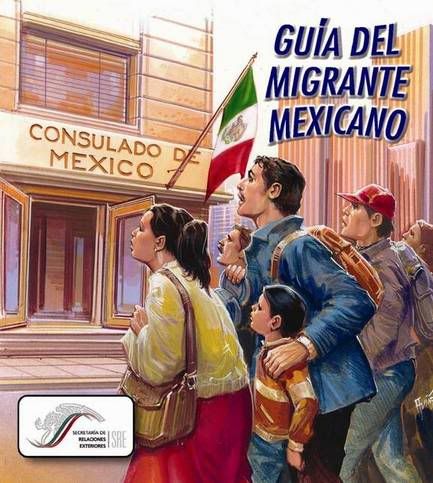
Guía del Migrante Mexicano
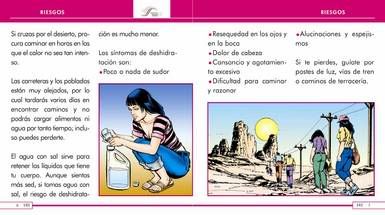
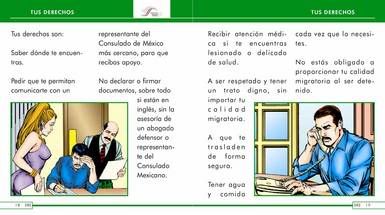
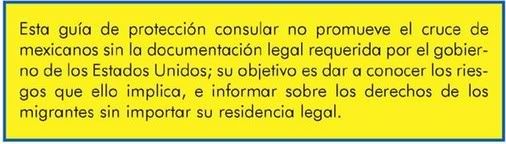
Last month, Mexico's Foreign Ministry published Guía del Migrante Mexicano [Guide for the Mexican Migrant], a 31-page illustrated handbook for Mexican workers who cross the Rio Grande in search of trabajo, and distributed "about 1.5 million copies" of it (James C. McKinley, Jr., "A Mexican Manual for Illegal Migrants Upsets Some in U.S.," New York Times, January 6, 2005).
Seriously, where would the U.S. economy be without an estimated $155 billion in output that 3 million undocumented Mexican workers add to it?
Seriously, where would the U.S. economy be without an estimated $155 billion in output that 3 million undocumented Mexican workers add to it?
Saturday, September 11, 2004
Gringoton
Check out Salón Chingón and watch Gringoton, a comic short film directed by Greg "Gringoyo" Berger, in which Berger stars as a gringo in shorts and a Hawaiian shirt who works Mexico City selling chewing gum, squeegeeing windshields, and singing songs in the streets -- all for the cause of raising funds for a popular insurrection to bring George W. Bush before an international human rights tribunal.
Thursday, June 24, 2004
A Day without a Mexican
Here's a new disaster film -- A Day without a Mexican/Un Día sin Mexicanos (Dir. Sergio Arau, 2004):
Since its May premier in cities with large Latino populations, A Day without a Mexican has done well in the United States: "It may not be on as many screens as some of the summer's big blockbusters, but the movie 'A Day Without A Mexican' has consistently sold out shows since it's recent opening" (Vivian Tamayo, "'A Day Without A Mexican' Released in Houston Theaters," June 1, 2004). See, also, indieWIRE:BOT's "Box Office Table" (June 2, 2004). The film will open in Latin America in August (Diego Cevallos/IPS, "Latinos or Chaos," June 23, 2004).
The film's funding, too, was a cross-border affair:
Watch the film's trailer at its official website.

The film envisions a mysterious cloud that envelops California and magically removes all the Latinos. The results are comical -- as in the case of the state senator's wife who must tackle the laundry without domestic help and the Border Patrol agents who fear for their jobs after all the migrants vanish. They are also pointed -- as schools and day cares shut down and panicked shoppers mob supermarkets for the last fresh fruits and vegetables. . . .A Day without a Mexican is a gentle satire (which Joe Rodriguez of The Mercury News says is "too polite" ["Who Would Pick Crops, Mow Lawns and Do Dishes?" June 11, 2004]), but what if the United States government actually succeeded in deporting all "illegal aliens" in the real world? "El profesor Raúl Hinojosa, de la Universidad de California en Los Angeles (UCLA) también actúa en la película y acaba de publicar un nuevo libro en que explora el impacto de la falta de inmigrantes en la economía californiana. 'La quinta economía más grande del mundo (la de California) está basada en la contribución de los inmigrantes', dijo hace poco a la prensa. 'Si realmente desaparecen todos los latinos en California sería una crisis mucho peor de como está en la película'" (Jorge Ramos Avalos, "Estados Unidos sin Latinos," June 7, 2004). Hinojosa's research demonstrated, for instance, that, based on a conservative estimate of 3 million undocumented Mexican workers, "[a] reduction in the undocumented Mexican immigrant population to zero [alone] would produce a dramatic drop in U.S. economic output (about $155 billion)" (Raul Hinojosa Ojeda, "Comprehensive Migration Policy Reform in North America: The Key to Sustainable and Equitable Economic Integration," August 2001, p. 6). Some advocate a more restrictive immigration policy, arguing that more immigrants, expanding the labor pool, depress wages, but Hinojosa says that further restrictions on immigrant rights, such as adoption of a neo-Bracero program, would produce a reduction in immigrant wages, which would in turn increase the demand for low-wage undocumented immigrants (August 2001, p. 6). In contrast, legalization of undocumented workers has been shown to raise their wages, creating a higher floor for wages of all workers: "Real wages of legalized undocumented workers rose an average of 15% in the 4-5 years following legalization, compared to declining real wages in the years prior to legalization" (US Department of Labor, 1996, p.43, qtd. in Hinojosa, August 2001, p. 28).
The disappearance leads Californians who once were dismissive or contemptuous of Latinos to hold candlelight vigils, where they sing "De Colores" with bad Spanish accents and march around with placards reading "Come back, amigos."
. . .[The director Sergio Arau and his wife Yareli Arizmendi who co-wrote the film's script] got the idea for the film when they visited New York and found the city observing a "Day Without Art," on which museums and galleries closed down to draw attention to the devastating effect of the AIDS epidemic on the art world.
"I said, 'Maybe what California needs is a day without Mexicans,' to revalue the role we play," said actress Arizmendi, who stars in the film and who was born in Mexico and raised in the United States. (Tyche Hendricks, "Dónde Están the Hired Hands?: 'A Day Without a Mexican' Portrays California Lacking a Third of Its People," San Francisco Chronicle, June 4, 2004)
Since its May premier in cities with large Latino populations, A Day without a Mexican has done well in the United States: "It may not be on as many screens as some of the summer's big blockbusters, but the movie 'A Day Without A Mexican' has consistently sold out shows since it's recent opening" (Vivian Tamayo, "'A Day Without A Mexican' Released in Houston Theaters," June 1, 2004). See, also, indieWIRE:BOT's "Box Office Table" (June 2, 2004). The film will open in Latin America in August (Diego Cevallos/IPS, "Latinos or Chaos," June 23, 2004).
The film's funding, too, was a cross-border affair:
Respecto de la producción Yareli agregó: "Sentimos bonito de que se haya realizado con una inversión mexicana y algo de española, porque es un poco irónico traer capital de fuera para contar la realidad de los hispanos en California, y si, es cierto, un gran porcentaje de los mexicanos que llegan a Estados Unidos ocupan con gran dignidad empleos que los estadunidenses de pronto no quieren hacer, y se convierten, paralelamente, en uno de los pilares que sostienen la economía del país más poderoso del mundo, porque con su trabajo colaboran para hacer realidad el sueño americano. ("Impresionante Respuesta del Público a Un Día sin Mexicanos en California," La Jornada, May 27, 2004)A darker irony, however, is that, while the high-concept film has achieved a modest success, making the US economy's dependence on labor of legal and illegal immigrants visible to the audience, immigration sweeps have struck fear into the hearts of many immigrants, bringing the film's images to life "without the comedy":
Across Southern California, in Ontario, Corona and Escondido, cities with Latino majorities, the streets are practically deserted. Storeowners complain of low sales. Residents avoid being seen in public, afraid that the U.S. Border Patrol will detain them and take them away.If Ralph Nader, overcoming his populist ambivalence toward immigration, follows the lead of Peter Miguel Camejo, the Green Party and the Nader/Camejo campaign will have a role to play in the hoped-for resurgence of pro-immigrant organizing.
Mothers call newspapers or immigrant organizations to ask, "Should we take our kids to school today?" and "Is there no danger?"
Outside on the streets, patrols roam: It's the immigration police, who detain people to find out if they are in the country legally. If they're not, residents are taken to detention centers to be processed for deportation to Mexico.
Suddenly, the script of the recent "mockumentary" film, "A Day Without a Mexican," seems to have become reality, but without the comedy. Right now in California there are sick people who don't dare go to clinics, business owners who fret about a 60 percent drop in sales, women who call their acquaintances asking if it's safe to go shopping.
In short, millions of people -- both longtime residents and recent immigrants -- are beset by the fear of being expelled.
"Those who didn't regularize their immigration status," says Raúl Villarreal, spokesman for the U.S. Customs and Border Protection, "should have known that one day they would be found." Besides, he adds, "enforcing the law" is nothing new; similar immigration enforcement activities have been conducted in Texas and the Southwest.
At the headquarters of immigrant rights organizations, telephones don't stop ringing. Many of the calls come from terrorized residents: "I'm calling to report a sweep at the Chino swap meet," says one caller. "Police are collaborating with La Migra (immigration agents)."
At times the person who calls is an English-speaker who won't accept being spoken to in Spanish. "I'm calling to protest against the illegals, because it's time that they go back," one says. Some are more threatening, conflating their hatred of undocumented immigrants with the organization itself: "Leave, we'll burn your building down."
Such is life in a season of immigration sweeps in Southern California. The authorities hate the word "sweeps" because it connotes random checks. They insist that the raids are part of a search for coyotes (human traffickers) through operations based on specific information obtained from local and state police and "people in the community."
Around 500 undocumented immigrants have been detained since the beginning of June, when a mobile unit of 12 agents from the U.S. Border Patrol Station in Temecula, Calif. began to operate. The unit's jurisdiction is 3,000 square miles. The large radius of action means the unit can act autonomously, without having to respond to orders from superiors.
U.S. Border Patrol spokespeople insist that there is no new policy behind the sweeps, and that there is no reason for alarm.
So, why is the Latino community so alarmed? Why was there such a clamor that even the Mexican President Vicente Fox had to complain about "the abuses" during a trip to Chicago? Why did up to 10,000 people march in protest -- many joining the marches spontaneously -- in Ontario, Pomona, Pasadena and other cities?
The fears are not unfounded; they are based on what people are experiencing. The population of undocumented immigrants in the state is of course much larger than the 500 people detained. Some even put the number as high as 7 million. In the United States as a whole there are 3 million children who are U.S. citizens but whose parents are undocumented.
Some undocumented immigrants have lived here 10, 15, 20 years but have not legalized their status due to apprehension, apathy, a stubborn conservatism, ignorance or poverty. Because of the comfort of their daily routines -- they pay taxes, have jobs, families, refrigerators filled with food -- the undocumented tend to gradually achieve a feeling of safety.
The recent raids have punctured that thin film of security, horrifying millions of people and making them feel hunted.
Fear is the source of rumors that the detentions have expanded to Norwalk, Long Beach, Pasadena, San Fernando, San Bernardino, Santa Ana, Huntington Park, Santa Barbara -- cities where the Border Patrol denies carrying out operations.
The rumors increase the sensation of disquiet and vulnerability, feed on themselves, multiply and worsen the climate of intimidation. There's an overriding feeling that in this country, immigrants, even the well-established ones, are not safe.
Immigration raids far from the border were common in Southern California until 1994, when the emphasis shifted to military-style surveillance directly along highly trafficked border areas. Aggressive interior enforcement decreased, and when it did recur, mass protests often embarrassed the Border Patrol and other agencies into retreat.
The recent operations -- call them sweeps or patrols -- could continue, as government spokespeople have promised they will. They could expand to other areas if, as some people suspect, the recent detentions were a kind of pilot plan.
If they do continue, the sweeps could destroy the security of millions of people all over the country, generate more controversy and animosity and become an election-year issue.
A decade ago, anti-immigrant ballot initiatives sparked the emergence of a social protest movement in solidarity with immigrants. If the raids continue, there may be another resurgence of comparable pro-immigrant political activism. (Gabriel Lerner/Pacific News Service, "Immigration Sweeps Mean Disrupted Lives, Silent Streets," June 21, 2004)
Subscribe to:
Posts (Atom)